
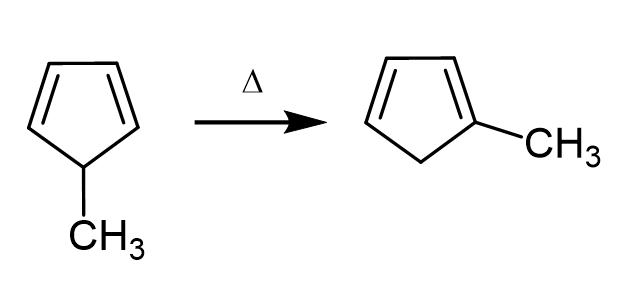
Sometimes we see rearrangement reactions that at first don’t make much sense (don’t they all…?). For example, look at how this methylcyclopentadiene suddenly changes the position of the double bond:
If we draw the hydrogen atom on the carbon between the double bonds, we will also see that the carbon where the methyl is connected to now has no hydrogen:
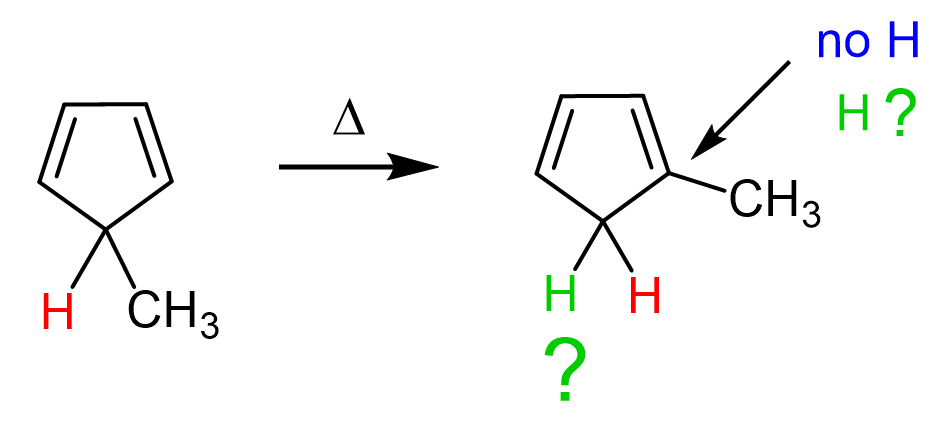
This may give us a hint of what is happening here.
In the product, the double bonds have shifted, which we can see because the methyl group is now connected to an sp2 carbon atom. This is a common feature of sigmatropic rearrangements: the π bonds move to new positions as the σ bond framework is reorganized. Remember that in sigmatropic rearrangements, one σ bond is broken while another is formed, and the π bonds shift as part of this concerted process.
In fact, the name “sigmatropic” comes from the Greek word tropos, meaning “change,” referring to the change in the position of the σ bond.
Recall the similar pattern in the Claisen and Cope rearrangements, which are also types of sigmatropic rearrangements:
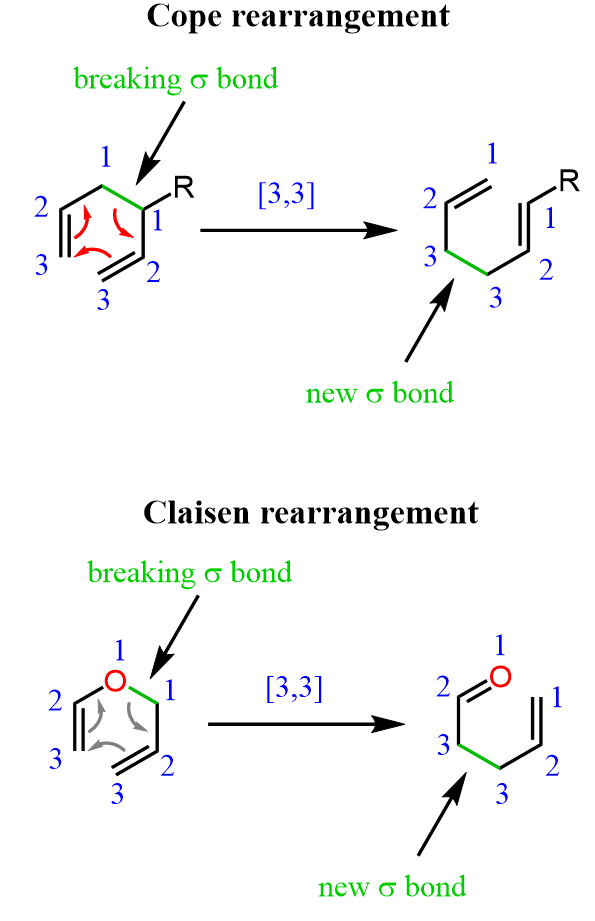
We discussed them in detail in the previous post, so feel free to check it out here as well.
So, what σ bond can we break to facilitate this shift of the double bonds?
By looking at the mechanisms of the Cope and Claisen rearrangements, you may have already come up with this hydrogen shift mechanism, which is facilitated by the shift of the pi electrons and breaking the C1-H sigma bond:
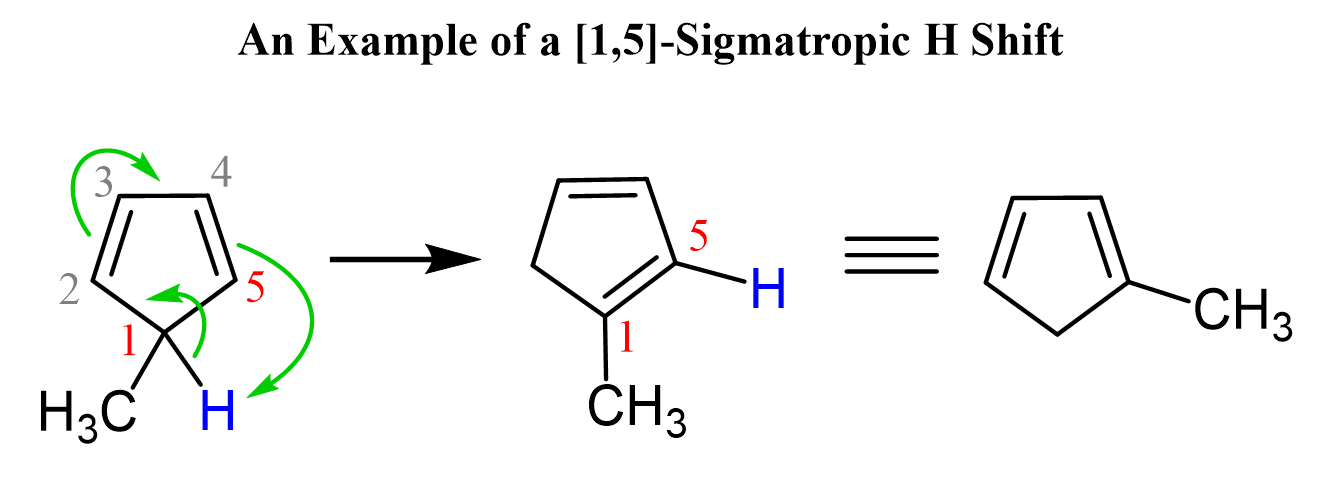
And yes, this is the correct mechanism for this 1,5-hydrogen shift reaction. It is a type of sigmatropic rearrangement. The next questions are: When and how do these reactions happen? Can we draw a concerted hydrogen-shift mechanism for any conjugated system? What is the stereochemistry of sigmatropic hydrogen-shift reactions?
It turns out that not every time we see a molecule with a double bond can we draw a hydrogen-shift reaction. For example, the following hydrogen-shift reaction of but-1-ene has been unsuccessfully tried many times:
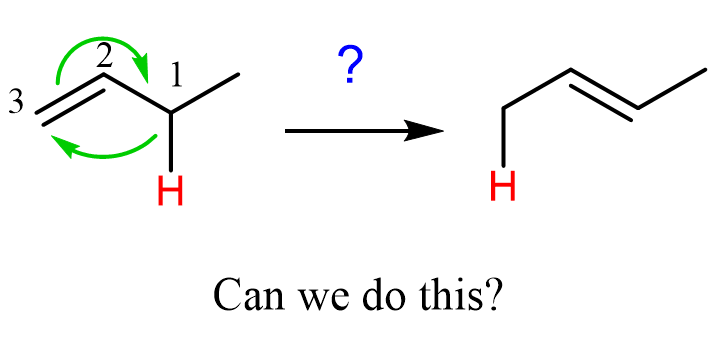
So, what prevents this hydrogen shift that looks to be just fine on paper?
We are going to answer these questions by looking at the molecular orbitals involved in this reaction. It is a long post, but I did my best to address these challenging concepts in a way that does not push students away from the topic of molecular orbitals, as antibonding orbitals usually do. 🙂
The Molecular Orbitals in Sigmatropic Hydrogen Shift Rearrangements
This content is for registered users only.
By joining Chemistry Steps, you will gain instant access to the answers and solutions for all the Practice Problems, including over 40 hours of problem-solving videos, Multiple-Choice Quizzes, Puzzles, Reaction Maps, and the powerful set of Organic Chemistry 1 and 2 Summary Study Guides.
Check Also
-
- Molecular Orbitals Made Easy
- Molecular Hydrogen Ions
- Molecular Orbitals of Li₂
- MO diagrams of Heteronuclear Diatomic Molecules
- s-p Mixing in Molecular Orbital Diagrams
- The g and u Notation in MO Diagrams
- The Molecular Orbital Theory of Organic Molecules
- The Molecular Orbital of Acetylene
- The Molecular Orbitals of Carbonyls
- Orbital Coefficients, HOMO-LUMO Interactions, and Reactivity
- Molecular Orbitals and UV-Vis Spectroscopy
- Molecular Orbitals of 1,3-Butadiene
- 1,3,5-Hexatriene Pi Molecular Orbitals
- The Molecular Orbitals of Allylic Systems
- The Molecular Orbitals of Benzene
- Molecular Orbitals in Diels-Alder and Other Cycloaddition Reactions
- Diels-Alder Reactions: EWG, EDG, and MO Interactions
- Electrocyclic Reactions
- Claisen and Cope Rearrangements