Imine and Enamine Hydrolysis Mechanism

 Imines and enamines can be hydrolyzed to aldehydes and ketones in acidic conditions:


Remember, the reactions of aldehydes and ketones with alcohols and amines are all reversible, and therefore, the products of these reactions – acetals, imines, and enamines can be converted back to carbonyl compounds if a large excess of water is used.

You can find the mechanism of acetal hydrolysis in this article, so now let’s discuss the mechanism of imine and enamine hydrolysis one by one.


Imine Hydrolysis Mechanism

The reaction involves the same intermediates as the formation of imines, and only the steps are reversed. It starts by protonation of the nitrogen, converting the imine into an iminium ion, which is very electrophilic and is attacked by water in the next step:


After a proton transfer from the oxygen to the nitrogen (likely an intermolecular process), the ammonium ion is kicked out as a neutral amine. This step forms an oxonium ion, which, after deprotonation, gives the desired ketone.


Enamine Hydrolysis Mechanism

The hydrolysis of enamines also starts with a protonation; however, this time it is the double-bonded carbon that participates in this step:


The resulting intermediate is now very electrophilic, and the C=O carbon is attacked by water, forming an unstable tetrahedral intermediate.

After this, a protonation of nitrogen occurs, converting it into a good leaving group which is kicked out by the lone pairs of the oxygen.

The ketone is obtained after a deprotonation of the oxonium ion.


The Shortcut to Imine and Enamine Hydrolysis

There are quite a few steps in these reactions, but fortunately, you don’t need to remember all of them in order to predict the structure of the aldehyde and ketone formed after the hydrolysis.

Here is the shortcut: draw a line between the nitrogen and the carbon atoms.

These are the bonds that are cleaved during the hydrolysis. The nitrogen is part of the amine, and the carbon connected to it is the C=O carbon atom:


Additional examples of imine and enamine, as well as acetal hydrolysis, are covered in this practice problem set:

 Hydrolysis of Acetals, Imines, and Enamines-Practice Problems
Practice

1.

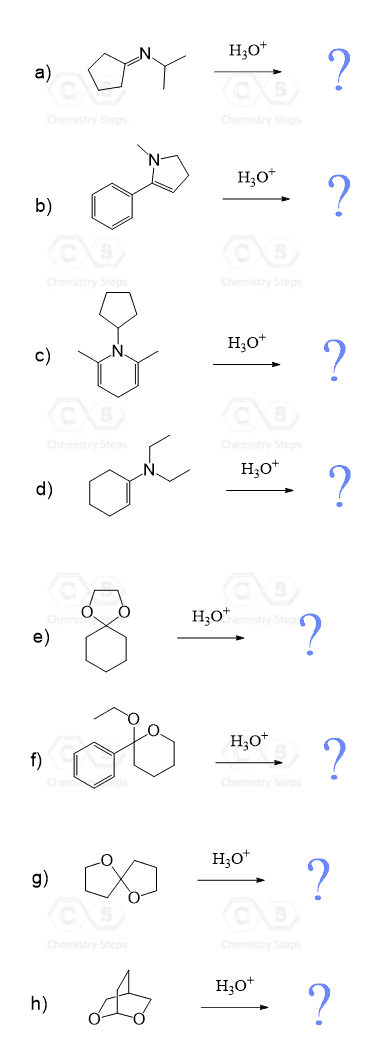
Predict the major product(s) obtained when each of the following compounds undergoes hydrolysis in the presence of an acid:

a)
Answer

b)
Answer

This content is for registered users only.

Click here to Register!

By joining Chemistry Steps, you will gain instant access to the answers and solutions for all the Practice Problems, including over 40 hours of problem-solving videos, Multiple-Choice Quizzes, Puzzles, Reaction Maps, and the powerful set of Organic Chemistry 1 and 2 Summary Study Guides.

c)
Answer

This content is for registered users only.

Click here to Register!

By joining Chemistry Steps, you will gain instant access to the answers and solutions for all the Practice Problems, including over 40 hours of problem-solving videos, Multiple-Choice Quizzes, Puzzles, Reaction Maps, and the powerful set of Organic Chemistry 1 and 2 Summary Study Guides.

d)
Answer

This content is for registered users only.

Click here to Register!

By joining Chemistry Steps, you will gain instant access to the answers and solutions for all the Practice Problems, including over 40 hours of problem-solving videos, Multiple-Choice Quizzes, Puzzles, Reaction Maps, and the powerful set of Organic Chemistry 1 and 2 Summary Study Guides.

e)
Answer

This content is for registered users only.

Click here to Register!

By joining Chemistry Steps, you will gain instant access to the answers and solutions for all the Practice Problems, including over 40 hours of problem-solving videos, Multiple-Choice Quizzes, Puzzles, Reaction Maps, and the powerful set of Organic Chemistry 1 and 2 Summary Study Guides.

f)
Answer

This content is for registered users only.

Click here to Register!

By joining Chemistry Steps, you will gain instant access to the answers and solutions for all the Practice Problems, including over 40 hours of problem-solving videos, Multiple-Choice Quizzes, Puzzles, Reaction Maps, and the powerful set of Organic Chemistry 1 and 2 Summary Study Guides.

g)
Answer

This content is for registered users only.

Click here to Register!

By joining Chemistry Steps, you will gain instant access to the answers and solutions for all the Practice Problems, including over 40 hours of problem-solving videos, Multiple-Choice Quizzes, Puzzles, Reaction Maps, and the powerful set of Organic Chemistry 1 and 2 Summary Study Guides.

h)
Answer

This content is for registered users only.

Click here to Register!

By joining Chemistry Steps, you will gain instant access to the answers and solutions for all the Practice Problems, including over 40 hours of problem-solving videos, Multiple-Choice Quizzes, Puzzles, Reaction Maps, and the powerful set of Organic Chemistry 1 and 2 Summary Study Guides.

Solution

This content is for registered users only.

Click here to Register!

By joining Chemistry Steps, you will gain instant access to the answers and solutions for all the Practice Problems, including over 40 hours of problem-solving videos, Multiple-Choice Quizzes, Puzzles, Reaction Maps, and the powerful set of Organic Chemistry 1 and 2 Summary Study Guides.

2 thoughts on “Imine and Enamine Hydrolysis Mechanism”

  1. Hello,

    This is a common reaction in an undergraduate curriculum and most textbooks will have it in the aldehydes and ketones chapter. A few good and popular textbooks I would recommend are Organic Chemistry by Smith, Klein, Bruice and Solomons. For more advanced level, read the March’s Organic Chemistry together with Carey and Sundberg.

    Reply

Share Your Thoughts, Ask that Question!

Stuck? Need a Quick Guidance?

🔴 Our Live Board is Here! 🖥️✏️
