The Chair is the most stable, most important, and common conformation of cyclohexane, so knowing how to draw it (them – there are two chair conformations), is an essential skill you will need to know throughout your journey in organic chemistry.
There are different ways of drawing a chair conformation, just like you can draw a square or a rectangle starting and finishing with any of the lines. You can draw the lines in any order you like, but regardless of how you draw a chair conformation, it is important to keep the angles and the relative lengths of these shapes.
Pay attention to these important features when drawing a chair conformation:
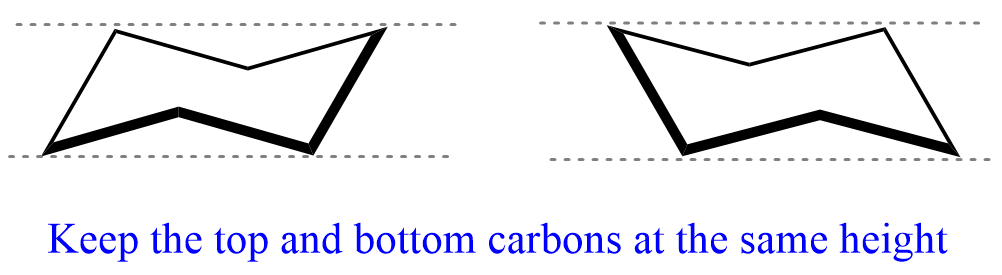
- Try to keep the upper and bottom carbon atoms within two parallel lines:
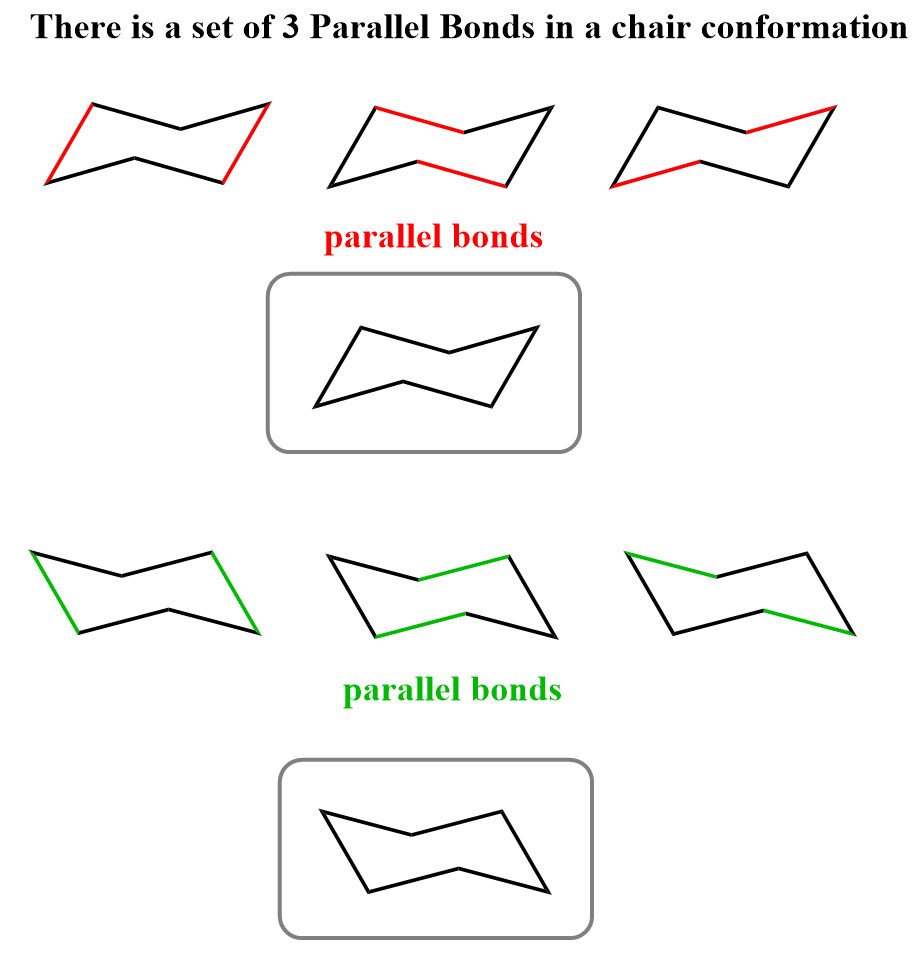
- There are three parallel bonds in the chair conformation:
The best way to master this skill is to print a chair conformation, place it under a blank sheet of paper, sketch it over, and keep practicing. Below are a couple of ways you can practice drawing chair conformation:

What we have shown above is the carbon skeleton of the chair conformations, and as drawn, the carbon atoms require two hydrogens to satisfy the octet. These hydrogens, or any other atoms, must also be drawn at correct angles and directions, classified as axial and equatorial positions:

The color-coded hydrogens do not imply the same atom. It is rather to show the axial and equatorial positions. The two chair forms are conformational isomers that interconvert through a ring flip, and we discuss this topic in detail here.
Here is also a short video clip for better visualization of the chair forms with the bond angles and perspectives:
Axial and Equatorial Positions
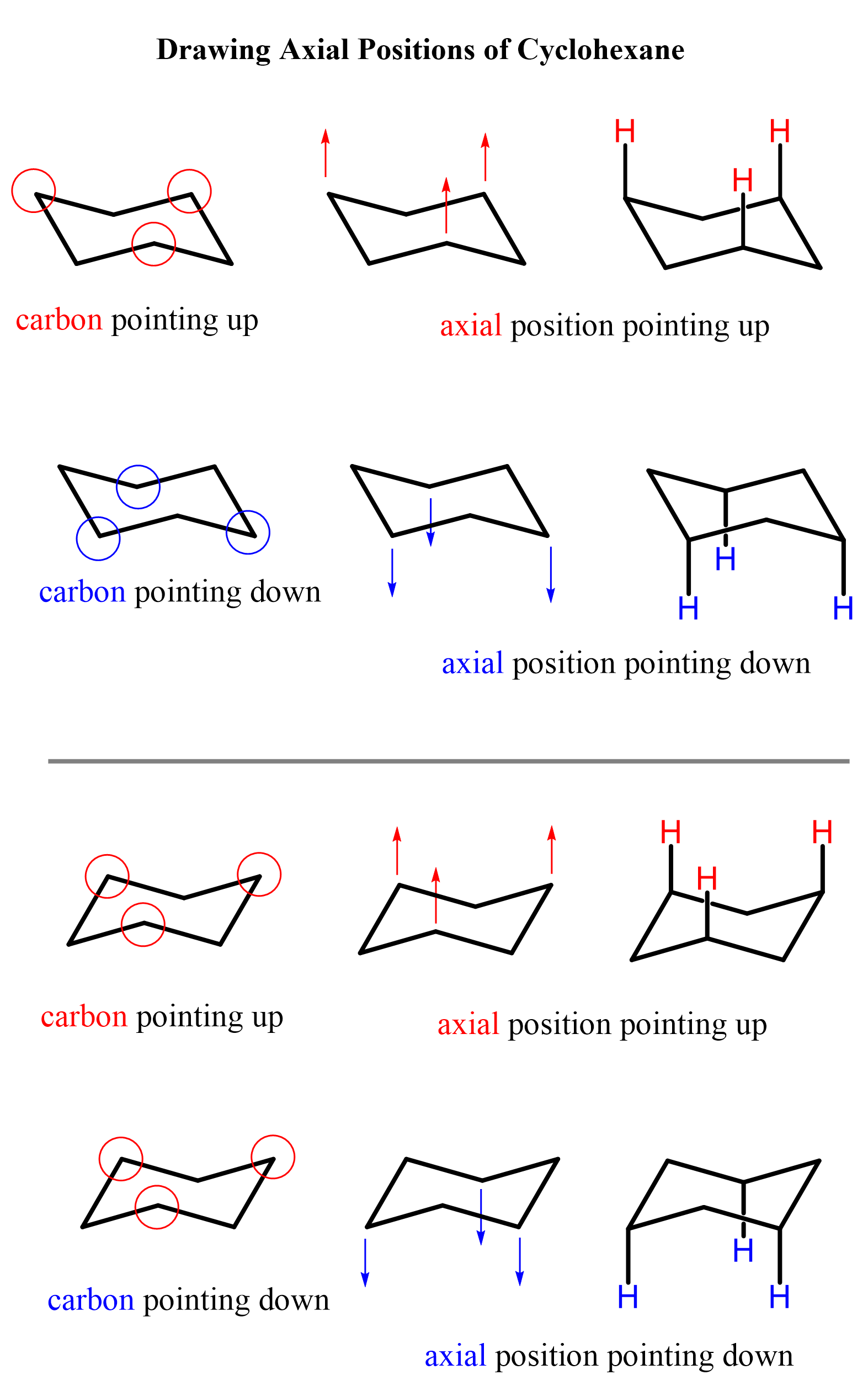
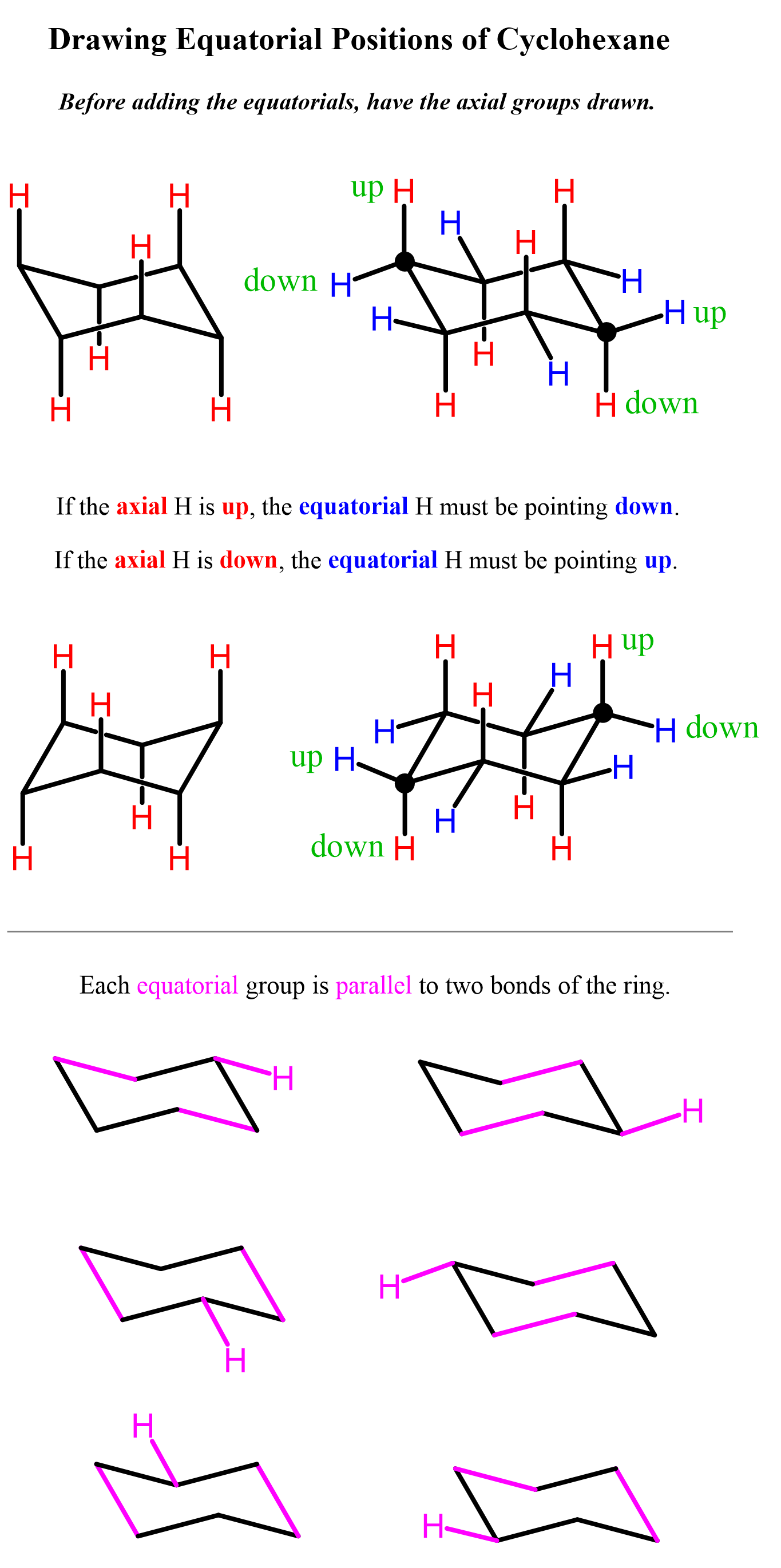
There are two positions in each chair conformation: axial and equatorial. Draw the axial groups first, and then the equatorials.
The axial positions are pointed straight up or down along the vertical direction. The ones on the carbons pointing down are pointed down, and those pointed up are pointed up as well:
Once you have the axial groups drawn, add the equatorials. Remember, if the axial is pointing up, the equatorial group must be pointing down. If the axial is pointing down, the equatorial group must be pointing up. The equatorial positions are pointing to the sides, parallel to two C-C bonds in the chair:
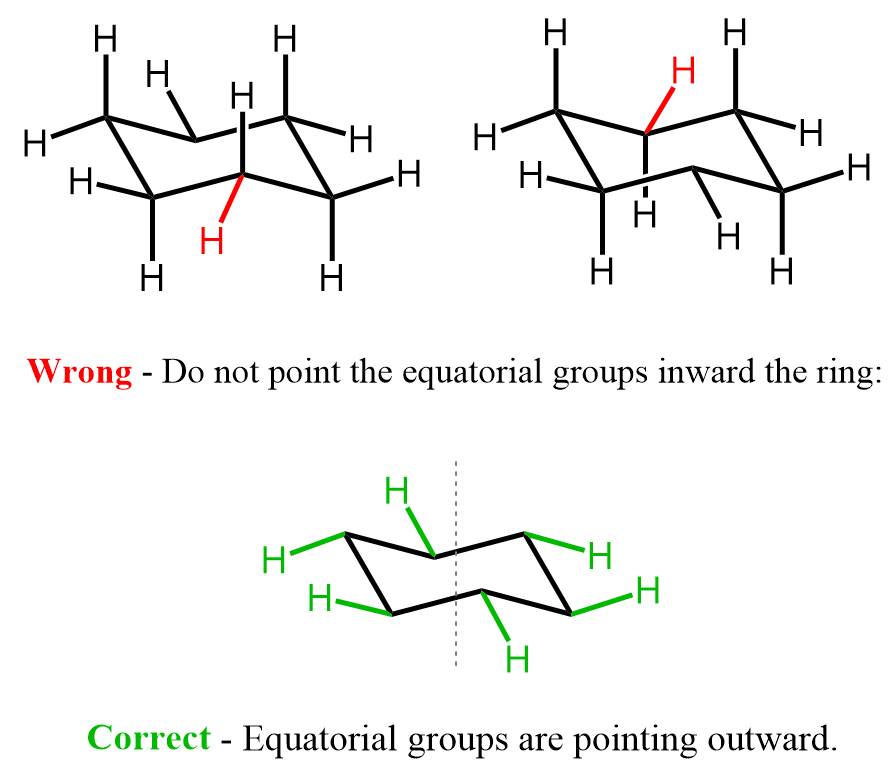
One common mistake by my students was placing the equatorial groups pointing inside instead of outside the ring. Do not point the equatorial groups inward the ring:
Coming up Next About the Chair Conformation
Once you master drawing the chair conformations of cyclohexane and showing the axial and equatorial groups correctly, you will also need to learn about the stability of having different groups in the axial and equatorial positions.
In general, having substituents in the axial positions is less favorable because that gives them less space and they fight with other atoms on the ring. This is known as 1,3-diaxial interaction. The equatorial position, on the other hand, gives them more space as they are all pointing to the side of the ring. As a result, the chair conformation with equatorial groups is more stable than the one with axial groups.
You will also learn that the two forms of the chair conformation are in equilibrium. This happens because all the carbon atoms are sp³-hybridized, which allows for rotation about the single bonds, and this rotation establishes an equilibrium between the two most stable conformers of cyclohexane.
This change of conformations is also known as a ring flip because it flips all the axial groups to equatorial and vice versa; all the equatorial groups become axial.
Check out the articles listed under the practice problems for more details and practice problems about these principles.