
In the previous post, we talked about the lack of reactivity of benzene towards bromination and the Kekulé structure that was suggested to explain these unique features.
In short, Kekulé suggested that benzene is an equilibrium mixture of two compounds with alternating double bonds:

Kekulé structure satisfies the characteristics of benzene except for one, and that is the bond lengths in the ring.
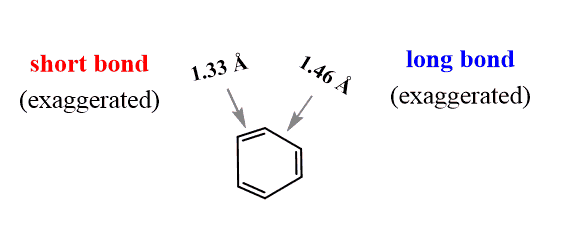
Let’s elaborate on this. It is now known that all the bonds in benzene are identical – 1.395 Å. However, if benzene existed in two resonance forms with alternating double bonds, we’d have two types of bonds: sp2–sp2 single bonds (1.46 Å) and double bonds (1.33 Å).
This would result in a distorted structure:
The perfectly symmetrical structure of benzene, however, indicates that it exists as a resonance hybrid:
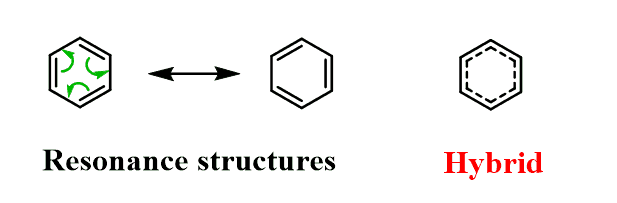
The actual bond length (1.395 Å) is intermediate between the sp2–sp2 single bonds (1.46 Å) and double bonds (1.33 Å).
The common practice of using only one of the Lewis structures is only to make keeping track of the π electrons easy.
The Structure and Geometry of Benzene
All the carbon atoms in benzene are sp2 hybridized connected by sp2–sp2 single bonds and each has a p orbital perpendicular to the plane of the atoms. These p orbitals overlap, delocalizing the six electrons and making benzene a fully conjugated system. The geometry of each carbon is trigonal planar:

Let’s summarize what we know about the structure of benzene so far:
- It is cyclic
- It is planar
- All the bonds are equal
- It is fully conjugated
So, how does all of this make it very stable?
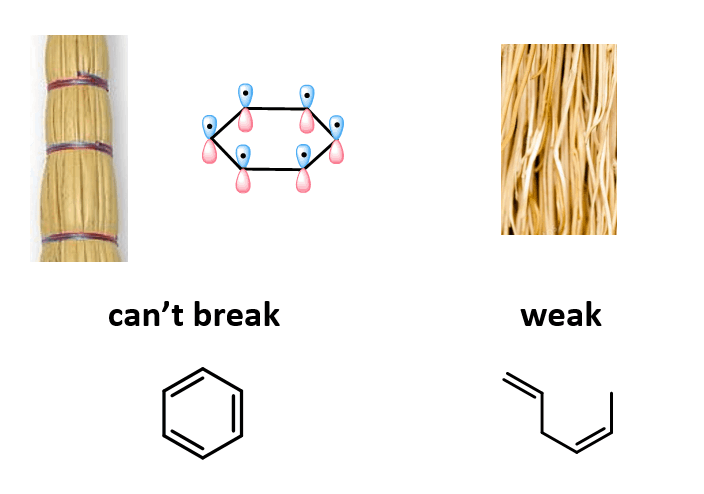
I like to think about it as a broom: you can easily break individual straws or a bunch of them when they are randomly stacked, but it wouldbe very difficult when they are all nicely aligned and tight together, just like the p orbitals of the aromatic ring:
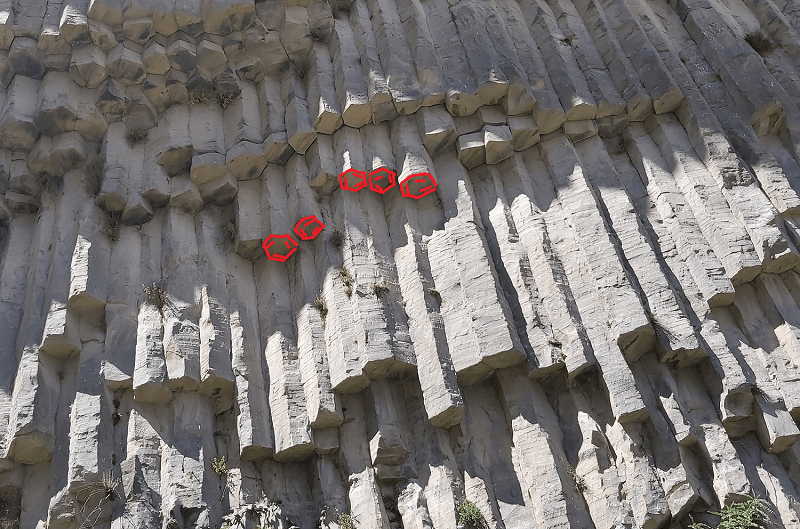
It turned out that benzene is not the only example demonstrating the stability of the hexagon in nature. When I once visited the Temple of Garni built in the first century AD in Armenia, we went for a hike in this beautiful place known as the “Symphony of the Stones” which is a gorge where the basalt cliff walls, stretching hundreds of feet, are shaped into long hexagonal columns:
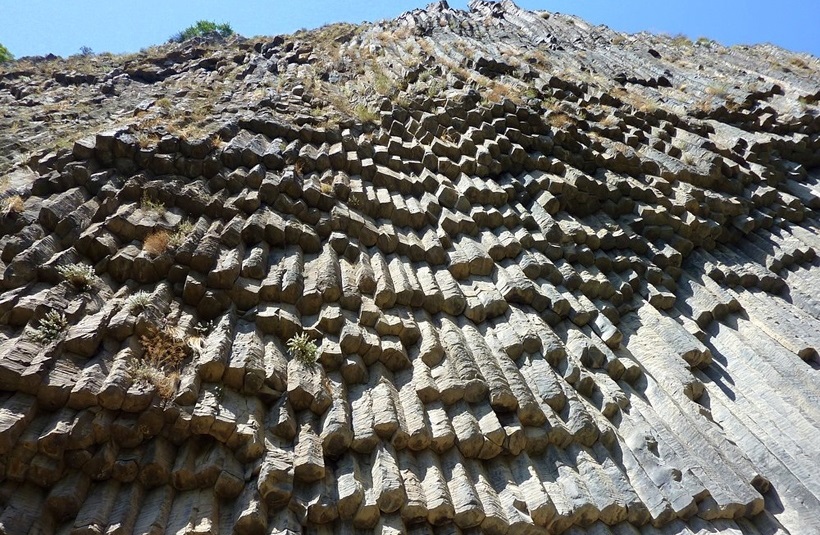
Look at all these stone-stable benzene rings!
Aromatic Resonance Stabilization
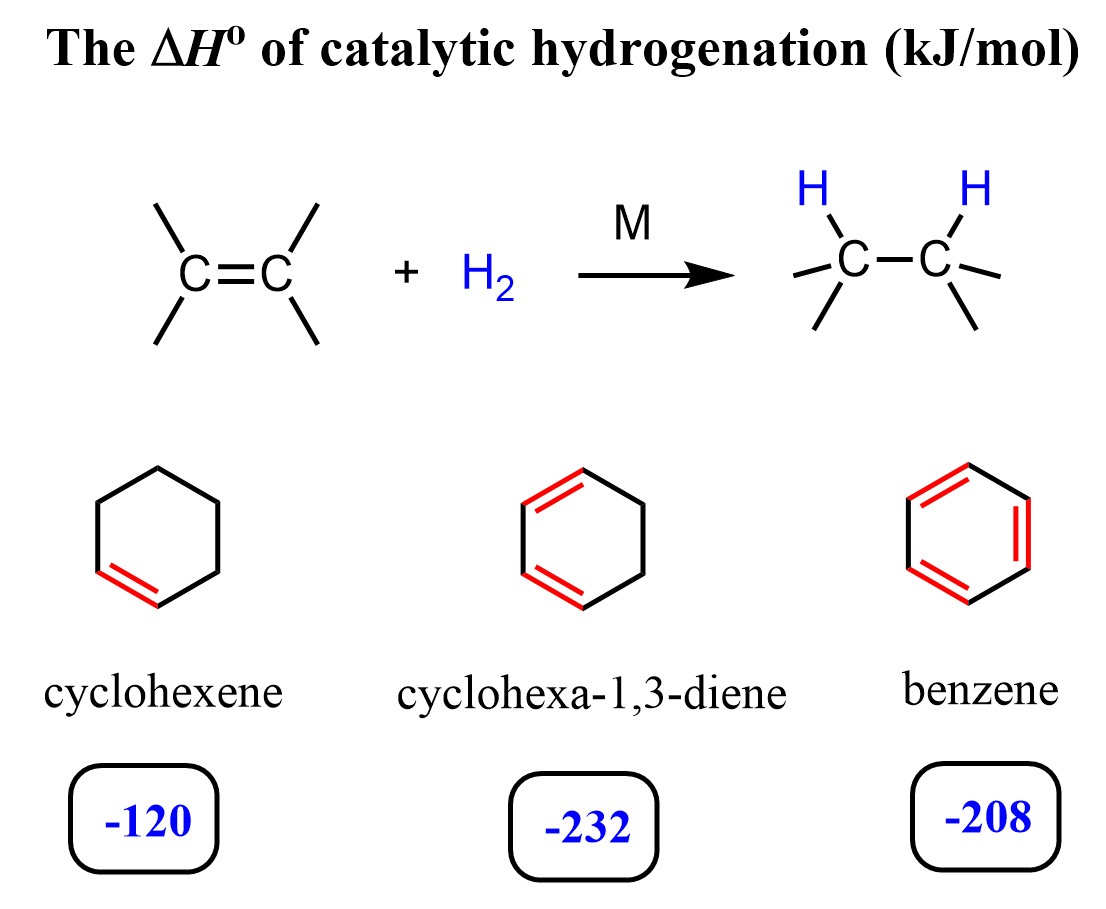
Aside from its lack of reactivity toward electrophilic addition, the additional stability of benzene can also be demonstrated by its heats of hydrogenation.
Let’s compare the heats of catalytic hydrogenation for cyclohexene, cyclohexa-1,3-diene, and benzene:
So, what is the idea behind comparing these values?
First, remember that C-H single bonds are stronger than C=C π bonds, which means that every time a C=C double bond is reduced, energy is released – the system moves to a more stable state. The heat of hydrogenation of cyclohexene is 120 kJ/mol (ΔH° = -120 kJ/mol), so we can say that the addition of one mole of H₂ releases 120 kJ/mol of energy.
From this, we can estimate that the ΔH° for the addition of two moles of H₂ to cyclohexa-1,3-diene should be 2 × (-120) = -240 kJ/mol (see the blue lines).
However, it turns out that the actual ΔH° is -232 kJ/mol. In other words, the system releases 8 kJ/mol less energy than expected. This means that cyclohexa-1,3-diene is 8 kJ/mol more stable than predicted based on two isolated double bonds. This additional stability is due to resonance because the double bonds are conjugated. Remember, conjugated systems are more stable because the π electrons are delocalized through resonance.
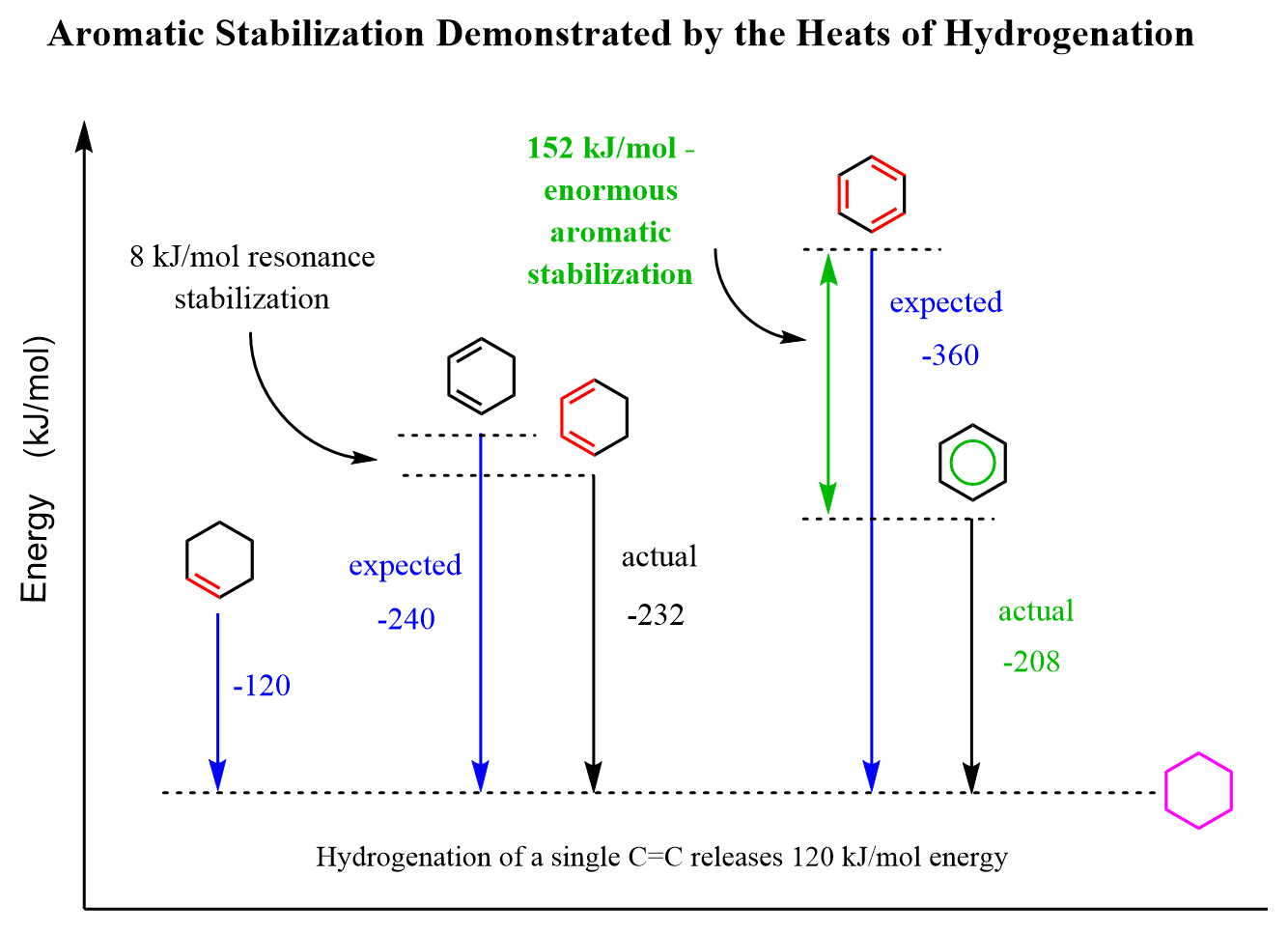
Now, using the same logic, benzene should be expected to have a heat of hydrogenation of 3 × (-120) = -360 kJ/mol if it behaved like a cyclohexatriene with three isolated double bonds. However, the actual heat of hydrogenation of benzene is only -208 kJ/mol. This means that benzene releases 152 kJ/mol less energy than expected upon hydrogenation. In other words, it has that much additional stability compared to if the double bonds were isolated.
This is a huge difference and cannot be explained by ordinary resonance stabilization alone. Such extraordinary stability is characteristic of aromatic compounds and arises from their unique cyclic structure and specific number of π electrons.
The green circle I used to show the structure of benzene is perhaps an outdated way of doing it, but the idea is to demonstrate that all the double bonds are delocalized together – there are not really alternating single and double bonds, and this is one of the reasons aromatic compounds are so stable.
The answer to what makes a compound aromatic and why they are so stable is explained by the requirements of being cyclic, planar, fully conjugated, and having a special number of electrons. This is a topic on its own, and we will dedicate the next few posts, including Hückel’s rule, to fully convey the principles of aromaticity in organic chemistry.
Check Also:
- Naming Aromatic Compounds
- Introduction to Aromatic Compounds
- Benzene – Aromatic Structure and Stability
Aromaticity and Huckel’s Rule - The 4n+2 Rule
- Identify Aromatic, Antiaromatic, or Nonaromatic Compounds
- Frost Circle
- Annulenes
- Electrophilic Aromatic Substitution – The Mechanism
- The Halogenation of Benzene
- The Nitration of Benzene
- The Sulfonation of Benzene
- Friedel-Crafts Alkylation with Practice Problems
- Friedel-Crafts Acylation with Practice Problems
- Vilsmeier-Haack Reaction
- The Alkylation of Benzene by Acylation-Reduction
- Ortho, Para, Meta in EAS with Practice Problems
- Ortho, Para, and Meta in Disubstituted Benzenes
- Why Are Halogens Ortho-, Para- Directors yet Deactivators?
- Is Phenyl an Ortho/Para or Meta Director?
- Limitations of Electrophilic Aromatic Substitution Reactions
- Orientation in Benzene Rings With More Than One Substituent
- Synthesis of Aromatic Compounds From Benzene
- Arenediazonium Salts in Electrophilic Aromatic Substitution
- Reactions at the Benzylic Position
- Benzylic Bromination
- Nucleophilic Aromatic Substitution
- Nucleophilic Aromatic Substitution Practice Problems
- Reactions of Phenols
- Reactions of Aniline
- Meta Substitution on Activated Aromatic Ring
- Electrophilic Aromatic Substitution Practice Problems
- Aromatic Compounds Quiz
- Reactions Map of Aromatic Compounds
many thanks for the information about benzene related aromaticity
very good information about benzene.
Thanks so much,I am delighted to have added something in my career of organic chemistry.