
The carbonyl group in aldoses and ketoses can be reduced by NaBH4 to a 1o and 2o alcohol, respectively. The product of this reaction is a polyalcohol called an alditol.

The reduction of the ketones creates a new chiral center in both configurations. This is because the carbonyl group is transformed into a secondary alcohol, while in the case of aldoses, it forms a primary alcohol, which is not chiral.
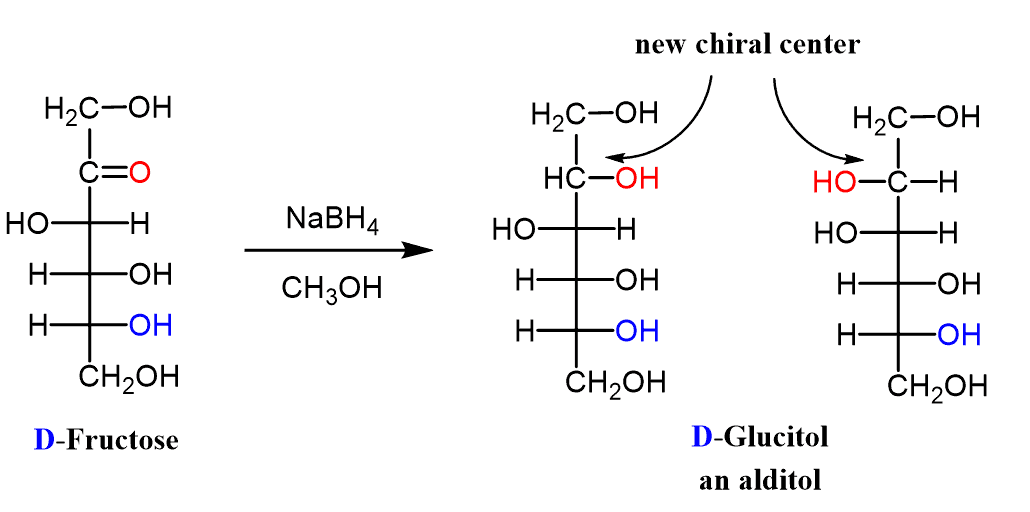
Remember also that cyclic hemiacetals are always in equilibrium with the open-chain form and therefore, they can also be reduced to alditols.
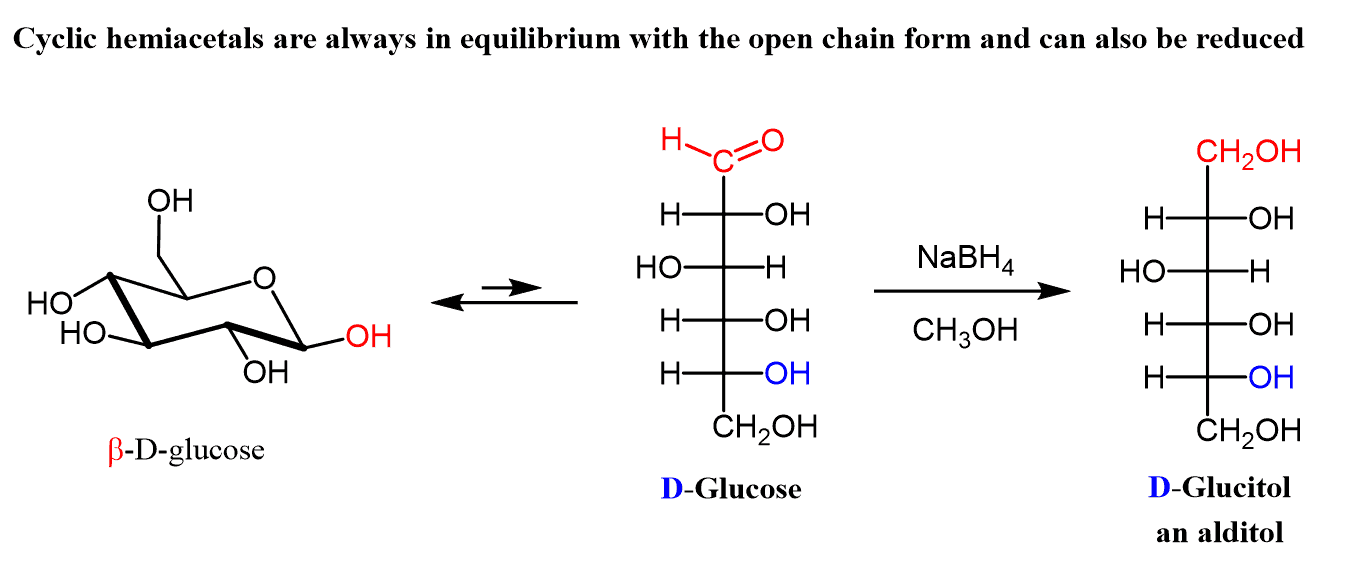
Even though the open-chain form exists in small quantities, the reduction product shifts the equilibrium to the right, forming more of it as the reaction proceeds.
Need some practice on carbohydrates?
Check this Multiple-Choice, summary quiz on the structure and reactions of carbohydrates with a 40-min video solution!

Carbohydrates Practice Problem Quiz
Check also in Carbohydrates
- Carbohydrates – Structure and Classification
- Erythro and Threo
- D and L Sugars
- Aldoses and Ketoses: Classification and Stereochemistry
- Epimers and Anomers
- Converting Fischer, Haworth, and Chair forms of Carbohydrates
- Mutarotation
- Glycosides
- Isomerization of Carbohydrates
- Ether and Ester Derivatives of Carbohydrates
- Oxidation of Monosaccharides
- Reduction of Monosaccharides
- Kiliani–Fischer Synthesis
- Wohl Degradation