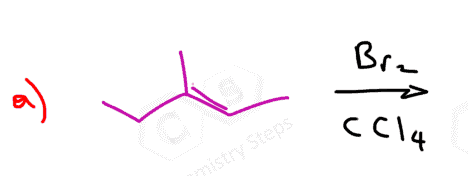
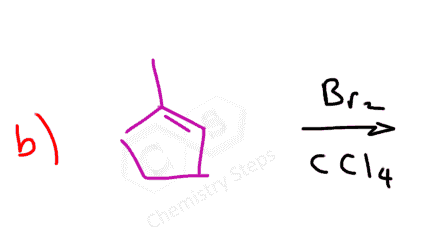
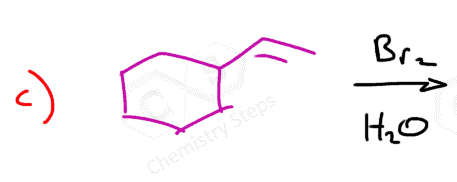
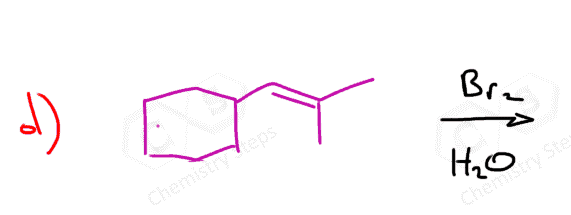
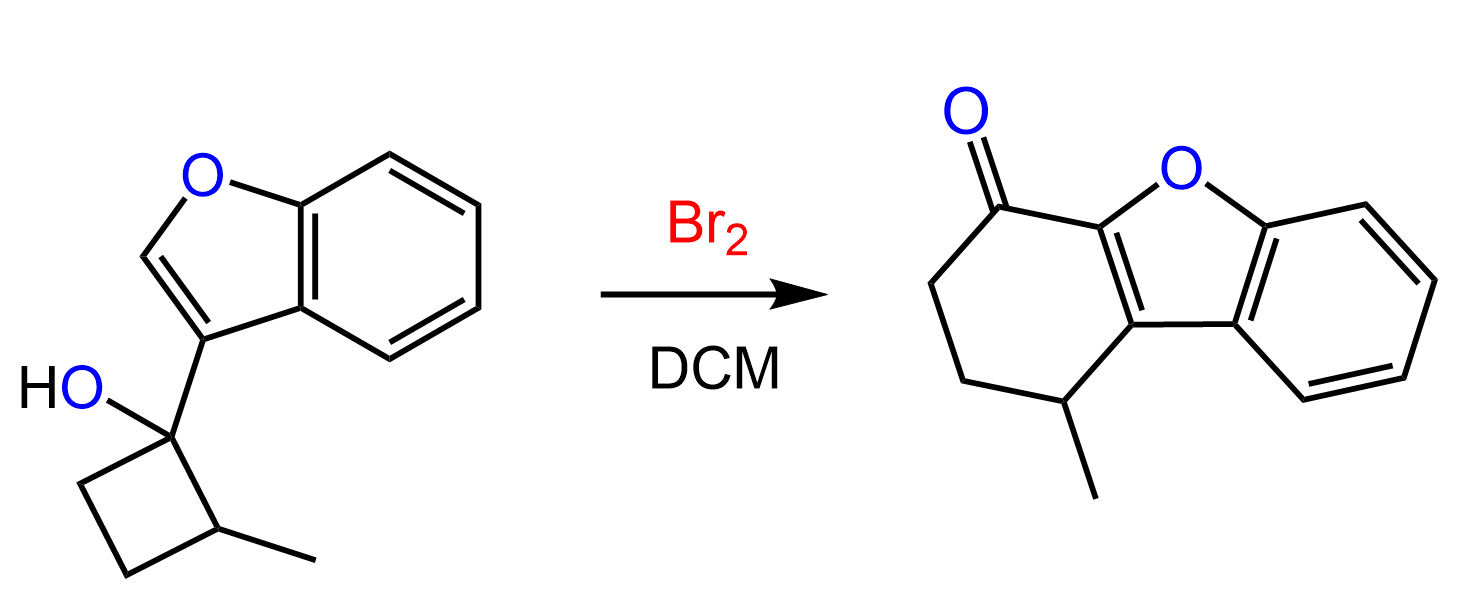
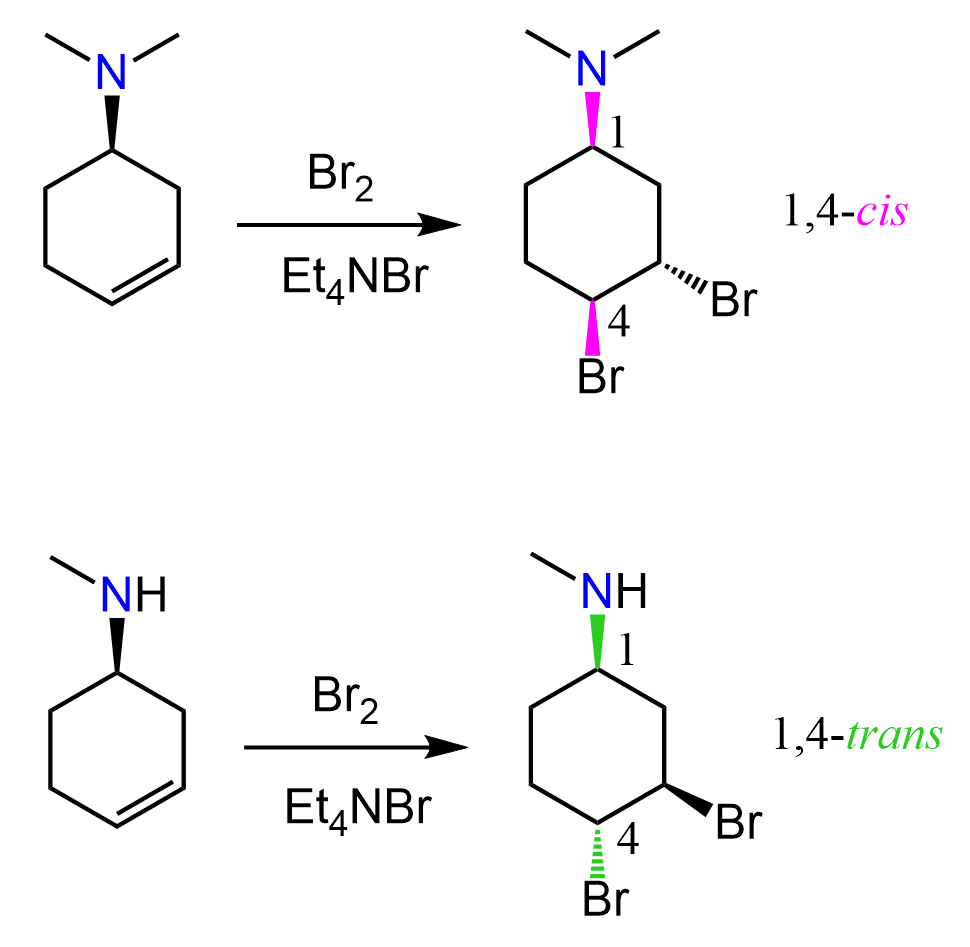
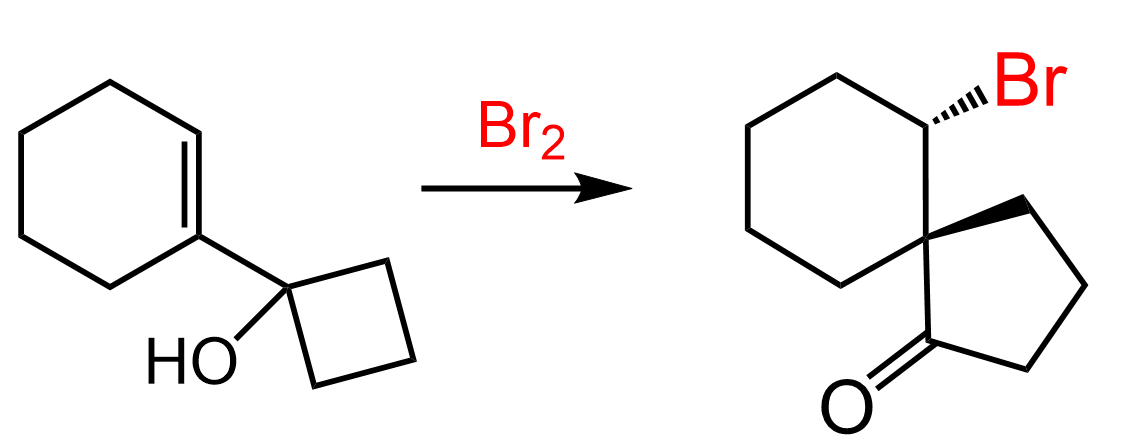
Halohydrins are compounds containing a vicinal (adjacent) halogen and a hydroxyl groups. Halohydrins are prepared by the traction of alkenes with halogens in the presence of water:
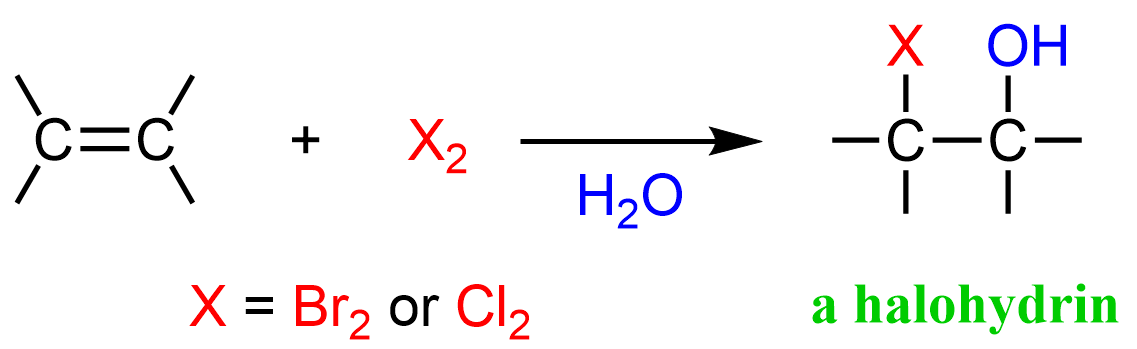
Recall that in neutral solvents such as CCl4 and DCM, the addition of halogens to alkenes results dihalogenation, and a vicinal dihalide is formed:
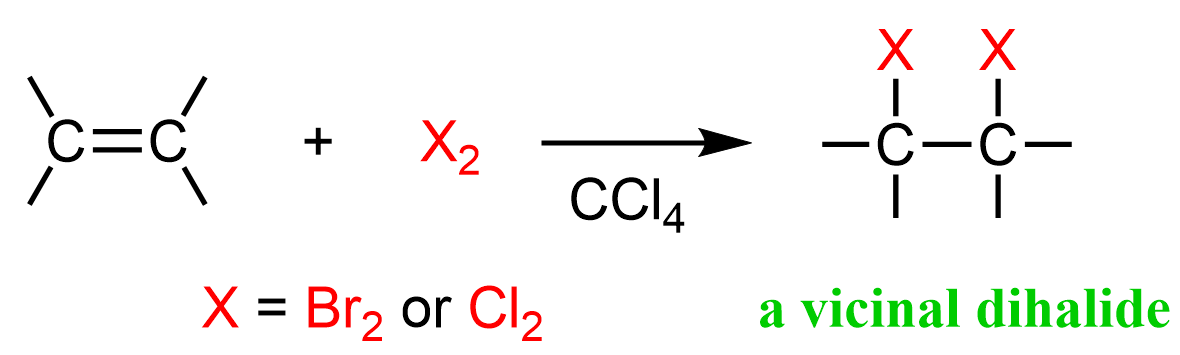
To understand why the presence of water gives a different product, we need to look at the mechanism of the reactions. Let’s start with the halogenation of alkenes, as this is the basis for understanding the formation of vicinal dihalides and halohydrins.
Formation of Halonium Ions
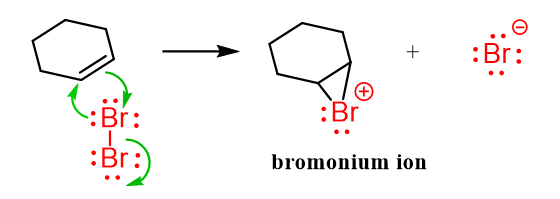
The first step of the halogenation is the addition of the halogen to the double bond forming an important intermediate called a halonium ion. In the case of bromine, for example, the intermediate would be called a bromonium ion. Let’s see how a bromonium ion is formed when cyclohexene is reacted with bromine:
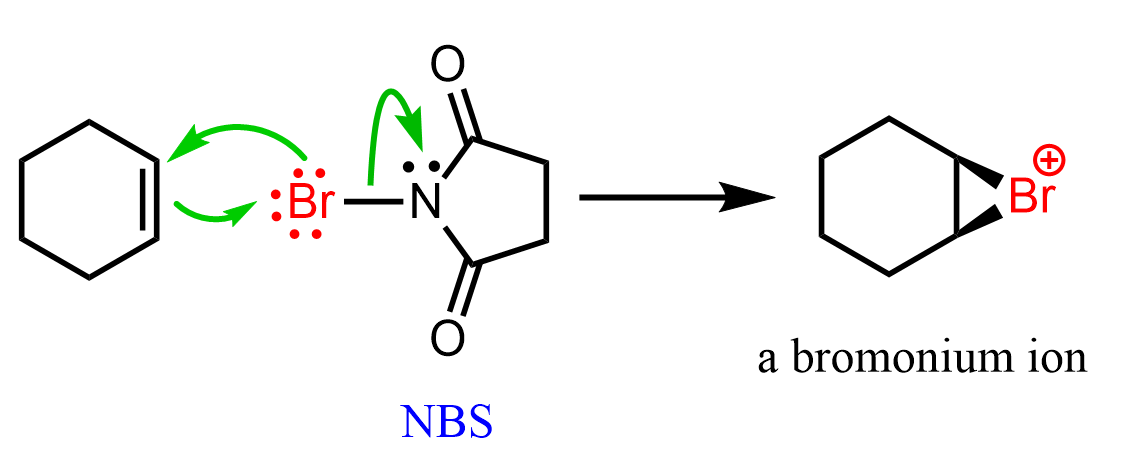
Another method for preparing halonium ions is the use of N-bromosuccinimide (NBS) instead of molecular bromine:
Ring Opening of Halonium Ions
What do we notice about the halonium ion? It is a three-membered ring and they are also charged. Three-membered rings are associated with high ring strain and charged species are not particularly stable in organic chemistry. If you have already covered epoxides, recall their reactivity towards almost any nucleophile due to their great ring strain:

Because of this high reactivity, the halonium ion is immediately attacked by the bromide ion formed during the addition to the double bond:

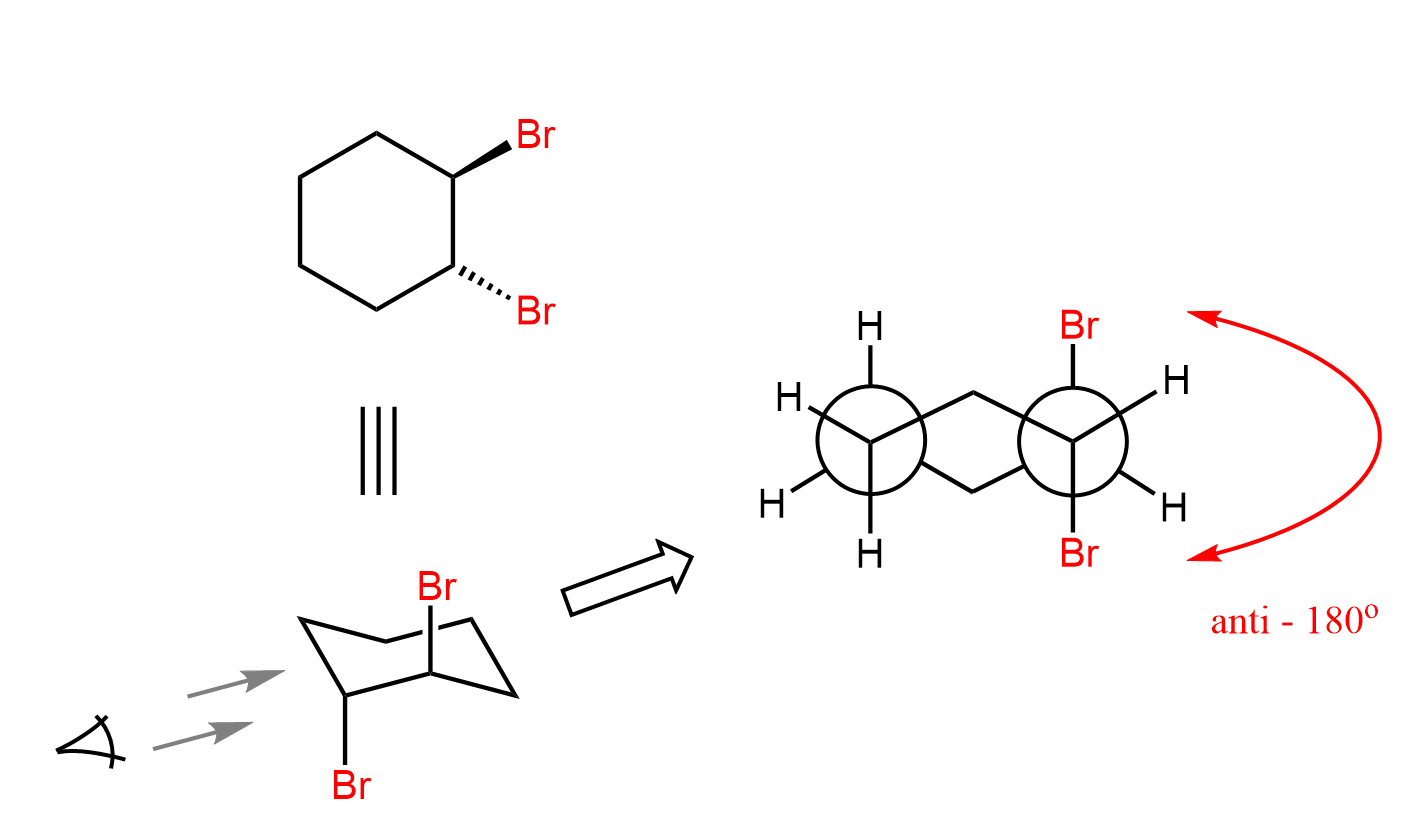
So, the bromine in the bromonium ion is the leaving group and the bromide ion is the nucleophile and overall, we have an SN2 substitution where the two species are at 180o. As a result, the two bromines have an anti orientation in the ring. Recall from Newman projections that anti conformation is when two groups of interest are anti-periplanar i.e., the dihedral angle between them is 180o:

We can also draw the Newman projection of this cyclohexane’s chair conformation to see the anti orientation of the two bromines:
Chlorine reacts the same way with alkenes forming chloronium ion, which in general is called halonium ion. F2 and I2 are not synthetically useful for this reaction, as F2 reacts explosively with the alkene, while the reaction with I2 does not proceed to a significant extent:

In this mechanism, we placed the bromine above the cyclohexene ring, and as a result, the given isomer of the trans-1,2-dibromocyclohexane was formed. Now, because double bonds are planar, the addition reaction can also occur from the other face, giving the enantiomer of this trans-1,2-dibromocyclohexane:

If the alkene contains a chirality center, then a pair of diastereomers is formed because while the newly-forming centers are going to be R and S, the original chirality center is intact, thus the halohydrins are not mirror images:
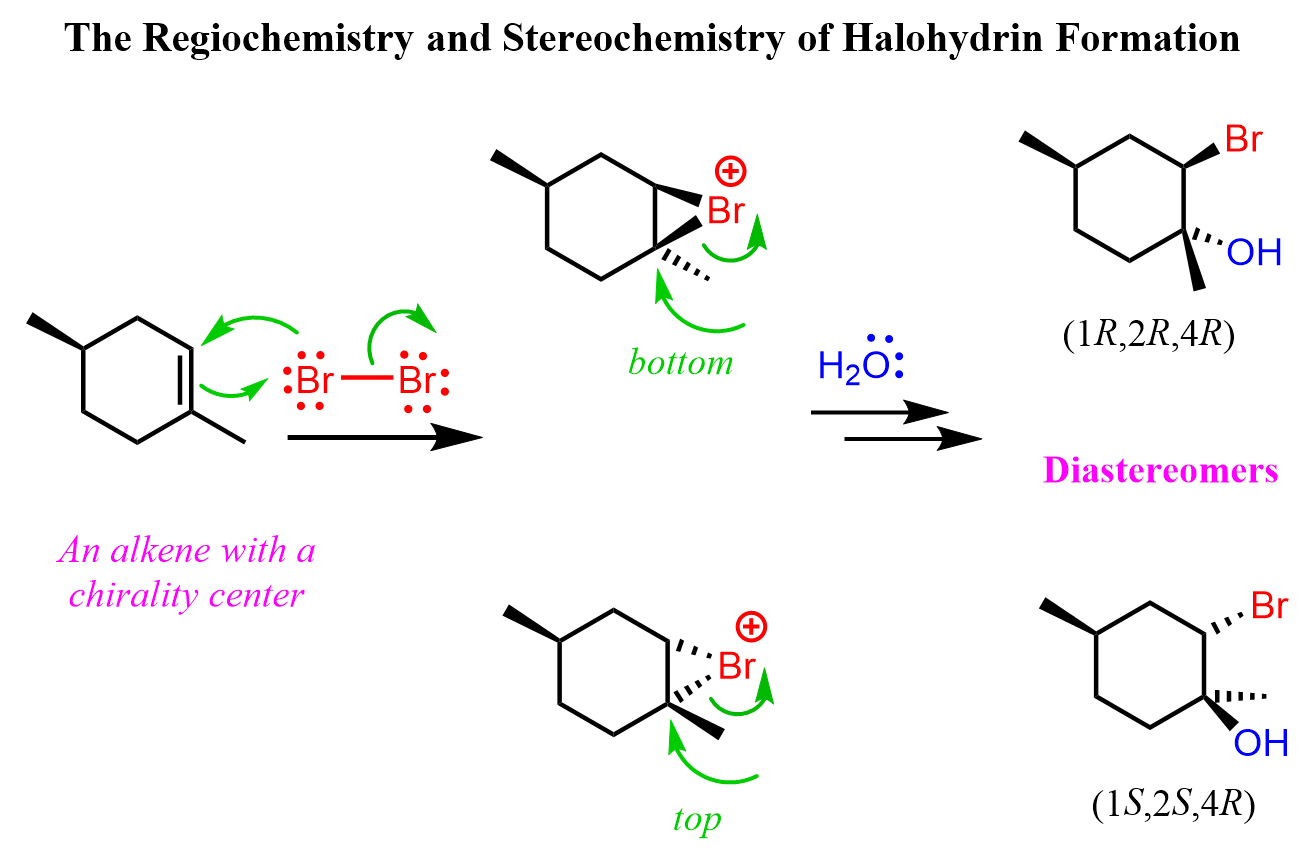
Overall, remember that the halogenation of alkenes gives a racemic mixture of enantiomers via anti-addition, unless there is another chirality center in the molecule, in which case diastereomers will be formed. Watch out also for meso compounds. Not every dihalide with chirality centers is going to be chiral:

Formation of Halohydrins
In the presence of nucleophiles such as water, alcohols, amines, and thiols, the halonium ion is attacked by them instead of the bromide ion. The reaction with water is when halohydrins are formed.
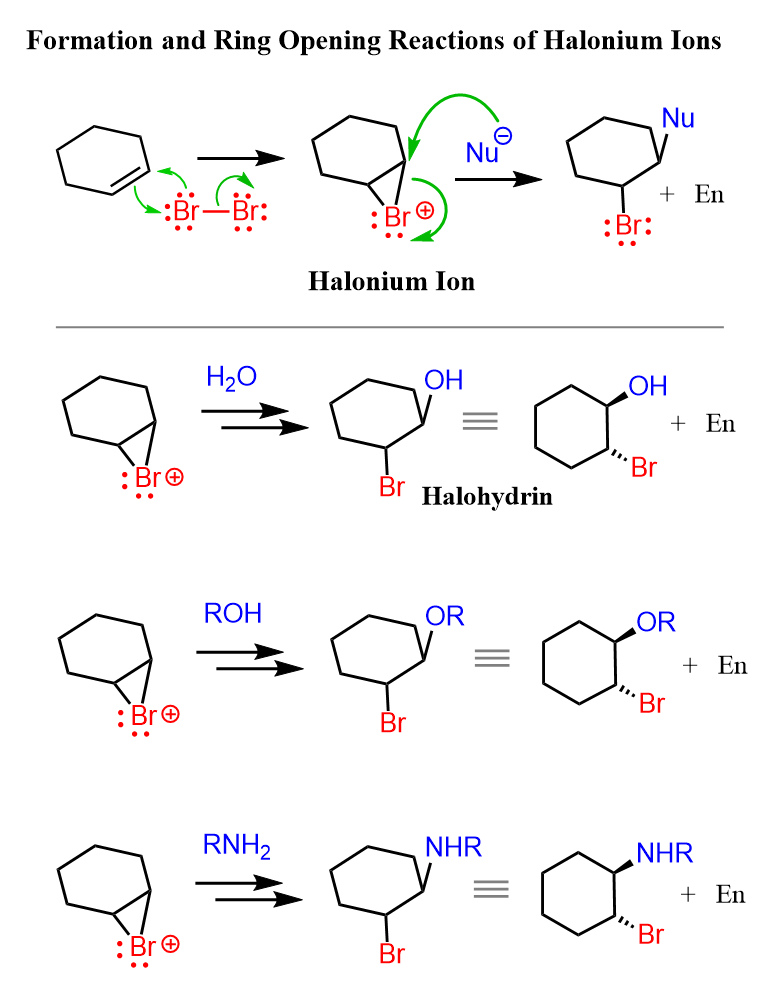
One important thing to mention address here is the reason why all these molecules, including water, get ahead of the bromide to attack the halonium ion. We know that water and alcohols are poor nucleophiles, so how come they beat the bromide ion here? The reason for this is quantity over quality since these nucleophiles are used either as the solvent for the reaction or in great excess. For each halonium ion formed, there is one halide formed and it competes with moles of the other nucleophile.
The Regiochemistry of Halohydrin Formation
Cyclohexene is a symmetrical alkene, and therefore, it does not matter which carbon of the halonium ion is attacked by water or other nucleophiles. However, for unsymmetrical akenes, different regioisomers can be formed depending on which carbon is attacked.

It has been shown that the nucleophile adds to the more substituted carbon, and the halogen ends up being on the less substituted carbon:

This is explained by the stability of the energy differences between the two possible transition states:
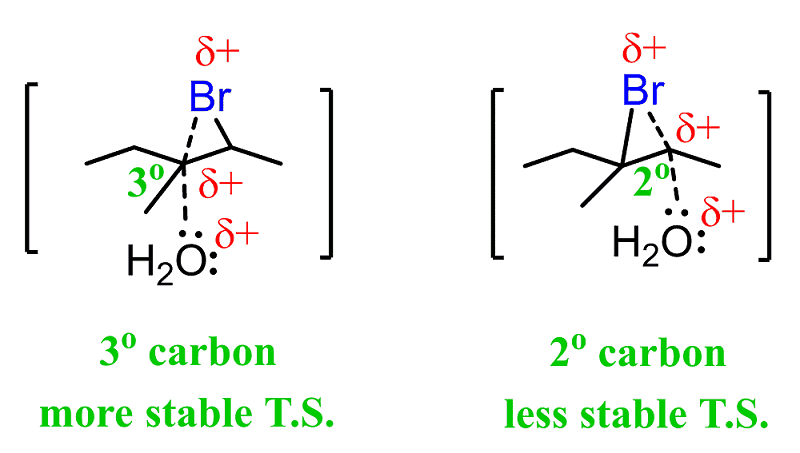
The first transition state has a partial positive charge on a more substituted carbon, making it more stable. This is similar to what we observe in the oxymercuration reaction, where the stability of one of the “transition states” dictates the addition of water or other nucleophiles to the more substituted carbon of the mercurinium ion:

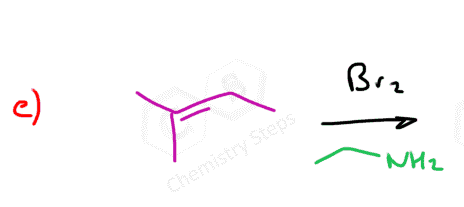
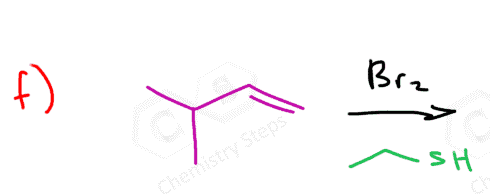
When other nucleophiles such as alcohols, amines, thiols, etc. are added to the reaction mixture, they react with the halonium ion in the same way:
Epoxides by Cyclization of Halohydrins
Another approach for preparing epoxides is the intramolecular SN2 reaction of halohydrins upon treatment with a strong base.

This is a variation of the Williamson ether synthesis, and what happens is the sodium hydride deprotonates the alcohol, converting it into a better nucleophile.

This is an intramolecular SN2 reaction, and the OH and Br must be in a trans configuration in order to accomplish the proper orbital alignment. We can see this better by drawing the chair conformations of the molecule.
Not only must the groups be trans, but they also need to be in an axial position because there is no good alignment of HOMO and LUMO orbitals for the substitution to occur:

Although the equilibrium is favored for the conformation with the two groups being equatorial, the diaxial conformation quickly undergoes a substitution reaction, thus moving the process forward.
The Games of Enantiomers and Diastereomers
At the end, I also wanted to consider the stereochemistry of the following bromination reaction. The alkene is (4R,5S)-4,5-dimethylcyclohex-1-ene, which is a meso compound, and two new chirality centers are formed upon the bromination.
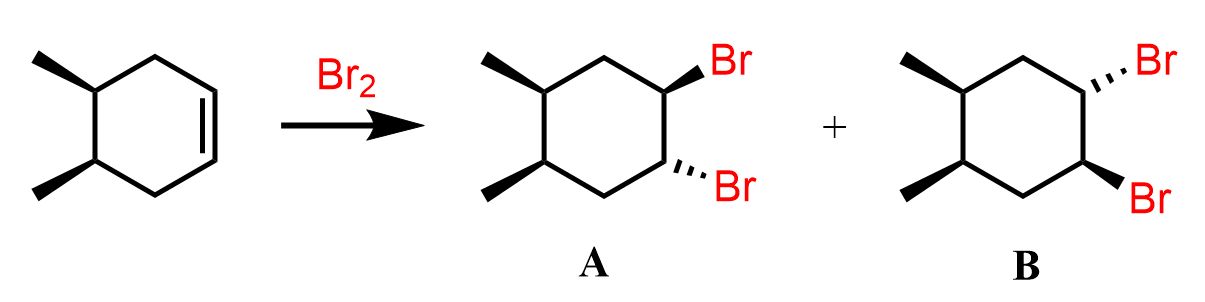
The question is whether the two products are enantiomers or diastereomers.
On one hand, they look to be diastereomers, as they have two chiral centers with identical absolute configurations and two with inverted absolute configurations. On the other hand, if we flip any of them by 180°, we can see that they are nonsuperimposable mirror images, which indicates that they are enantiomers.
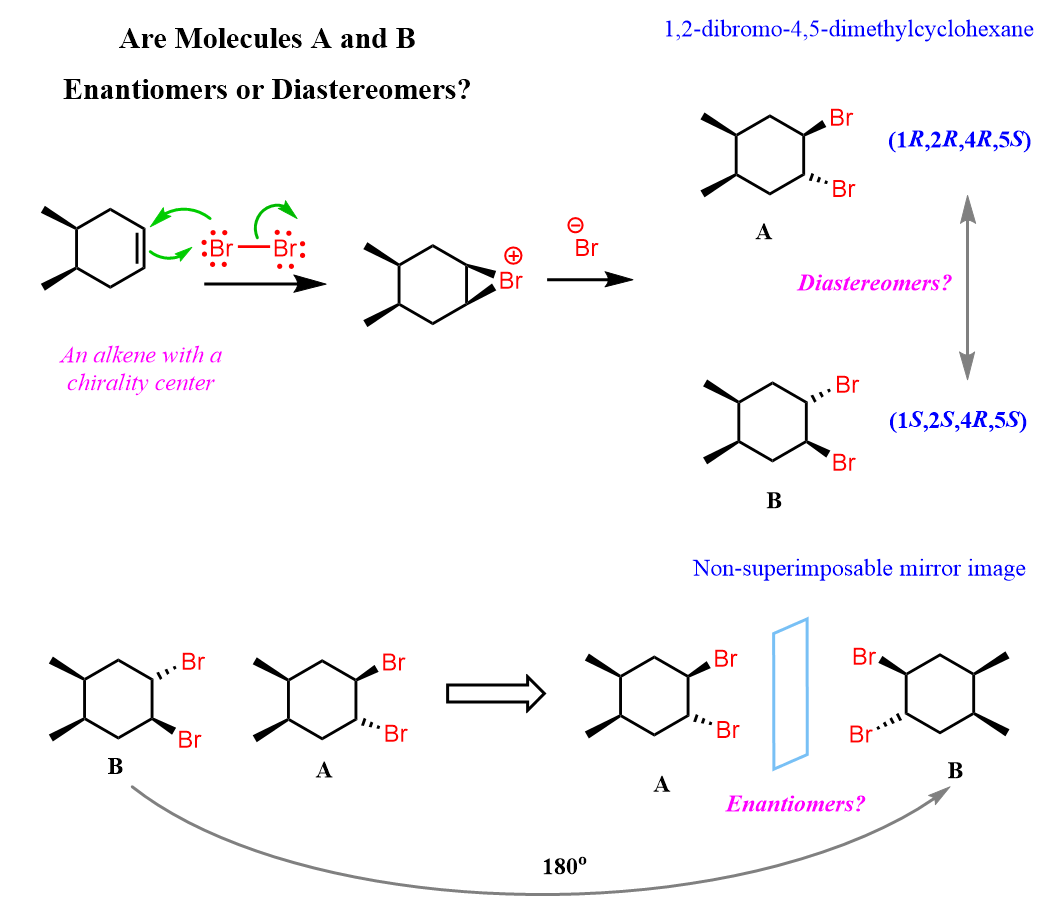
Notice that they are not meso compounds because they lack a plane of symmetry. So, what are they? I was not able to find literature data on such scenarios, and cannot give a definite answer, but if you have experience working with such molecules, feel free to let us know in the comments below.
I would guess these molecules have identical physical properties, and if they rotate the plane of polarized light by identical magnitudes in opposite directions, then they should probably be classified as enantiomers.
What do you think about the relationship between these molecules?