
We have discussed earlier that esters can be hydrolyzed under acidic or basic conditions to give carboxylic acids and alcohols.

Lactones behave in an analogous way, except that being cyclic esters, their hydrolysis leads to ring opening and formation of hydroxy acids.
Under acidic conditions, lactones first undergo protonation of the carbonyl oxygen, which increases the electrophilicity of the carbonyl carbon and makes it more susceptible to nucleophilic attack by water. Water then attacks the activated carbonyl to form a tetrahedral intermediate, which subsequently collapses with cleavage of the C–O bond, opening the ring and ultimately yielding the corresponding hydroxy acid after a series of proton transfers.
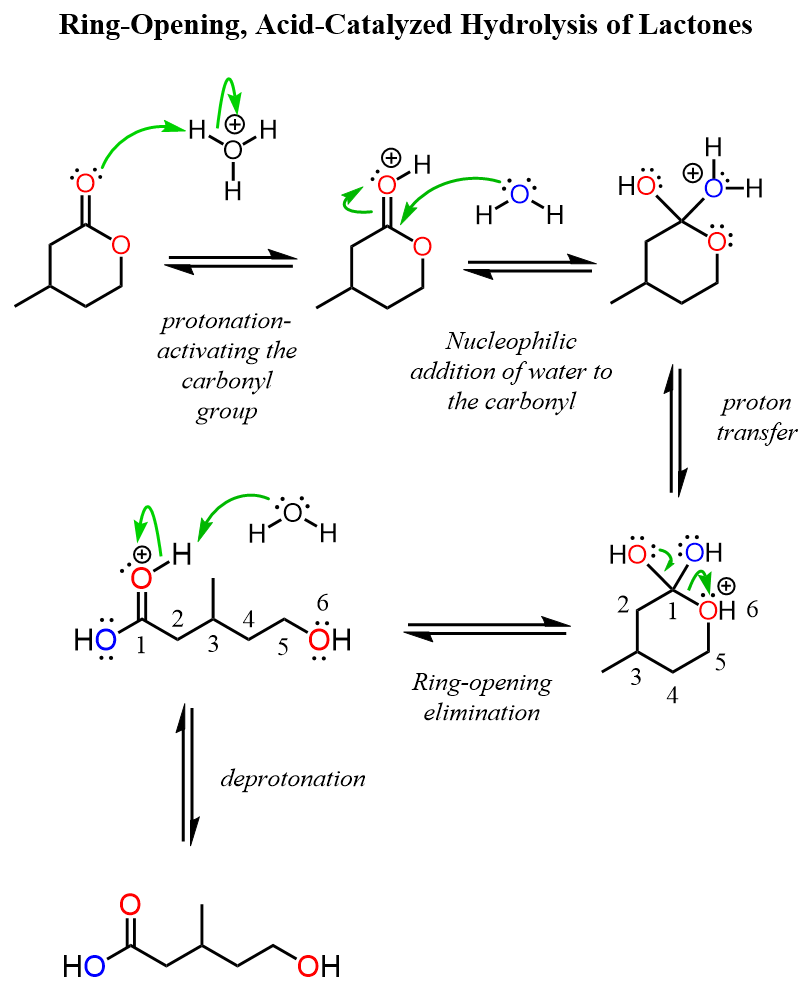
Like in the case of esters, lactone hydrolysis is reversible. Since hydroxy acids can cyclize back to lactones under acidic conditions, removal of water shifts the equilibrium toward ring closure.
Base-catalyzed Hydrolysis of Lactones
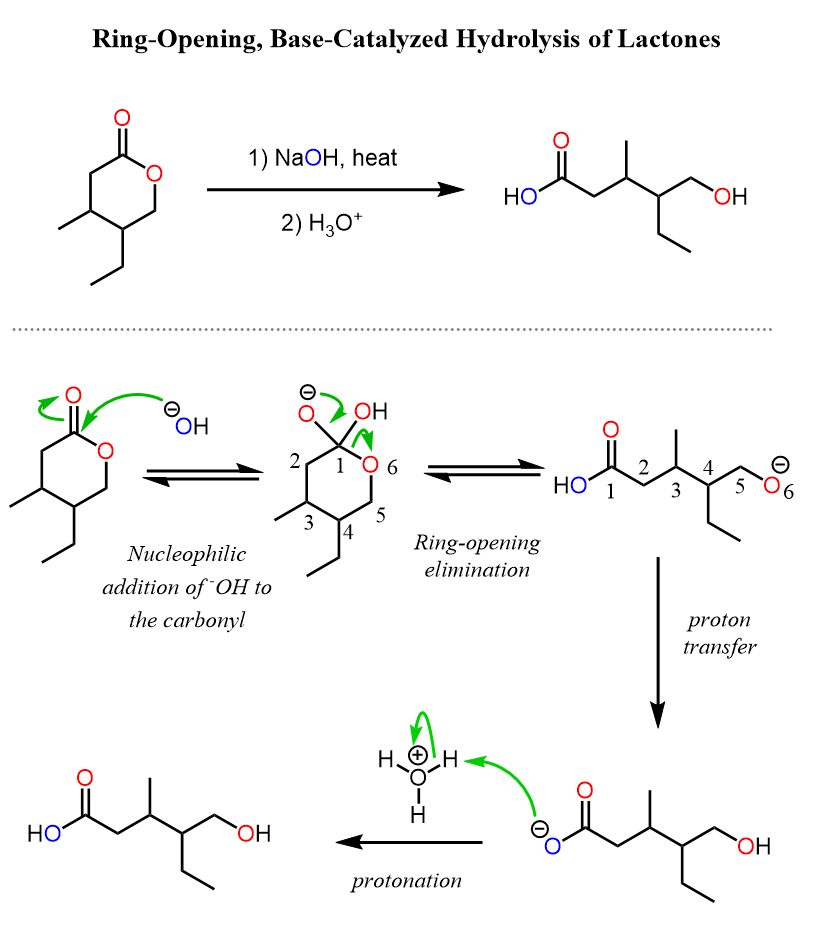
When hydroxide is present, it directly attacks the carbonyl of the lactone without the need for protonation, causing rapid ring opening. Hydrolysis under basic conditions produces a carboxylate salt rather than a neutral acid, which drives the reaction strongly forward because the carboxylate is a poor electrophile and cannot easily reform the cyclic structure.
The Polymerization of Lactones
A particularly important application of base-catalyzed lactone ring opening is in the ring-opening polymerization of cyclic lactones such as ε-caprolactone.
Caprolactone is a seven-membered cyclic ester that can undergo nucleophilic attack at the carbonyl to initiate polymerization, leading to the formation of poly(ε-caprolactone), a biodegradable polyester widely used in biomedical materials, drug delivery systems, and resorbable sutures. In this process, an alkoxide generated under basic conditions acts as the initiating species, opening the lactone ring and propagating the chain through successive ester formation.
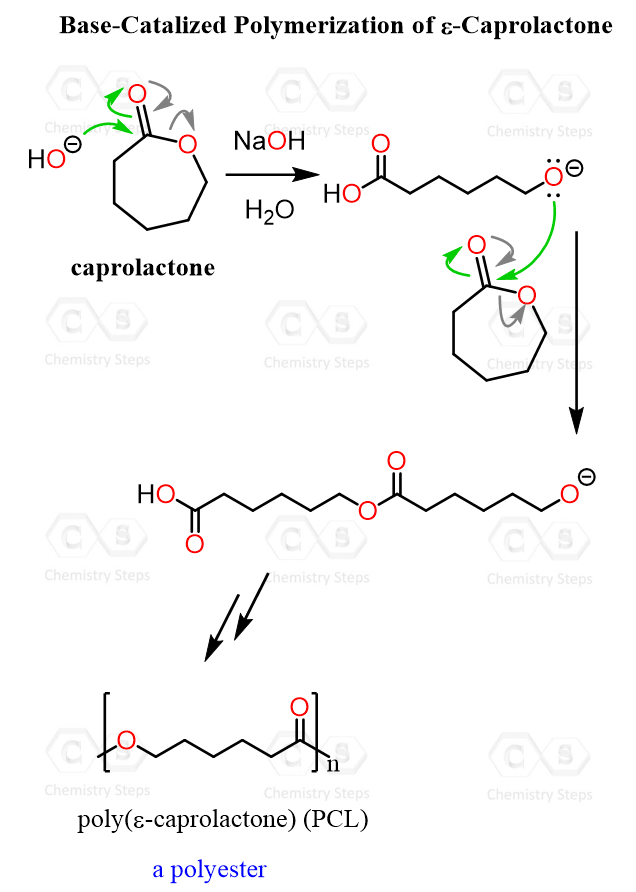
This polymerization does not require strictly basic conditions. It can also be initiated under aluminum-based Lewis acid catalysis, such as aluminum isopropoxide (Al(OiPr)3), which activates the carbonyl group toward nucleophilic attack by an alcohol initiator. In both cases, whether base- or Lewis acid-catalyzed, the key step is activation of the lactone carbonyl followed by ring opening and chain propagation to form the polyester.
We have a dedicated post on the Synthesis and Reactions of Lactones and Lactams, where you can find more reactions and practice problems on this class of molecules.
Check Also
- Preparation of Carboxylic Acids
- Naming Carboxylic Acids
- Naming Nitriles
- Naming Esters
- Naming Carboxylic Acid Derivatives – Practice Problems
- The Addition-Elimination Mechanism
- Fischer Esterification
- Ester Hydrolysis by Acid and Base-Catalyzed Hydrolysis
- What is Transesterification?
- Esters Reaction with Amines – The Aminolysis Mechanism
- Ester Reactions Summary and Practice Problems
- Preparation of Acyl (Acid) Chlorides (ROCl)
- Reactions of Acid Chlorides (ROCl) with Nucleophiles
- R2CuLi Organocuprates – Gilman Reagent
- Reaction of Acyl Chlorides with Grignard and Gilman (Organocuprate) Reagents
- Reduction of Acyl Chlorides by LiAlH4, NaBH4, and LiAl(OtBu)3H
- Reduction of Carboxylic Acids and Their Derivatives
- Preparation and Reaction Mechanism of Carboxylic Anhydrides
- Amides – Structure and Reactivity
- Naming Amides
- Amides Hydrolysis: Acid and Base-Catalyzed Mechanism
- Amide Dehydration Mechanism by SOCl2, POCl3, and P2O5
- Amide Reduction Mechanism by LiAlH4
- Reduction of Amides to Amines and Aldehydes
- Amides Preparation and Reactions Summary
- Amides from Carboxylic Acids-DCC and EDC Coupling
- The Mechanism of Nitrile Hydrolysis To Carboxylic Acid
- Nitrile Reduction Mechanism with LiAlH4 and DIBAL to Amine or Aldehyde
- The Mechanism of Grignard and Organolithium Reactions with Nitriles
- The Reactions of Nitriles
- Converting Nitriles to Amides
- Carboxylic Acids to Ketones
- Esters to Ketones
- Synthesis and Reactions of Lactones and Lactams
- Carboxylic Acids and Their Derivatives Practice Problems
- Carboxylic Acids and Their Derivatives Quiz
- Reactions Map of Carboxylic Acid Derivatives