
Oxidation of Aldehydes with Tollens’ Reagent
Tollens’ reagent is a mild oxidizing agent used for converting aldehydes to carboxylic acids. It is prepared from silver(I) oxide in aqueous ammonia and is commonly written as Ag₂O, NH₃, ⁻OH or Ag2O, NH4OH:
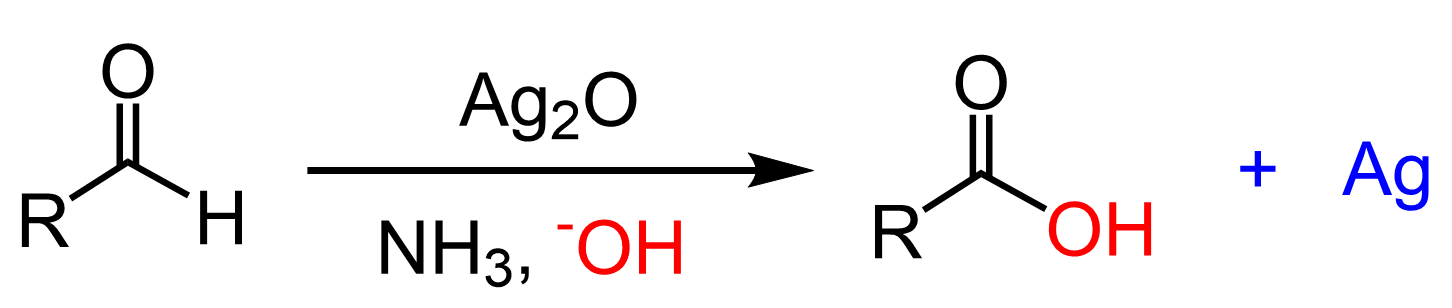
What is unique about the Tollens’ reaction is that when an aldehyde is treated with Tollens’ reagent, it is oxidized to a carboxylate ion while Ag⁺ is reduced to metallic silver, producing the characteristic silver mirror coating on the inner surface of the reaction vessel.

Because of this characteristic appearance, Tollens’ reagent is commonly used to distinguish aldehydes from ketones, as ordinary ketones do not undergo oxidation under these mild conditions. The reaction itself is thus called Tollens’ test.
Oxidation of Carbohydrates with Tollens’ Reagent
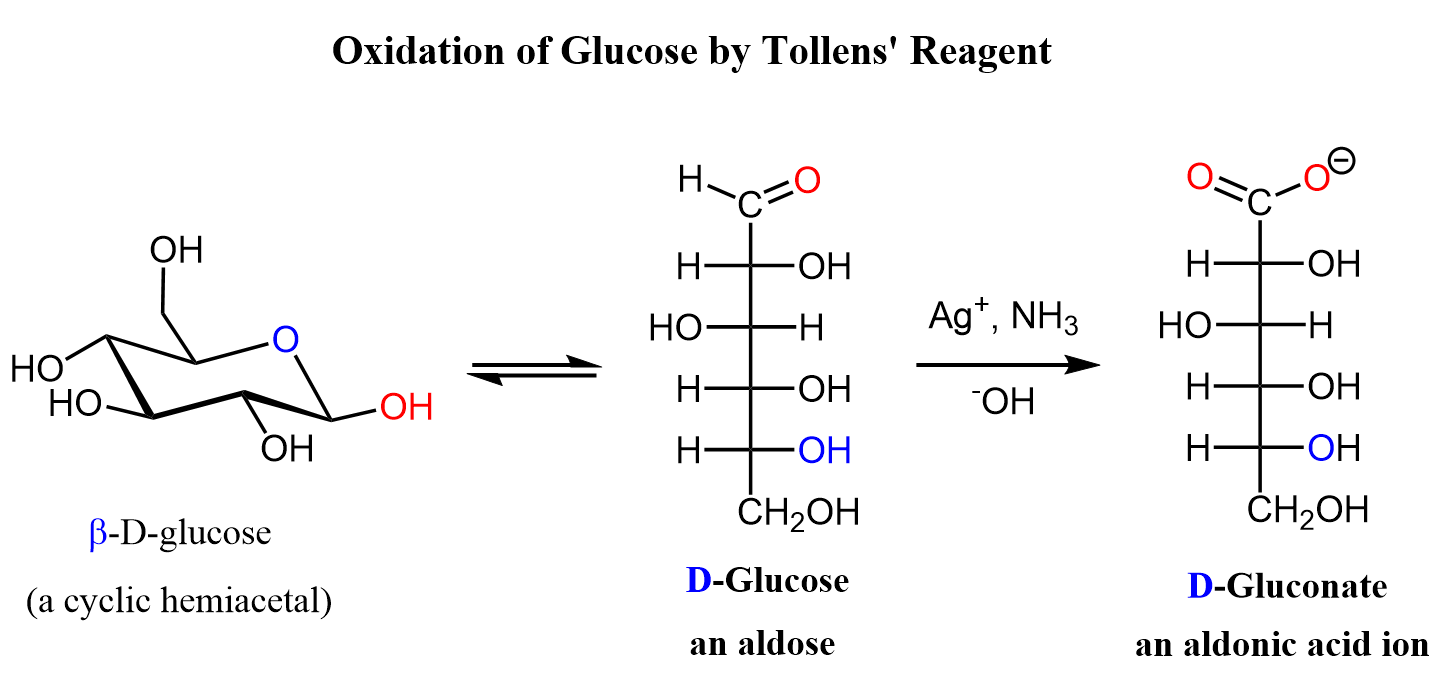
Tollens’ reagent is also useful for the oxidation of carbohydrates containing an aldehyde group, which are also classified as aldoses. Recall that aldoses, such as glucose, exist primarily in their cyclic hemiacetal form, but are always in equilibrium with a small amount of the open-chain aldehyde form.
Under the basic conditions of Tollens’ reagent, the open-chain aldehyde is oxidized to a carboxylate group. As the aldehyde is consumed, more of the cyclic form opens up to re-establish the equilibrium, eventually leading to oxidation of the entire carbohydrate:
Interestingly, despite the fact that Tollens’ reagent does not oxidize ketones (which are generally resistant to oxidation), it can still be used to oxidize ketoses to the corresponding carboxylates. This is because, under the basic reaction conditions, ketoses undergo isomerization to aldoses through an enediol intermediate. Once converted into an aldose, the aldehyde group can be readily oxidized by Tollens’ reagent.
For example, D-fructose, which is a ketose, is converted into D-glucose and D-mannose under the reaction conditions. These aldoses are then oxidized by Tollens’ reagent to the corresponding aldonic acids (or carboxylates), giving the characteristic positive silver mirror test.
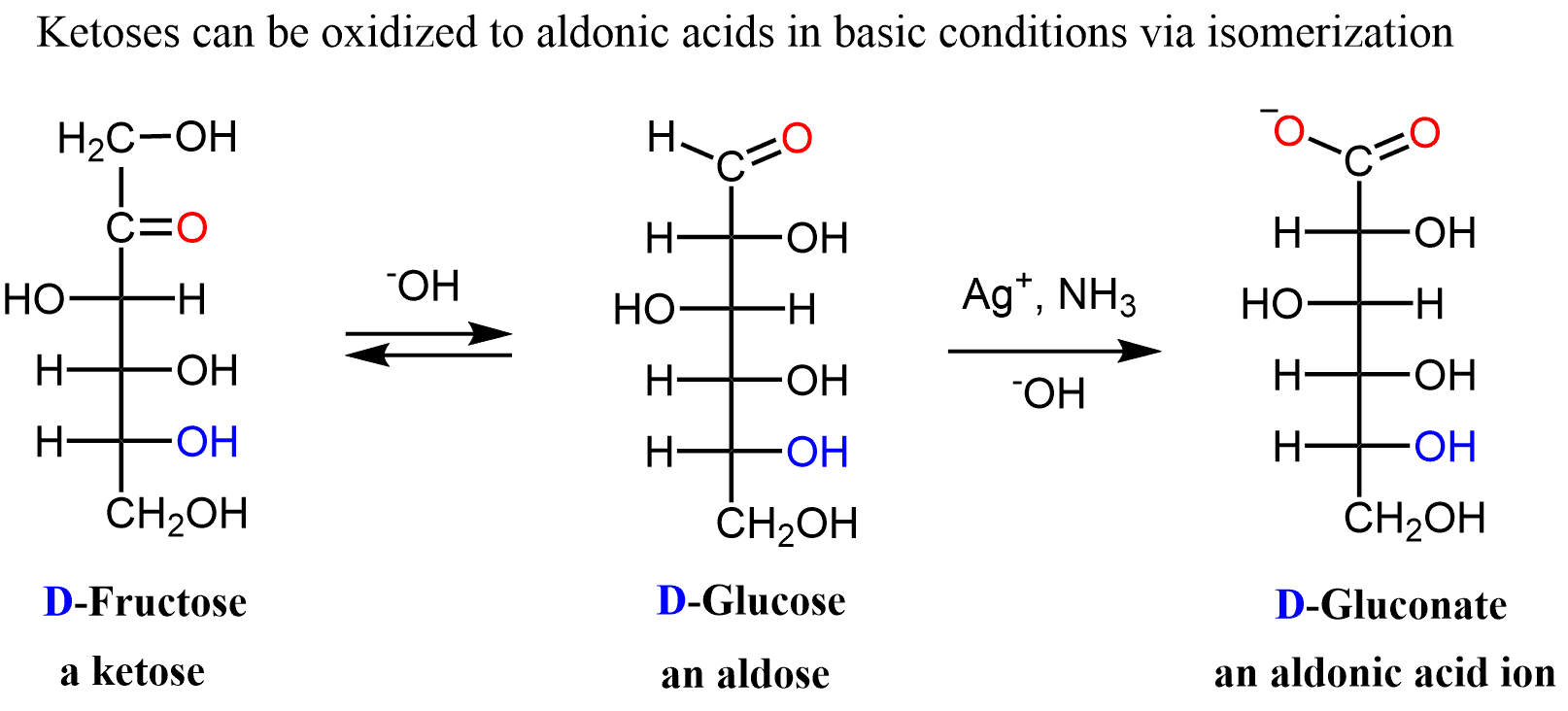
Notice that the isomerization is reversible, establishing an equilibrium between the aldose and ketose forms.
Along with Tollen’s reagent, there is also Fehlingto’s reagent (Cu2+ in aqueous sodium tartrate), and Benedict’s reagent (Cu2+ in aqueous sodium citrate) that are used for the oxidation of the aldehyde group in carbohydrates:

Check this post for a more detailed sisscussin on different ways of oxidizing carbohydrates.
discussion
Other Methods for Oxidizing Aldehydes
Tollens’ reaction is by far not the most common way of oxidizing aldehydes, as there are much simpler strategies such as using Na₂Cr₂O₇, CrO₃/H₂SO₄ (Jones reagent), or KMnO₄. These are all strong oxidizing agents that can also be used for the direct oxidation of primary alcohols all the way to carboxylic acids.
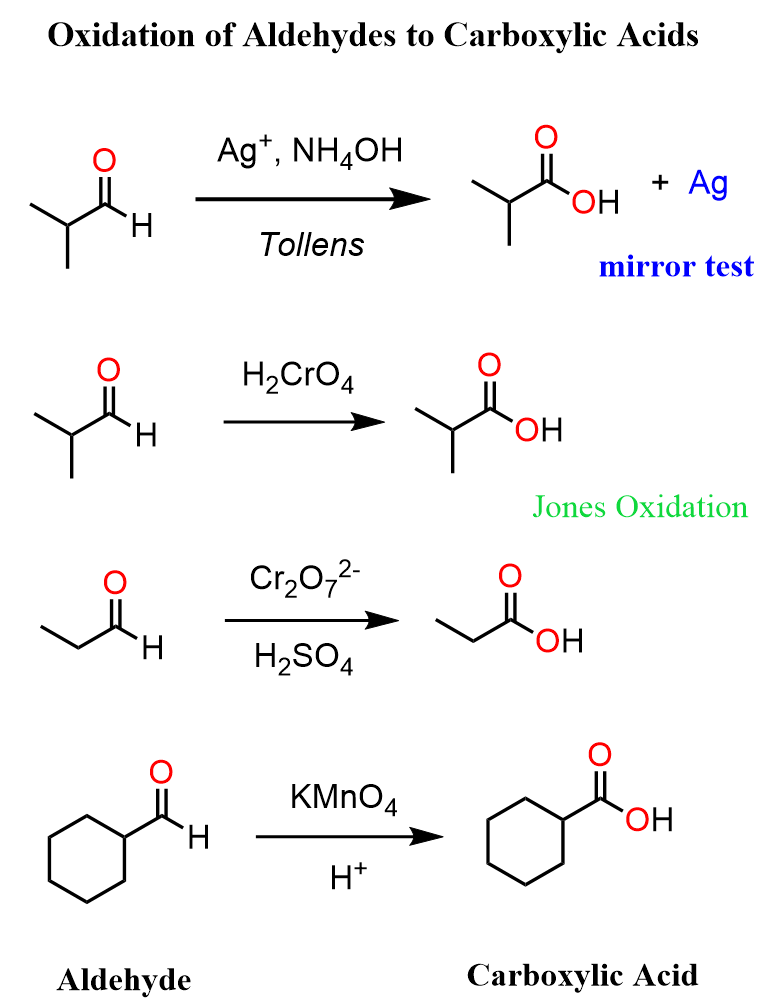
Tollens’ reagent is therefore used mainly as a qualitative test for aldehydes rather than as a practical synthetic oxidation method. Historically, the reaction was also used for silvering glassware and manufacturing mirrors, taking advantage of the smooth metallic silver deposit formed during the reaction.
Need some practice on carbohydrates?
Check this Multiple-Choice, summary quiz on the structure and reactions of carbohydrates with a 40-minute video solution!

Carbohydrates Practice Problem Quiz
Check also
- Oxidation of Alcohols to Aldehydes, Ketones, and Caboxylcia Acids
- Carbohydrates – Structure and Classification
- Erythro and Threo
- D and L Sugars
- Aldoses and Ketoses: Classification and Stereochemistry
- Epimers and Anomers
- Converting Fischer, Haworth, and Chair forms of Carbohydrates
- Mutarotation
- Glycosides
- Isomerization of Carbohydrates
- Ether and Ester Derivatives of Carbohydrates
- Oxidation of Monosaccharides
- Reduction of Monosaccharides
- Kiliani–Fischer Synthesis
- Wohl Degradation
I am an ex chemistry teache my sister tells me that in new zealand where she lives schools are being urged to get rid of Tollens reagent from their cupboards. We always made it in situ so what have they been doing?
I have seen this topic about Tollens’ reagent popping up here and there too, Lora. I haven’t gone through the details much, but it seems like some schools have been storing it, perhaps without realizing that the reagent can become explosive when left standing.
Here is a good article from RSC Education that also mentions explicitly that Tollens’ reagent is likely to explode on standing. In fact, they specifically say not to prepare it in advance and to dispose of it shortly after mixing.