
We have seen earlier that both aldoses and ketoses can be oxidized by a variety of methods, such as Tollens’ reagent, Fehling’s solution, and bromine water, to form aldonic acids. For example, glucose is oxidized at the aldehyde group to give gluconic acid (an aldonic acid), while the terminal primary alcohol remains unchanged under these mild conditions. Notice that it is the open form of the glucose that is oxidized rather than the cyclic form, which hides the aldehyde group in the form of a cyclic hemiacetal:
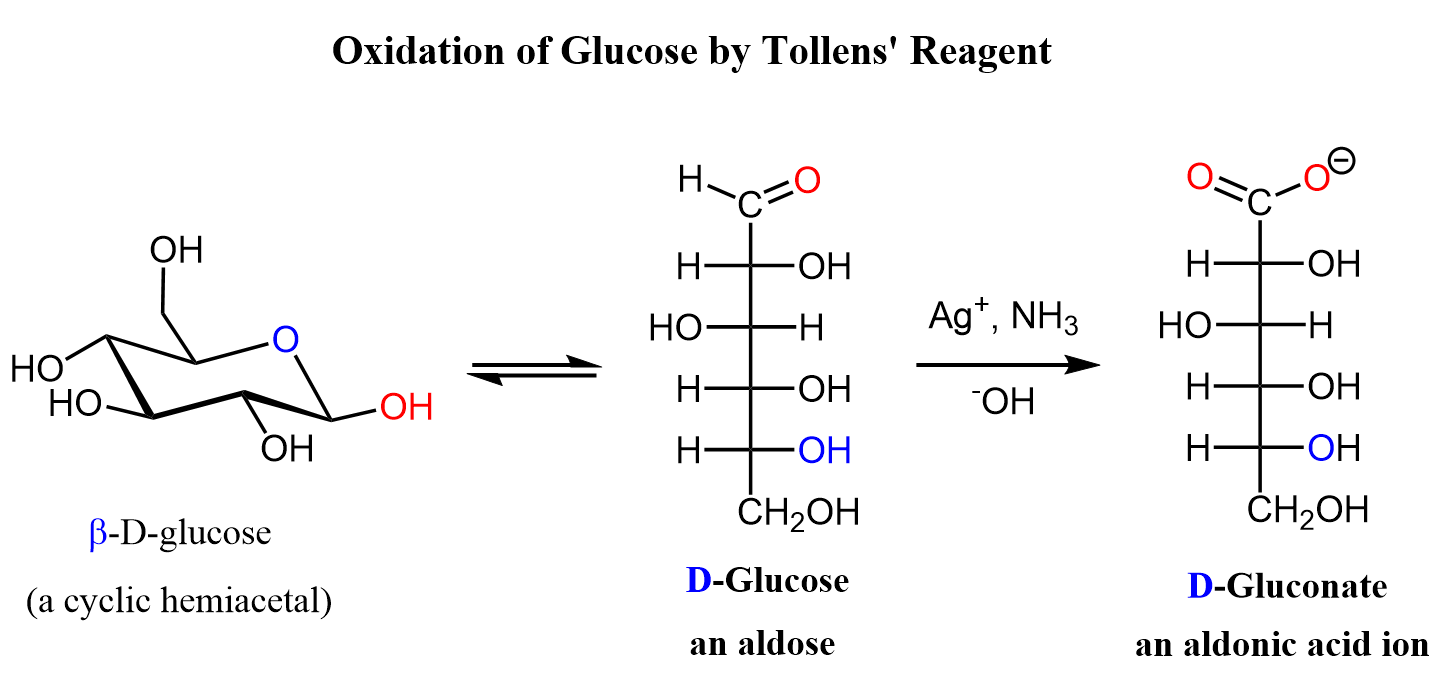
Any carbohydrate that reacts with an oxidizing agent to produce an aldonic acid is classified as a Reducing Sugar, since it reduces the oxidizing agent in the process.
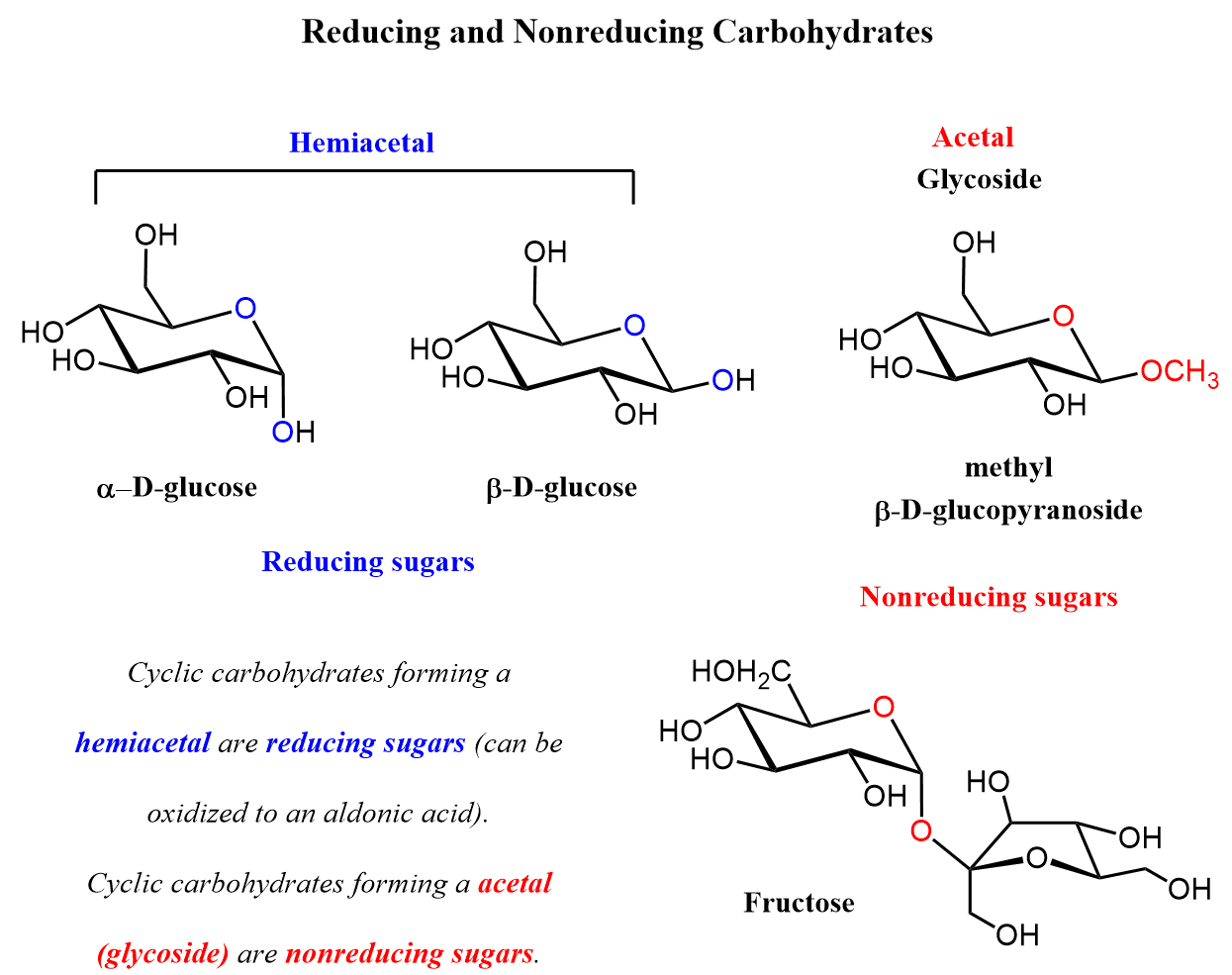
This definition can also be rephrased as: any carbohydrate that contains a free hemiacetal group is a reducing sugar. This is true because hemiacetal aldoses are the cyclic forms of the corresponding aldehydes and, as we have already seen above, the hemiacetal is in equilibrium with its open-chain aldehyde form; thus, it can be oxidized.
What is interesting here is the fact that ketoses can also be reducing sugars, despite the fact that ketones cannot be oxidized any further. This again is because, under the basic reaction conditions, ketoses undergo isomerization to aldoses through an enediol intermediate. Once converted into an aldose, the aldehyde group can be readily oxidized to an aldonic acid.
For example, D-fructose, which is a ketose, is converted into D-glucose and D-mannose under the reaction conditions. These aldoses are then oxidized by Tollens’ reagent to the corresponding aldonic acids (or carboxylates), giving the characteristic positive silver mirror test.
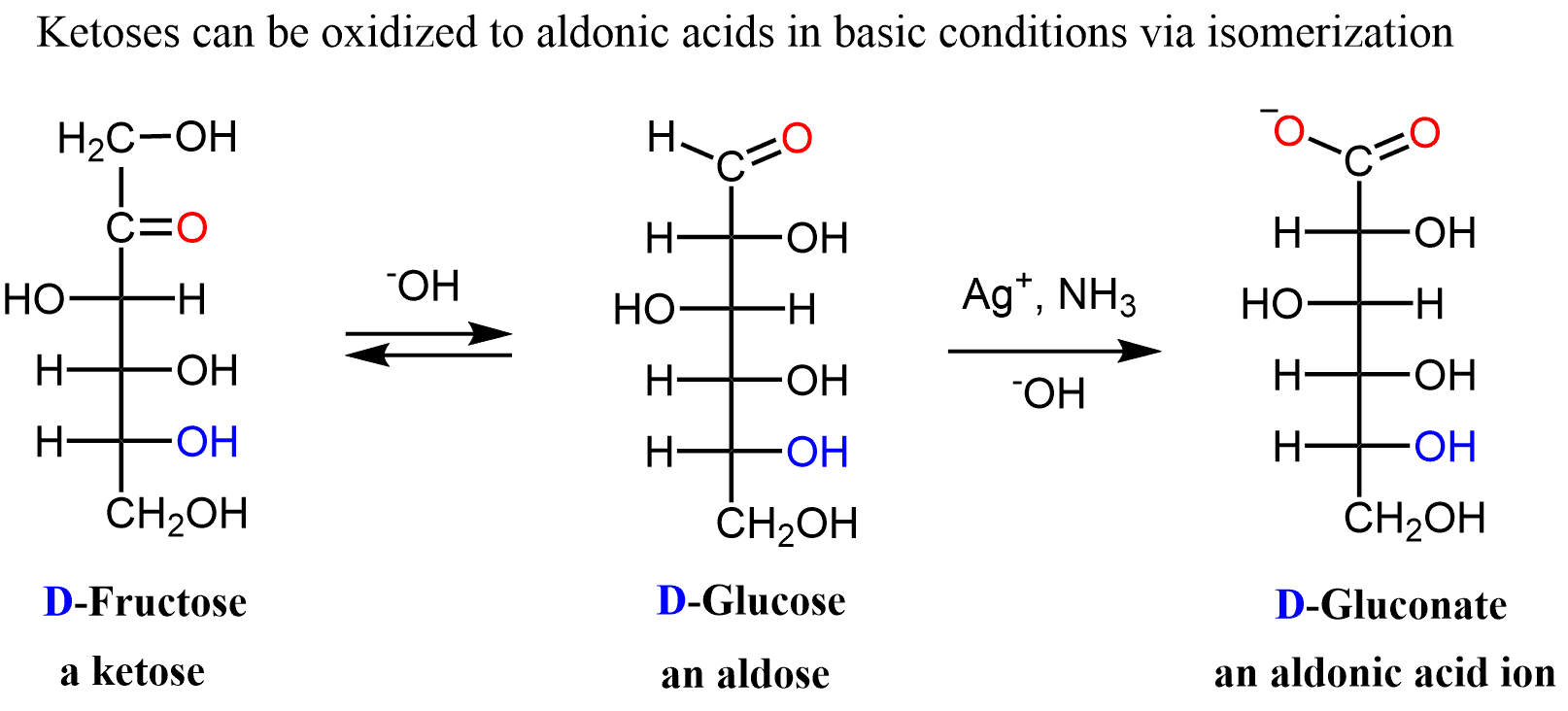
The isomerization is reversible, establishing an equilibrium between the aldose and ketose forms.
Another example of a reducing sugar is maltose, which is a disaccharide composed of two glucose units linked by an α(1→4) glycosidic bond. Since one of the anomeric carbons remains free (not involved in the glycosidic bond), maltose can open to form a reactive aldehyde group and therefore acts as a reducing sugar:
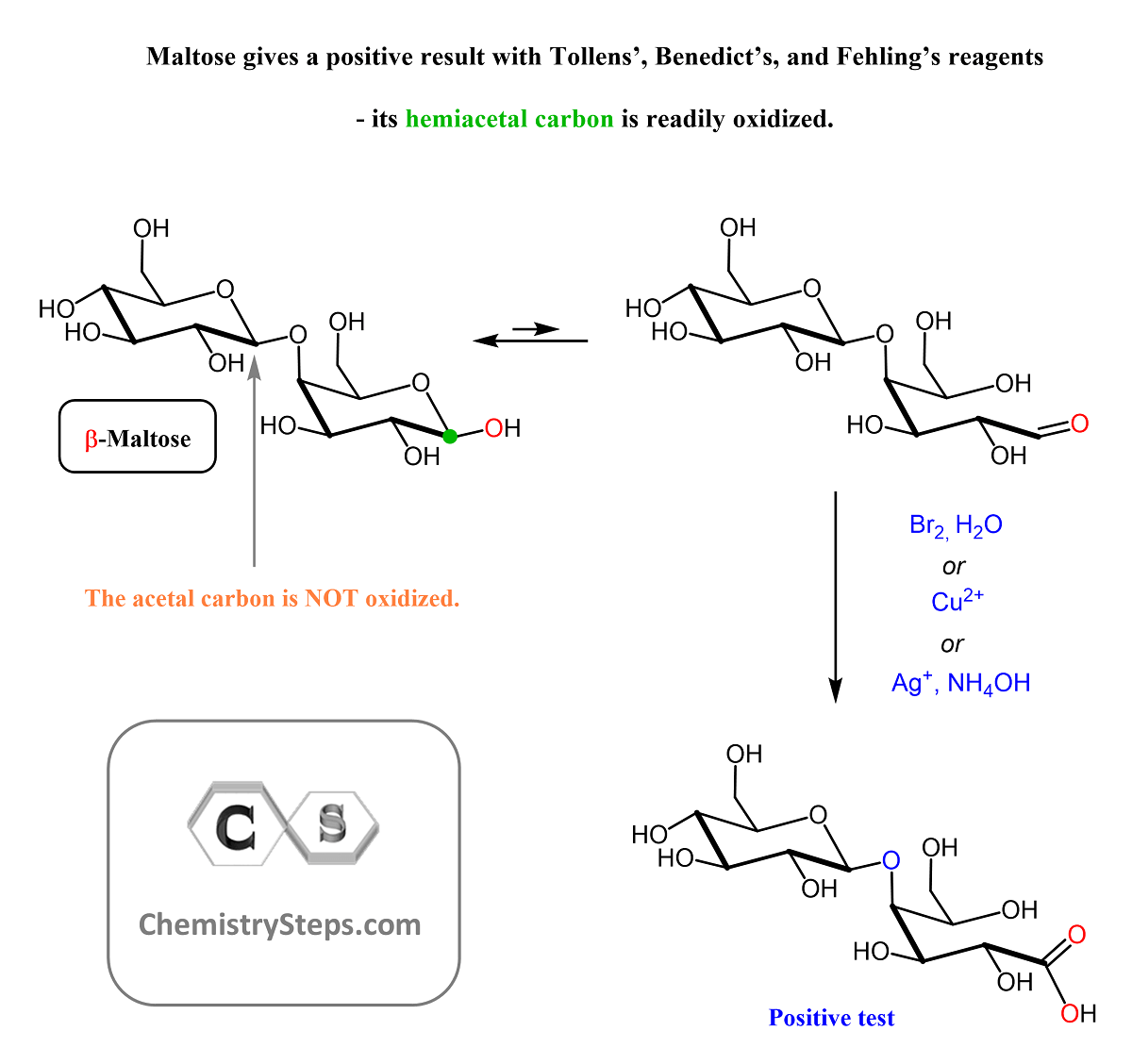
These reactions are commonly used as qualitative tests for reducing sugars. Reagents such as Tollens’, Benedict’s, and Fehling’s solutions act as mild oxidizing agents and help distinguish reducing from non-reducing carbohydrates. A positive test is indicated by a clear visual change: Tollens’ reagent forms a silver mirror, while Benedict’s and Fehling’s solutions produce a colored precipitate (typically red or brick-red Cu₂O).

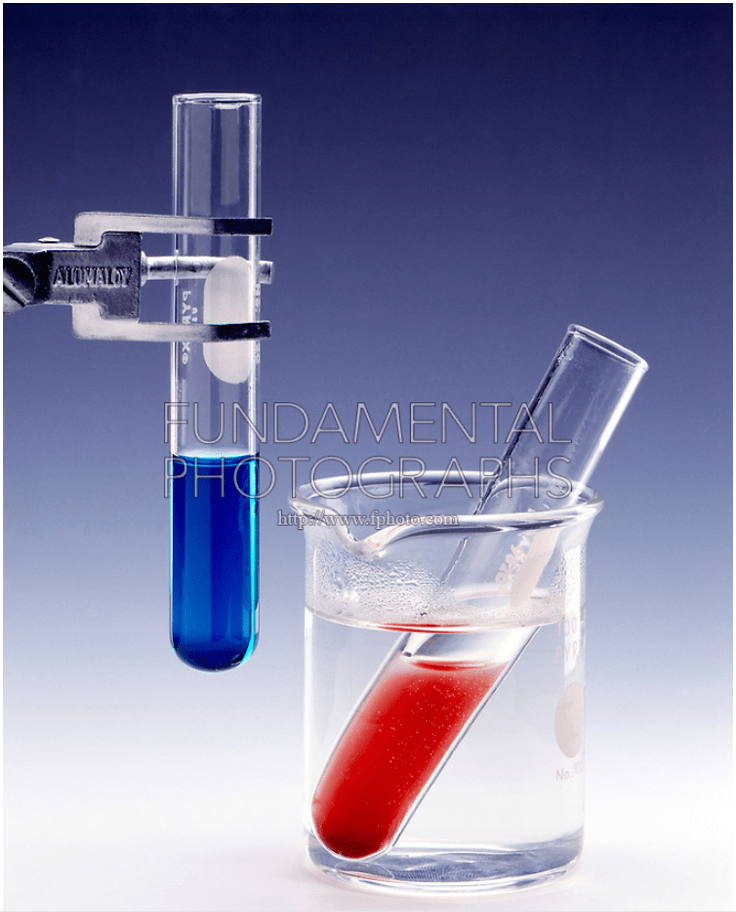
They can also be used to distinguish simple aldehydes from ketones.
Nonreducing Sugars
So, are there any nonreducing sugars?
Yes, cyclic sugars in which the anomeric carbon is in the form of an acetal are not prone to oxidation and do not give a positive result in Tollens’ or Benedict’s tests. Therefore, they are not classified as reducing sugars. Recall that acetals of monosaccharides are called glycosides and consist of an alkoxy group (–OR) bonded to the anomeric carbon. These are prepared by reacting the carbohydrate with the corresponding alcohol under acidic conditions:
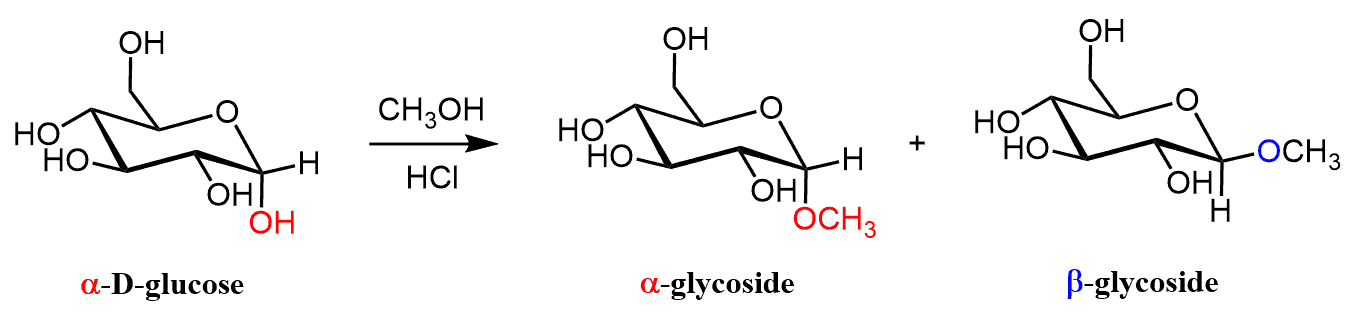
The α- and β-D-glucopyranosides shown above are examples of non-reducing sugars, formed when the anomeric hydroxyl group of glucose is converted into a methyl acetal (glycoside).
This is because glycosides lock the anomeric carbon in an acetal form, they are stable under neutral and basic conditions, and do not undergo ring opening to the aldehyde form, making them non-reducing.Carboxylic
The acetal protecting group is removed by an acidic treatment, acidic treatment; therefore, glycosides can be hydrolyzed with acid and water glycosides can be hydrolyzed with acid and water back to cyclic hemiacetals.

Notice that just like in the formation of glycosides, a mixture of two anomers is formed from either glycoside because the reaction goes through the formation of a planar carbocation.
Oxidation of Carbohydrates to Aldaric Acids
I also wanted to add that it is possible to oxidize both the aldehyde group and the terminal alcohol to carboxylic acids, in which case an aldaric acid is formed.

This is achieved using stronger oxidizing agents such as nitric acid (HNO₃), which can oxidize both ends of the sugar molecule.
that

One feature of aldaric acids is that they have two identical groups (COOH) on the terminal carbons, and therefore, it is always a good idea to check whether it is a meso compound. For example, D-Glucose is chiral while D-glucaric acid is a meso compound, as can be seen from the perpendicular plane of symmetry on the Fischer projection. Remember, meso compounds are not optically active and therefore are achiral.

Summarizing Reducing Sugars
Reducing sugars are carbohydrates that can be oxidized to aldonic acids by mild oxidizing agents such as Tollens’ reagent, Fehling’s solution, or bromine water. This occurs because they can generate a free carbonyl group in solution, typically through the open-chain form of the sugar.
You can recognize reducing sugars by identifying the presence of a hemiacetal group. Since cyclic hemiacetals are in equilibrium with their open-chain aldehyde (or keto) forms, they can act as reducing agents and give positive tests in Tollens’ or Benedict’s reactions.
Aldoses are naturally reducing sugars because they readily equilibrate with their open-chain aldehyde form. Ketoses are also reducing sugars, even though they contain a ketone group, because under basic conditions they undergo enediol-mediated isomerization to aldoses, which are then oxidized.
Many disaccharides are reducing as well, such as maltose, provided that one anomeric carbon remains free and can open to form a reactive carbonyl group.
In contrast, carbohydrates in which the anomeric carbon is locked as an acetal (glycoside) are non-reducing. These structures cannot open to the carbonyl form and therefore do not react with common oxidizing tests.
Need some practice on carbohydrates?
Check this Multiple-Choice, summary quiz on the structure and reactions of carbohydrates with a 40-minute video solution!

Carbohydrates Practice Problem Quiz
Check also
- Oxidation of Alcohols to Aldehydes, Ketones, and Carboxylic Acids
- Carbohydrates – Structure and Classification
- Erythro and Threo
- D and L Sugars
- Aldoses and Ketoses: Classification and Stereochemistry
- Epimers and Anomers
- Converting Fischer, Haworth, and Chair forms of Carbohydrates
- Mutarotation
- Glycosides
- Isomerization of Carbohydrates
- Ether and Ester Derivatives of Carbohydrates
- Oxidation of Monosaccharides
- Reduction of Monosaccharides
- Kiliani–Fischer Synthesis
- Wohl Degradation