
Nuclear Magnetic Resonance (NMR) Spectroscopy

NMR Signal Splitting N+1 Rule Multiplicity Practice Problems

In the previous two posts, we have talked about the number of NMR signals and the multiplicity which is the signal splitting based on the n + 1 rule. Let’s quickly summarize what these two features are. First, the number … Read more
Splitting and Multiplicity (N+1 rule) in NMR Spectroscopy

NMR signals may have different number of peaks (the number of lines). This is called the splitting of the signal or the multiplicity. Signal splitting is arguably the most unique and important feature that makes NMR spectroscopy a comprehensive tool … Read more
DEPT NMR: Signals and Problem Solving

At times, solving an NMR problem leads to two or more plausible structures satisfying the given data. We have seen that 13C NMR is usually decoupled and therefore, there is no splitting of signals which limits the information we can … Read more
13C Carbon NMR Spectroscopy

Let’s start with the good news! Unlike the 1H NMR, there is no integration and signal splitting in 13C NMR spectroscopy. We are only looking at the number of signals that each non-equivalent carbon atom gives as a single peak! … Read more
Homotopic Enantiotopic Diastereotopic Practice Problems
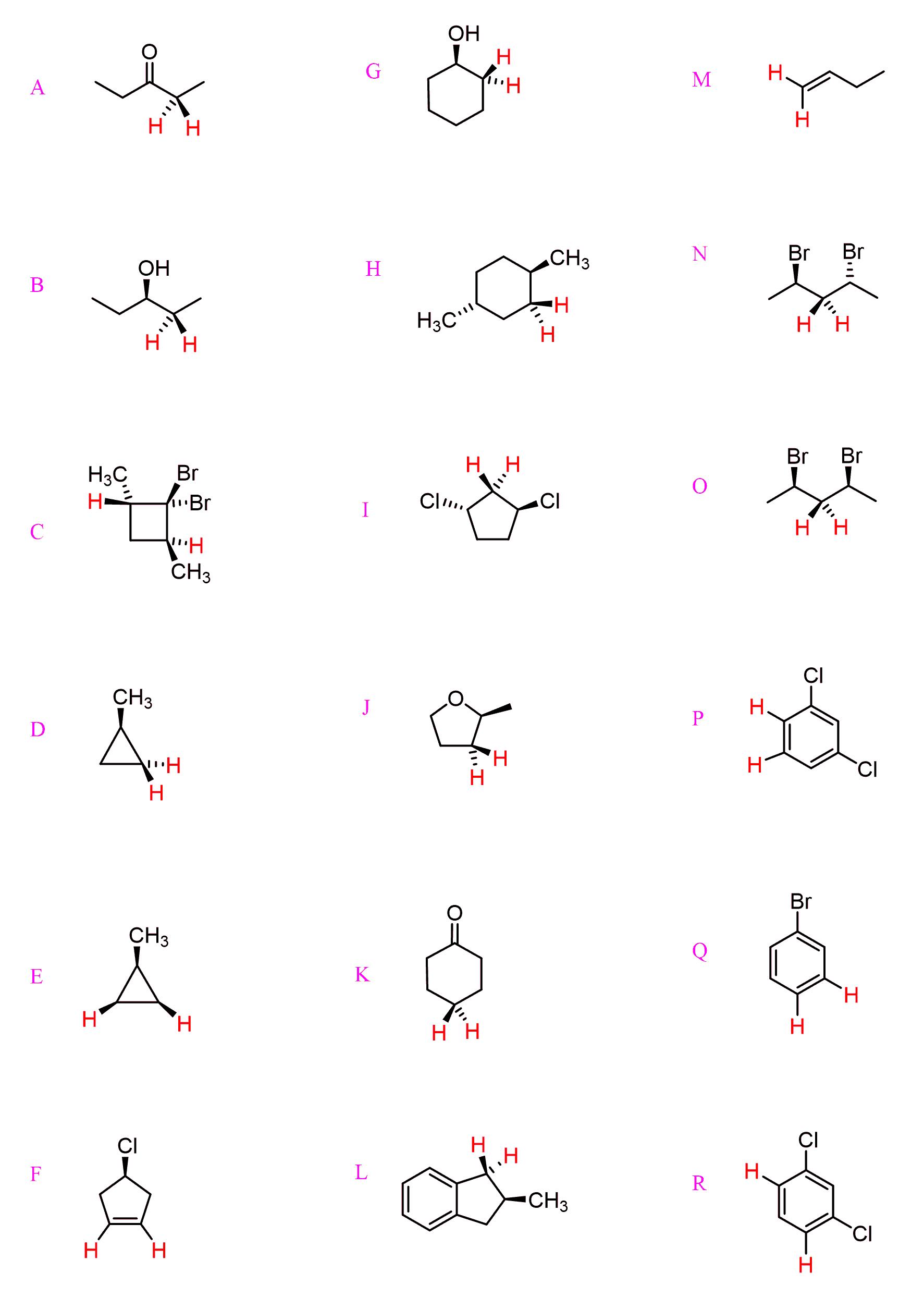
In the previous post, we talked about homotopic, enantiotopic, diastereotopic, and constitutionally heterotopic protons. In short, these are all about whether a set of protons is in the same environment or not, and for NMR purposes, it helps us determine … Read more
Integration in NMR Spectroscopy

The integration in NMR tells us the number of protons represented by a given signal. To be more accurate, let’s mention that it is the ratio of the protons behind each signal. For example, we have seen that chloroethane gives … Read more
NMR Number of Signals and Equivalent Protons

The number of NMR signals represents the number of different types of protons in a molecule. This is the example we used in the introduction to NMR spectroscopy: The spectrum has five signals which indicates five types of … Read more
Homotopic Enantiotopic Diastereotopic and Heterotopic
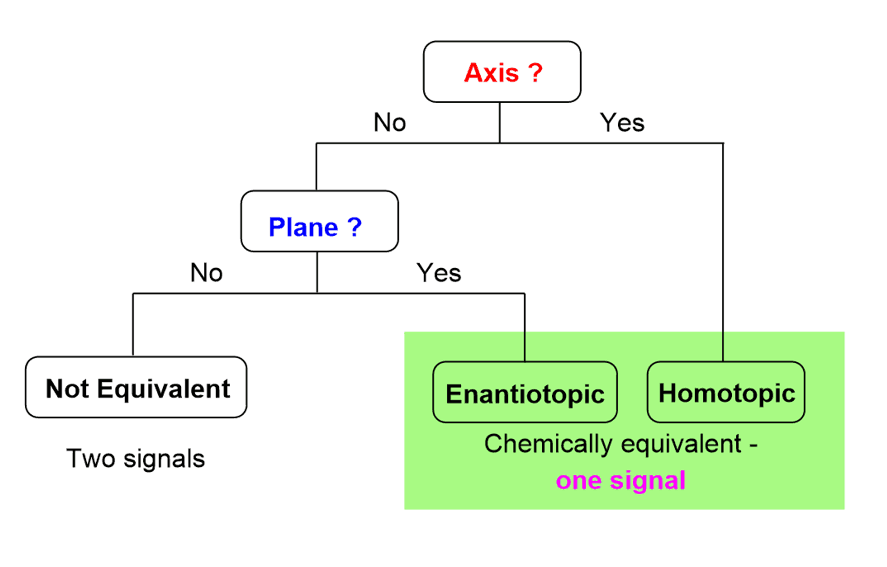
We have seen that chemically equivalent protons give one signal in NMR spectroscopy. For example, How many signals do you expect to see in the 1H NMR of ethane? Despite having 6 hydrogens, it only shows one signal, and this … Read more
NMR Chemical Shift Values Table

In the previous post, we talked about the principles behind the chemical shift addressing questions like how the ppm values are calculated, why they are independent of the magnetic field strength, and what is the benefit of using a more … Read more