
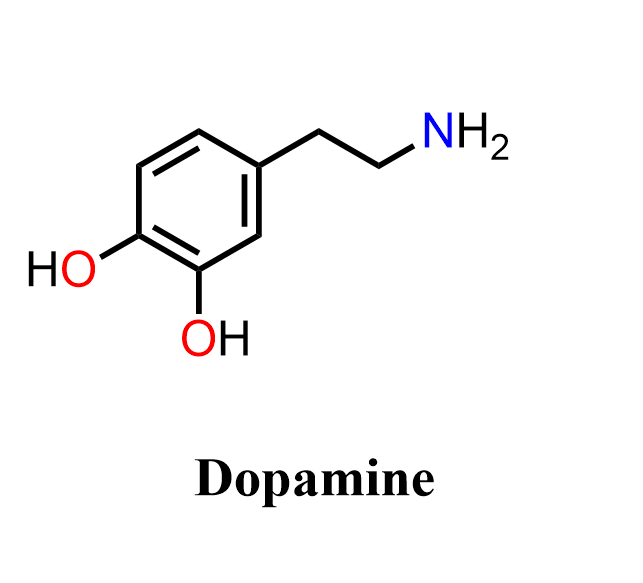
 Dopamine is a naturally occurring catecholamine neurotransmitter that plays a central role in the brain’s reward, motivation, and motor control pathways. It is also an important pharmaceutical target, as its levels and receptor activity are critical in the treatment of conditions such as Parkinson’s disease, schizophrenia, and certain types of hypotension.
From a synthetic chemistry perspective, dopamine is an instructive molecule because it contains both a catechol (1,2-dihydroxybenzene) moiety and a primary amine, requiring careful protection and functional-group manipulation. Its synthesis involves Electrophilic Aromatic Substitution (EAS), including the preparation and reactions of aniline, understanding ortho/para/meta directing effects, and the use of arene diazonium salts for selective functionalization. These strategies, combined with reductive amination and selective hydroxylation, illustrate how core principles of aromatic chemistry and multi-step synthesis are applied to construct biologically active amines like dopamine.
Practice
This content is for registered users only.
By joining Chemistry Steps, you will gain instant access to the answers and solutions for all the Practice Problems, including over 40 hours of problem-solving videos, Multiple-Choice Quizzes, Puzzles, Reaction Maps, and the powerful set of Organic Chemistry 1 and 2 Summary Study Guides.