
How to Determine the R and S Configuration

What is the R and S Configuration, and why do we need it? If we name these two alkyl halides based on the IUPAC nomenclature rules, we get the name as 2-chlorobutane for both: … Read more
What is the R and S Configuration, and why do we need it? If we name these two alkyl halides based on the IUPAC nomenclature rules, we get the name as 2-chlorobutane for both: … Read more
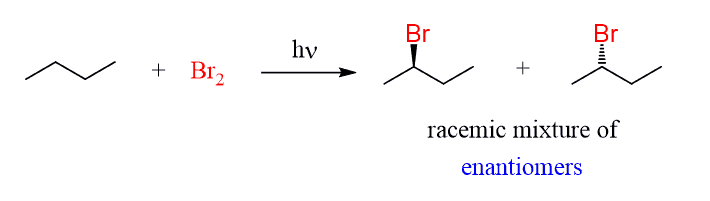
In this post, we will talk about the stereochemistry of radical halogenation leading to racemic mixture of enantiomers or diastereomers. Before getting into more details, let’s recall that radicals are similar to carbocations as both are trigonal planar, sp2-hybrydized atoms … Read more

Consider these E2 elimination reactions. For both, the β hydrogens are on the right side of the Br, and as expected, that’s where the double bond appears in the product: So, no problems with the regiochemistry of these … Read more

Determine the Relationship of molecules Enantiomers, Diastereomers, Constitutional isomers, Same or no relationship? A question that covers so much for you to learn, yet a very important one as it lays the basis of understanding organic chemistry. Let’s put this … Read more

In the previous post, we talked about the Cahn-Ingold-Prelog rules for assigning the R and S configuration. In the following practice problems, we will assign the R and S configuration for bond-line representations and use it to determine the relationship between … Read more

Conformations Let’s first talk about conformations. These, also referred to as conformers or conformational isomers, are different arrangements of atoms that occur as a result of rotation about single bonds. For example, in the following molecule, we can have a … Read more