
We have seen that LiAlH4 is one of the most powerful reducing agents and can be used to reduce many functional groups, such as aldehydes, ketones, esters, nitriles, and even carboxylic acids.
Many of these reductions can also be achieved with catalytic hydrogenation, so let’s put a list of some reduction reactions with LiAlH4 and catalytic hydrogenation:
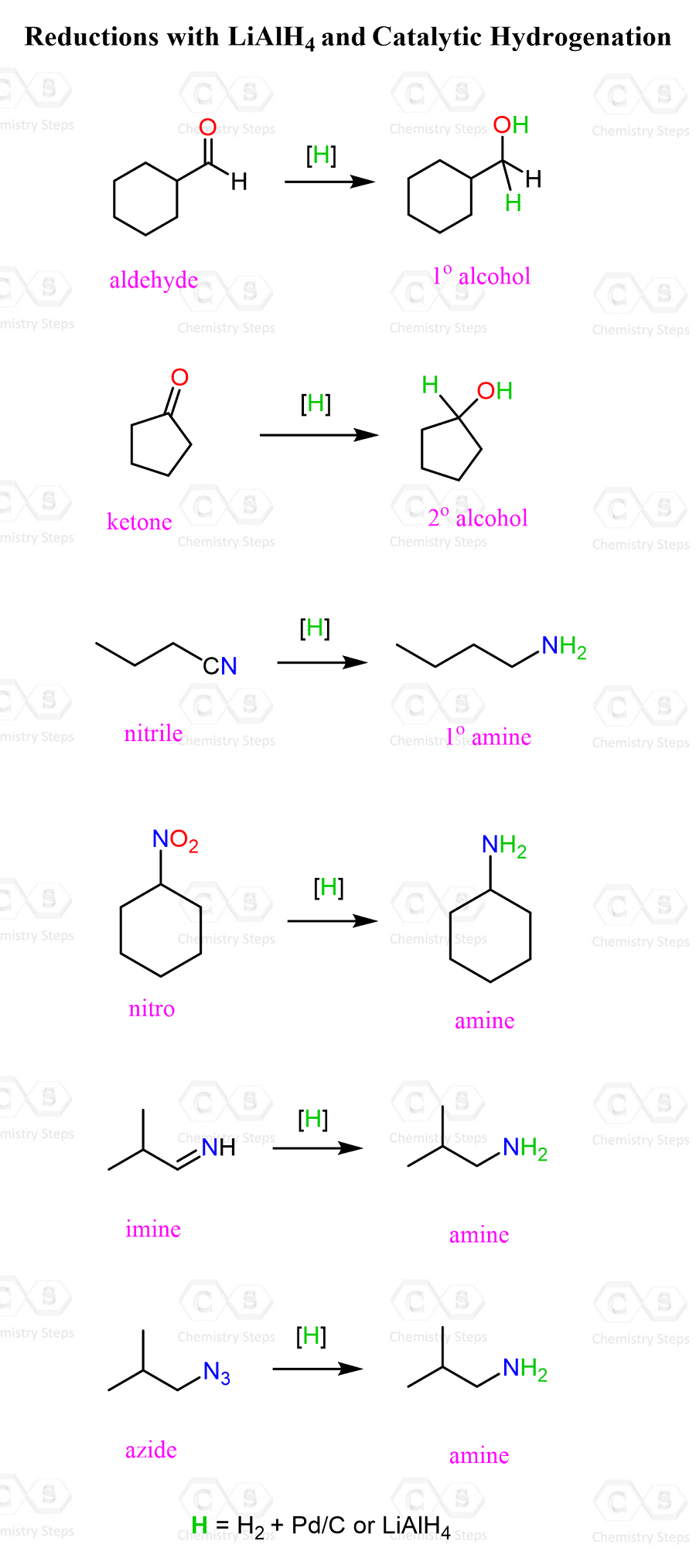
The focus of today’s discussion is the last reaction shown above, which is the reduction of azides to primary amines, most often carried out using LiAlH4 or catalytic hydrogenation.
So, let’s start with the Mechanism of Azide Reduction with LiAlH4.
The Mechanism of Azide Reduction with LiAlH4
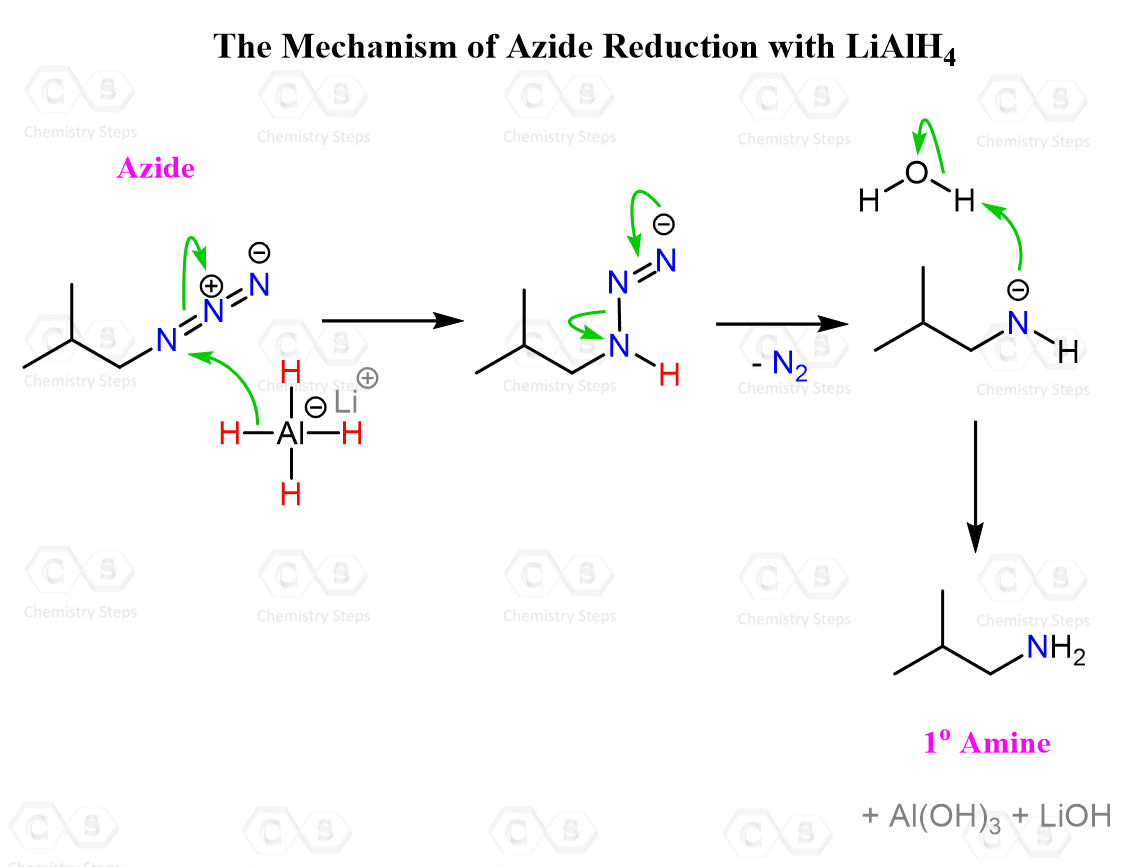
The reaction starts with a nucleophilic addition of a hydride to the π bond, forming an anionic intermediate. This intermediate then loses a nitrogen gas molecule, forming the conjugate base of the amine, which is protonated during the aqueous workup to give the final product, a primary amine:
Staudinger Azide Reduction
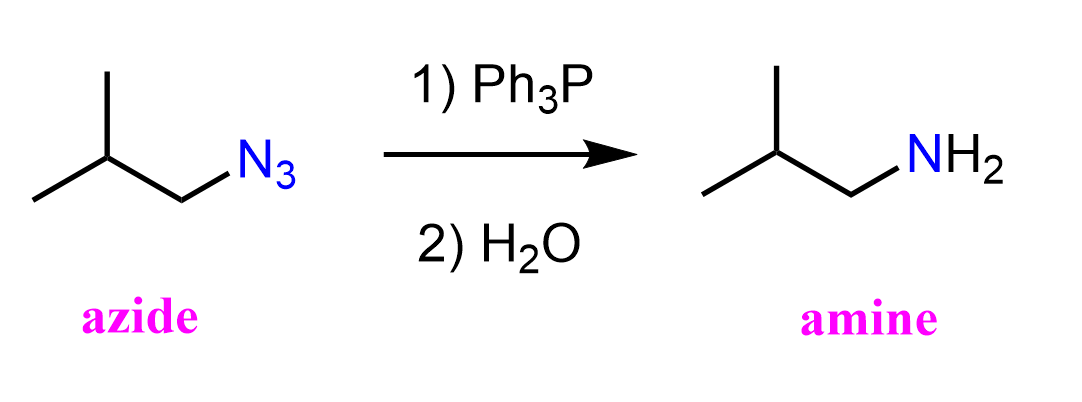
A somewhat unusual reduction of azides to primary amines can also be done by the Staudinger reaction, which uses phosphine (Ph₃P):
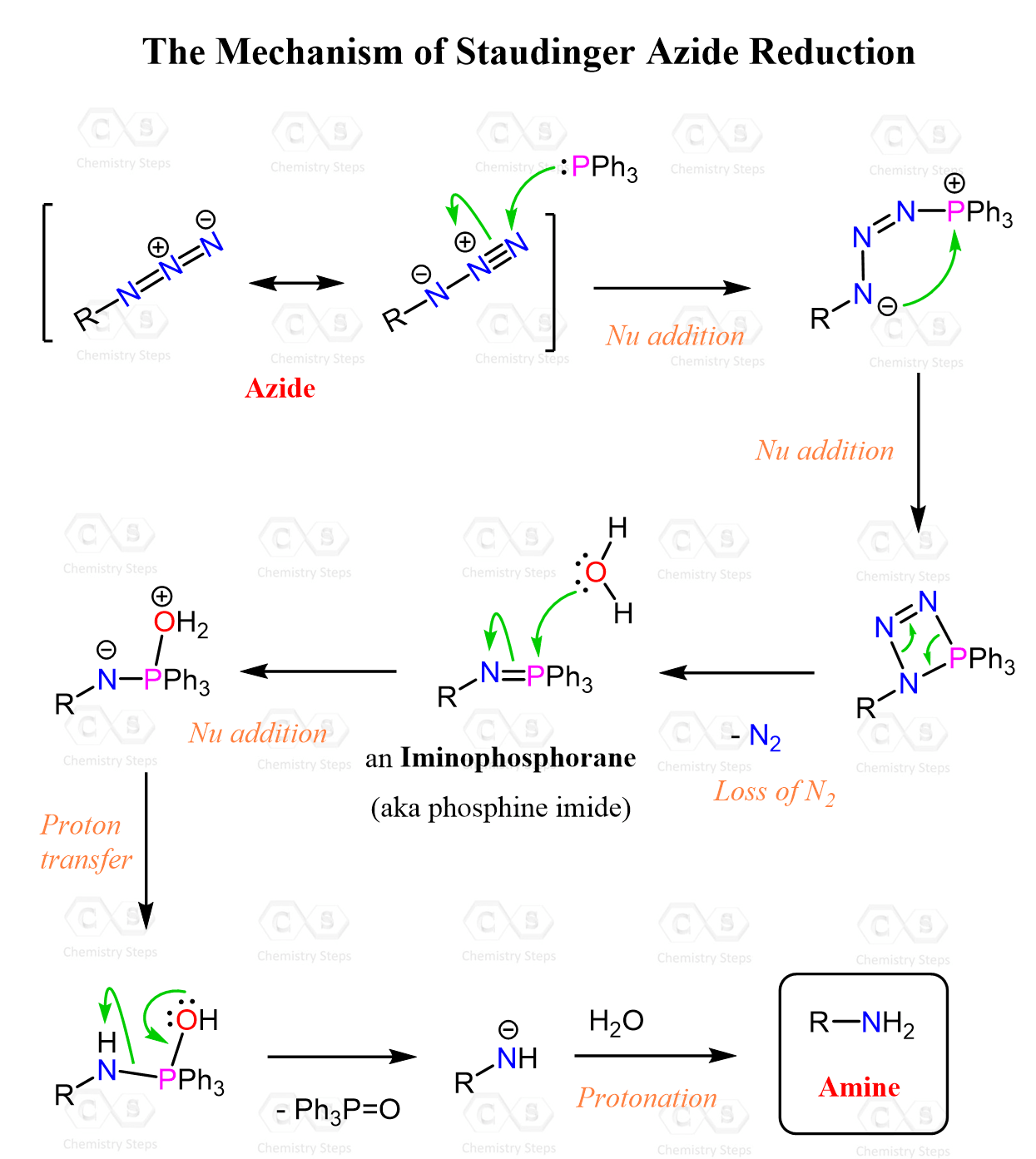
The reaction involves the formation of an iminophosphorane through nucleophilic addition of the aryl or alkyl phosphine (typically PPh3) to the terminal nitrogen atom of the organic azide, followed by the release of N₂. The iminophosphorane is then hydrolyzed with water to give the corresponding primary amine and a phosphine oxide byproduct:
This reduction of azides is highly chemoselective and can proceed with retention of stereochemistry.
Azide Reduction by Dithiols
Since we mentioned one unusual reduction of azides for undergraduate chemistry, let’s add another one which is based on the use of dithiols:
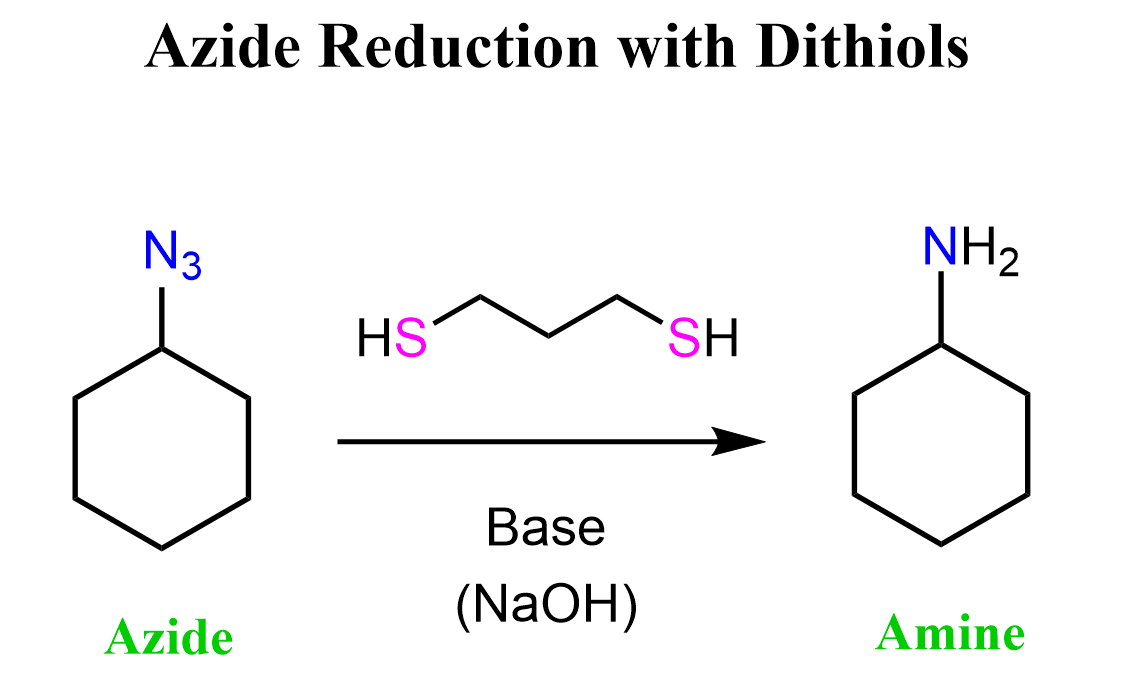
As mentioned in the cited article, azides can be reduced with thiols; however, this requires elevated temperatures, whereas this method can be used at room temperature.
The reaction starts with a nucleophilic attack of one of the sulfur atoms on the terminal nitrogen of the azide, forming an intermediate containing three nitrogen and two sulfur atoms. These two sulfur atoms then bond, forming a five-membered cyclic disulfide known as 1,2-dithiolane, with simultaneous loss of nitrogen to form the conjugate base of the amine:
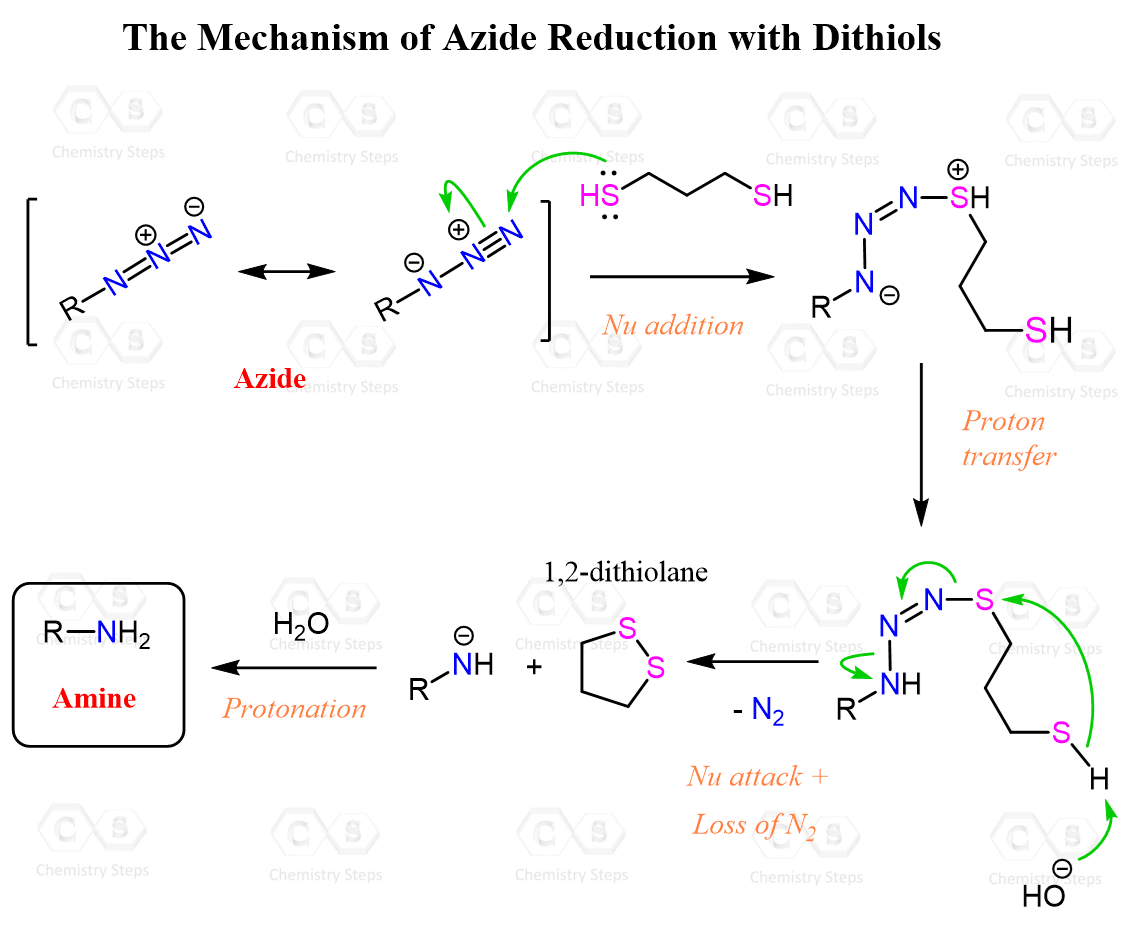
In the last step, we have protonation of the conjugate base, and the target amine is formed.
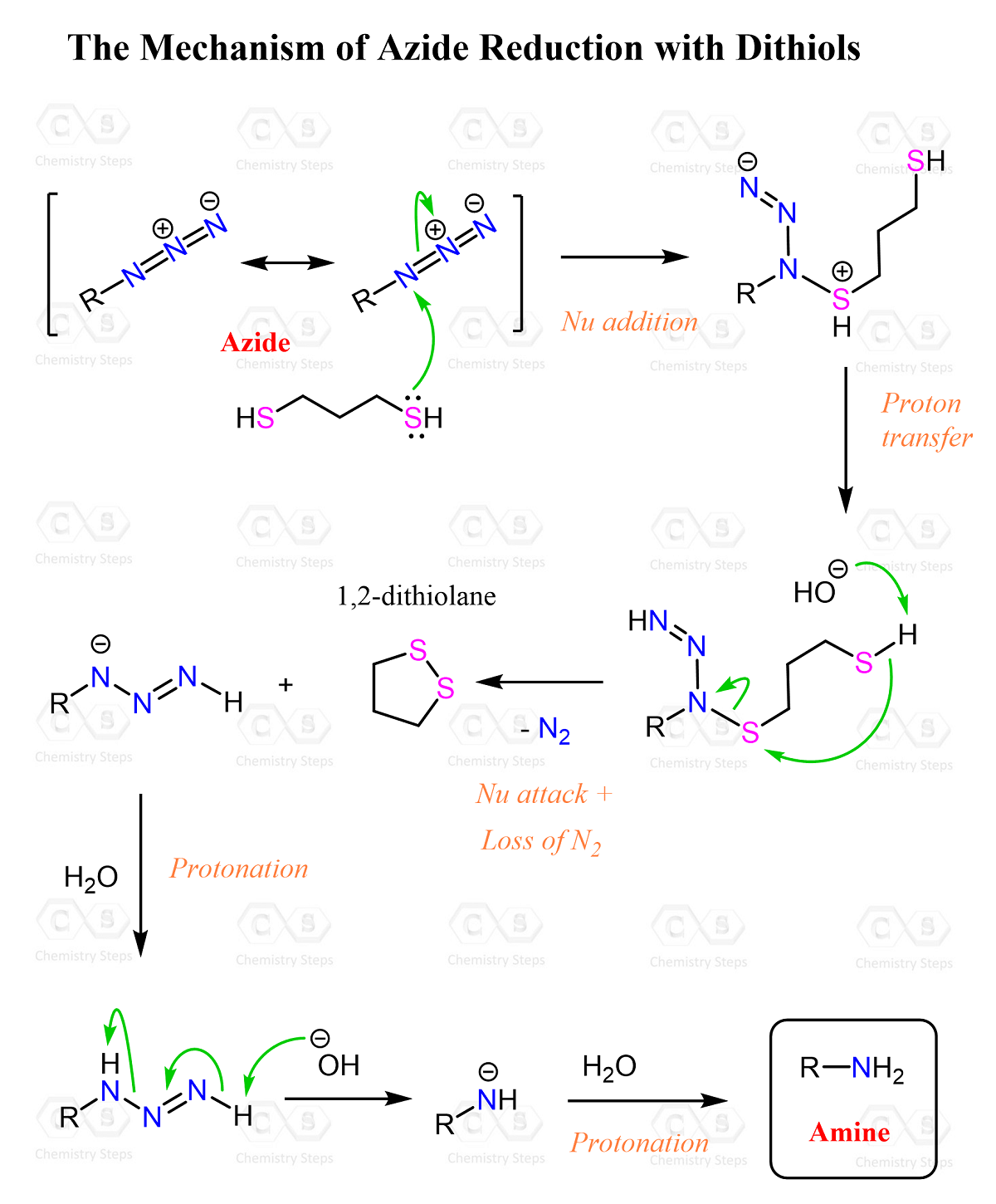
A mechanism is also proposed for the sulfur attack on the internal nitrogen atom of the azide:
Overall, the reduction of azides results in a primary amine, and these reactions are just one of the ways of preparing amines.
You can find more about different ways of preparing amines in this dedicated post.
References
-
Cartwright, I. L.; Hutchinson, D. W.; Armstrong, V. W. Nucleic Acids Res. 1976, 3, 2331.
- Clayden, J.; Greeves, N.; Warren, S. Organic Chemistry, 2nd ed.; Oxford University Press: Oxford, 2012.
- László Kürti and Barbara Czakó, Strategic Applications of Named Reactions in Organic Synthesis, 2005
Check Also
- Naming Amines: Systematic and Common Nomenclature
- Preparation of Amines
- The Gabriel Synthesis of Primary Amines
- Imines from Aldehydes and Ketones with Primary Amines
- Enamines from Aldehydes and Ketones with Secondary Amines
- The Hofmann Elimination of Amines and Alkyl Fluorides
- The Reaction of Amines with Nitrous Acid
- Reactions of Amines Practice Problems
- The Cope Elimination
- Basicity of Amines
- Boc Protecting Group for Amines