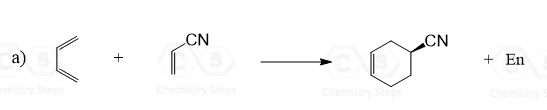
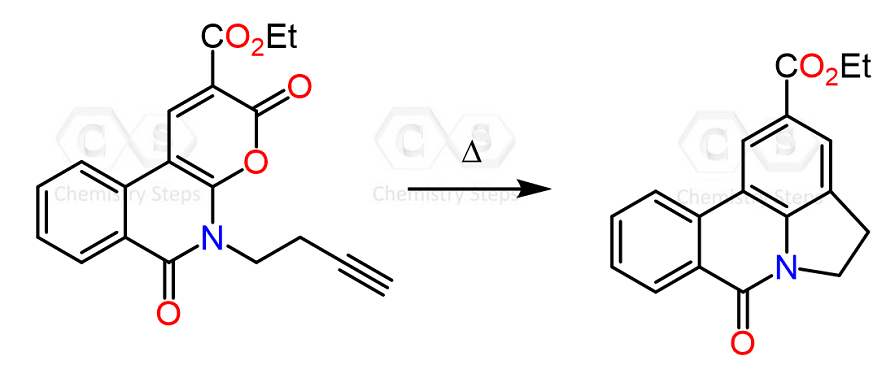
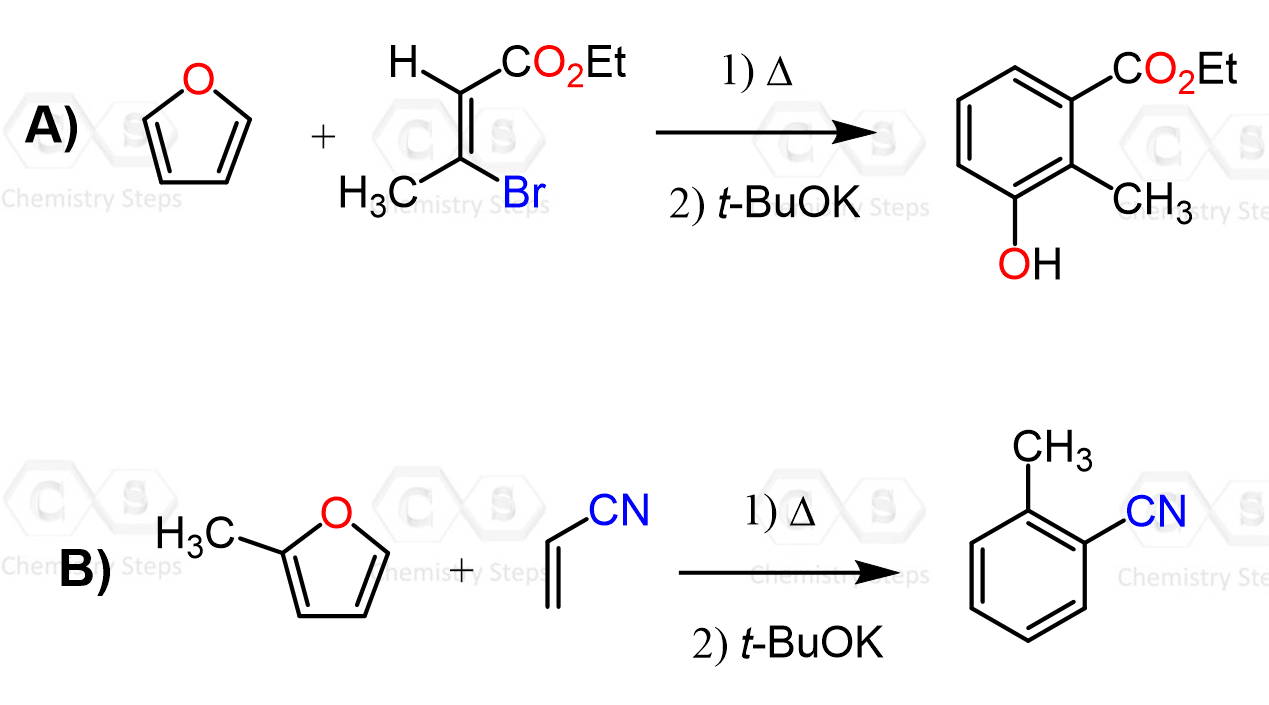
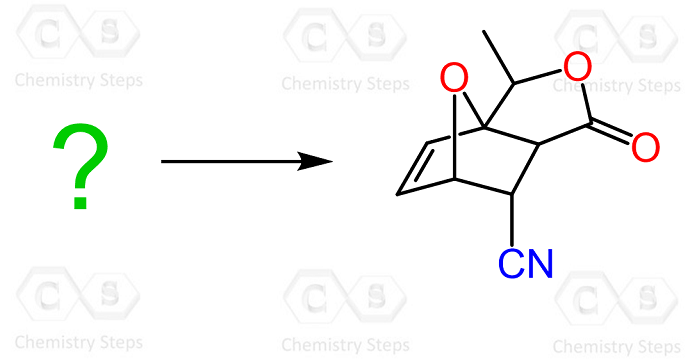
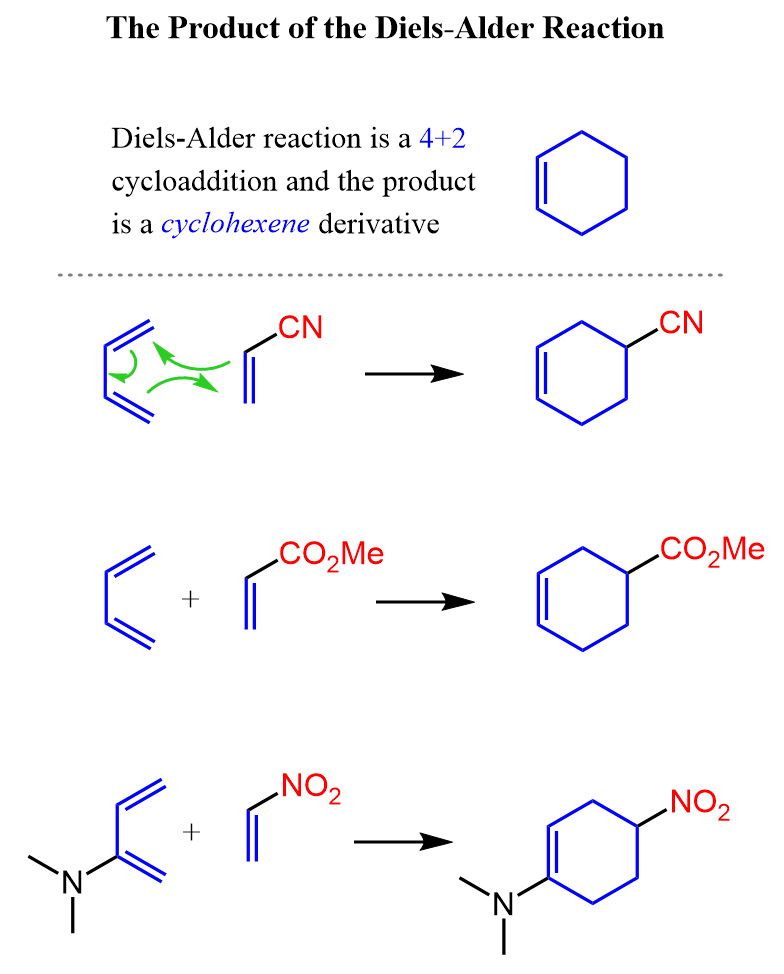
We have seen that the product of the Diels-Alder reaction is most often a cyclohexene derivative. The ring is formed by the newly formed sigma bonds between the diene and the dienophile, which means 4 conjugated atoms combine with 2 conjugated atoms. More accurately, it is combining a system with 4 conjugated atoms with a system of 2 conjugated atoms, because it is an addition of 4 and 2 atoms, but at the end of the day, it is the entire molecules that combine.
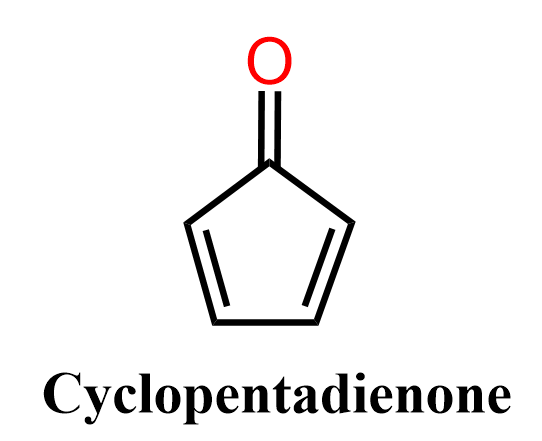
Now, if the diene itself is cyclic, the product of the reaction is a bicyclic compound. We can think about it this way: the Diels-Alder reaction is a cycloaddition reaction, so when there is no ring in the starting materials, one ring is formed. If one of the starting materials is already cyclic, then two rings are present in the product:
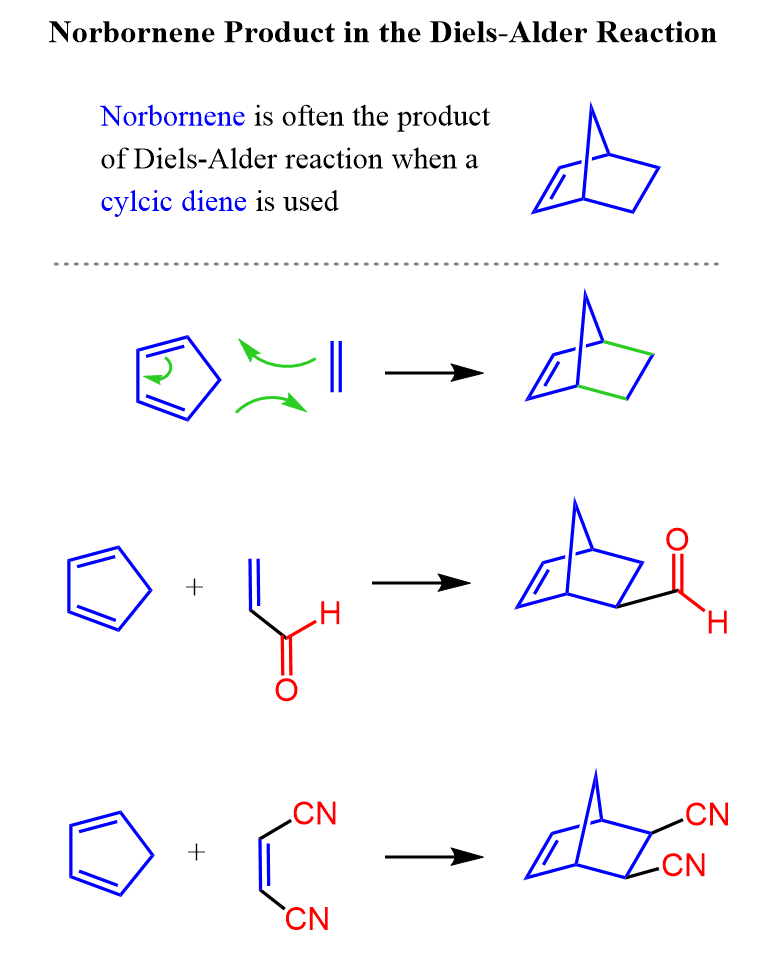
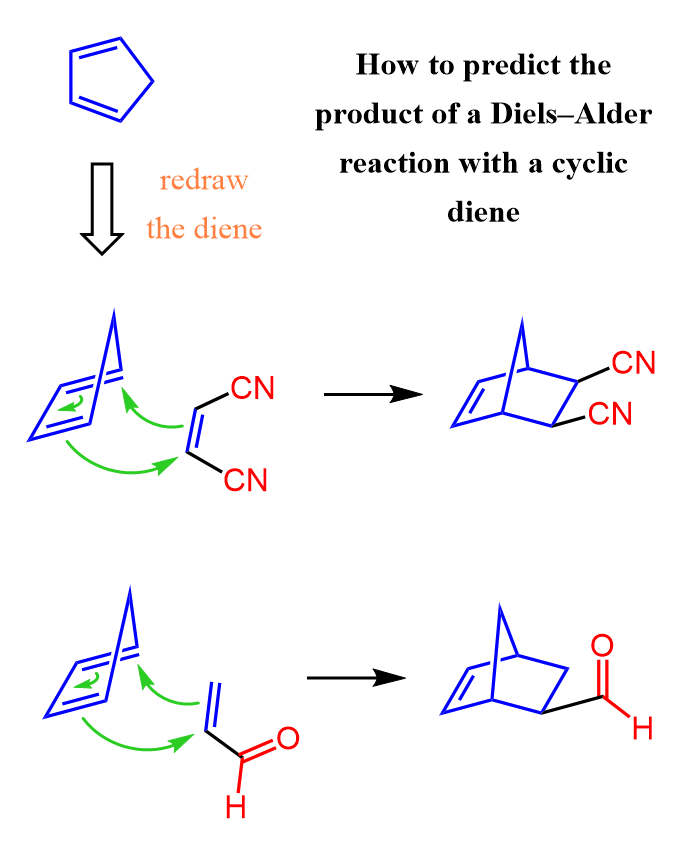
Although we all know that this is not the correct geometry for sp²-hybridized carbons, to make the process easier to visualize, we can draw the atom connecting the two diene carbons above the plane and then follow the electron flow of the Diels-Alder mechanism:
The Endo and Exo Products in the Diels-Alder Reaction of Cyclic Dienes
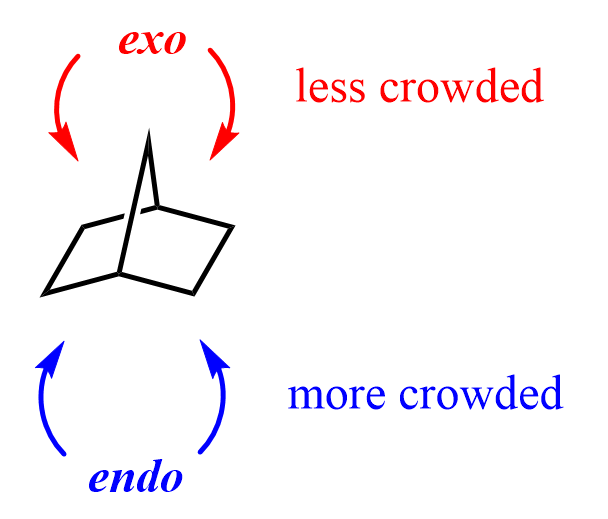
As we have just seen, the most common bicyclic framework formed in reactions of cyclic dienes is Norbornene, also known as norbornylene or norcamphene. It has two distinct faces: the exo face and the endo face. As drawn, the exo face is the top face, while the endo face is the bottom face.
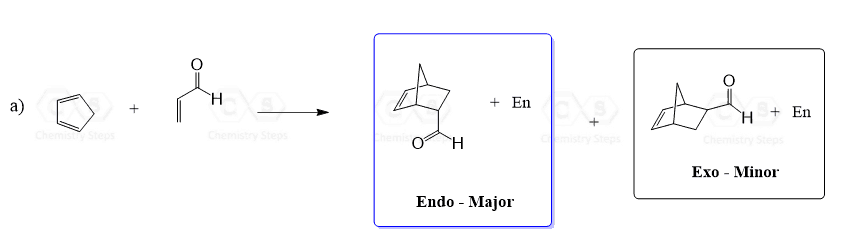
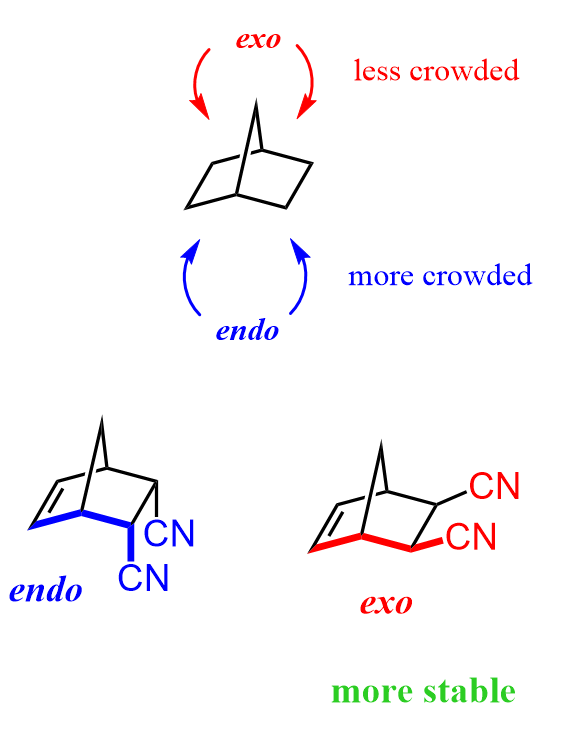
Therefore, the product of the cyclopentadiene Diels-Alder reaction can be either an endo or an exo orientation of the substituent on the diene:

Notice that in the exo product, the groups are pointing out of the cyclic system – exiting the ring.
Now, how do we know if the product of the Diels-Alder reaction is endo or exo?
The exo face is sterically less hindered, and therefore the exo product is generally the more stable isomer. Once again, in the exo product, the substituents are oriented away from the bridge of the bicyclic system, minimizing steric interactions with the atoms that form the bridge.
The endo face, on the other hand, is more crowded because of the two bridge carbons located beneath it. As a result, substituents on the endo face experience greater steric repulsion, making the endo product less stable than the corresponding exo product.
However, in most textbooks, the endo is considered the default major product and hence the Endo Rule. The reason for this is that it forms much faster because it is formed when the electron-withdrawing groups of the dienophile are pointing towards the π electrons of the diene.
This decreases the energy of the transition state due to favorable secondary orbital interactions between the π orbitals of the diene and the π* orbitals of the electron-withdrawing groups on the dienophile.

Cis and Trans Dienophiles in Diels-Alder Reaction
Depending on the configuration of the dienophile, cis or trans product is obtained in the reaction of cyclic dienes. More specifically, a trans dienophile forms a trans product, and a cis dienophile forms a cis product.
In the following examples, the symmetric cis dienophile forms a pair of cis exo and cis endo products, whereas the trans dienophile forms a pair of enantiomers in which the ester groups remain trans in both the exo and endo products.
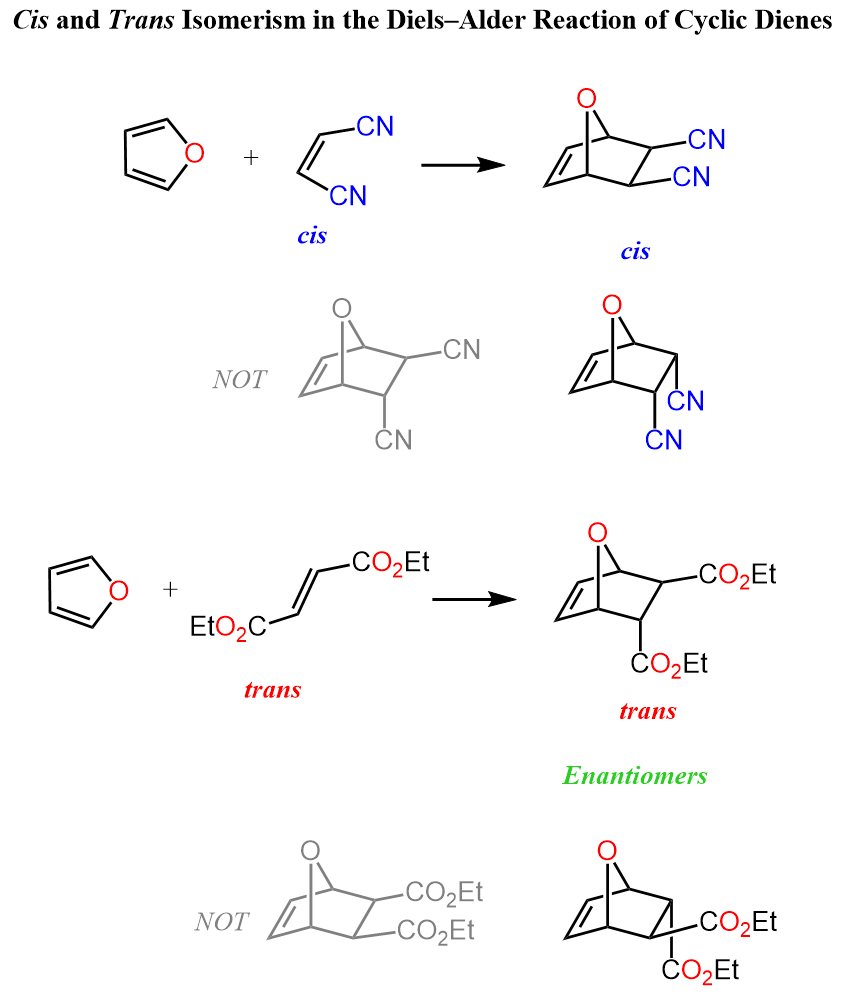
Notice that the product of the cis dienophile is a meso compound; however, when a trans dienophile is used, the symmetry is broken, and a pair of enantiomers is formed.
The Eno-Exo products and their relationship are covered in more detail in the corresponding article here, so feel free to check that out as well.
The Diels-Alder Reaction of Cyclic Dienophiles
One of the most common such examples is the reaction of Maleic anhydride and its derivatives, which can react with cyclic and acyclic dienes. The product of such reactions is also cis because the dienophile is locked in cis geometry:
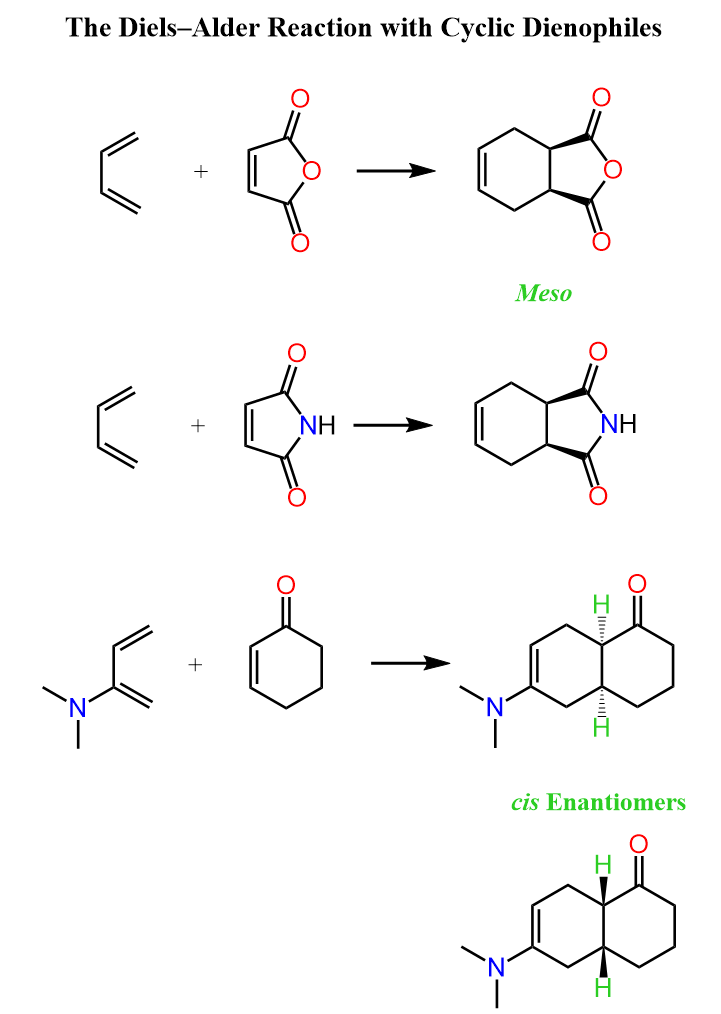
In summary, the Diels-Alder reaction of cyclic dienes gives bicyclic products because the two new σ bonds introduce a new ring in the product. When a cyclic diene like cyclopentadiene is used, the product is a bicyclic system such as norbornene.
The geometry of the starting materials controls the stereochemistry of the product, so the reaction is stereospecific. The dienophile keeps its original configuration, meaning cis dienophiles give cis products and trans dienophiles give trans relationship in the final structure.
Two approaches are possible in the reaction: endo and exo. The exo product is generally less crowded and more stable because substituents are directed away from the bridge. The endo product is often formed faster due to favorable secondary orbital interactions. On the tests, endo is most often considered the major product.
Depending on the dienophile used, the product can be a meso compound (cis case) or a pair of enantiomers (trans case).