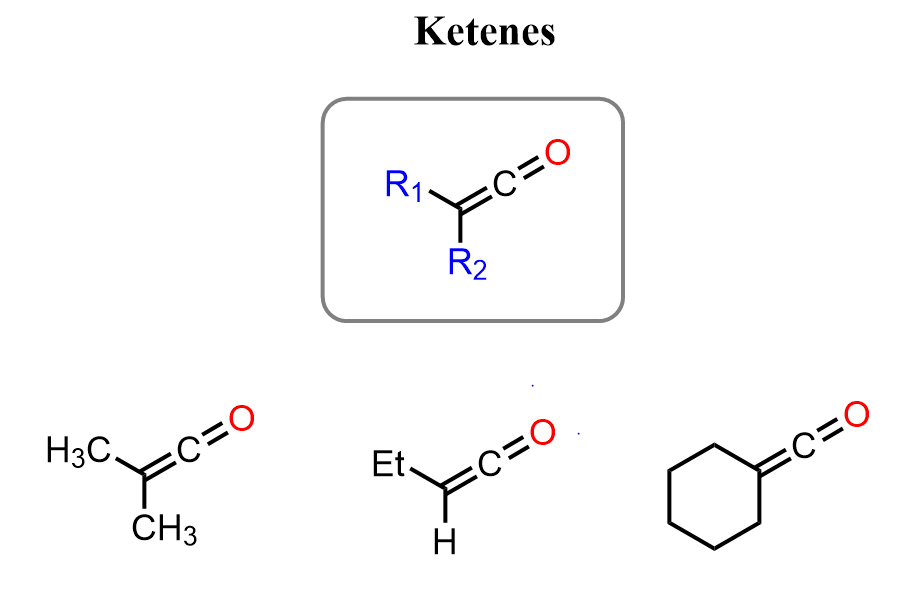
The Structure of Ketenes
Ketenes are compounds containing a C=C=O functional group:
The structure and geometry of ketenes are similar to those of allenes, where three carbon atoms are connected via double bonds. As much as the central carbon may look to be sp² hybridized because of the double bonds, it is actually sp-hybridized. Consider this representation of the orbitals in allenes for the analogy:
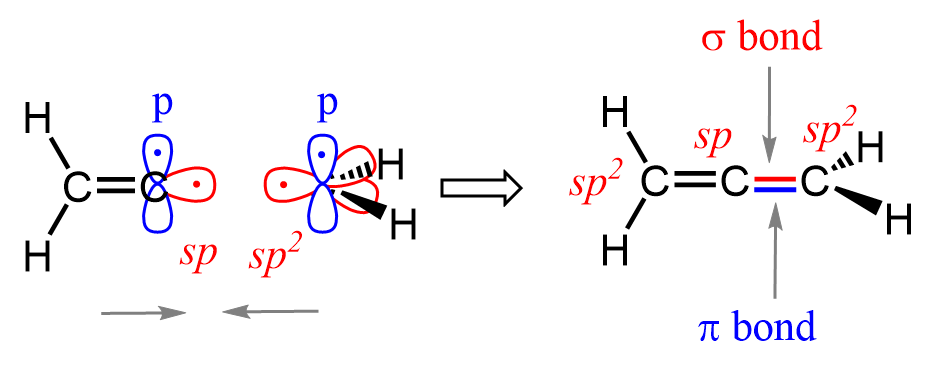
The central carbon forms two σ bonds using its two sp hybrid orbitals, while the two remaining unhybridized p orbitals are used to form the two π bonds with the adjacent atoms. Since these p orbitals are perpendicular to each other, the two π bonds are also perpendicular, giving the ketene its characteristic linear geometry around the central carbon.
Preparation of Ketenes
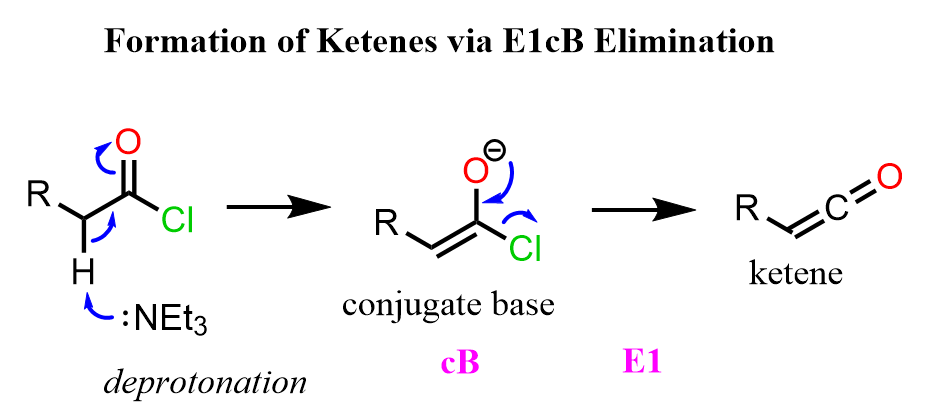
Ketenes are typically prepared by the elimination reactions of acid chlorides containing an α-hydrogen using Zn or a bulky base:
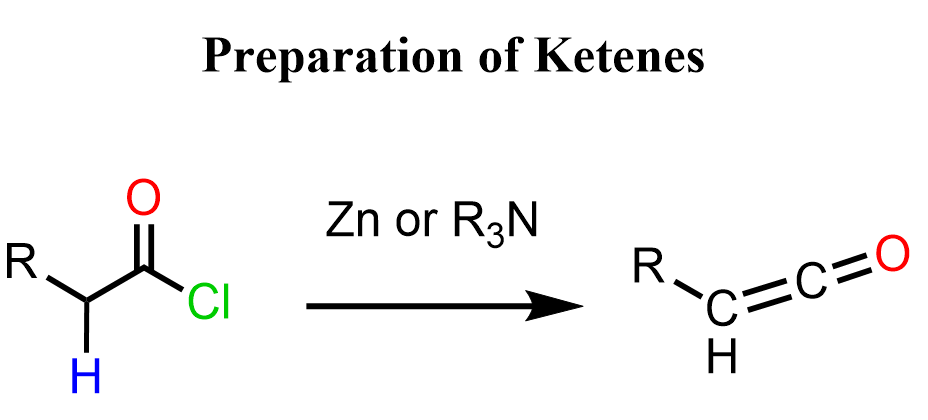
The reaction with base follows an E1cB elimination, which involves the deprotonation of the α-hydrogen to form a conjugate base, followed by the elimination of chloride ion to form the ketene:
The Reactions of Ketenes
Ketenes are very reactive due to the presence of the C=C=O functional group, which contains two cumulated double bonds and makes the carbonyl carbon highly electrophilic. They are generally not stable enough to be stored and react with a variety of nucleophiles such as water, alcohols, thiols, and amines:
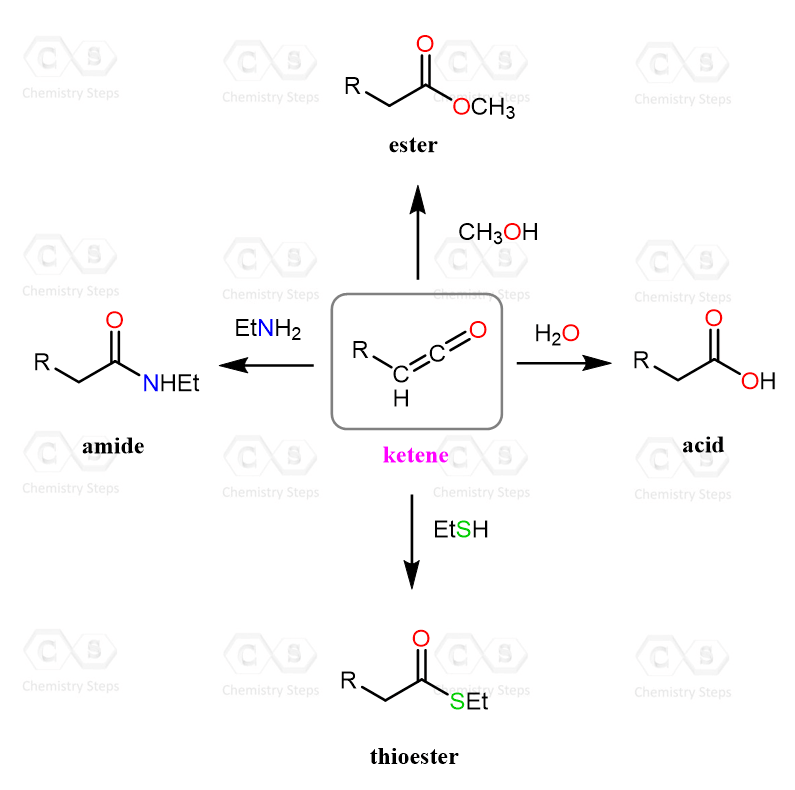
As we have seen in the preparation of ketenes, the reaction of α-hydrogen-containing acid chlorides with nucleophiles can proceed via an E1cB elimination followed by nucleophilic addition to the ketene.
Let’s consider the mechanism of the nucleophilic addition to ketenes with the example of converting an acid chloride to its isopropyl ester:
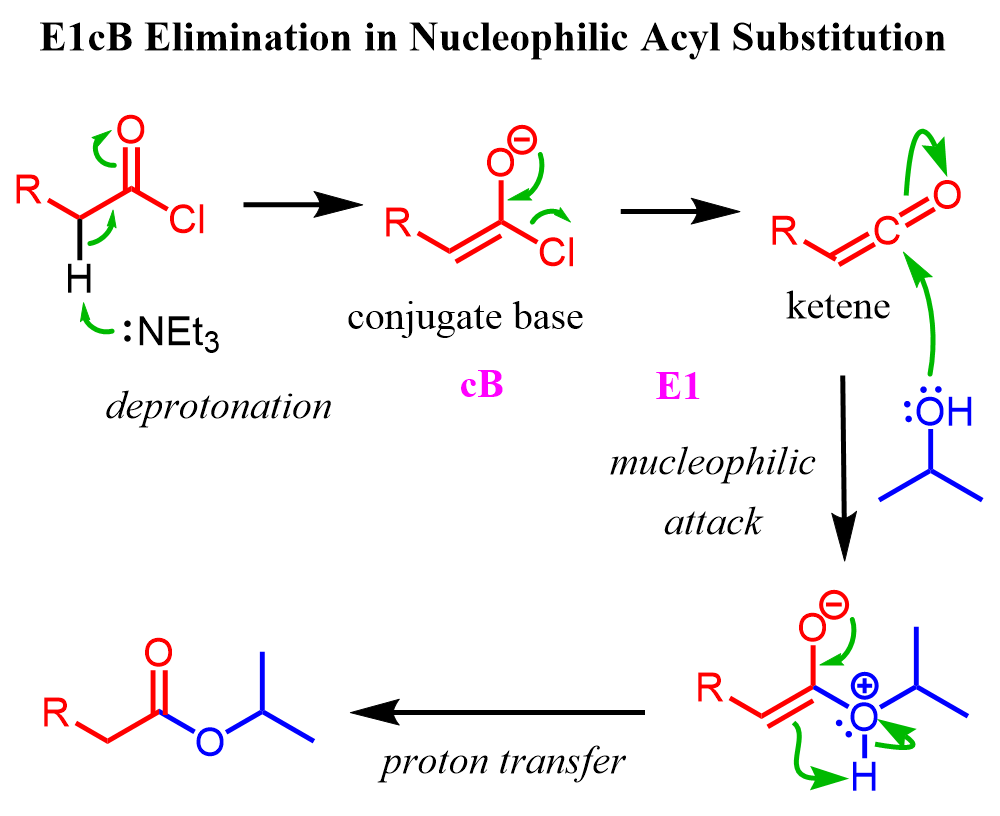
Notice that this is different from the conventional addition-elimination mechanism, where the nucleophile attacks the carbonyl carbon of the acid chloride, forming a tetrahedral intermediate that subsequently expels Cl⁻.
Now, to avoid confusion, the addition-elimination mechanism is perfectly acceptable for many instructors. Therefore, be sure to check with your instructor about how they expect you to show the nucleophilic acyl substitution of acid chlorides containing an α-hydrogen.
Ketenes as Intermediates in Organic Synthesis
Ketenes are also intermediates in some important reactions such as the Arndt-Eistert reaction, which is used for extending the carbon chain of carboxylic acids by one carbon atom:
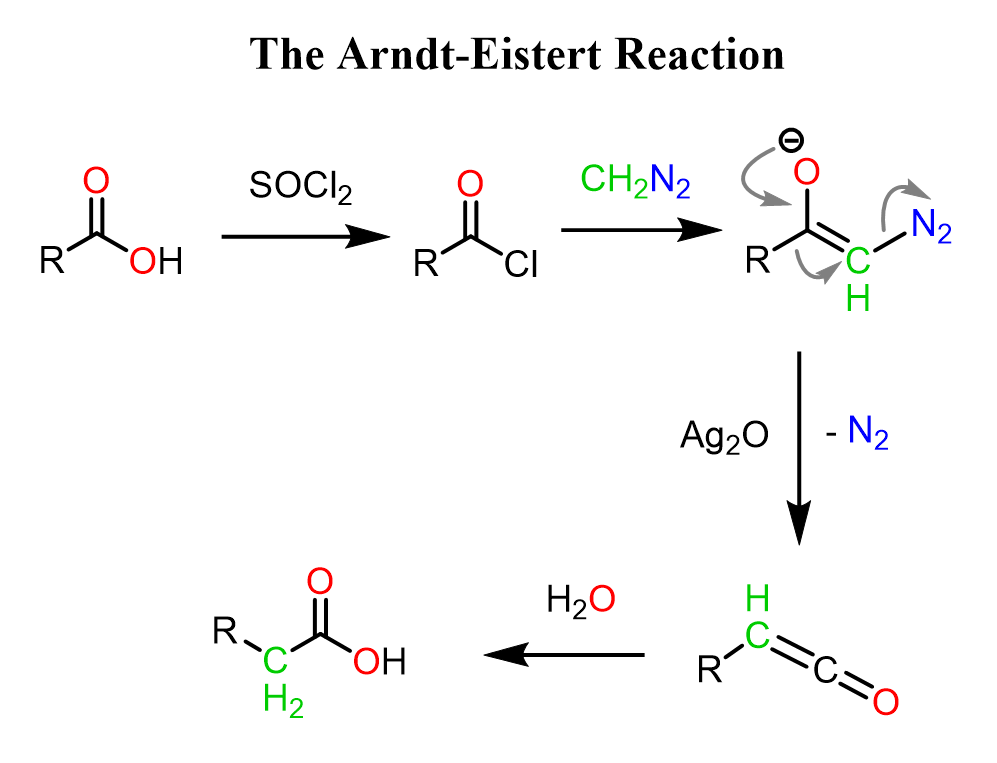
You can find more details about the mechanism of the Arndt-Eistert reaction here.
References
- Tidwell, T. T. Ketene Chemistry after 100 Years: Ready for a New Century. Eur. J. Org. Chem. 2006, 2006, 563–576
- Clayden, J.; Greeves, N.; Warren, S. Organic Chemistry, 2nd ed.; Oxford University Press: Oxford, 2012.
- László Kürti and Barbara Czakó, Strategic Applications of Named Reactions in Organic Synthesis, 2005