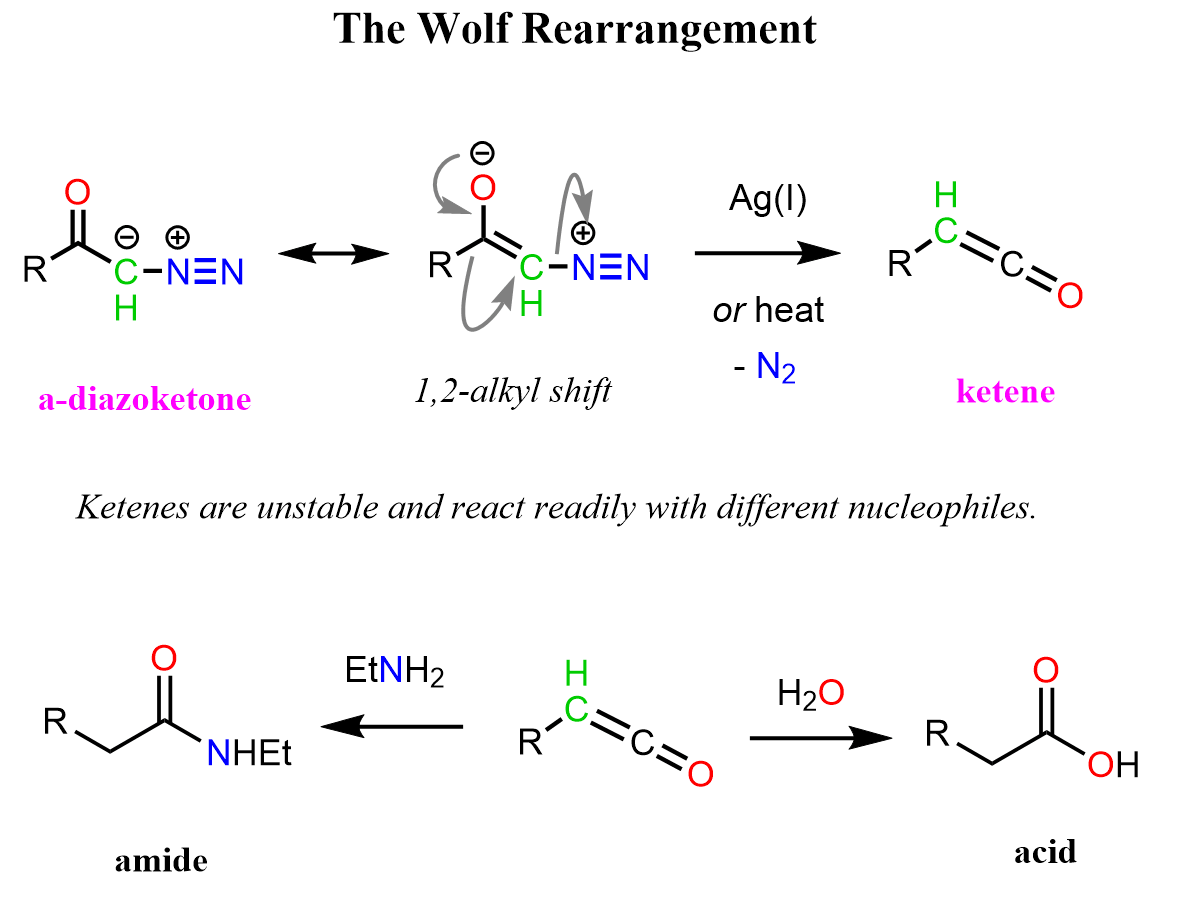
In the Wolff rearrangement, an α-diazocarbonyl compound is converted into a ketene by the loss of nitrogen, which is facilitated by a 1,2-shift (1,2-rearrangement):
As a reminder, ketenes are highly reactive species that contain a C=C=O functional group:
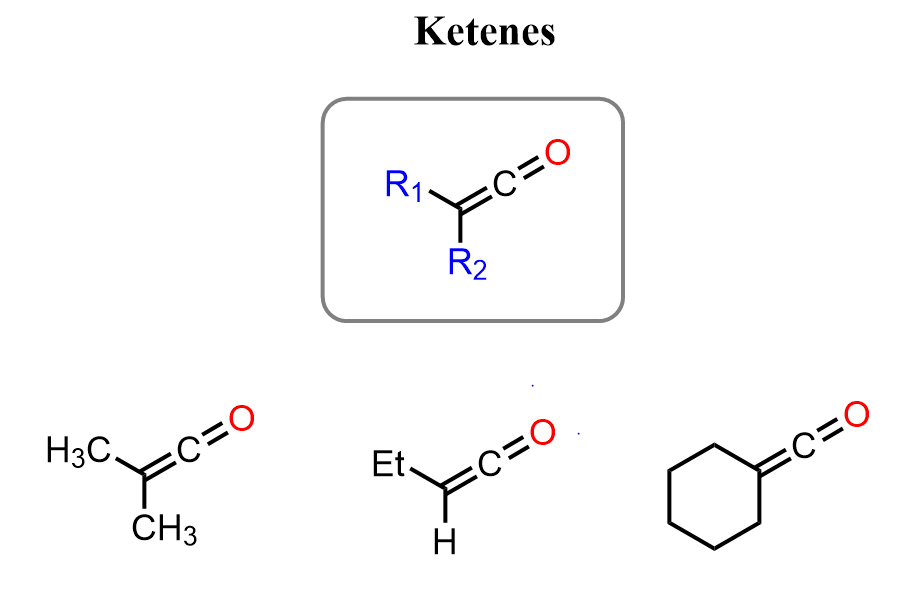
They are not stable enough to be isolated in most cases and are mostly formed as intermediates in a variety of synthetic transformations.
Check this article, dedicated to the structure, preparation, and reactions of ketenes, for more details.
The Mechanism of Wolff rearrangement
So, let’s go a step backward and see how the α-diazocarbonyl compounds are formed in the first place before undergoing the Wolff rearrangement to form ketenes.
α-Diazocarbonyl compounds are generally formed by reacting acid chlorides with diazomethane. There are several resonance structures we can use to represent the structure of an α-diazocarbonyl compound, and one of them, which is in an enolate form, is particularly useful for representing the 1,2-alkyl shift in the Wolff rearrangement:
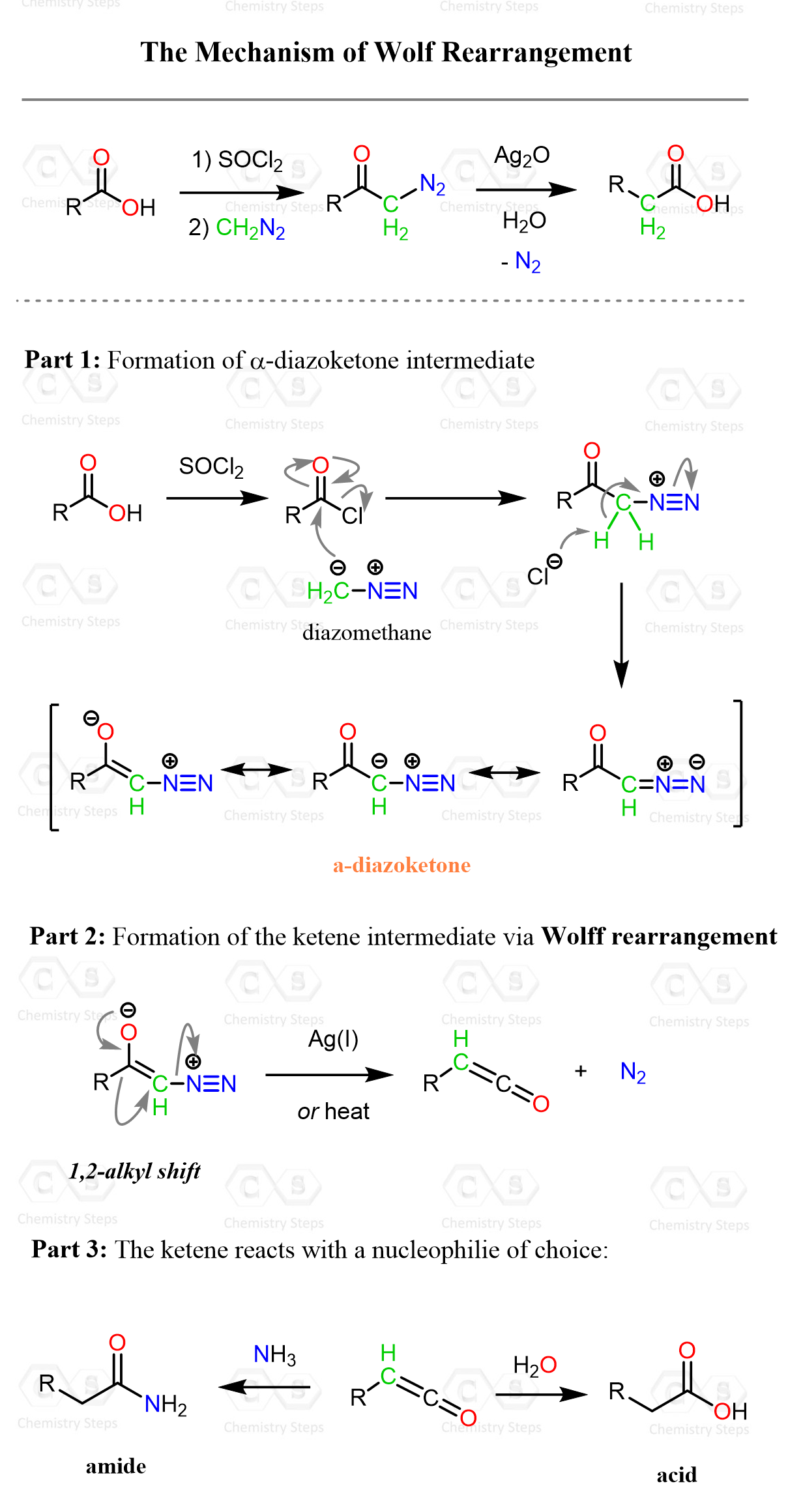
So, what happens in the last step is the restoration of the carbonyl double bond, which expels the R group with the bonding electron pair to form a new C–C bond. Once again, the loss of nitrogen plays a pivotal role here, as it is an extremely good leaving group and an important entropy contributor.
The Applications of the Wolff Rearrangement
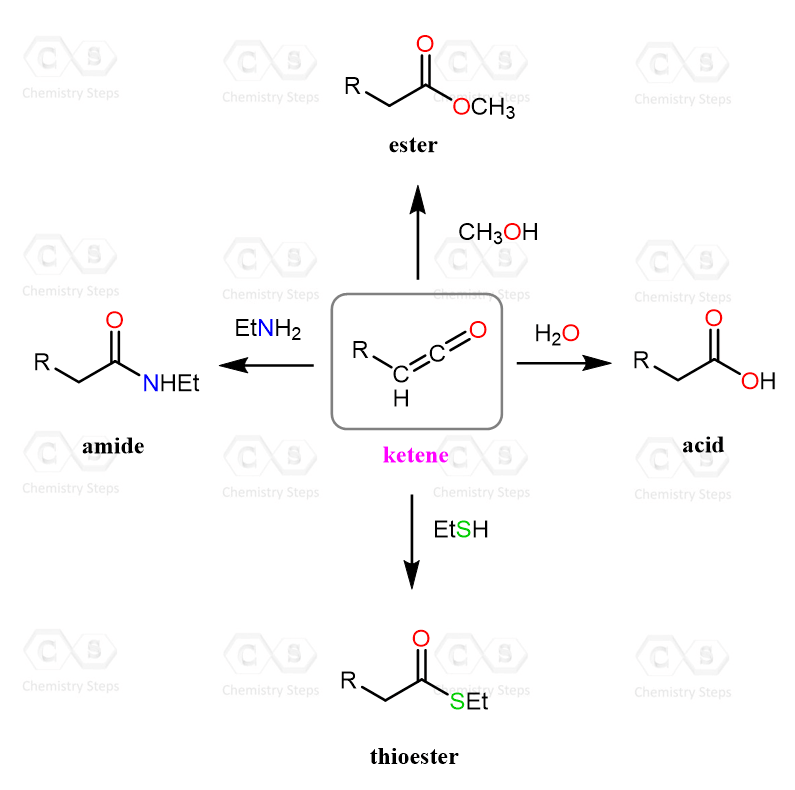
As mentioned earlier, ketenes are highly reactive intermediates which, due to the electrophilicity of the central carbon atom, react with a variety of nucleophiles, such as water, alcohols, amines, thiols, and acid derivatives such as acetate ions:
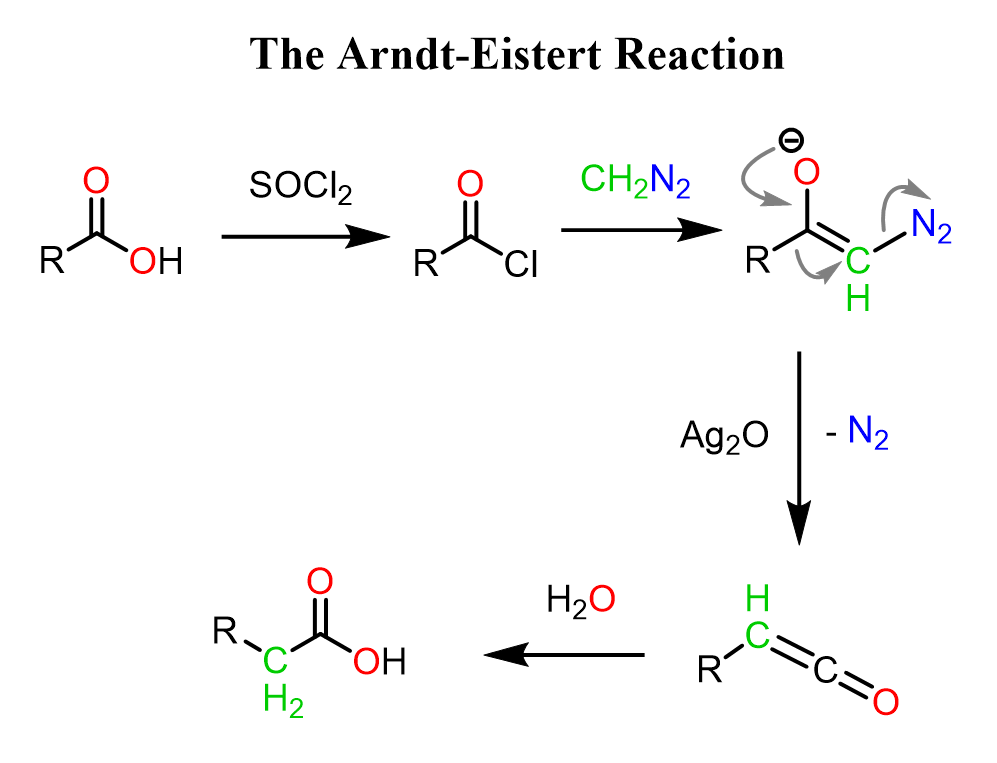
You can find more details about the mechanism of the Arndt-Eistert reaction here and, in general, about ketenes in this article.
Check Also
- Curtius Rearrangement
- Preparation of Carboxylic Acids
- Naming Carboxylic Acids
- Naming Nitriles
- Naming Esters
- Naming Carboxylic Acid Derivatives – Practice Problems
- The Addition-Elimination Mechanism
- Fischer Esterification
- Ester Hydrolysis by Acid and Base-Catalyzed Hydrolysis
- What is Transesterification?
- Esters’ Reaction with Amines – The Aminolysis Mechanism
- Ester Reactions Summary and Practice Problems
- Preparation of Acyl (Acid) Chlorides (ROCl)
- Reactions of Acid Chlorides (ROCl) with Nucleophiles
- R2CuLi Organocuprates – Gilman Reagent
- Reaction of Acyl Chlorides with Grignard and Gilman (Organocuprate) Reagents
- Reduction of Acyl Chlorides by LiAlH4, NaBH4, and LiAl(OtBu)3H
- Reduction of Carboxylic Acids and Their Derivatives
- Preparation and Reaction Mechanism of Carboxylic Anhydrides
- Amides – Structure and Reactivity
- Naming Amides
- Amide Hydrolysis: Acid- and Base-Catalyzed Mechanism
- Amide Dehydration Mechanism by SOCl2, POCl3, and P2O5
- Amide Reduction Mechanism by LiAlH4
- Reduction of Amides to Amines and Aldehydes
- Amides Preparation and Reactions Summary
- Amides from Carboxylic Acids-DCC and EDC Coupling
- The Mechanism of Nitrile Hydrolysis To Carboxylic Acid
- Nitrile Reduction Mechanism with LiAlH4 and DIBAL to Amine or Aldehyde
- The Mechanism of Grignard and Organolithium Reactions with Nitriles
- The Reactions of Nitriles
- Converting Nitriles to Amides
- Carboxylic Acids to Ketones
- Esters to Ketones
- Synthesis and Reactions of Lactones and Lactams
- Carboxylic Acids and Their Derivatives Practice Problems
- Carboxylic Acids and Their Derivatives Quiz
- Reactions Map of Carboxylic Acid Derivatives
References
- Tidwell, T. T. Ketene Chemistry after 100 Years: Ready for a New Century. Eur. J. Org. Chem. 2006, 2006, 563–576
- Clayden, J.; Greeves, N.; Warren, S. Organic Chemistry, 2nd ed.; Oxford University Press: Oxford, 2012.
- László Kürti and Barbara Czakó, Strategic Applications of Named Reactions in Organic Synthesis, 2005