
We have seen earlier that the length of carbohydrates can be enlarged by using the Kiliani-Fischer synthesis, where an aldose is converted into the next higher aldose by adding one carbon to the chain:

The reverse, that is, shortening the carbon chain of the carbohydrate, is also possible, and there are two main reactions you may need to know. Without any preference, the first one is the Wohl degradation, where the aldehyde group of an aldose is first reacted with NH2OH to form the corresponding oxime. The oxime is then treated with Ac2O, which converts it into a nitrile. Finally, the nitrile group is removed as HCN, resulting in an aldose with one fewer carbon atom:

The second approach is the use of oxidation followed by decarboxylation, which is known as the Ruff degradation. In the first step, the aldose is oxidized with Br2/H2O to form the corresponding aldonic acid. This is then treated with H2O2 and Fe³⁺, which causes oxidative decarboxylation, removing the carboxyl group as CO2 and giving an aldose with one fewer carbon atom:
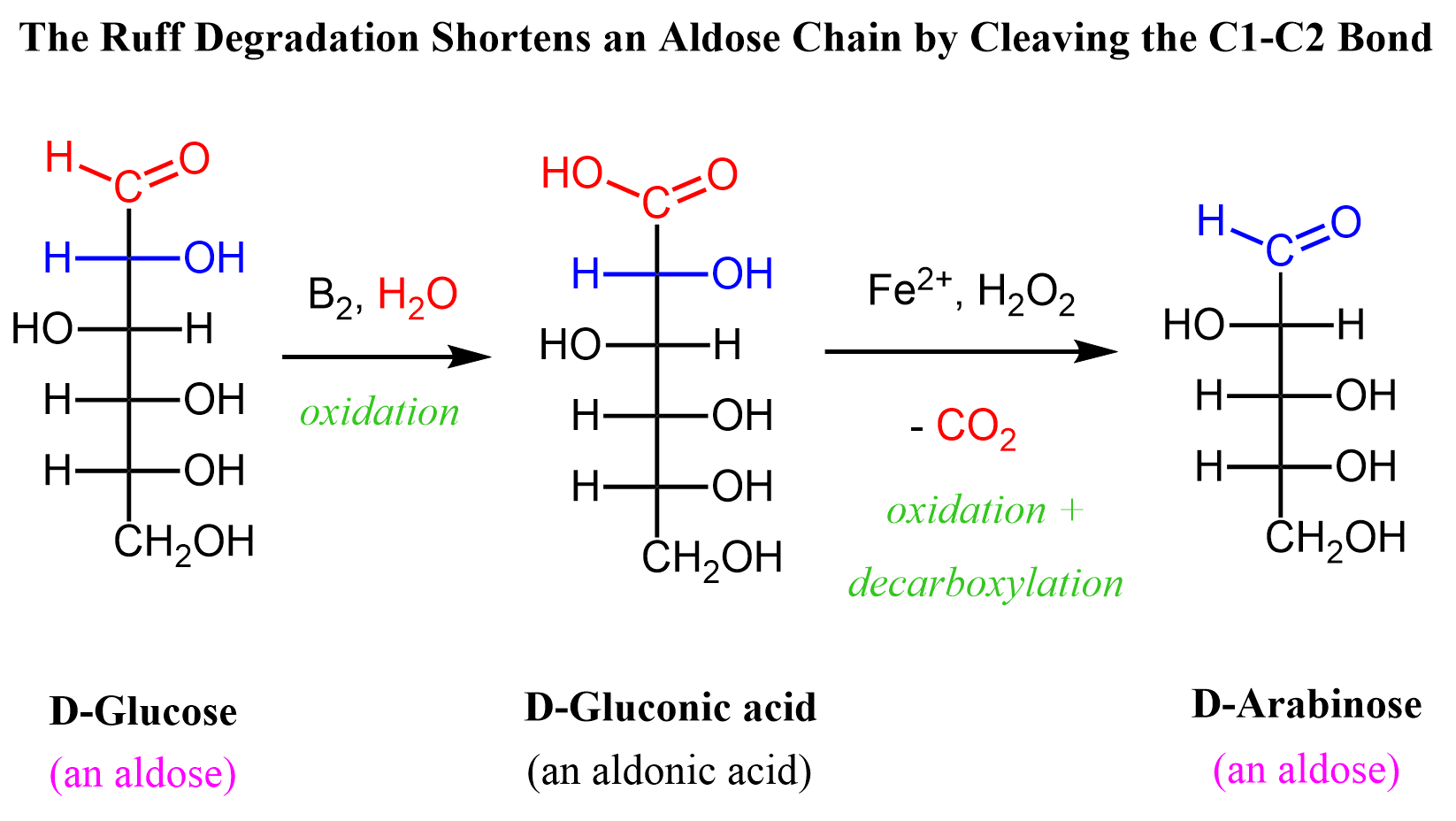
The Mechanism of Ruff Degradation
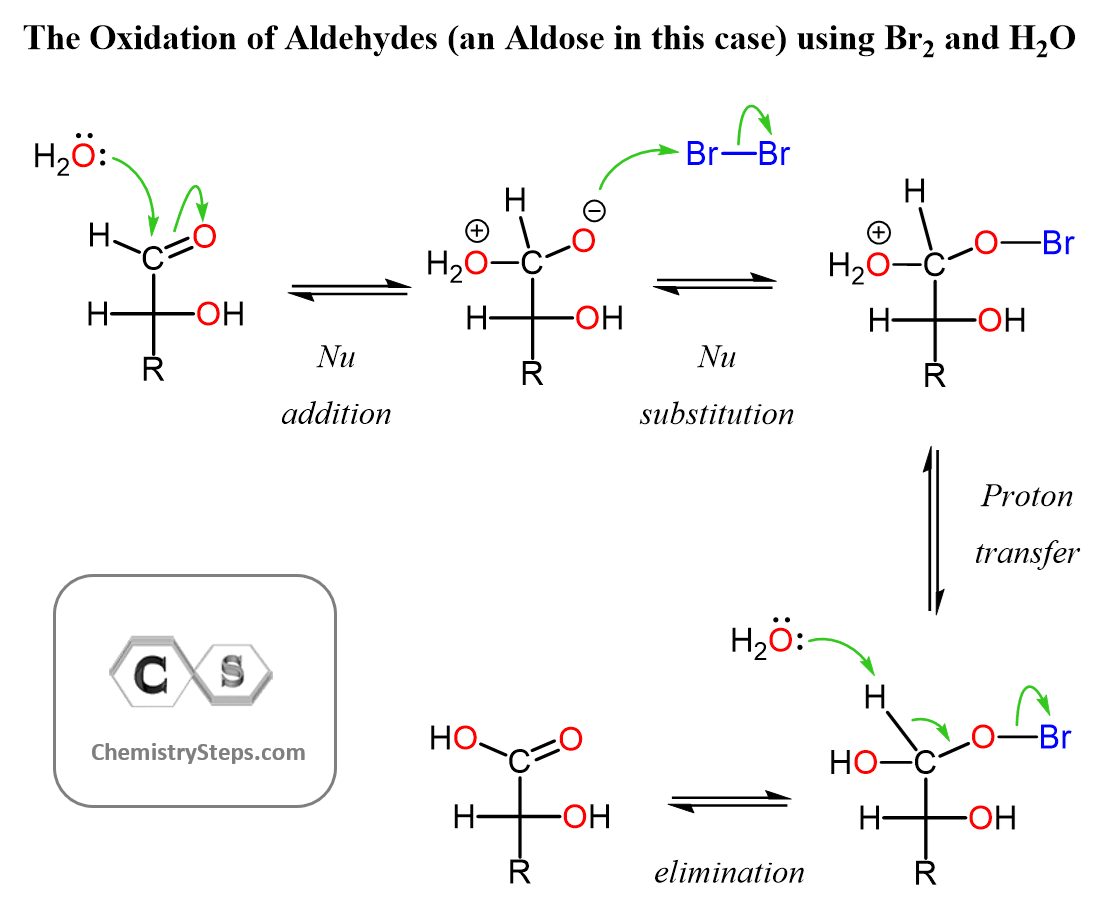
The first part of the Ruff degradation is the oxidation of the aldehyde to the corresponding carboxylic acid group. The reaction starts with a nucleophilic addition of water to the carbonyl group, forming a hydrate. It is actually the conjugate base of the hydrate that attacks the bromine in the next step to form an O-Br bond, which is ultimately cleaved via an E2 elimination facilitated by water:
The second part of the Ruff degradation is the shortening of the carbon chain, which is achieved by loss of CO2 – decarboxylation.
Now, there have been and are debates regarding the mechanism of this step, and I will show a couple of them so we have a general idea of what is happening.
One of the proposed mechanisms starts with an abstraction of hydrogen from the neighboring OH group by the ·OH radical, which is formed when the hydrogen peroxide reacts with Fe2+ ions (Fenton’s reagent).
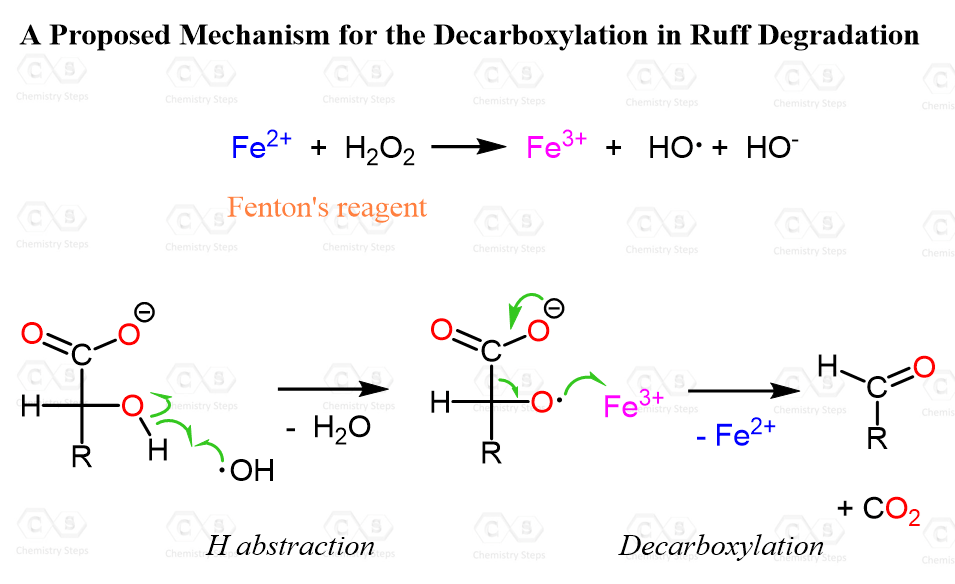
In the next step, decarboxylation occurs when the carboxylate ion regenerates the C=O bond, cleaving the C-C sigma bond. This is facilitated by the abstraction of a single electron from the radical R-O· group, which forms the aldehyde group by reducing the Fe3+ to Fe2+ ion.
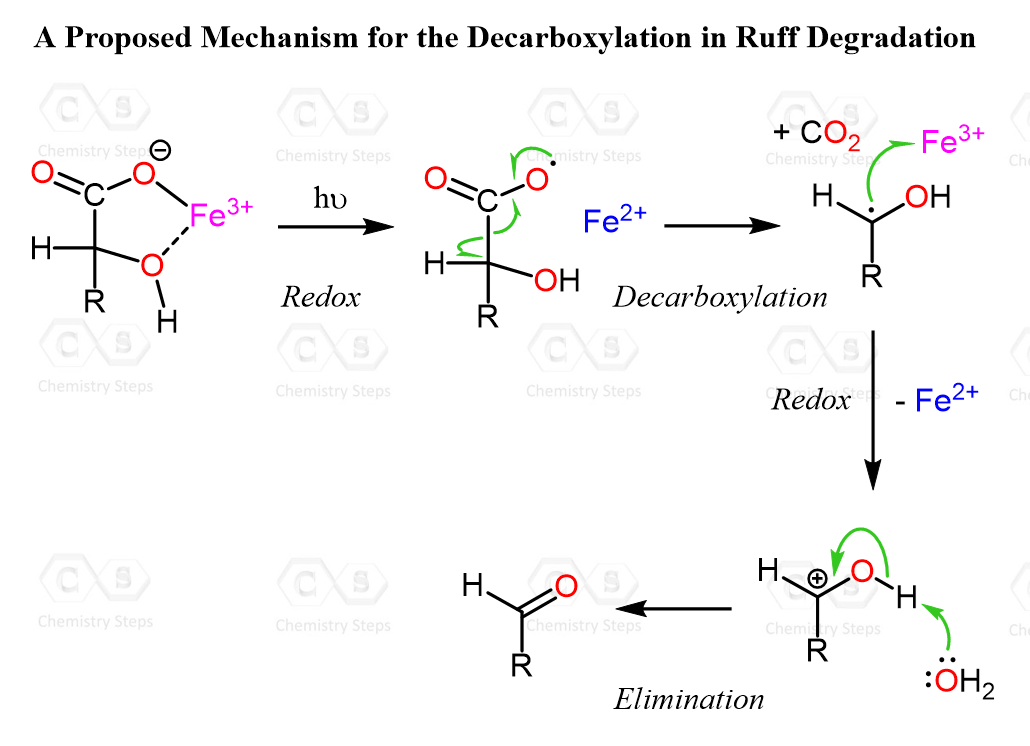
Another possibility is the decarboxylation of a radical carboxylate ion, which is formed by abstraction of an electron by Fe3+ from the carboxylate ion. The resulting radical is then oxidized to the corresponding carbocation by giving an electron to another Fe3+ ion. In the last step, the alpha carbocation is converted to the carbonyl group (Hofer-Moest-type decarboxylation):
To summarize today’s discussion, remember that the Kiliani-Fischer synthesis is used for extending the length of the carbon chain of carbohydrates, whereas the Wohl and Ruff degradations are the opposite processes, where the carbon chain of a carbohydrate is shortened. In the Wohl degradation, the aldehyde group is converted into a nitrile and ultimately removed as HCN, while the Ruff degradation involves oxidation of the aldehyde to a carboxylic acid followed by decarboxylation, removing one carbon as CO2.
You can read more about the proposed mechanisms of Ruff degradation in the article by
Stapley et al., Carbohydr. Res. 2007, 342 (3–4), 407–418.
Need some practice on carbohydrates?
Check this Multiple-Choice, summary quiz on the structure and reactions of carbohydrates with a 40-minute video solution!

Carbohydrates Practice Problem Quiz
Check also
- Oxidation of Alcohols to Aldehydes, Ketones, and Carboxylic Acids
- Carbohydrates – Structure and Classification
- Erythro and Threo
- D and L Sugars
- Aldoses and Ketoses: Classification and Stereochemistry
- Epimers and Anomers
- Converting Fischer, Haworth, and Chair forms of Carbohydrates
- Mutarotation
- Glycosides
- Isomerization of Carbohydrates
- Ether and Ester Derivatives of Carbohydrates
- Oxidation of Monosaccharides
- Reduction of Monosaccharides
- Kiliani–Fischer Synthesis
- Wohl Degradation