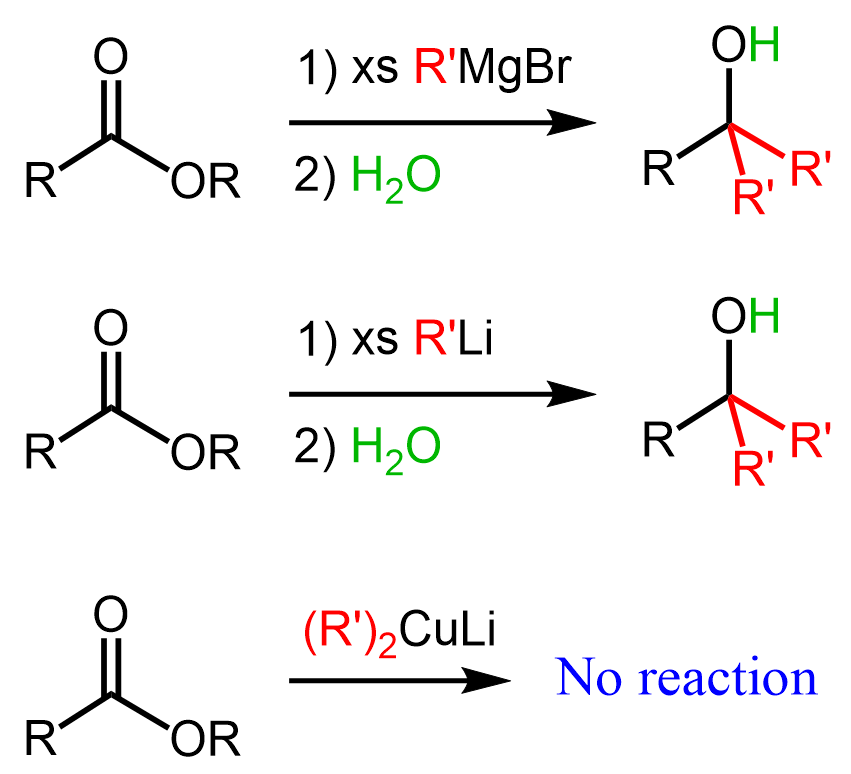
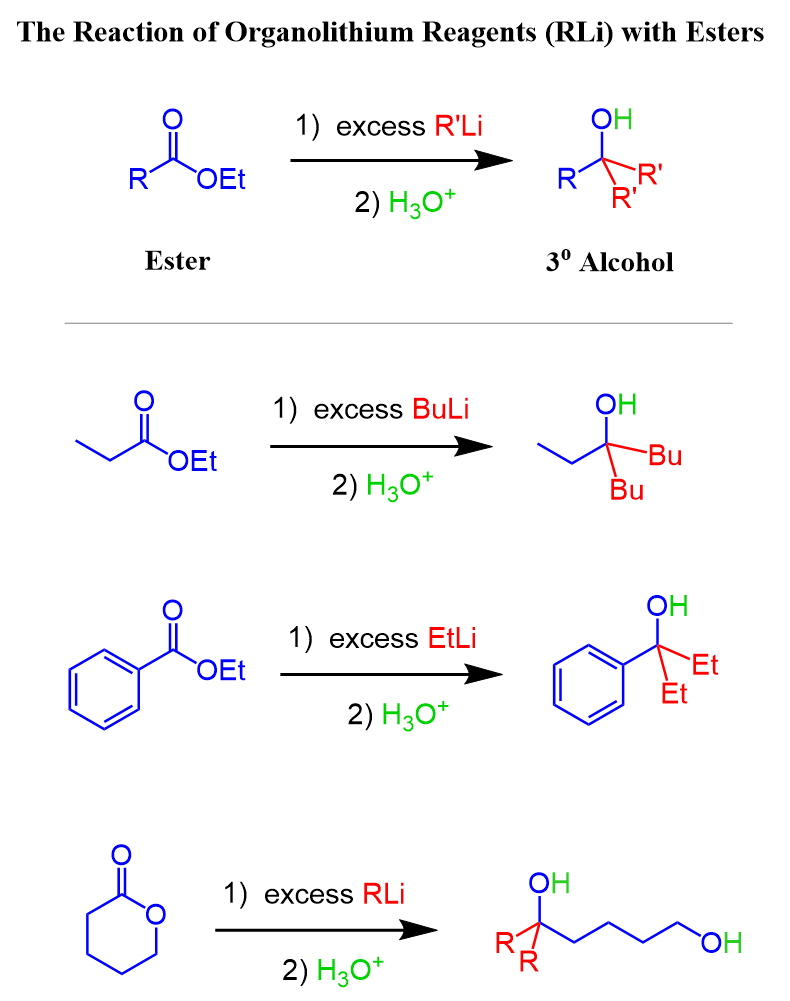
Esters are reacted with an excess of organolithium reagents to obtain tertiary alcohols. As always with any organometallic reagents, such as Grignard (RMgX), organocuprates (R2CuLi), etc., the reaction must be carried out under dry conditions to avoid quenching the reagent:
The Mechanism of the Reaction of Organolithium Reagents (RLi) with Esters
The mechanism of the reaction is a conventional addition-elimination mechanism, where we have the addition of the nucleophile to the carbonyl group, forming a tetrahedral intermediate, which is then either hydrolyzed or continues reacting further, as in the case of esters:
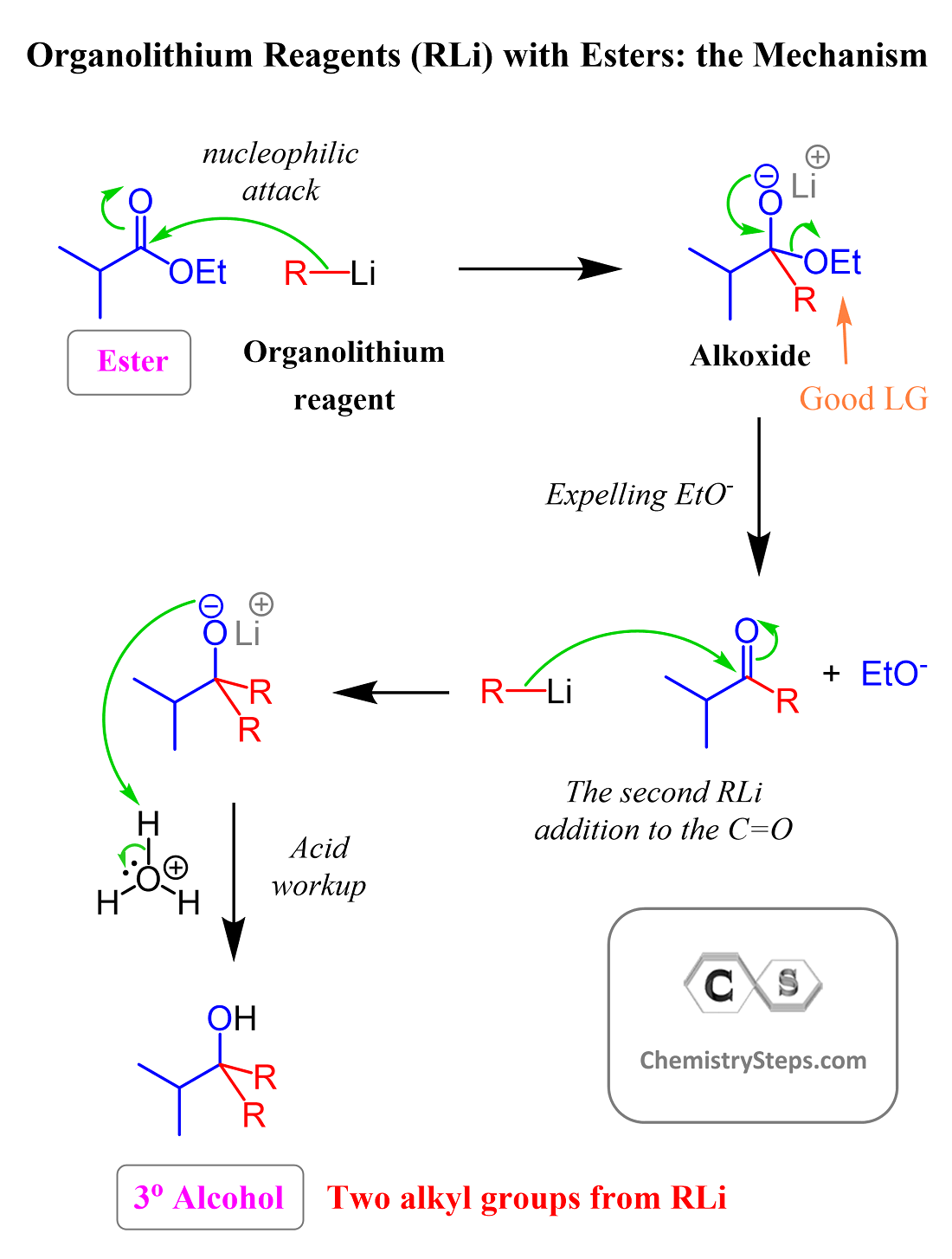
So, unlike aldehydes and ketones, the tetrahedral intermediate formed in the reaction of esters with organolithiums or Grignard reagents restores the carbonyl group by expelling the alkoxide component of the ester. This forms a ketone, which reacts with another equivalent of organolithium, and only after this is the tetrahedral intermediate treated with an aqueous workup to form a tertiary alcohol as the final product.
One question you may be wondering is why we can’t use one equivalent of the organolithium and obtain a ketone instead of the tertiary alcohol.
The problem with this is that ketones are more reactive than esters because their carbonyl group is more electrophilic. This is because of the resonance donation of the alkoxide component of the ester, which reduces the partial positive charge on the C=O carbon compared to the aldehyde or ketone analog:

This effect is more profound in amides, which makes them the least reactive among carboxylic acid derivatives:

The implication of the greater reactivity of the ketone is that it reacts with the organolithium as soon as it forms, or at least before the ester reacts with RLi, and we lose control over obtaining a single major product.
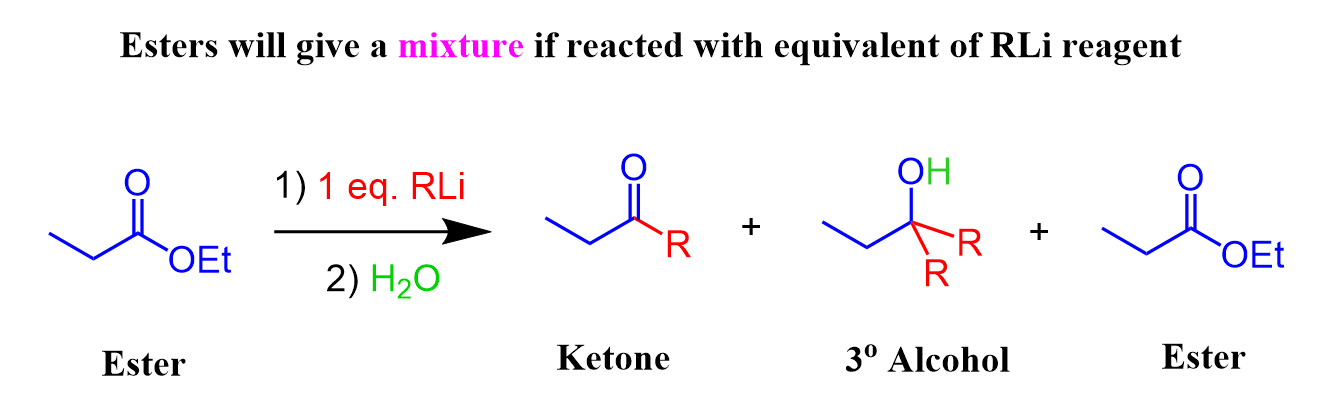
Therefore, if one equivalent were used, a mixture of a tertiary alcohol, ketone, and unreacted ester would be obtained after the acidic work-up:
The Reaction of Organolithiums with Lactones
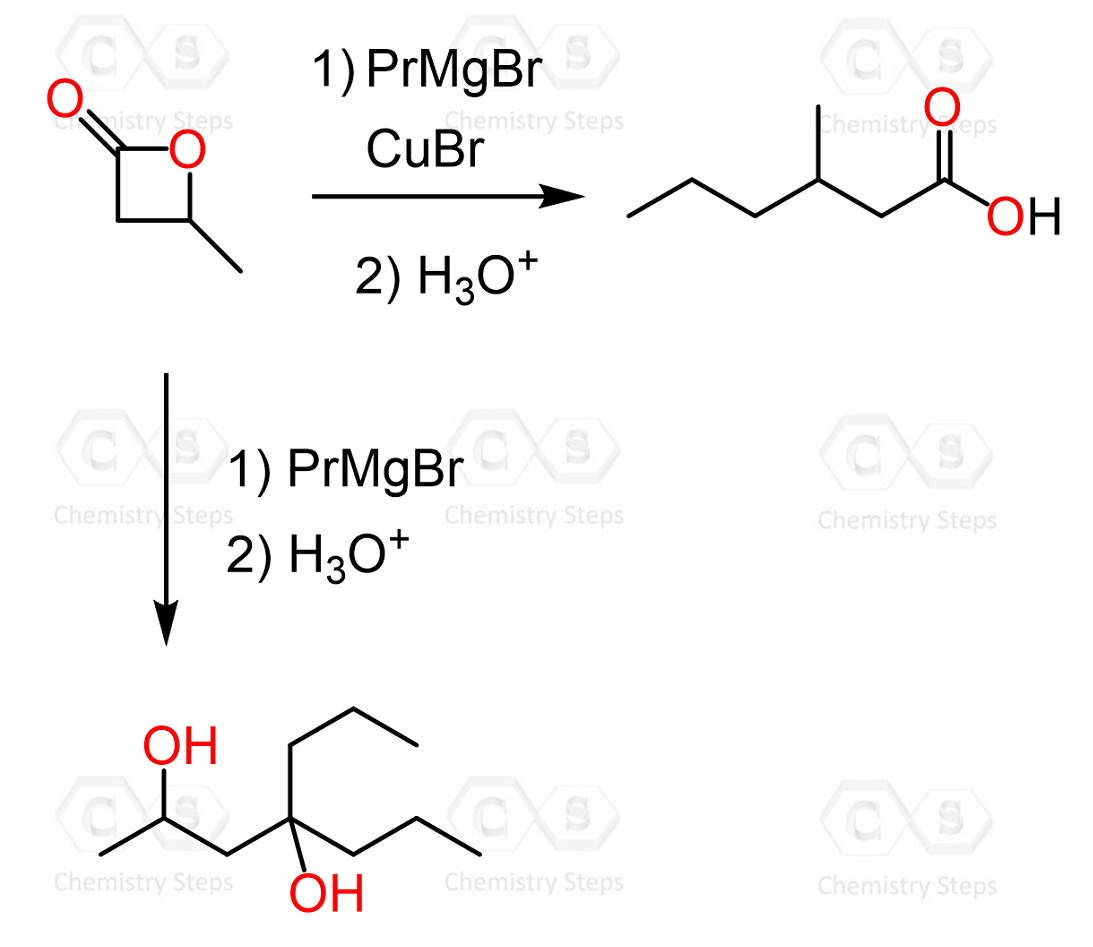
Lactones are cyclic esters and react similarly to esters with organolithium reagents. It starts with A nucleophilic addition to the carbonyl group, and in the next step, where the C=O bond is restored, the loss of the alkoxide leaving group opens the cyclic structure of the lactone, forming a ketone, which undergoes another nucleophilic addition by the RLi reagent:
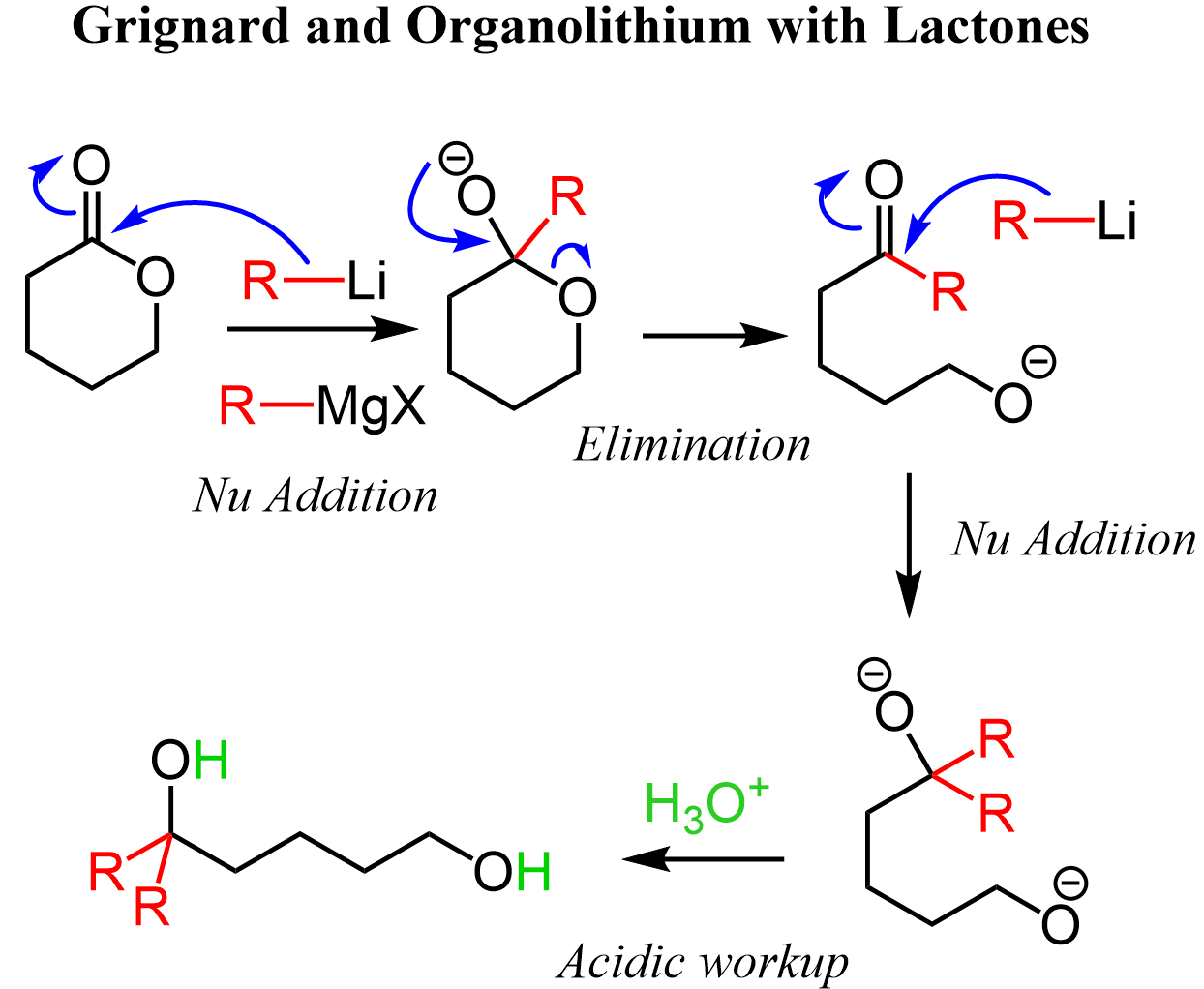
The last step of the reaction is the acidic workup, which yields the final product, containing primary and tertiary alcohols.
We have a dedicated post on the reactions of Lactones and Lactams with lots of practice problems here.
As a summary of the reaction of organometallics with esters, remember that Grignard and organolithium reagents form tertiary alcohols, whereas Gilman reagents, being less reactive, do not normally react with esters: