
Let’s discuss some strategies for converting alkyl halides to aldehydes and ketones. Converting the alkyl halide to an alcohol and oxidizing the latter to an aldehyde or ketone requires the least number of topics to have covered, so let’s start with it.
Alkyl Halides to Aldehydes and Ketones via Alcohols
We can convert the following primary alkyl halide to an aldehyde or a ketone. For the aldehyde, we can do an SN2 substitution with a hydroxide, and oxidize the resulting primary alcohol to aldehyde using a mild oxidizing agent such as PDC, PPC, or DMP is dichloromethane solvent (DCM):

Notice that for the ketone, we convert the alkyl halide to an alkene, and then to secondary alcohol via a Markovnikov addition of water to the double bond. The secondary alcohol can be oxidized with a mild or strong oxidizing agent as they all lead to a ketone.
Extending the Length of the Carbon Chain
In the method we discussed above, the length of the carbon chain is not changed, and we only convert one functional group to another. Let’s also mention one method to increase the length of the carbon chain when converting an alkyl halide to an aldehyde or a ketone. The most common way of extending the carbon chain in the first semester of organic chemistry is the use of substitutions involving the cyanide (–CN) ion. Unlike all the other nucleophiles such as the halide ions, sulfides, hydroxide, and alkoxides, the –CN nucleophile introduces an extra carbon to the alkyl halide.
The resulting compound is a nitrile, and these can be cornered to aldehydes and ketones by a reduction with DIBAL and a reaction with organolithium and Grignard reagents respectively:

Shortening the Carbon Chain
To prepare an aldehyde or a ketone with a shorter carbon chain, we can convert the alkyl halide to an alkene by Zaitsev or Hofmann elimination and oxidize it to a carbonyl using ozonolysis:

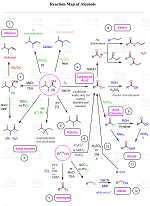
Organic Chemistry Reaction Maps
Never struggle again to figure out how to convert an alkyl halide to an alcohol, an alkene to an alkyne, a nitrile to a ketone, a ketone to an aldehyde, and more! The comprehensive powerfull Reaction Maps of organic functional group transformations are here!
Check Also
- Nucleophilic Substitution Reactions – An Introduction
- All You Need to Know About the SN2 Reaction Mechanism
The SN2 Mechanism: Kinetics, Thermodynamics, Curved Arrows, and Stereochemistry with Practice Problems - The Stereochemistry of SN2 Reactions
- The SN1 Nucleophilic Substitution Reaction
- Reactions of Alkyl Halides with Water
- The SN1 Mechanism: Kinetics, Thermodynamics, Curved Arrows, and Stereochemistry with Practice Problems
- The Substrate and Nucleophile in SN2 and SN1 Reactions
- Carbocation Rearrangements in SN1 Reactions with Practice Problems
- Ring Expansion Rearrangements
- When Is the Mechanism SN1 or SN2?
- Reactions of Alcohols with HCl, HBr, and HI Acids
- SOCl2 and PBr3 for Conversion of Alcohols to Alkyl Halides
- Alcohols in Substitution Reactions with Tons of Practice Problems
- How to Choose Molecules for Doing SN2 and SN1 Synthesis-Practice Problems
- Exceptions in SN2 and SN1 Reactions
- Nucleophilic Substitution and Elimination Practice Quiz