The SN1 Mechanism
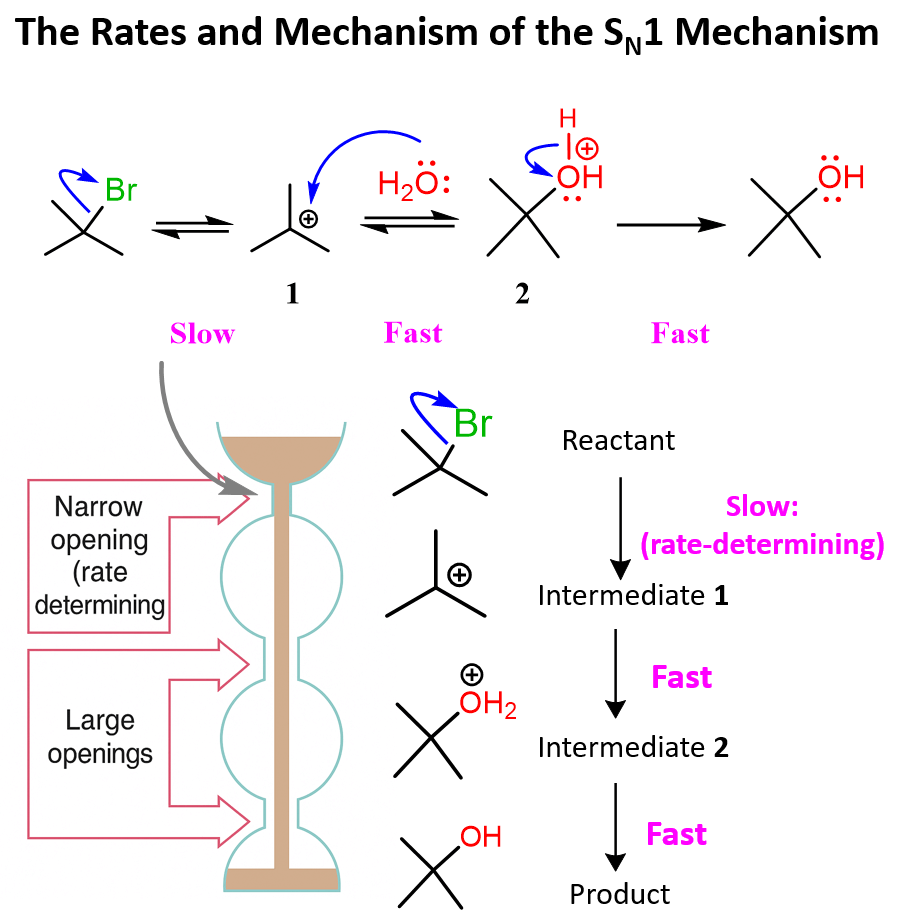
The SN1 nucleophilic substitution is a unimolecular – first-order reaction: It is a stepwise mechanism that starts by breaking the bond of the α carbon and the leaving group, followed by the nucleophilic attack: As you … Read more
In the following posts, we will learn about and do many practice problems on Nucleophilic Substitution Reactions. Nucleophilic Substitution Reactions are one of the most important major classes of organic chemistry and essential that you build a solid foundation and understanding of their principles and mechanisms such as the SN1 and SN2 reactions.

We will start from the introduction and general features of Nucleophilic Substitution Reactions and go in detail individually for the SN1 and SN2 mechanism. Each practice problem is designed to address the specifics of these mechanisms; the reactivity, stereochemistry and possibility of rearrangements. For example, you will have many practice problem examples that demonstrate in detail the inversion of R and S configuration during SN2 reactions. On the other hand, we will also see why a racemic mixture is obtained when the reaction goes by the SN1 mechanism via the formation of a carbocation intermediate.
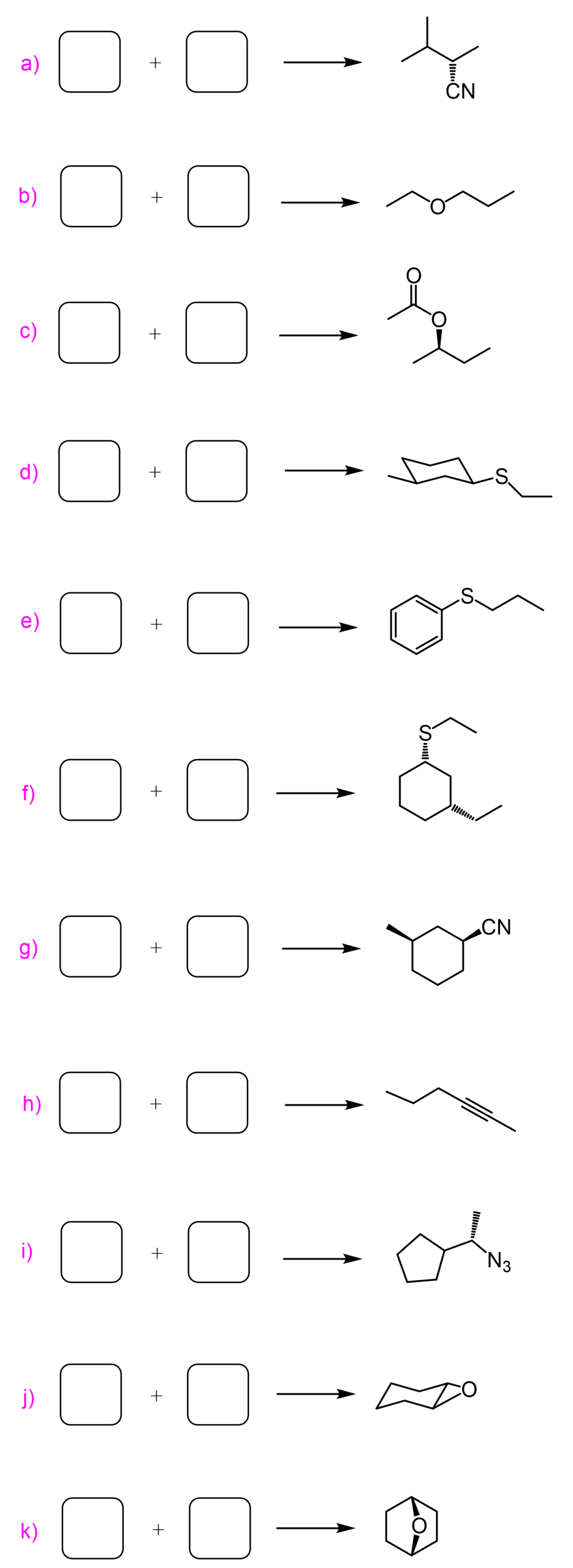
One important and yet overwhelming questions in Nucleophilic Substitution Reactions is the prediction of the mechanism as to whether it is SN1 or SN2. And we will talk about how to choose between SN1 and SN2 considering the nucleophile, the substrate, the solvent, and the reaction conditions. Once you have sufficient knowledge, we will so do the retrosynthetic analysis of Nucleophilic Substitution Reactions to learn the best of choosing a reagent for functional group transformations.
The SN1 nucleophilic substitution is a unimolecular – first-order reaction: It is a stepwise mechanism that starts by breaking the bond of the α carbon and the leaving group, followed by the nucleophilic attack: As you … Read more
Choosing Between SN1, SN2, E1, and E2 If you are reading this post, welcome to the world of SN1, SN2, E1, and E2 business! The good news is that you are not alone and that also, we are going to make … Read more
In this practice problem, you will need to determine the major organic product and the mechanism of each reaction. This covers the competition between SN1, SN2 nucleophilic substitution, and E1/E2 elimination reactions. You can check this post (SN1 SN2 E1 … Read more
Check Also in Nucleophilic Substitution Reactions: SN1 SN2 E1 E2 – How to Choose the Mechanism Is it SN1 SN2 E1 or E2 Mechanism With the Largest Collection of Practice Problems Introduction to Alkyl Halides Nomenclature of Alkyl Halides Nucleophilic Substitution … Read more
How to Convert the OH into a Leaving Group In many cases, when students are asked to convert an alcohol to an alkyl halide, they would use the corresponding halide and show the reaction with an SN2 mechanism:The result is … Read more
Is it an SN1 or SN2 mechanism? If you are asked to determine whether the nucleophilic substitution goes through an SN1 or SN2 mechanism, look at the following criteria in the given order: 1) Check the substrate (alkyl halide most … Read more
Now that you have learned about the SN1 and SN2 mechanisms, try to draw a reasonable mechanism for the following substitution reaction: Wait, this doesn’t make sense, right? The nucleophile suddenly appears where there was no leaving group… … Read more
Choosing between SN1, SN2, E1 and E2 In the previous posts, we discussed choosing between SN1 and SN2, as well as SN1, SN2, E1, and E2 mechanisms. The main focus here was on the substrate and the strength of the … Read more