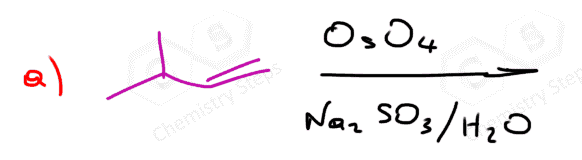
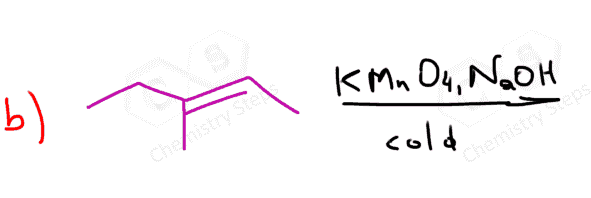
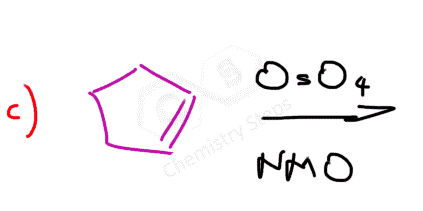
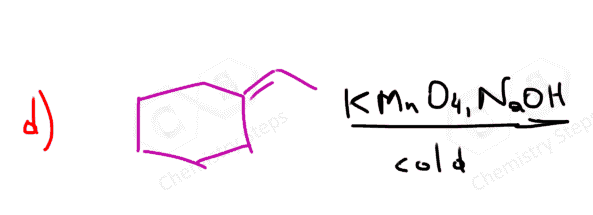
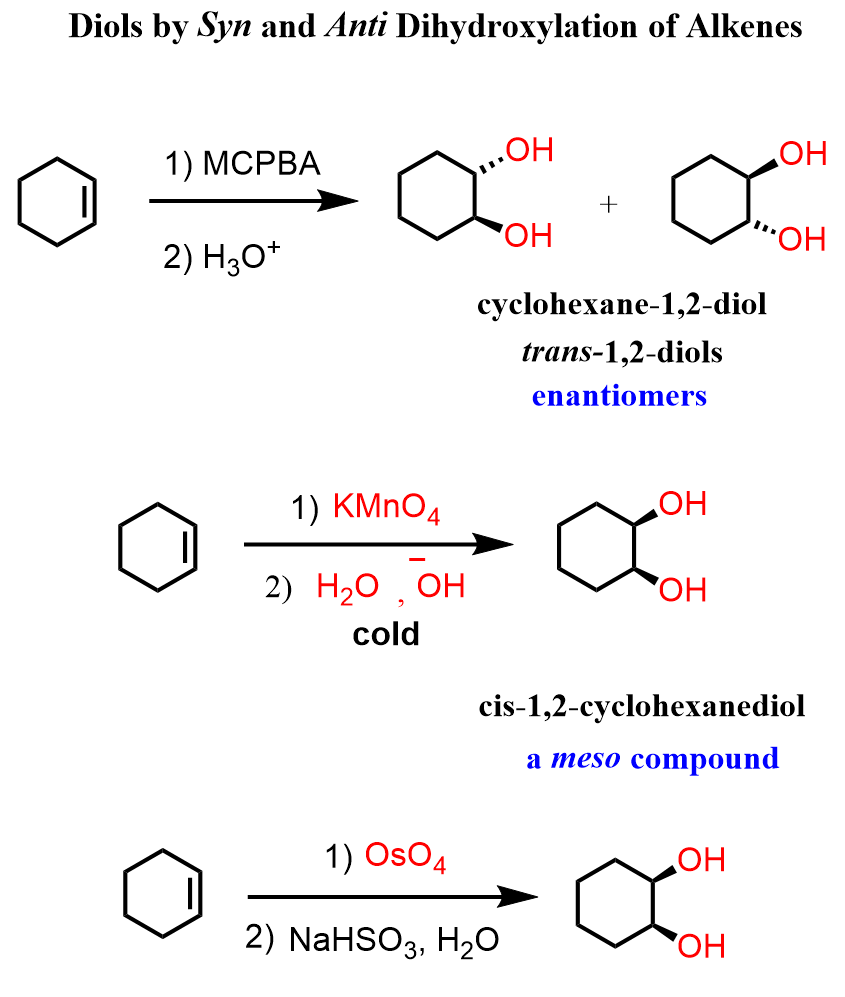
Diols are compounds containing two hydroxyl groups; therefore, we can view the conversion from alkenes to diols are adding two OH groups across the double bond. These are called dihydroxylation reactions:

Notice that the two OH groups are next to each other; therefore, these particular ones are vicinal diols or 1,2-diols. There are other isomers of diols, and you can read more about them in this dedicated article.
There are a few ways of converting alkenes to diols, and depending on the method, we can control the stereochemistry of these addition reactions.

We are talking about the relative orientation of the two groups in the diol i.e., whether it is cis or a trans diol. Remember, when the two identical groups are pointing in the same direction, we have a cis isomer, and when they are pointing in opposite directions, we have a trans isomer. This nomenclature is mostly relevant to alkenes and cycloalkanes:

In general, to have the two OH groups on the opposite sides, anti dihydroxylation is used, and for the cis diols, syn-dihydroxylation is used. Recall the anti and syn conformations in butane:
Let’s start with the anti-dihydroxylation.
Anti-Dihydroxylation via Epoxidation of Alkenes
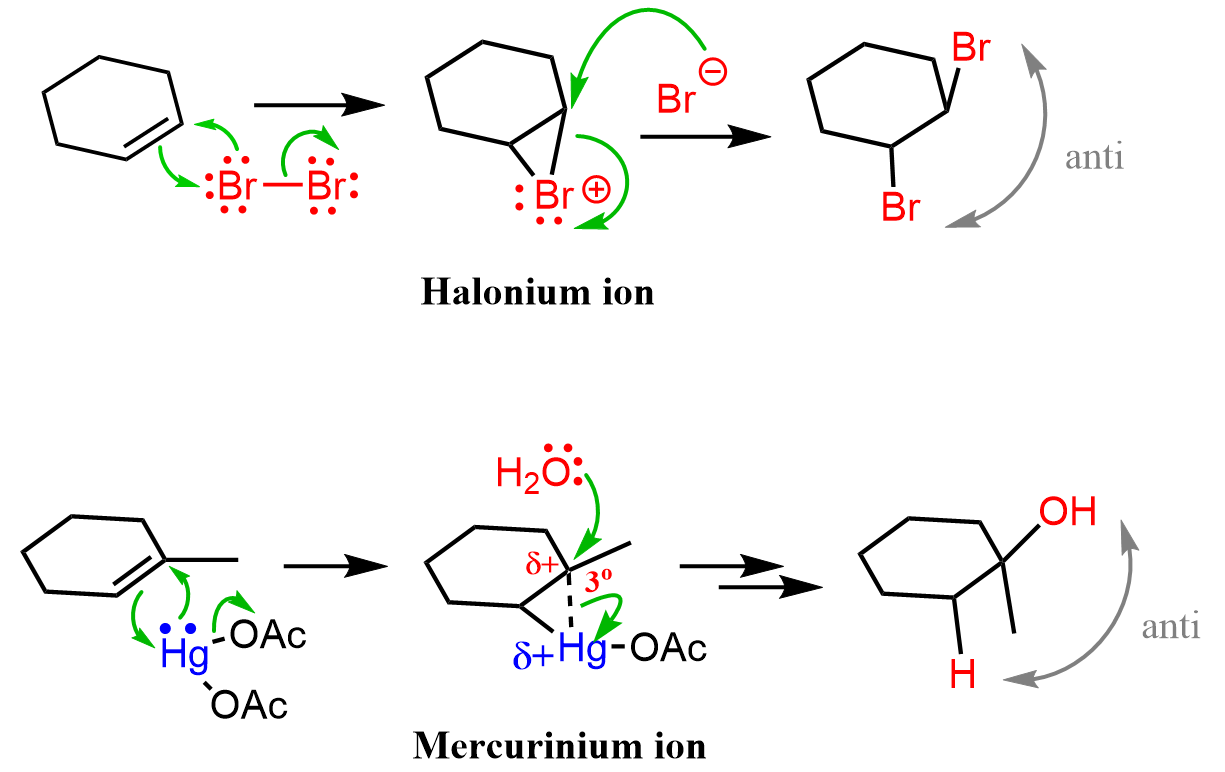
You may remember anti additions to alcohols when we discussed the halogenation and oxymercuration reactions. In both cases, a three-membered ring intermediate was formed, which was then opened up by a nucleophile, thus putting two groups on opposite sides of the product:
These types of reactions are all backed up by the ring-opening reactions of epoxides which occur because of their high ring strain:

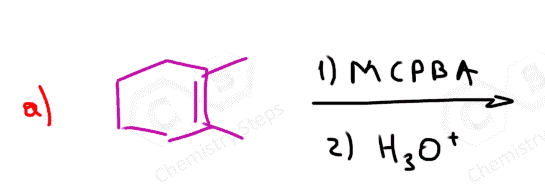
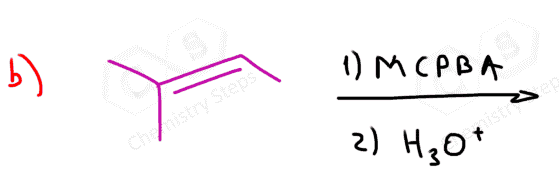
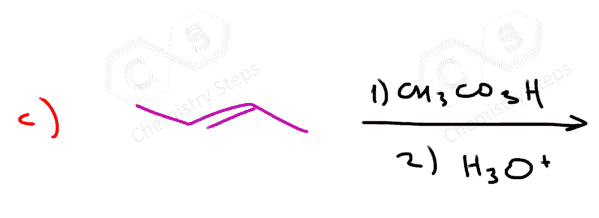
This feature of epoxides is used in anti-dihydroxylation of alkenes, where they are first converted to epoxides and the latter is activated and reacted with water. The epoxidation of alkenes is achieved with peroxy acids such as MCPBA (meta-chloroperoxy benzoic acid) or Peroxyacetic acid. Here is a short scheme for the anti-dihydroxylation via epoxidation, and you can find all the details about the mechanism in this article:

Just like in any epoxide reaction, a nucleophilic attack occurs from the opposite side of the oxygen, and an SN2 substitution is achieved. Notice that the attack on the epoxide occurs at the more substituted carbon atom. This is because the transition state resembles a carbocation, and the more substituted carbocations are more stable.
In dihydroxylation, this does not matter from the perspective of regiochemistry since both groups are OH, but if other weak nucleophiles such as alcohols are used, we need to add them to the more substituted carbon atom:

Notice that it is the opposite when good nucleophiles are used as they do not need an activation of the epoxide and simply attack the more accessible (less substituted carbon atom).
The Stereochemistry of anti-Dihydroxylation
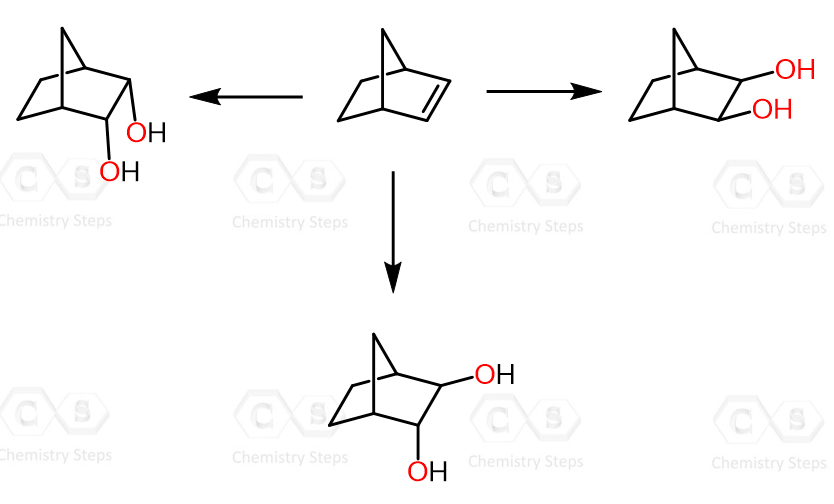
Most often, the anti-dihydroxylation gives a mixture of enantiomers unless the starting alkene contains a chiral center, in which case, a pair of diastereomers will be formed.
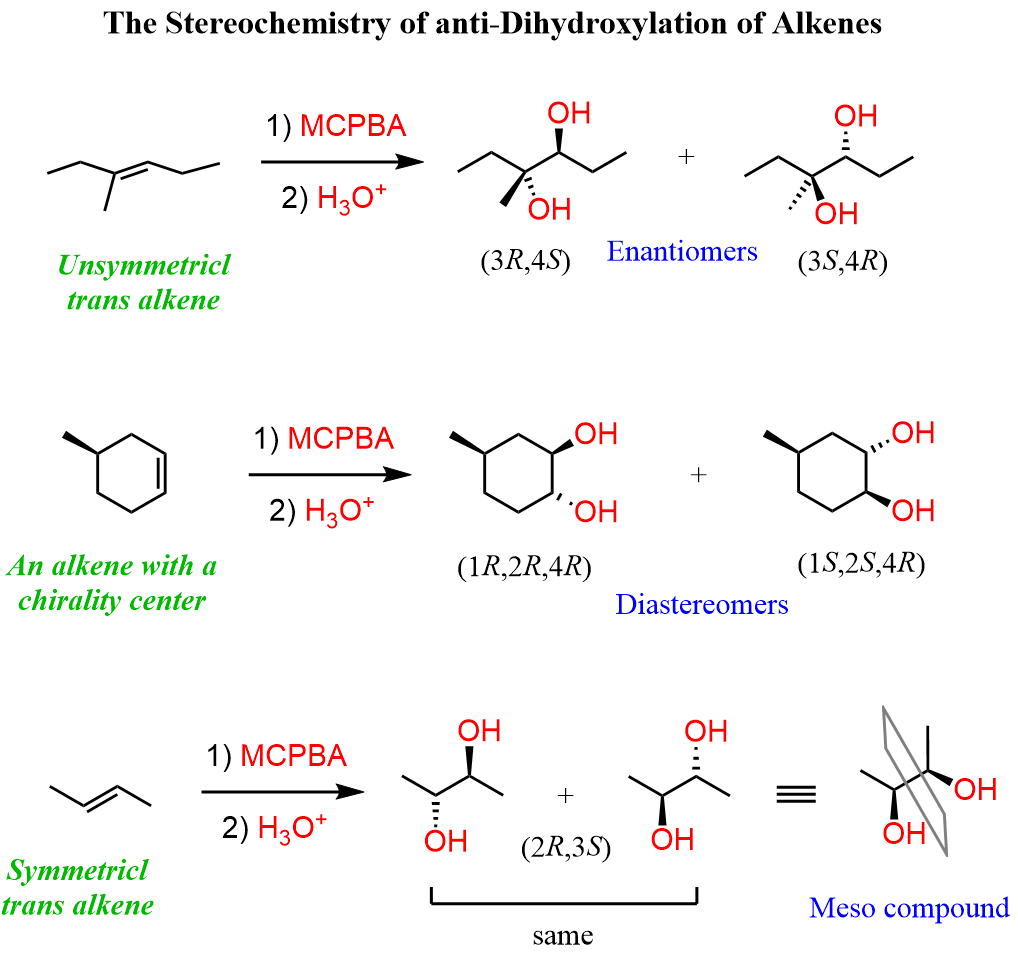
Watch out for meso compounds when working with a symmetrical alkene. Although visually may not be visually apparent, the dihydroxylation of a symmetrical trans alkene will give a meso compound.
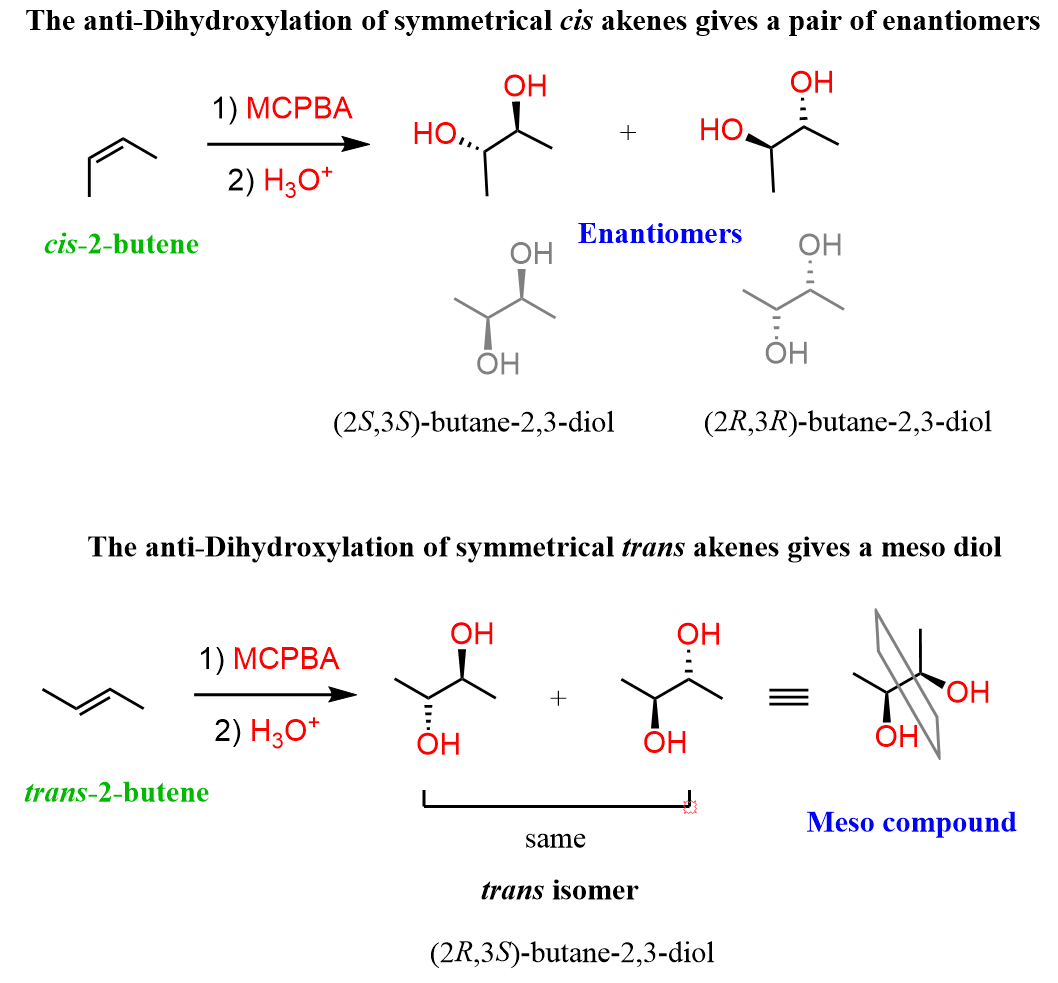
You can read the article “Cis Products in Anti-Additions to Alkenes” for about these types of tricks in the addition reaction of alkenes.
Syn-Dihydroxylation of Alkenes
The syn dihydroxylation is done using osmium tetroxide, and 1,2-diols (vic-diols – vicinal diols) are obtained. This can also be achieved with potassium permanganate, although this approach has the risk of cleaving the double bond and over-oxidizing it to a carboxylic acid.
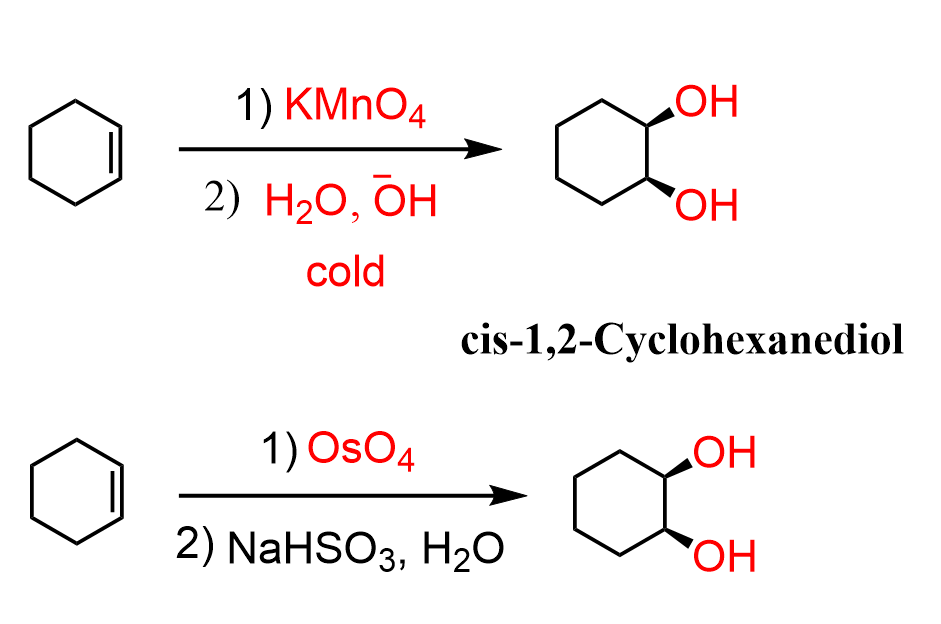
The reason KMnO4 and OsO4 give syn dihydroxylation is that, unlike epoxidation followed by its opening, these reactions go through the formation of a cyclic intermediate, which is formed by a syn addition to the double bond. The intermediates are then hydrolyzed by water, during which the stereochemistry of newly-formed C-O bonds is retained, thus producing cis-diols:

The Stereochemistry of syn-Dihydroxylation of Alkenes
Like in the case of anti-dihydroxylation, unsymmetrical alkene gives a pair of enantiomers, and if the alkene had a chirality center(s), then a pair of diastereomers would have been formed.