The m/z 43 peak is one of the most common and characteristic fragments you’ll see in organic mass spectrometry.
There are two main sources for this peak: 1) Acylium cation and 2) Propyl or isopropyl cation.

While the propyl and isopropyl cations can form from very much any compound, the acylium ion is a direct hint of a carbonyl compound. More specifically, you should think of a methyl ketone once you see it in a mass spectrum.
For example, let’s look at the mass spectrum of octan-2-one. There are two main peaks, and one of them is the m/z 43 coming from an alpha cleavage of the carbonyl group:

The prominent peak at m/z 43 comes from the acylium ion (CH₃–C≡O⁺), which is formed via α-cleavage – that is, breaking the bond between alpha and beta carbon atoms.
In general, you should know that alpha cleavage is a highly favored process because the resulting carbocation is stabilized by the lone pair of electrons on the heteroatom.
This includes a large number of functional groups, such as aldehydes, ketones, esters, alcohols, and amines. The role of the heteroatom is the stabilization of the carbocation by its lone pair of electrons.
The base peak at m/z 58 in this mass spectrum comes from a McLafferty rearrangement, which is also characteristic of carbonyl compounds. Keep in mind, however, that this rearrangement happens only with carbonyl compounds with a gamma carbon. In other words, the side chain(s) of the carbonyl must be long enough to provide a gamma hydrogen (see the mechanism on the spectrum).
Propyl and isoPropyl Fragments
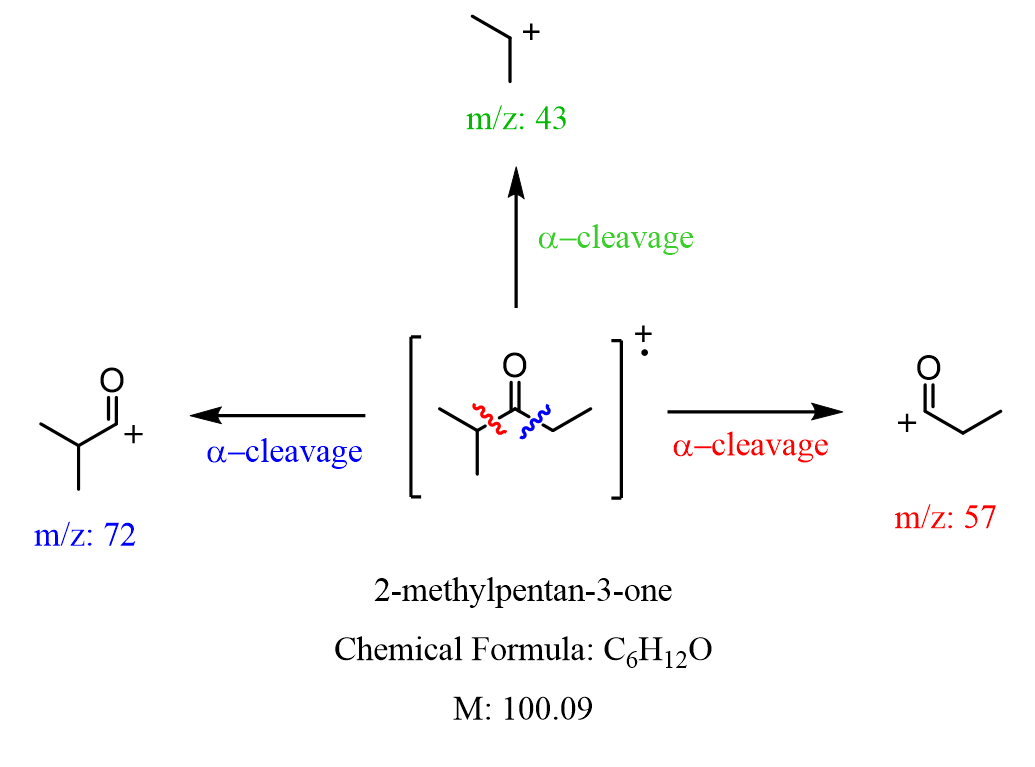
The mass of the alpha cleavage fragment can, of course, vary depending on the side chains. For example, the mass spectrum of 2-methylpentan-3-one produces 3 main peaks, including m/z 43; however, this time, it is from an isopropyl cation:
Let’s also examine an example where the m/z 43 peak originates from an alkyl halide. The mass spectrum of 2-chloropropane shows a base peak at m/z 43, which corresponds to the secondary (isopropyl) carbocation.

The isopropyl cation is a secondary cation, which is quite stable in mass spectrometry standards. However, you will often see compounds with propyl fragments showing an intense peak at m/z 43. This is likely a result of a rearrangement of the propyl cation to a more stable isopropyl cation.
Summarizing the m/z 43 Peak in Mass Spectrometry
The m/z 43 ion is one of the “signature peaks” in mass spectrometry, and it should be an immediate hint to you for the presence of a carbonyl, especially a methyl ketone, and a propyl or isopropyl fragment, which can come from any compound.
Check out our detailed Guide on Solving Mass Spectrometry Problems that includes the key McLafferty fragmentations of aldehydes, ketones, esters, acids, and nitriles. Once you master the key fragmentation, work on the comprehensive Mass Spectrometry Problems.