
Your professor has been talking about the SN2 reaction, and you have got the key principles such as the curved arrow mechanism, inversion of configuration, and second-order reaction, but there was one phrase that left you wondering: “concerted mechanism”.
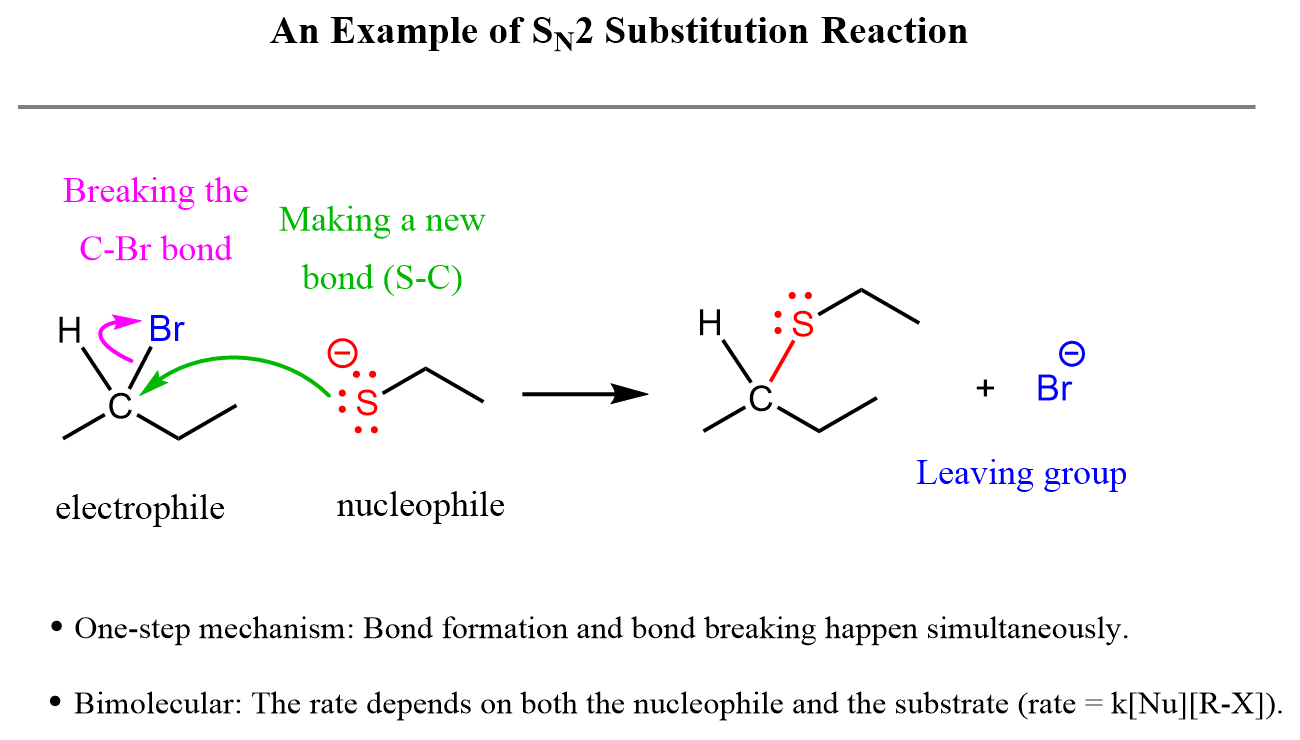
So, what is a concerted mechanism? Well, it simply means everything in the rate-determining step occurs simultaneously. Remember, most often there is only one step in the SN2 mechanism, and that is the attack of the nucleophile and the loss of the leaving group. For example, let’s look at the mechanism of the SN2 reaction between 2-bromobutane and ethyl thiolate ion:
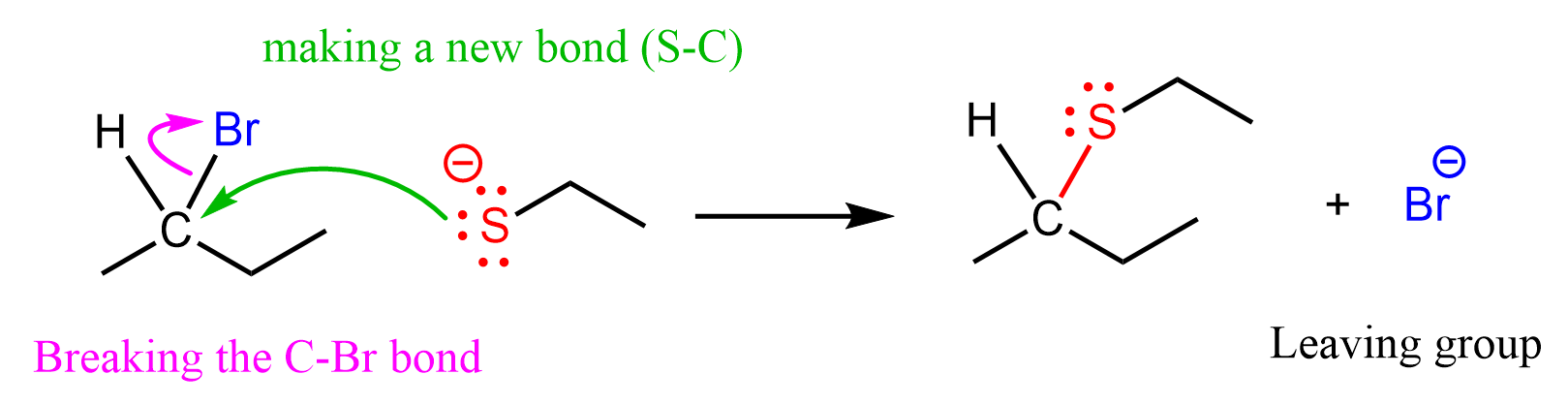
The green arrow shows the formation of the C-S bond, and the purple arrow shows the cleavage of the C-Br bond (loss of the leaving group). Importantly, these two happen at the same time – the C-S bond is forming as the C-Br bond is breaking. This is an example of a concerted mechanism, and if we think about it, it makes sense in the context of the bimolecular nature of the SN2 reaction. The rate of the reaction depends equally on the substrate and the nucleophile, as they both make their contribution equally and simultaneously.
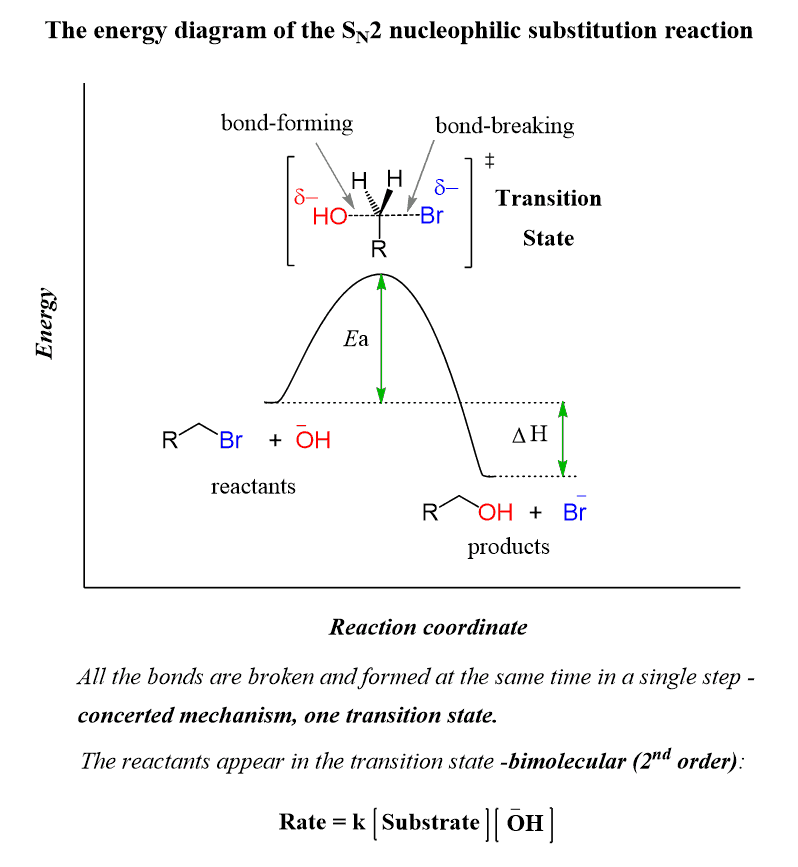
We can see the concerted nature of the SN2 reaction by looking at the transition state of the reaction between an alkyl halide and a hydroxide ion. The C–O bond is forming as the C–Br bond is breaking:
E2 – Another Concerted Mechanism
The E2 elimination is similar to the SN2 mechanism, as in both reactions, all the steps happen simultaneously, and they are both bimolecular reactions. The only difference is that in E2, instead of the electrophilic carbon, its neighboring hydrogen is attacked and a double bond is formed:
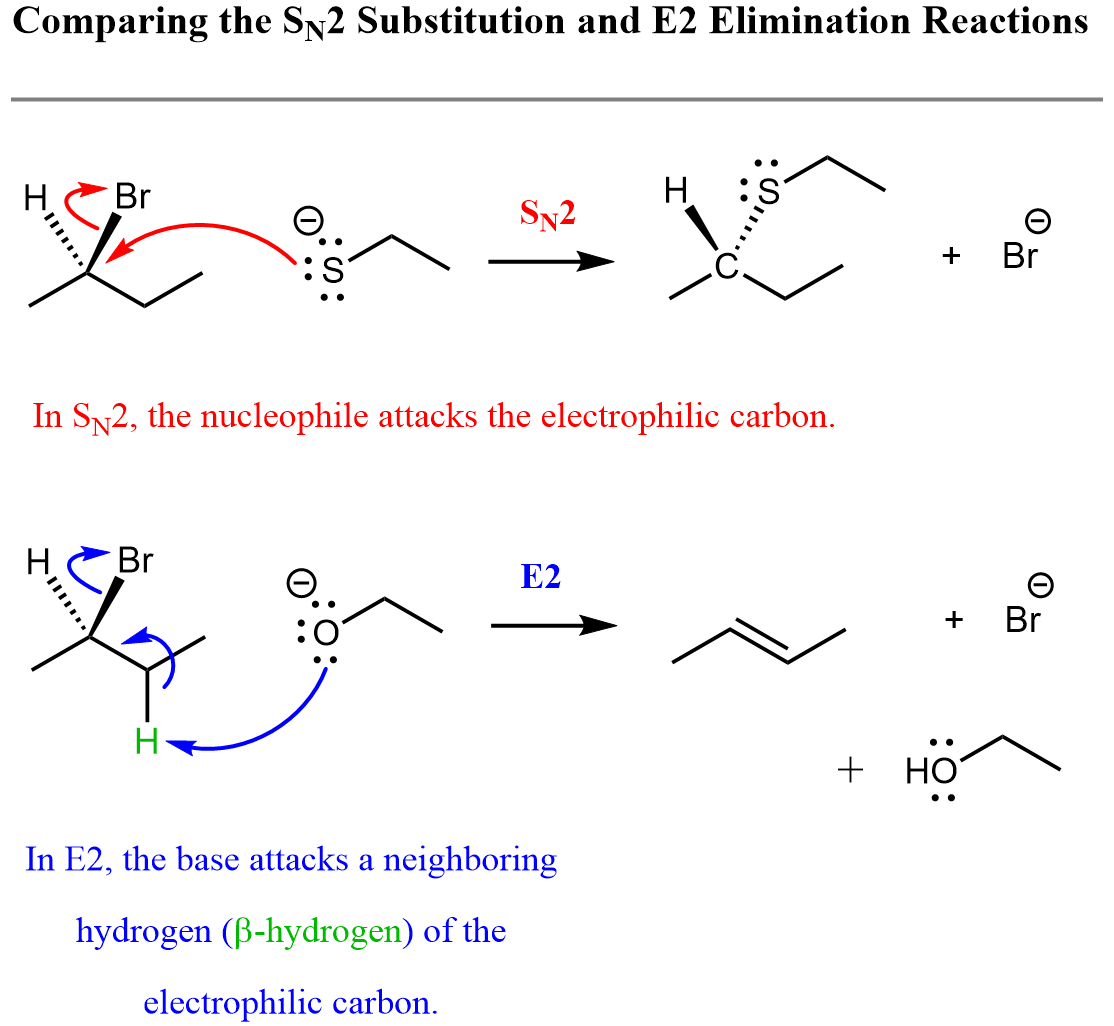
The neighboring hydrogen is also called a beta hydrogen as it is on the beta carbon. Recall that the alpha carbon is the one bearing the leaving group (Br in this case), and the beta carbon is/are the one(s) connected to it. Therefore, the hydrogen connected to this carbon is called a beta hydrogen.
We have separate posts on SN2 and E2 reactions, as well as one for comparing them side by side, addressing the factors favoring each of them, so feel free to check out the linked articles.
For the focus of today’s discussion, let’s mention one more time that the E2 elimination reaction is also a concerted mechanism, and the attack of the base, formation of the double bond, and the expulsion of the leaving group happen simultaneously:
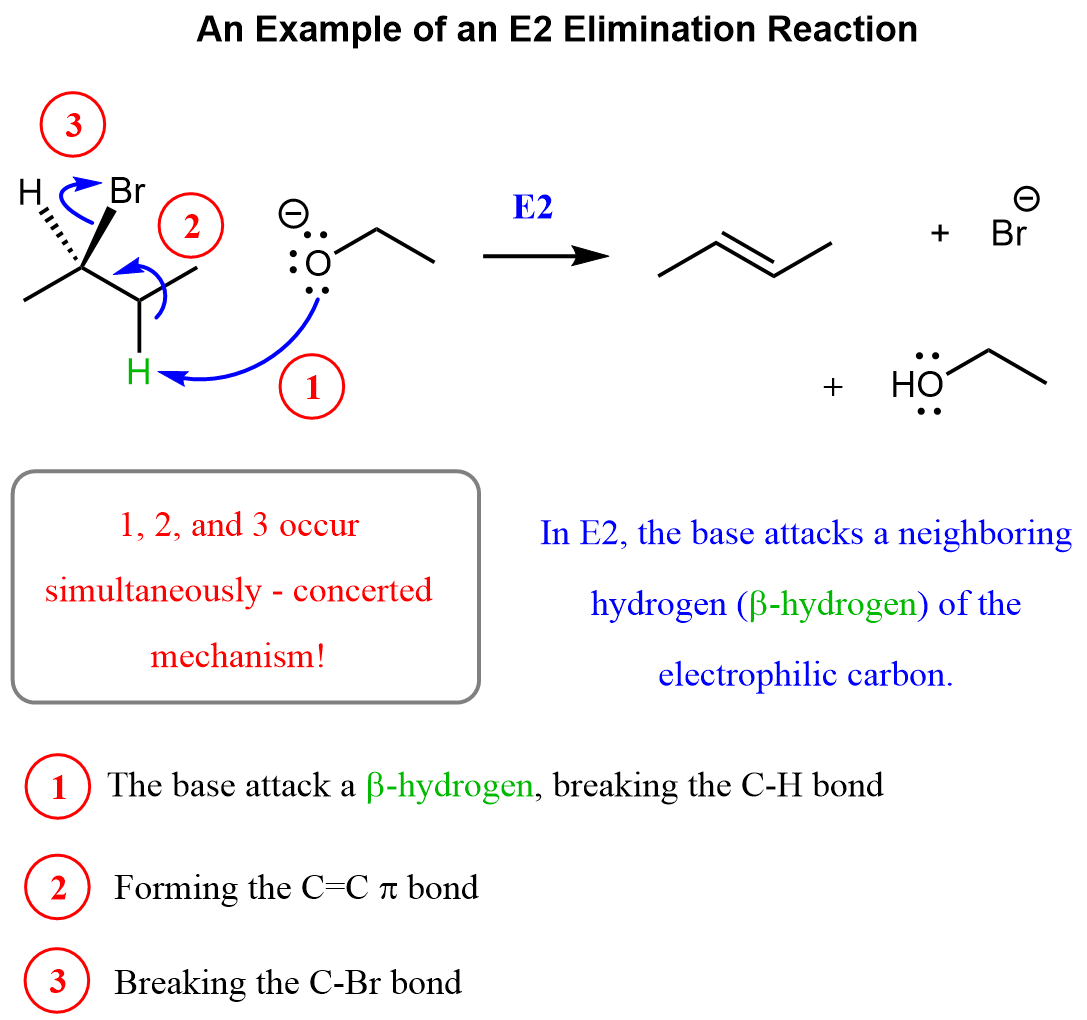
Once again, the numbering of arrows here is to simply label and explain them rather than show the sequence of steps – they all happen simultaneously.
Hydroboration-Oxidation: Another Concerted Mechanism
The hydroboration-oxidation is used for the hydration of alkenes and alkynes to prepare alcohols and aldehydes/ketones, respectively.
The first step of the reaction is the concerted formation of the C-B and C-H bonds, which happens as a result of the pi bond electrons attacking the empty orbital of the borane:
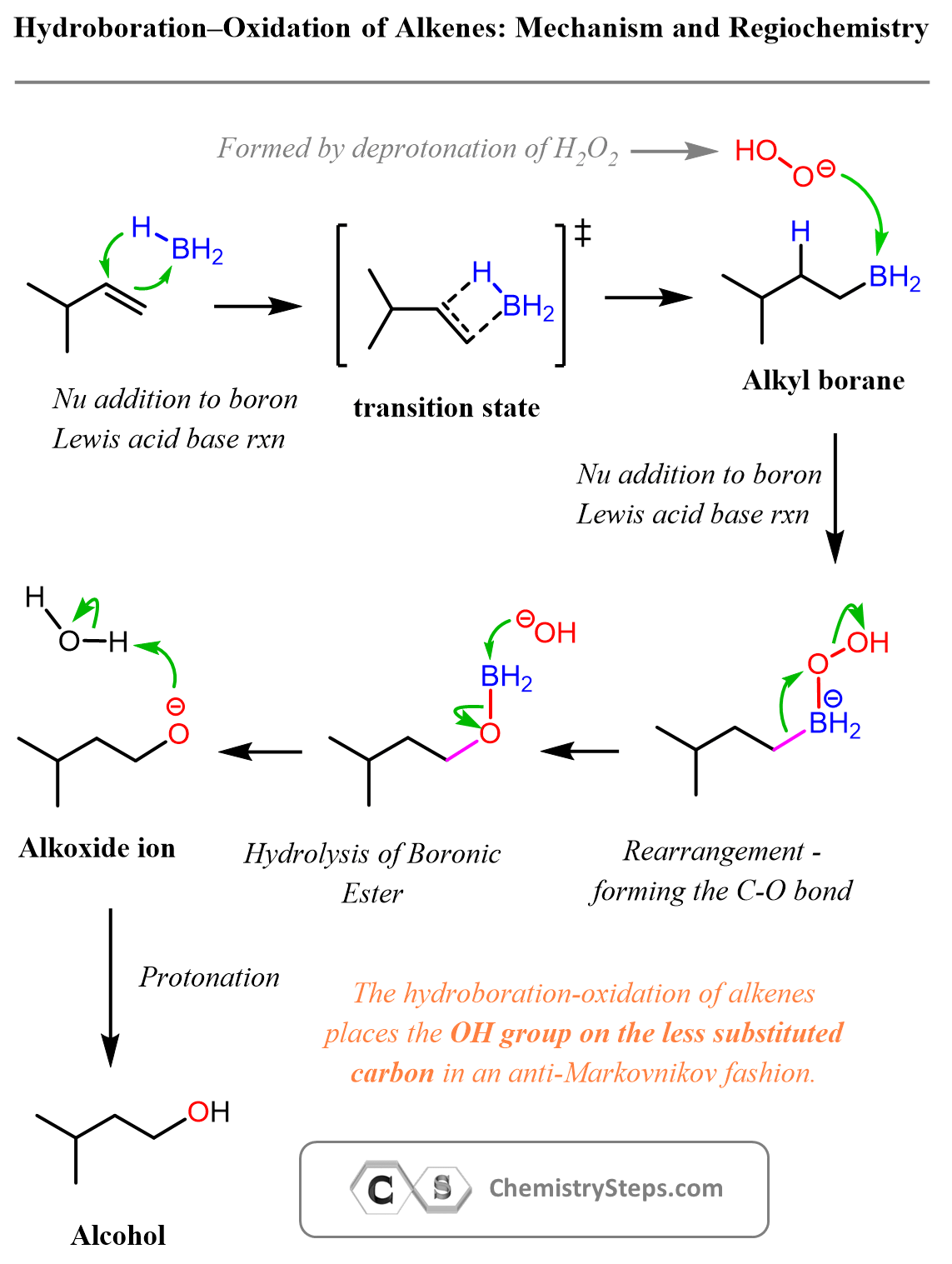
You can read more about the hydroboration-oxidation of alkenes and alkynes in these two articles.
The Diels–Alder Reaction – a Concerted Cycloaddition Mechanism
This is most often an Organic II topic, so feel free to skip it if you are in the chapter on nucleophilic substitution and elimination reactions.
In the Diels–Alder reaction, a conjugated diene reacts with a dienophile (an alkene or alkyne) to form a six-membered ring.

This reaction is also concerted, meaning that the π bonds in the diene and dienophile reorganize simultaneously in a single step to form two new σ bonds. There are no intermediates-the reaction proceeds through a cyclic transition state, which explains its stereospecificity. The Diels–Alder reaction is widely used in organic synthesis because it allows for the rapid construction of cyclic structures with precise stereochemistry.
Are there Non-Concerted Mechanisms?
There are certainly reactions where not everything happens simultaneously. The main examples are the unimolecular SN1 and E1 reactions, where the loss of the leaving group happens before the next steps of nucleophilic attack and hydrogen removal occur.
We won’t go into the details of SN1 and E1 reactions here, as they both require a separate post, which we do have. However, as a general scheme, consider the reaction of tert-butyl bromide with water, where, as usual, the SN1 and E1 reactions go hand in hand:

Notice again that the SN1 and E1 reactions occur in a stepwise mechanism, that is, first loss of a leaving group, only then a nucleophilic attack (SN1) or a removal of beta hydrogen (E1) by water.
What About SN2 with More Than One step?
It is true that there are SN2 reactions with more than one step. These are the ones of alcohols, where they first get protonated, and only then does the nucleophilic attack happen.
For example, let’s take a look at the reaction of butan-2-ol with HBr. The reaction happens via both SN1 and SN2 mechanisms.
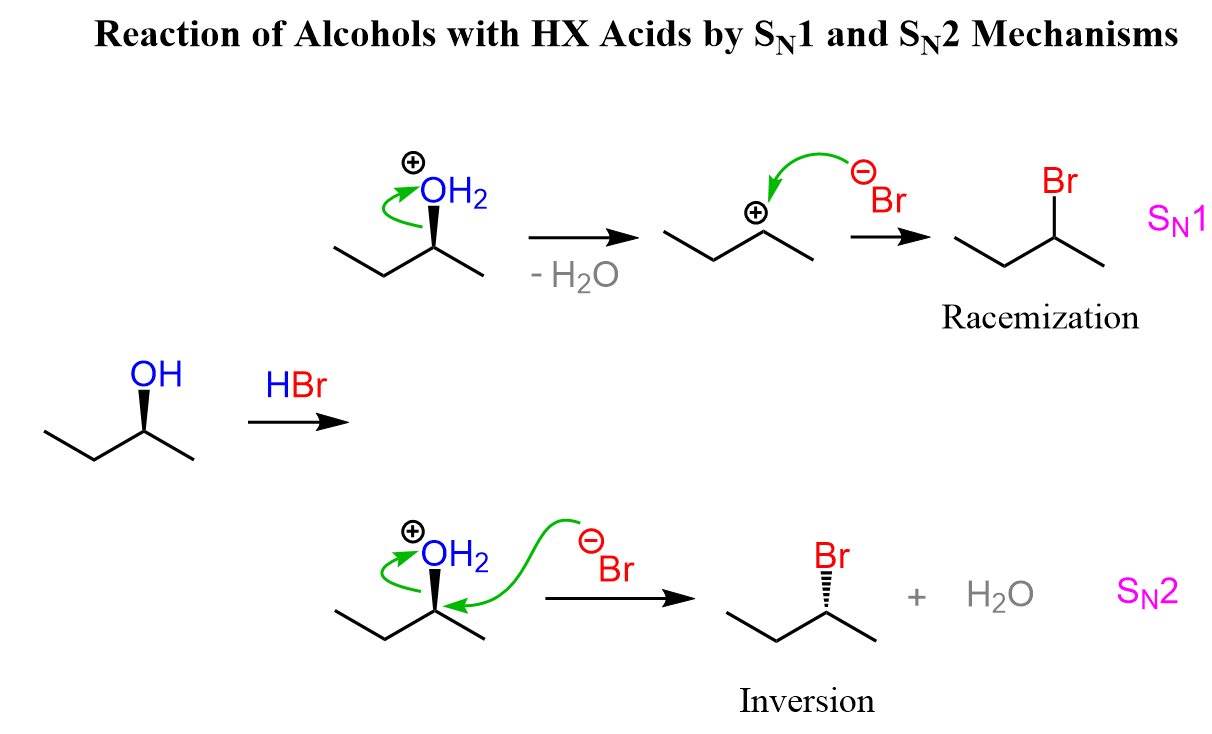
Even though there are two steps in the SN2 reaction – protonation of the OH followed by its substitution by the bromide ion, the latter is the rate-determining, actual SN2 step, which occurs by a concerted mechanism.
Check the article “The SN1 and SN2 Reactions of Alcohols” for more details, as well as the others listed below for more details, examples, and practice problems.
- Introduction to Alkyl Halides
- Nomenclature of Alkyl Halides
- Substitution and Elimination Reactions
- Nucleophilic Substitution Reactions – An Introduction
- All You Need to Know About the SN2 Reaction Mechanism
- SN2 Mechanism: Kinetics, Thermodynamics, Curved Arrows, and Stereochemistry with Practice Problems
- The Stereochemistry of SN2 Reactions
- Stability of Carbocations
- The SN1 Nucleophilic Substitution Reaction
- Reactions of Alkyl Halides with Water
- The Stereochemistry of the SN1 Reaction Mechanism
- The SN1 Mechanism: Kinetics, Thermodynamics, Curved Arrows, and Stereochemistry with Practice Problems
- Steric Hindrance in SN2 and SN1 Reactions
- Carbocation Rearrangements in SN1 Reactions with Practice Problems
- Ring Expansion Rearrangements
- Ring Contraction Rearrangements
- When Is the Mechanism SN1 or SN2?
- SN1 vs E1 Reactions
- SN2 vs E2 Reactions
- Reactions of Alcohols with HCl, HBr, and HI Acids
- SOCl2 and PBr3 for Conversion of Alcohols to Alkyl Halides
- Alcohols in SN1 and SN2 Reactions
- How to Choose Molecules for Doing SN2 and SN1 Synthesis–Practice Problems
- Exceptions in SN2 and SN1 Reactions
- SN1 SN2 E1 E2 – How to Choose the Mechanism
- Polar Protic and Polar Aprotic Solvents
- SN1 SN2 E1 or E2 – The Largest Collection of Practice Problems