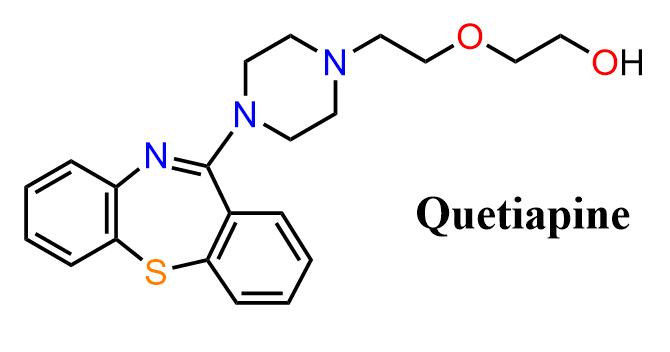
 Quetiapine is an atypical antipsychotic used in the treatment of schizophrenia, bipolar disorder, and as an adjunct in major depressive disorder. It works by modulating neurotransmitter systems, particularly dopamine and serotonin receptors.
Structurally, quetiapine contains a dibenzothiazepine core connected to a piperazine ring through an ether linkage. The molecule includes multiple functional groups such as aromatic rings, a sulfur-containing heterocycle, and a tertiary amine, making it a useful target for studying diverse transformations in organic synthesis.
Because of its structure, quetiapine is often discussed in the context of nucleophilic aromatic substitution, intramolecular cyclization for heterocycle formation, amine alkylation, and key C–N bond-forming reactions.
In the following practice problem, we will focus on the organic synthesis of quetiapine rather than its pharmacological properties. In particular, we will examine how the dibenzothiazepine core is constructed from substituted aromatic precursors, followed by installation of the piperazine fragment via nucleophilic substitution, and final functional group adjustments to complete the synthesis.
As with all examples in this section, this discussion is presented solely for educational purposes and is not intended to represent a practical or real-world method of preparation.
Practice
Add the missing intermediates and reagents in the following synthesis of Quetiapine. Draw curved arrow mechanisms for all the steps starting from intermediate 2.
This content is for registered users only.
Click here to Register!
By joining Chemistry Steps, you will gain instant access to the answers and solutions for all the Practice Problems, including over 40 hours of problem-solving videos, Multiple-Choice Quizzes, Puzzles, Reaction Maps, and the powerful set of Organic Chemistry 1 and 2 Summary Study Guides.
