Diels-Alder Stereochemistry

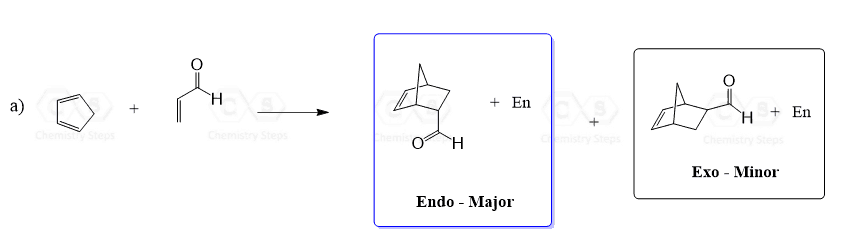
The main component of the stereochemistry of the Diels-Alder reaction that you are going to see in your class is the formation of endo and exo products when cyclic dienes react with dienophiles.

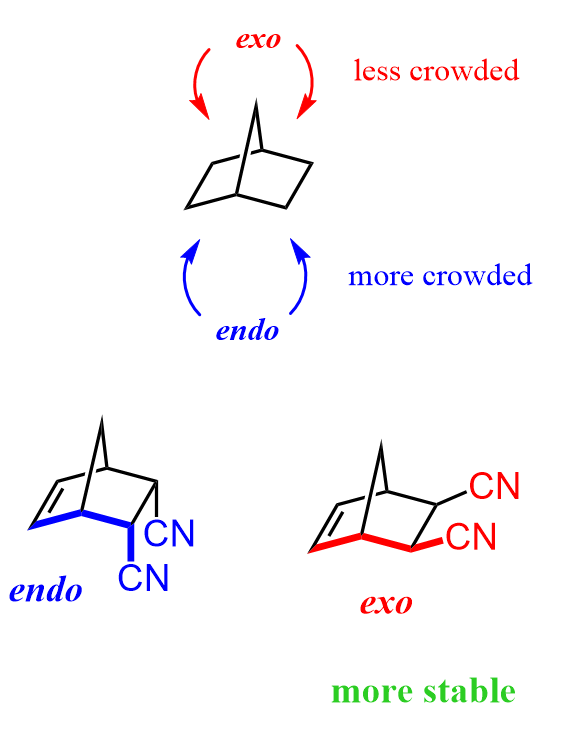
The most common products in the reactions of cyclic dienes are derivatives of norbornene, which is a bicyclic compound composed of a cyclohexene ring and a bridgehead carbon atom.
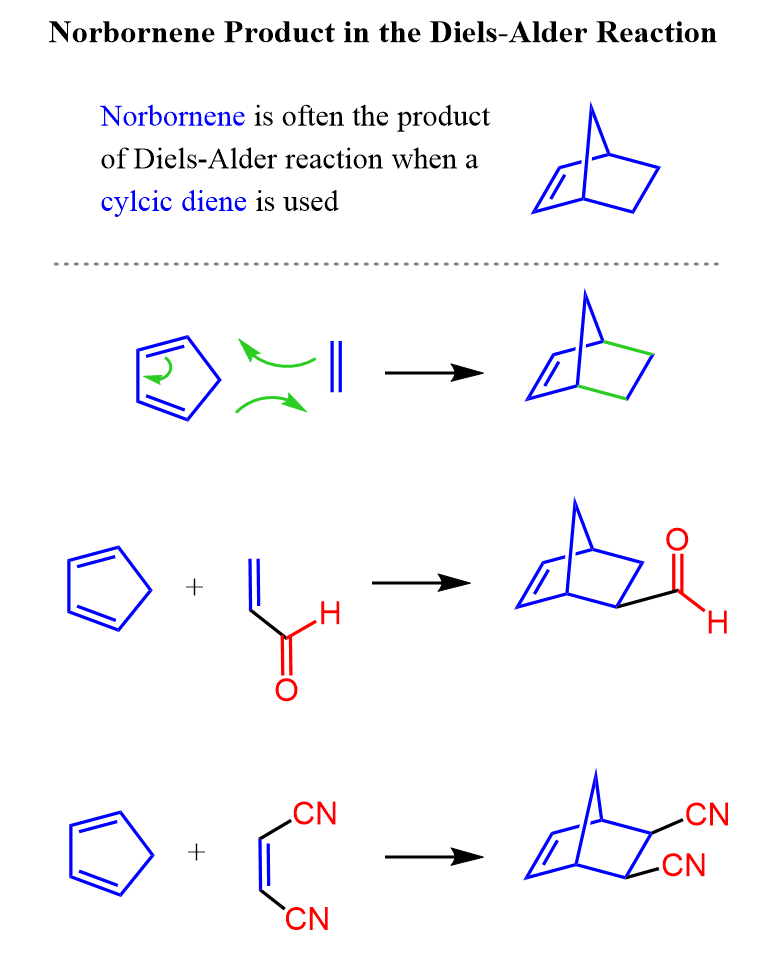


In short, the endoexo configuration is about whether the group(s) on the dienophile are pointing toward the bottom or the top face of the product in these reactions.

In the exo product, the groups are pointing out of the ring system, while in the endo product, they are pointing inward toward the ring system:


In general, the endo configuration is the major product, hence the common terminology of the Endo Rule or Endo Effect.

The reason the endo product predominates is that there are favorable secondary orbital interactions in the transition state. These arise from additional overlap between the π system of electron-withdrawing substituents on the dienophile and the developing π system of the diene. Even though these interactions are not part of the main HOMO–LUMO overlap, they stabilize the transition state, lowering its energy and making the endo pathway kinetically favored.


However, it is worth mentioning that the exo product is generally more stable because the top face (the exo face) of the norbornane framework is sterically less hindered than the bottom, endo face.

Keep in mind that the “top” and “bottom” faces are not accurate scientific descriptions because, of course, they are reversed when we flip the molecule. However, it is easier to explain these concepts this way, and we are referring to the structure as drawn – when the one-carbon bridge is on the top. Notice that there are two carbon atoms on the bottom, making that face sterically more hindered.


Cis and Trans Dienophiles in Diels-Alder Reaction

Depending on the configuration of the dienophile, cis or trans product is obtained in the reaction of cyclic dienes. More specifically, a trans dienophile forms a trans product, and a cis dienophile forms a cis product.

In the following examples, the symmetric cis dienophile forms a pair of cis exo and cis endo products, whereas the trans dienophile forms a pair of enantiomers in which the ester groups remain trans in both the exo and endo products.
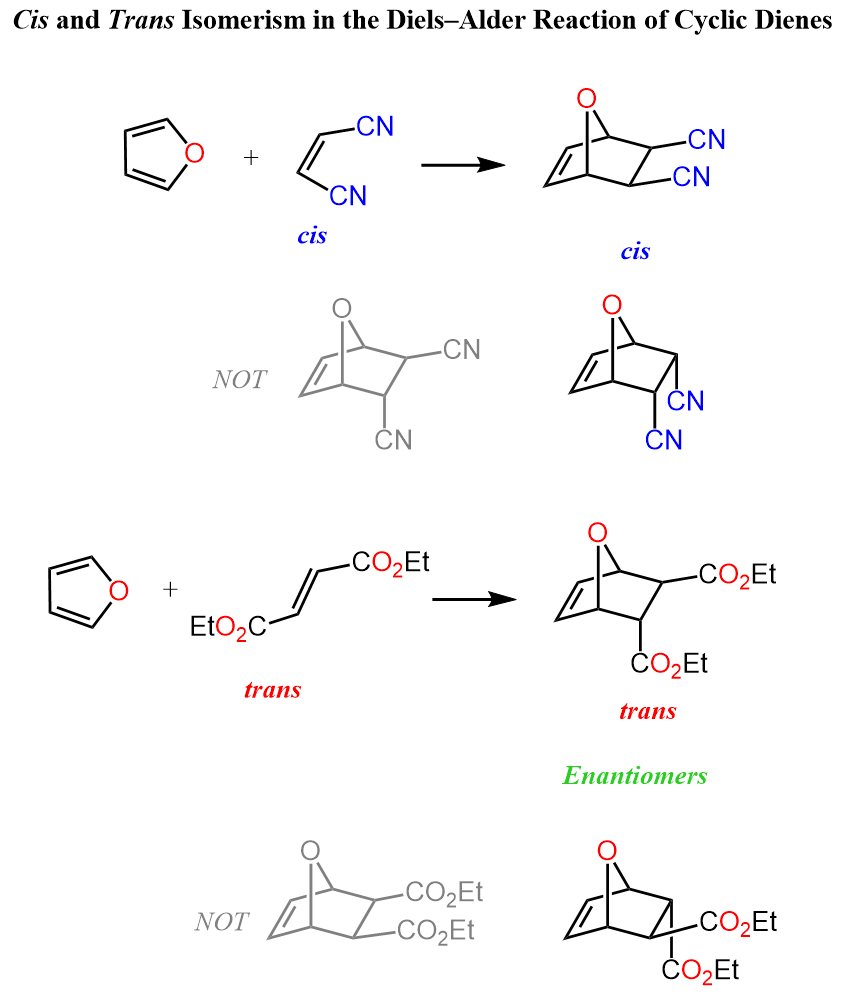


Notice that the product of the cis dienophile is a meso compound; however, when a trans dienophile is used, the symmetry is broken, and a pair of enantiomers is formed.

The Eno-Exo products and their relationship are covered in more detail in the corresponding article here, so feel free to check that out as well.


Acyclic Dienes and the Stereochemistry of the Diels-Alder Reaction

Things get a little more confusing when the diene is acyclic and we need to figure out the stereochemistry of the Diels-Alder reaction.

For example, these are the major products of the following two Diels-Alder reactions:
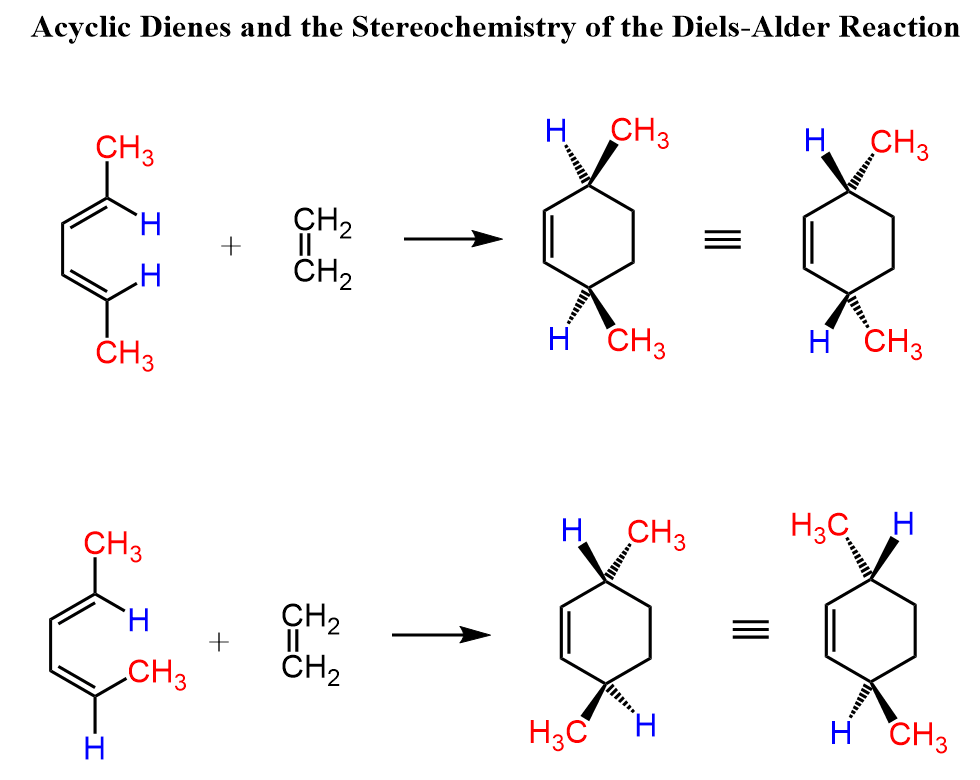


Notice that the two methyl groups in the first reaction appear cis in the product, and the ones in the second reaction are trans.

How does this occur?

There are many ways of explaining this, and they mainly differ in how deep you want to go into the molecular orbital theory of the Diels-Alder reaction, but we need to try to keep it simple and digestible, don’t we?

So, here is the shortcut to the stereochemistry of the Diels-Alder reaction.

Remember, the terminal sp2 carbons of the diene transform into sp3 atoms in the product, so although it is not accurate to show a rotation about the double bonds of the diene, we can do this in an imaginary way to visualize what’s happening.

To keep a better track of movement, we designate the groups/atoms on the terminal sp2 carbons of the diene as “outer” and “inner” groups:
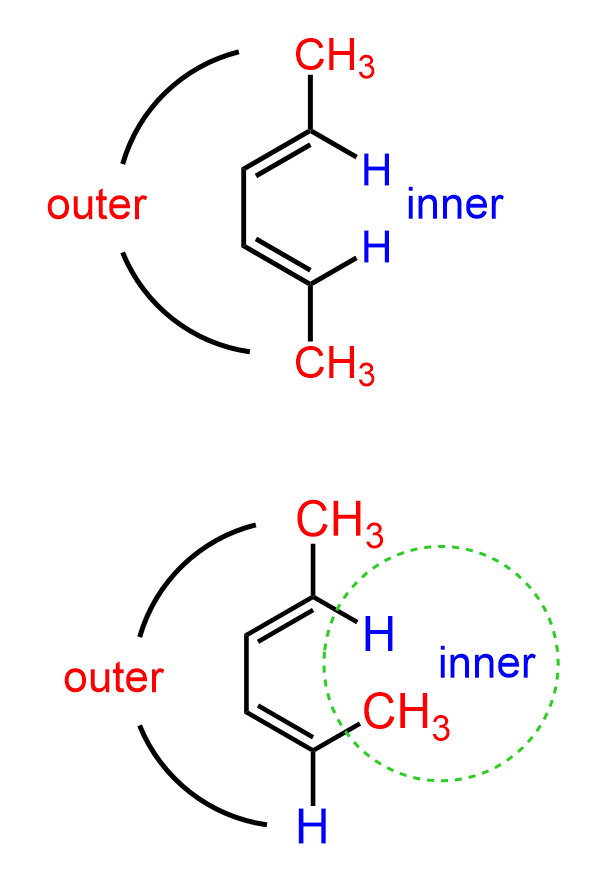


Now, back to the rotation of the diene bonds during the Diels-Alder reaction. The rotation occurs in opposite directions – if one is clockwise, the other is counterclockwise and vice versa. This moves them toward each other – the arrows are going to meet, which, in turn, means that the atoms/groups on the terminal carbons of the diene are always going to be on the same side in the product:
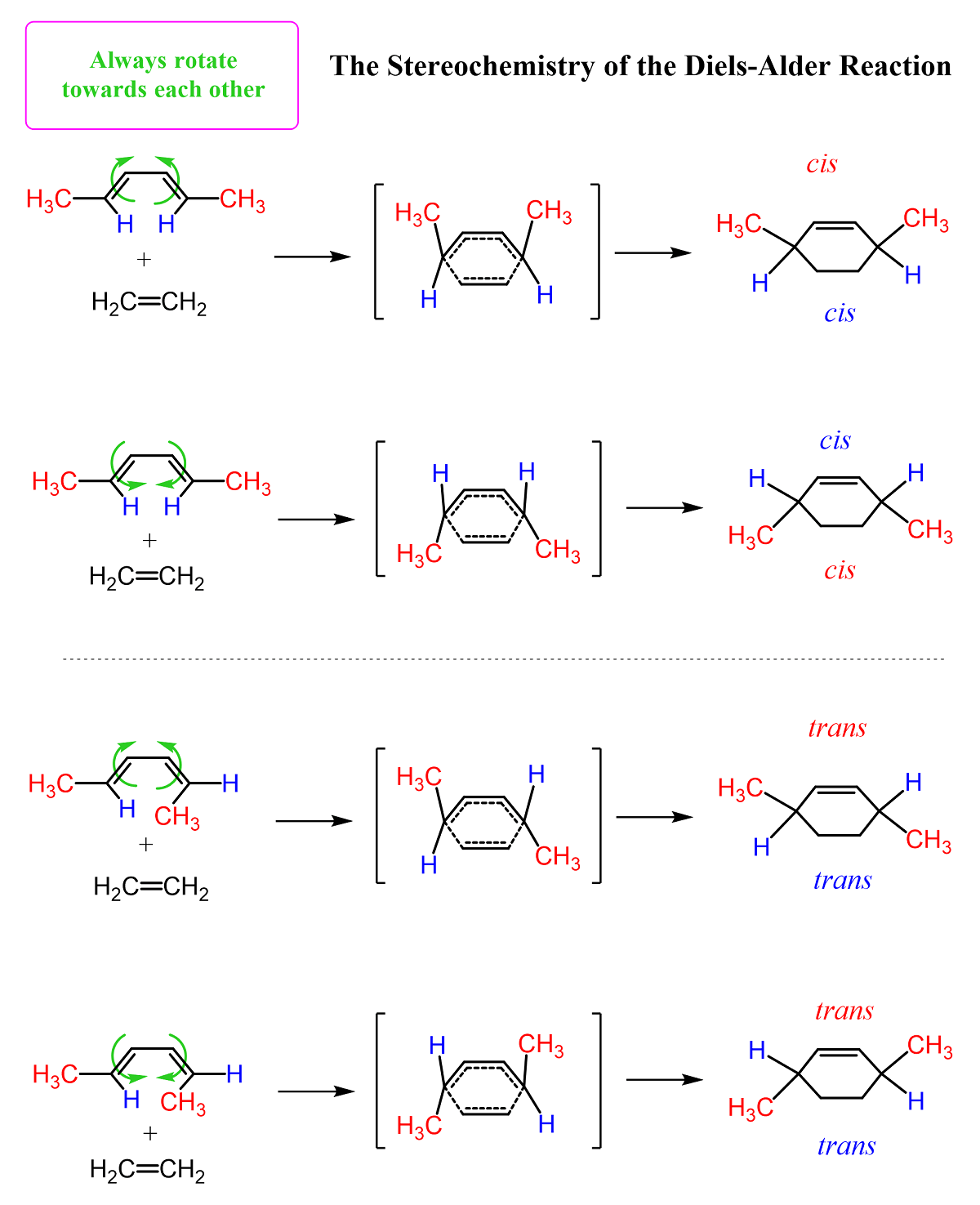


Notice that when the CH3 groups are a “mix of outer and inner” orientation, then they appear in trans configuration of the Diels-Alder product. This is demonstrated in the last two entries of the image above.

The next question is about the group on the dienophile – is it cis or trans to the methyl groups? Because the dienophile can approach the diene in any orientation, the group can be either cis or trans – both are possible. Let’s see this by replacing the symmetrical ethylene with methyl vinyl ketone (MVK), which has a carbonyl group on one of the C=C carbon atoms.

To make this easier to understand, place an imaginary CH2 group, connecting the terminal sp2 carbons of the diene, and we see that, indeed, when the carbonyl is endo, it is cis to the two CH3 groups – outer groups of the diene:


When the substituent on the dienophile is cis to the methyl groups of the diene, the product is called endo – yes, the endo-exo terminology does not pertain only to reactions of cyclic dienes. In fact, the common presentation of endo and exo products using cyclic dienes such as cyclopentadiene and similar structures is a particular case that happens to be the most frequently encountered in textbooks and introductory discussions of the Diels-Alder reaction. You can also see it on the intermediates when the green CH2 is not replaced yet – the endo carbonyl is cis with the CH3 groups, and it is trans to them in the exo isomer.


Molecular Orbitals and the Stereochemistry of the Diels-Alder Reaction

The Diels-Alder reaction occurs between the HOMO of the diene and the LUMO of the dienophile. Remember, HOMO stands for Highest Occupied Molecular Orbital, while LUMO stands for Lowest Unoccupied Molecular Orbital. This is how π molecular orbitals are formed: when p orbitals combine, they split into bonding and antibonding orbitals.

When drawing the HOMO of the diene, we need to have two in-phase lobes (matching colors) and one node. The LUMO of the dienophile is the π* orbital, which has opposite-phase lobes on the two carbon atoms of the double bond and a node between them.
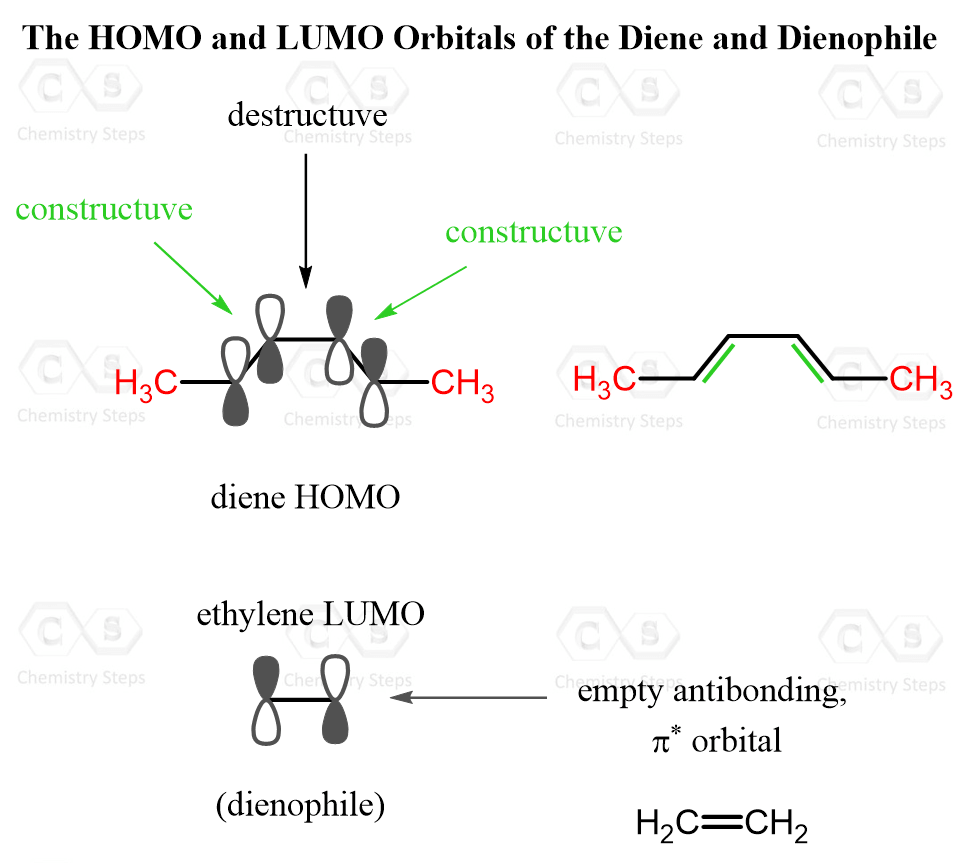


The HOMO of the diene is the highest bonding π orbital, so it retains mostly constructive overlap but includes one node due to the higher energy level. The LUMO of the dienophile is the lowest antibonding π orbital, which must have one node because the out-of-phase combination creates a sign change between the two p orbitals.

These are the frontier molecular orbitals that control many reactions involving π systems. In the Diels-Alder reaction, electrons flow from the HOMO of the diene into the LUMO of the dienophile.

Now, the idea of the Diels-Alder cycloaddition is to make the phases of the diene and dienophile match (constructive interaction) because new bonds are forming; therefore, the two bonds of the diene are rotated in opposite directions, which places the outer groups in a cis configuration:
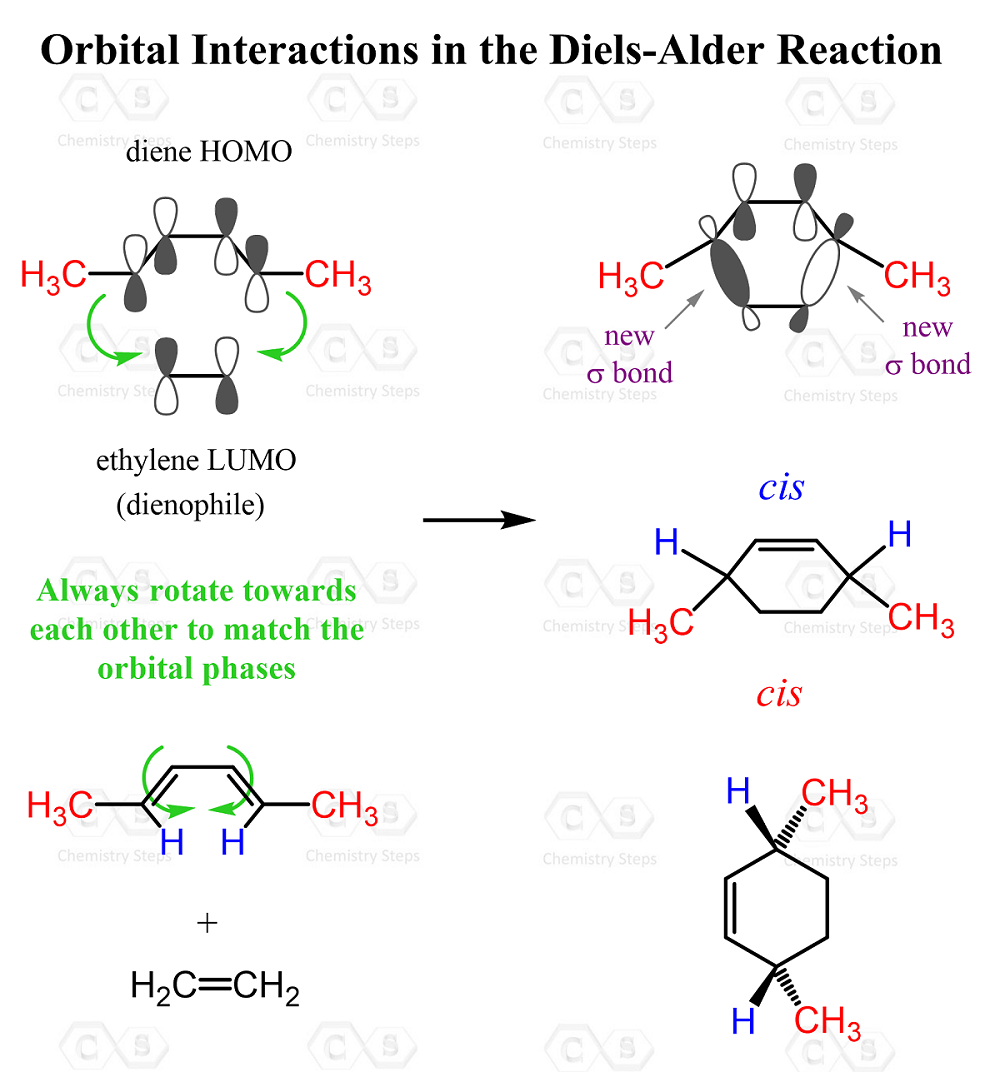


Once again, the key and the shortcut here is to remember to rotate the arrows towards each other. This helps to correctly determine the stereochemistry of the Diels-Alder reaction.
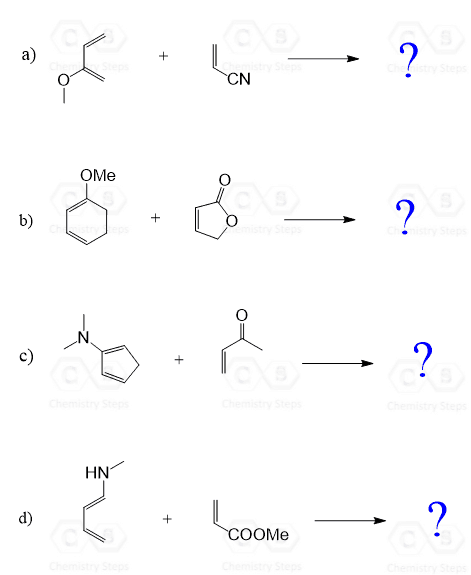
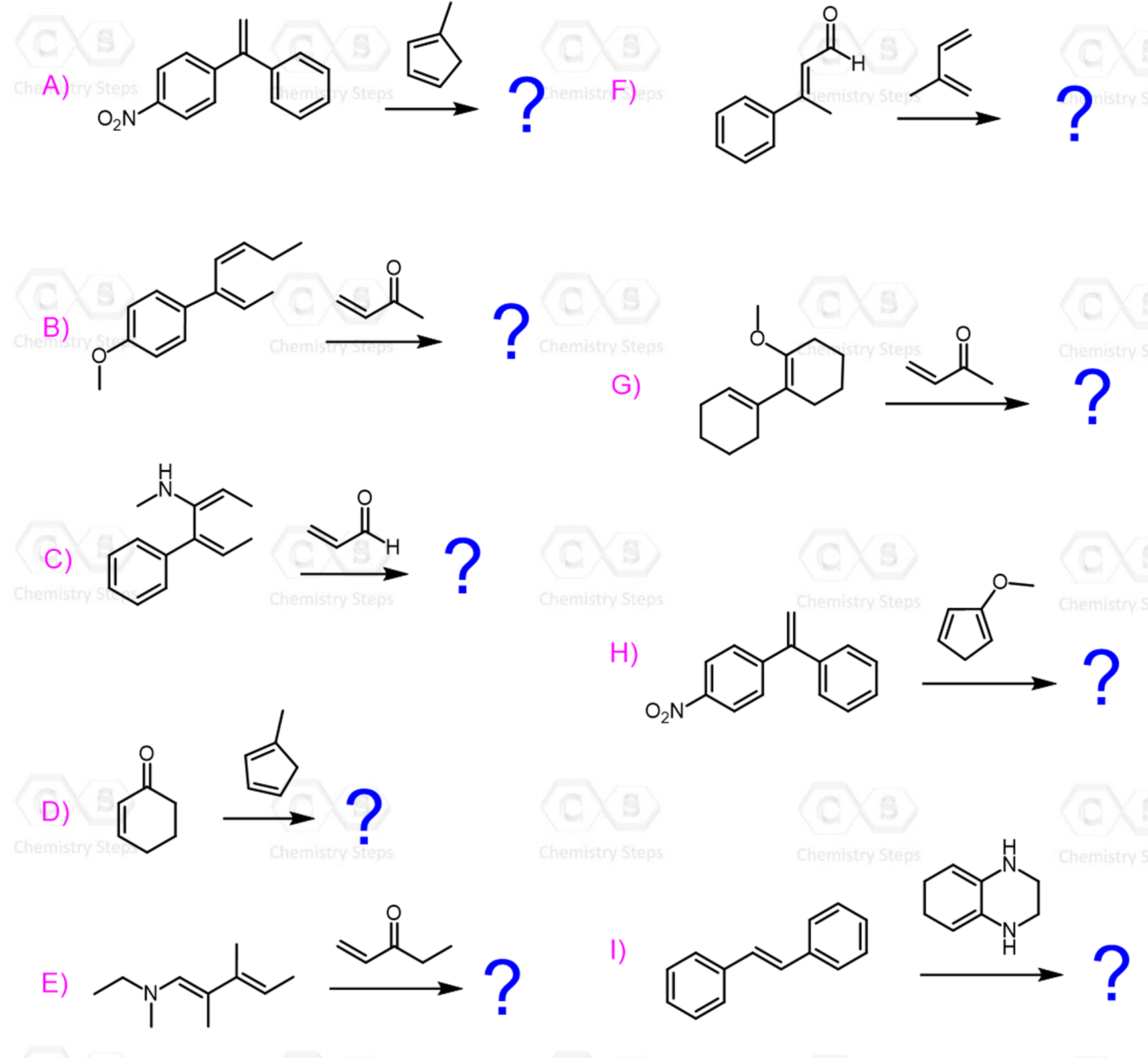


Practice

1.

Predict the regioisomer that will form as a major product for each of the following Diels–Alder reactions:

a)
Answer

This content is for registered users only.

Click here to Register!

By joining Chemistry Steps, you will gain instant access to the answers and solutions for all the Practice Problems, including over 40 hours of problem-solving videos, Multiple-Choice Quizzes, Puzzles, Reaction Maps, and the powerful set of Organic Chemistry 1 and 2 Summary Study Guides.

b)
Answer

This content is for registered users only.

Click here to Register!

By joining Chemistry Steps, you will gain instant access to the answers and solutions for all the Practice Problems, including over 40 hours of problem-solving videos, Multiple-Choice Quizzes, Puzzles, Reaction Maps, and the powerful set of Organic Chemistry 1 and 2 Summary Study Guides.

c)
Answer

This content is for registered users only.

Click here to Register!

By joining Chemistry Steps, you will gain instant access to the answers and solutions for all the Practice Problems, including over 40 hours of problem-solving videos, Multiple-Choice Quizzes, Puzzles, Reaction Maps, and the powerful set of Organic Chemistry 1 and 2 Summary Study Guides.

d)
Answer

This content is for registered users only.

Click here to Register!

By joining Chemistry Steps, you will gain instant access to the answers and solutions for all the Practice Problems, including over 40 hours of problem-solving videos, Multiple-Choice Quizzes, Puzzles, Reaction Maps, and the powerful set of Organic Chemistry 1 and 2 Summary Study Guides.

Solution

This content is for registered users only.

Click here to Register!

By joining Chemistry Steps, you will gain instant access to the answers and solutions for all the Practice Problems, including over 40 hours of problem-solving videos, Multiple-Choice Quizzes, Puzzles, Reaction Maps, and the powerful set of Organic Chemistry 1 and 2 Summary Study Guides.

2.

For each Diels–Alder reaction, predict the major product(s) by addressing the regiochemistry and stereochemistry. Identify the Endo and Exo isomers for the reaction of all the cyclic and acyclic dienes.


a)
Answer

This content is for registered users only.

Click here to Register!

By joining Chemistry Steps, you will gain instant access to the answers and solutions for all the Practice Problems, including over 40 hours of problem-solving videos, Multiple-Choice Quizzes, Puzzles, Reaction Maps, and the powerful set of Organic Chemistry 1 and 2 Summary Study Guides.

b)
Answer

This content is for registered users only.

Click here to Register!

By joining Chemistry Steps, you will gain instant access to the answers and solutions for all the Practice Problems, including over 40 hours of problem-solving videos, Multiple-Choice Quizzes, Puzzles, Reaction Maps, and the powerful set of Organic Chemistry 1 and 2 Summary Study Guides.

c)
Answer

This content is for registered users only.

Click here to Register!

By joining Chemistry Steps, you will gain instant access to the answers and solutions for all the Practice Problems, including over 40 hours of problem-solving videos, Multiple-Choice Quizzes, Puzzles, Reaction Maps, and the powerful set of Organic Chemistry 1 and 2 Summary Study Guides.

d)
Answer

This content is for registered users only.

Click here to Register!

By joining Chemistry Steps, you will gain instant access to the answers and solutions for all the Practice Problems, including over 40 hours of problem-solving videos, Multiple-Choice Quizzes, Puzzles, Reaction Maps, and the powerful set of Organic Chemistry 1 and 2 Summary Study Guides.

e)
Answer


This content is for registered users only.

Click here to Register!

By joining Chemistry Steps, you will gain instant access to the answers and solutions for all the Practice Problems, including over 40 hours of problem-solving videos, Multiple-Choice Quizzes, Puzzles, Reaction Maps, and the powerful set of Organic Chemistry 1 and 2 Summary Study Guides.

f)
Answer

This content is for registered users only.

Click here to Register!

By joining Chemistry Steps, you will gain instant access to the answers and solutions for all the Practice Problems, including over 40 hours of problem-solving videos, Multiple-Choice Quizzes, Puzzles, Reaction Maps, and the powerful set of Organic Chemistry 1 and 2 Summary Study Guides.

g)
Answer

This content is for registered users only.

Click here to Register!

By joining Chemistry Steps, you will gain instant access to the answers and solutions for all the Practice Problems, including over 40 hours of problem-solving videos, Multiple-Choice Quizzes, Puzzles, Reaction Maps, and the powerful set of Organic Chemistry 1 and 2 Summary Study Guides.

h)
Answer

This content is for registered users only.

Click here to Register!

By joining Chemistry Steps, you will gain instant access to the answers and solutions for all the Practice Problems, including over 40 hours of problem-solving videos, Multiple-Choice Quizzes, Puzzles, Reaction Maps, and the powerful set of Organic Chemistry 1 and 2 Summary Study Guides.

i)
Answer

This content is for registered users only.

Click here to Register!

By joining Chemistry Steps, you will gain instant access to the answers and solutions for all the Practice Problems, including over 40 hours of problem-solving videos, Multiple-Choice Quizzes, Puzzles, Reaction Maps, and the powerful set of Organic Chemistry 1 and 2 Summary Study Guides.

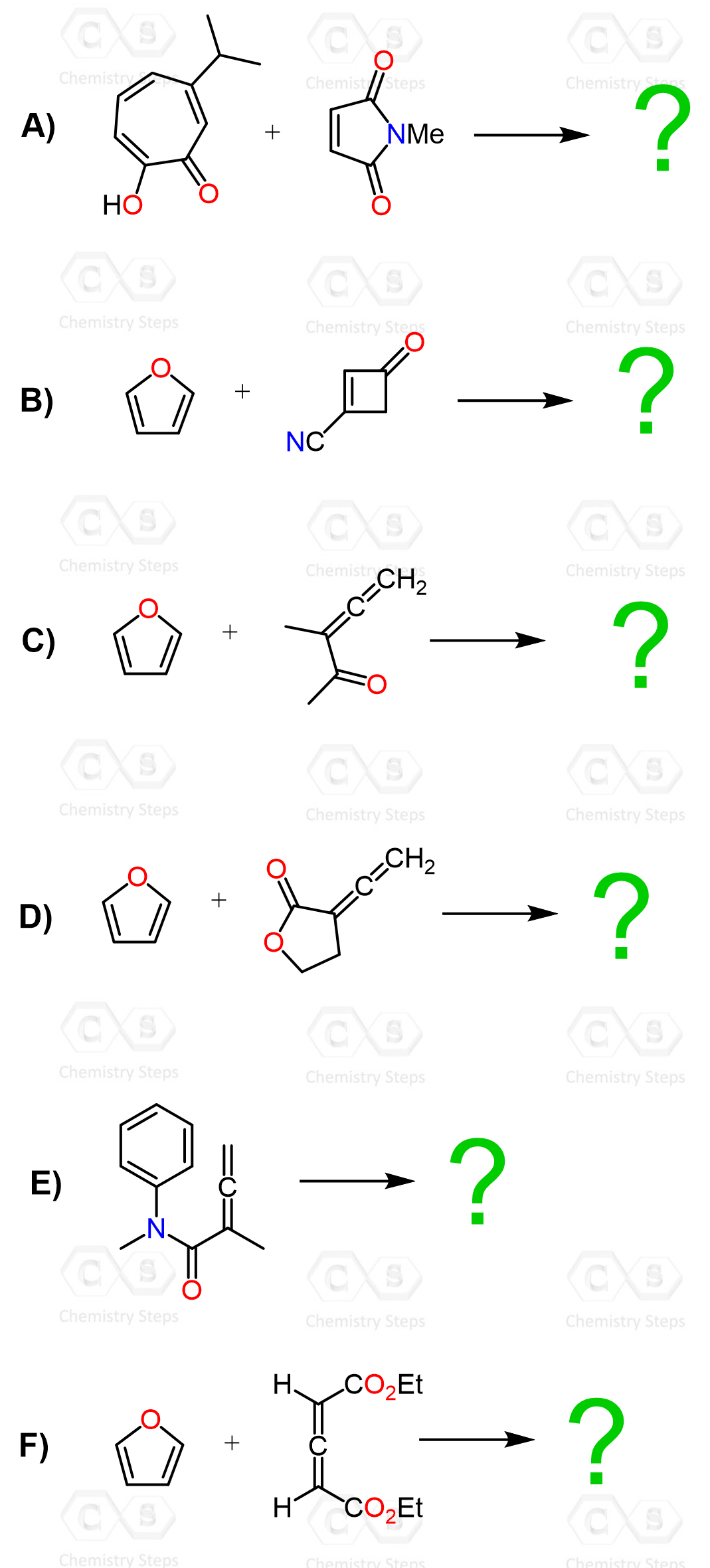
3.

For each Diels–Alder reaction, predict the major product(s) with correct stereochemistry when each cyclic diene is reacted with a dienophile:

a)
Answer

b)
Answer

This content is for registered users only.

Click here to Register!

By joining Chemistry Steps, you will gain instant access to the answers and solutions for all the Practice Problems, including over 40 hours of problem-solving videos, Multiple-Choice Quizzes, Puzzles, Reaction Maps, and the powerful set of Organic Chemistry 1 and 2 Summary Study Guides.

c)
Answer

This content is for registered users only.

Click here to Register!

By joining Chemistry Steps, you will gain instant access to the answers and solutions for all the Practice Problems, including over 40 hours of problem-solving videos, Multiple-Choice Quizzes, Puzzles, Reaction Maps, and the powerful set of Organic Chemistry 1 and 2 Summary Study Guides.

d)
Answer

This content is for registered users only.

Click here to Register!

By joining Chemistry Steps, you will gain instant access to the answers and solutions for all the Practice Problems, including over 40 hours of problem-solving videos, Multiple-Choice Quizzes, Puzzles, Reaction Maps, and the powerful set of Organic Chemistry 1 and 2 Summary Study Guides.

e)
Answer

This content is for registered users only.

Click here to Register!

By joining Chemistry Steps, you will gain instant access to the answers and solutions for all the Practice Problems, including over 40 hours of problem-solving videos, Multiple-Choice Quizzes, Puzzles, Reaction Maps, and the powerful set of Organic Chemistry 1 and 2 Summary Study Guides.

Solution

This content is for registered users only.

Click here to Register!

By joining Chemistry Steps, you will gain instant access to the answers and solutions for all the Practice Problems, including over 40 hours of problem-solving videos, Multiple-Choice Quizzes, Puzzles, Reaction Maps, and the powerful set of Organic Chemistry 1 and 2 Summary Study Guides.

4.

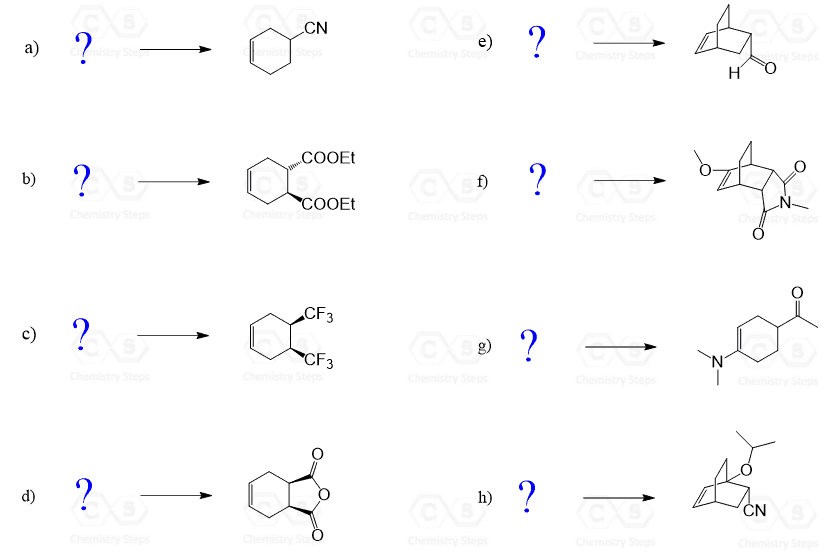
Identify the Diene and Dienophile with correct stereochemistry for each fo the following Diels–Alder Reactions:

a)
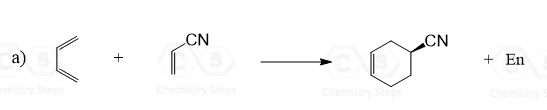
Answer

b)
Answer

This content is for registered users only.

Click here to Register!

By joining Chemistry Steps, you will gain instant access to the answers and solutions for all the Practice Problems, including over 40 hours of problem-solving videos, Multiple-Choice Quizzes, Puzzles, Reaction Maps, and the powerful set of Organic Chemistry 1 and 2 Summary Study Guides.

c)
Answer

This content is for registered users only.

Click here to Register!

By joining Chemistry Steps, you will gain instant access to the answers and solutions for all the Practice Problems, including over 40 hours of problem-solving videos, Multiple-Choice Quizzes, Puzzles, Reaction Maps, and the powerful set of Organic Chemistry 1 and 2 Summary Study Guides.

d)
Answer

This content is for registered users only.

Click here to Register!

By joining Chemistry Steps, you will gain instant access to the answers and solutions for all the Practice Problems, including over 40 hours of problem-solving videos, Multiple-Choice Quizzes, Puzzles, Reaction Maps, and the powerful set of Organic Chemistry 1 and 2 Summary Study Guides.

e)
Answer

This content is for registered users only.

Click here to Register!

By joining Chemistry Steps, you will gain instant access to the answers and solutions for all the Practice Problems, including over 40 hours of problem-solving videos, Multiple-Choice Quizzes, Puzzles, Reaction Maps, and the powerful set of Organic Chemistry 1 and 2 Summary Study Guides.

f)
Answer

This content is for registered users only.

Click here to Register!

By joining Chemistry Steps, you will gain instant access to the answers and solutions for all the Practice Problems, including over 40 hours of problem-solving videos, Multiple-Choice Quizzes, Puzzles, Reaction Maps, and the powerful set of Organic Chemistry 1 and 2 Summary Study Guides.

g)
Answer

This content is for registered users only.

Click here to Register!

By joining Chemistry Steps, you will gain instant access to the answers and solutions for all the Practice Problems, including over 40 hours of problem-solving videos, Multiple-Choice Quizzes, Puzzles, Reaction Maps, and the powerful set of Organic Chemistry 1 and 2 Summary Study Guides.

h)
Answer

This content is for registered users only.

Click here to Register!

By joining Chemistry Steps, you will gain instant access to the answers and solutions for all the Practice Problems, including over 40 hours of problem-solving videos, Multiple-Choice Quizzes, Puzzles, Reaction Maps, and the powerful set of Organic Chemistry 1 and 2 Summary Study Guides.

Solution

This content is for registered users only.

Click here to Register!

By joining Chemistry Steps, you will gain instant access to the answers and solutions for all the Practice Problems, including over 40 hours of problem-solving videos, Multiple-Choice Quizzes, Puzzles, Reaction Maps, and the powerful set of Organic Chemistry 1 and 2 Summary Study Guides.

5.

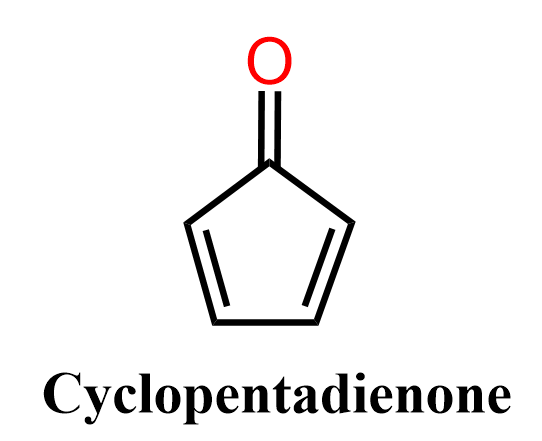
The synthesis of cyclopentadienone is challenging, and a Diels-Alder adduct is obtained. Explain why it is difficult to synthesize cyclopentadienone and draw the structure of the Diels-Alder adduct.

Answer

This content is for registered users only.

Click here to Register!

By joining Chemistry Steps, you will gain instant access to the answers and solutions for all the Practice Problems, including over 40 hours of problem-solving videos, Multiple-Choice Quizzes, Puzzles, Reaction Maps, and the powerful set of Organic Chemistry 1 and 2 Summary Study Guides.

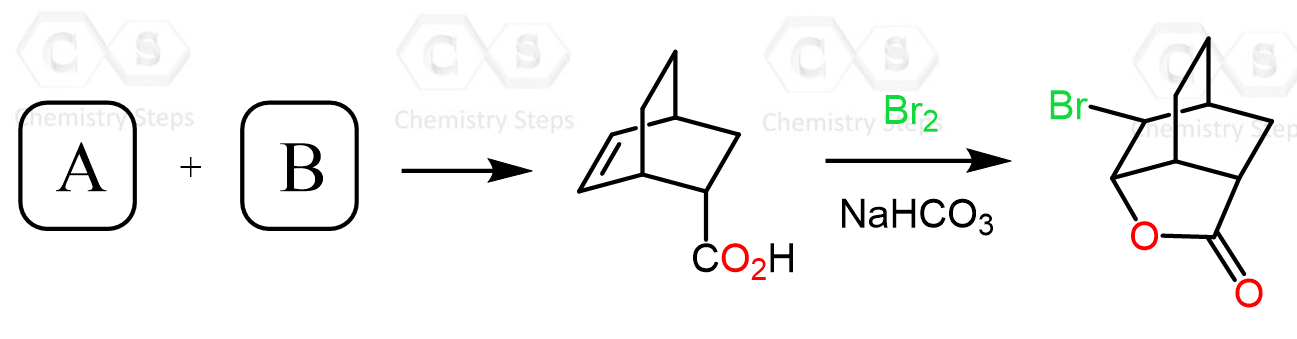
6.

Identify compounds A and B and propose a mechanism for the following synthesis:

Answer

This content is for registered users only.

Click here to Register!

By joining Chemistry Steps, you will gain instant access to the answers and solutions for all the Practice Problems, including over 40 hours of problem-solving videos, Multiple-Choice Quizzes, Puzzles, Reaction Maps, and the powerful set of Organic Chemistry 1 and 2 Summary Study Guides.

Solution

This content is for registered users only.

Click here to Register!

By joining Chemistry Steps, you will gain instant access to the answers and solutions for all the Practice Problems, including over 40 hours of problem-solving videos, Multiple-Choice Quizzes, Puzzles, Reaction Maps, and the powerful set of Organic Chemistry 1 and 2 Summary Study Guides.

7.

Draw the mechanism to predict the major product(s) in each Diels-Alder reaction:

a)
Answer

This content is for registered users only.

Click here to Register!

By joining Chemistry Steps, you will gain instant access to the answers and solutions for all the Practice Problems, including over 40 hours of problem-solving videos, Multiple-Choice Quizzes, Puzzles, Reaction Maps, and the powerful set of Organic Chemistry 1 and 2 Summary Study Guides.

b)
Answer

This content is for registered users only.

Click here to Register!

By joining Chemistry Steps, you will gain instant access to the answers and solutions for all the Practice Problems, including over 40 hours of problem-solving videos, Multiple-Choice Quizzes, Puzzles, Reaction Maps, and the powerful set of Organic Chemistry 1 and 2 Summary Study Guides.

c)
Answer

This content is for registered users only.

Click here to Register!

By joining Chemistry Steps, you will gain instant access to the answers and solutions for all the Practice Problems, including over 40 hours of problem-solving videos, Multiple-Choice Quizzes, Puzzles, Reaction Maps, and the powerful set of Organic Chemistry 1 and 2 Summary Study Guides.

d)
Answer

This content is for registered users only.

Click here to Register!

By joining Chemistry Steps, you will gain instant access to the answers and solutions for all the Practice Problems, including over 40 hours of problem-solving videos, Multiple-Choice Quizzes, Puzzles, Reaction Maps, and the powerful set of Organic Chemistry 1 and 2 Summary Study Guides.

e)
Answer

This content is for registered users only.

Click here to Register!

By joining Chemistry Steps, you will gain instant access to the answers and solutions for all the Practice Problems, including over 40 hours of problem-solving videos, Multiple-Choice Quizzes, Puzzles, Reaction Maps, and the powerful set of Organic Chemistry 1 and 2 Summary Study Guides.

f)
Answer

This content is for registered users only.

Click here to Register!

By joining Chemistry Steps, you will gain instant access to the answers and solutions for all the Practice Problems, including over 40 hours of problem-solving videos, Multiple-Choice Quizzes, Puzzles, Reaction Maps, and the powerful set of Organic Chemistry 1 and 2 Summary Study Guides.

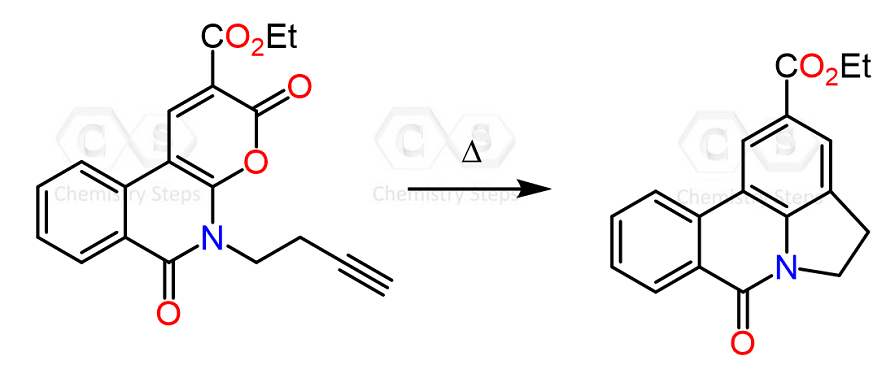
8.

Draw a mechanism for the following synthetic transformation that involves a Diels-Alder reaction:

Answer

This content is for registered users only.

Click here to Register!

By joining Chemistry Steps, you will gain instant access to the answers and solutions for all the Practice Problems, including over 40 hours of problem-solving videos, Multiple-Choice Quizzes, Puzzles, Reaction Maps, and the powerful set of Organic Chemistry 1 and 2 Summary Study Guides.

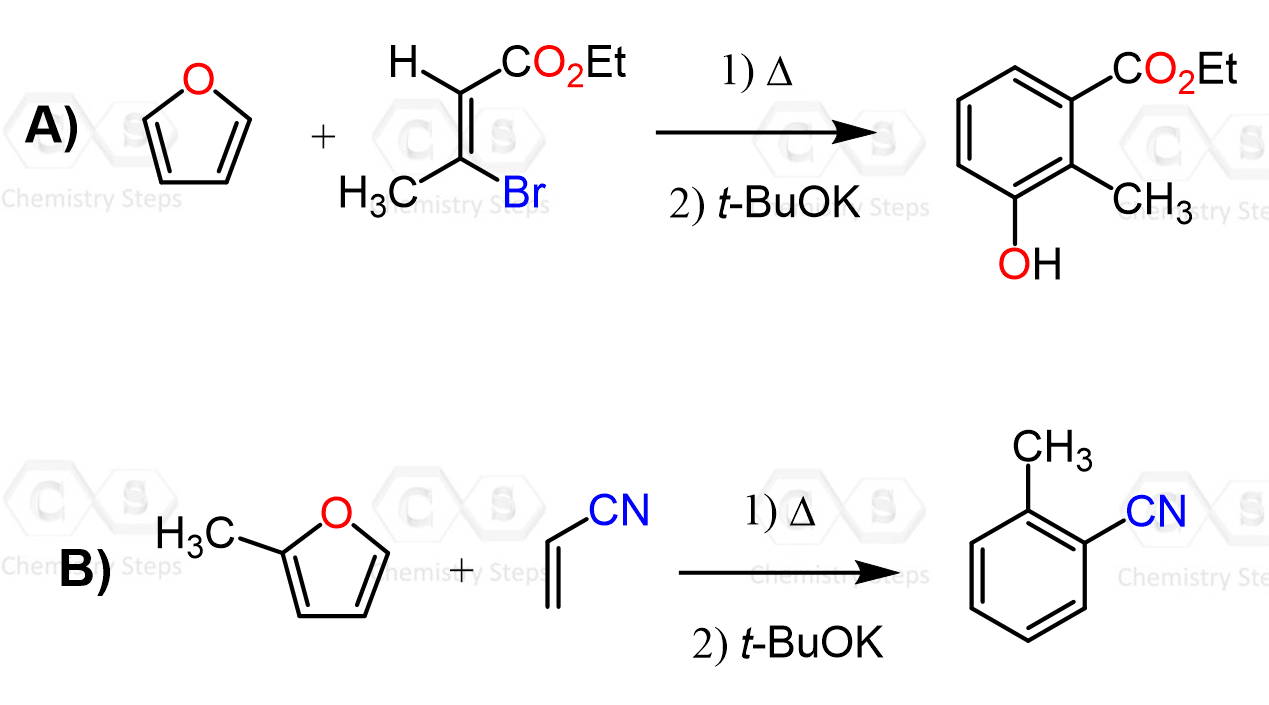
9.

Draw a plausible curved arrow mechanism for the following reactions:

a)
Answer

This content is for registered users only.

Click here to Register!

By joining Chemistry Steps, you will gain instant access to the answers and solutions for all the Practice Problems, including over 40 hours of problem-solving videos, Multiple-Choice Quizzes, Puzzles, Reaction Maps, and the powerful set of Organic Chemistry 1 and 2 Summary Study Guides.

b)
Answer

This content is for registered users only.

Click here to Register!

By joining Chemistry Steps, you will gain instant access to the answers and solutions for all the Practice Problems, including over 40 hours of problem-solving videos, Multiple-Choice Quizzes, Puzzles, Reaction Maps, and the powerful set of Organic Chemistry 1 and 2 Summary Study Guides.

10.

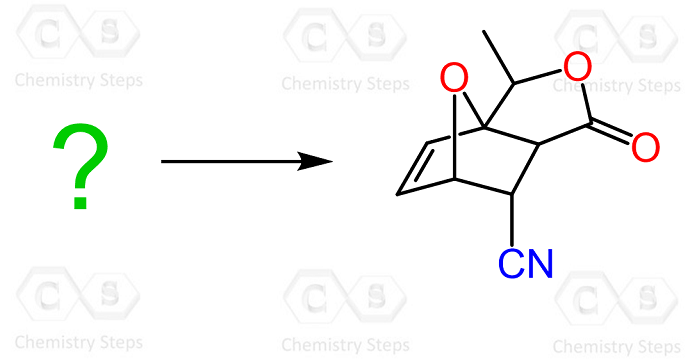
Identify the starting material(s) in the formation of the following lactone via a Diels-Alder reaction:

Answer

This content is for registered users only.

Click here to Register!

By joining Chemistry Steps, you will gain instant access to the answers and solutions for all the Practice Problems, including over 40 hours of problem-solving videos, Multiple-Choice Quizzes, Puzzles, Reaction Maps, and the powerful set of Organic Chemistry 1 and 2 Summary Study Guides.

Share Your Thoughts, Ask that Question!

Stuck? Need a Quick Guidance?

🔴 Our Live Board is Here! 🖥️✏️