We have seen earlier in the chapter on alcohols that the carbonyl group can be reduced to an alcohol by different methods, such as using LiAlH4, NaBH4, or even catalytic hydrogenation.
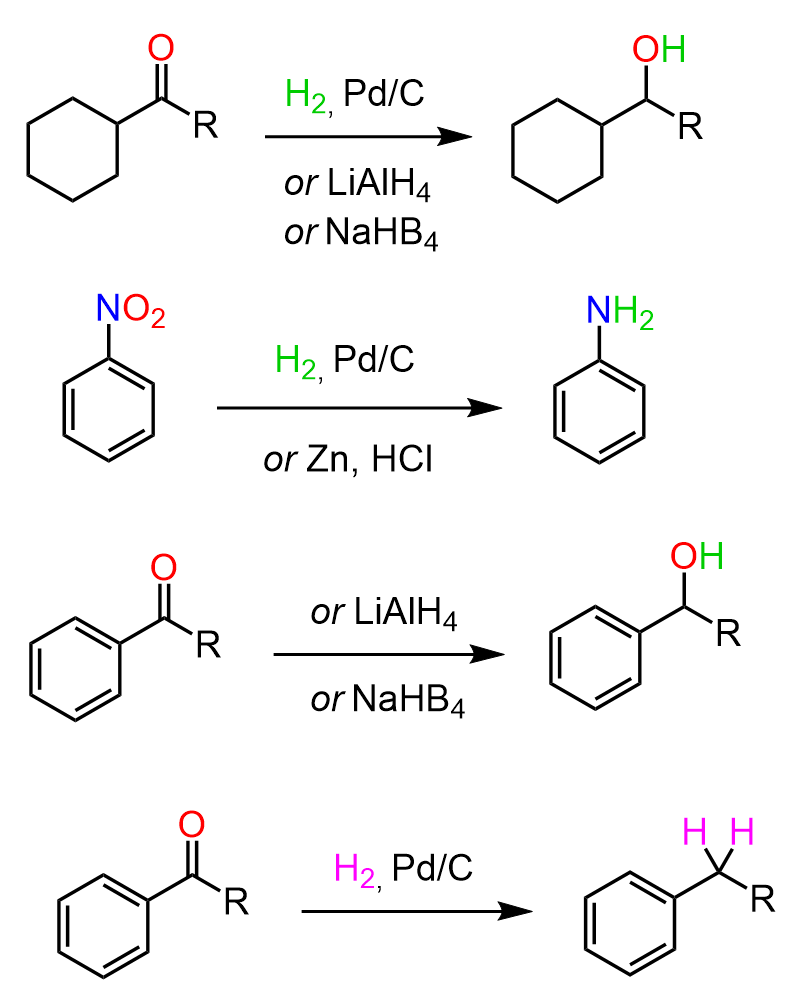
Now, very often in synthesis problems, we need to get rid of the oxygen completely – that is, to convert the carbonyl group into an alkane, as we see in the last example above. This conversion of carbonyls to CH2 by catalytic hydrogenation is specific to the benzylic position. Another drawback is that not every functional group survives the conditions of catalytic hydrogenation.
So, is there a universal approach for the deoxygenation of aldehydes and ketones?
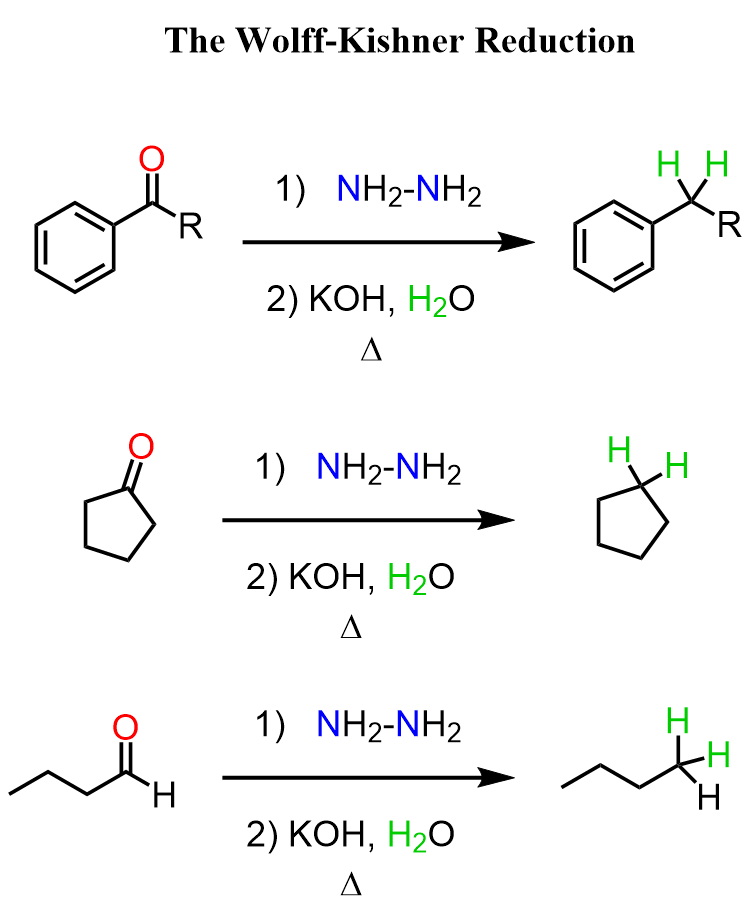
One of the reactions that achieves this is the Wolff-Kishner reduction, which can be used for reducing aliphatic and aromatic aldehydes and ketones to the corresponding C-H bond derivatives. The reaction is carried out using hydrazine in a hot basic solution:
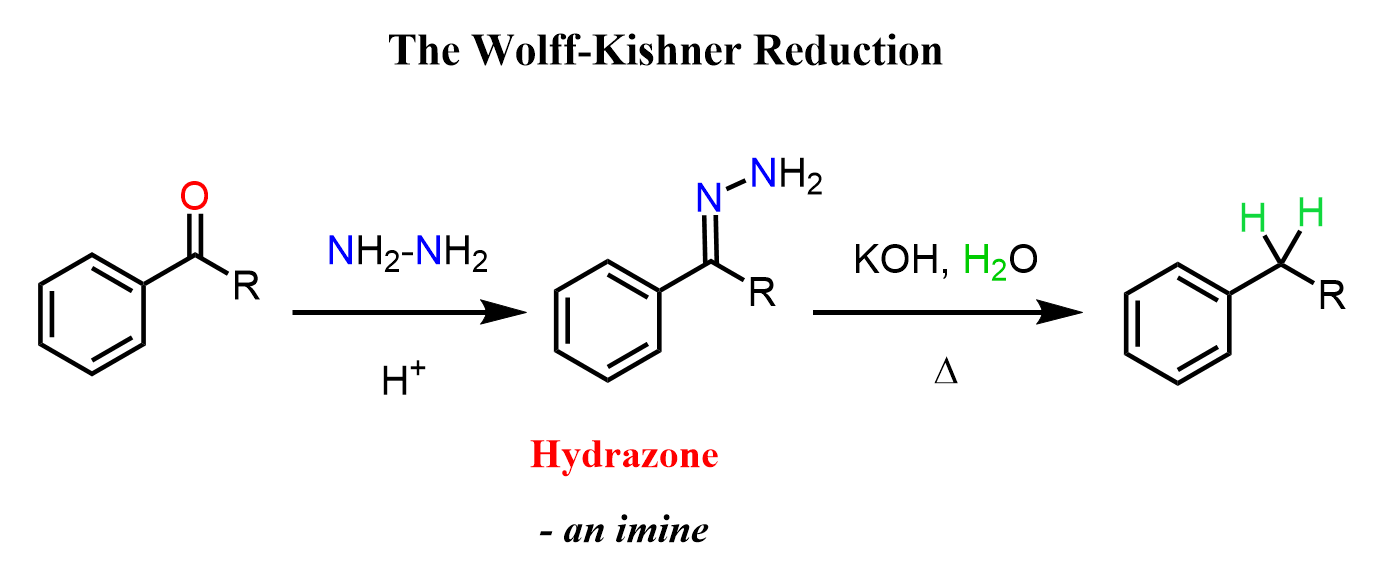
The conversion consists of two main parts. In the first part, the carbonyl reacts with hydrazine, forming the hydrazone intermediate. It is an imine derivative, which can be formed either in acidic or basic solution via a nucleophilic addition-elimination mechanism of hydrazine to the carbonyl. In the second part, the hydrazone is converted into the alkane under strongly basic and high-temperature conditions.
The Mechanism of the Wolff-Kishner Reaction
The reaction starts with the formation of the hydrazone imine, which is typically facilitated under mild acidic conditions. The protonation of the carbonyl is needed to activate the C=O bond toward the nucleophilic attack of the nitrogen. A couple of proton transfers facilitate the elimination of water, which forms the C=N bond of the imine. You can read this article for more information about the formation of imines and enamines.
Next, we have the second part, which is the reduction of the C=N bond via the loss of nitrogen gas, which is the driving force of the reaction, making it irreversible.
It starts with the deprotonation of the hydrazone, forming a resonance-stabilized anionic intermediate:
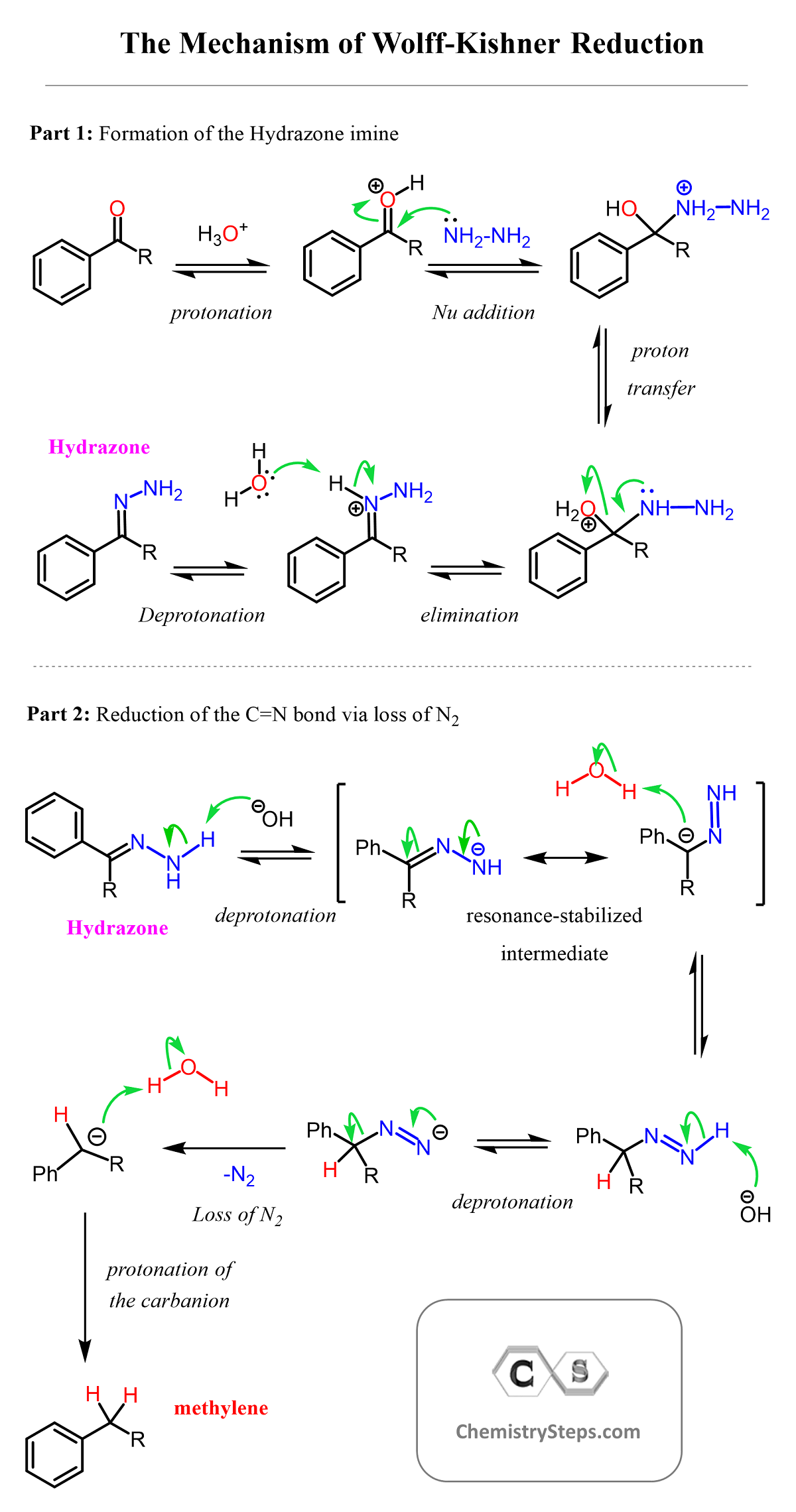
This intermediate is then protonated at the carbon by water, and the process repeats one more time, thus introducing the two methylene protons of the CH2 group. Notice that all the steps, from the formation of the imine to the reduction of the C=N bond, are reversible except for the loss of nitrogen gas, which bubbles out of the solution. The formation and release of N2 is the driving force of the reaction, providing a significant entropy gain and making the overall process irreversible.
Although not mentioned in most undergraduate textbooks, I want to add here that the Wolf-Kishner reaction often requires temperatures above 200 oC for which a high boiling point solvent such as diethylene glycol is used.
The Clemmensen reduction
A similar conversion of aldehydes and ketones is achieved via the Clemmensen reduction, which uses zinc amalgam (Zn(Hg)) in concentrated hydrochloric acid to reduce the carbonyl group to an alkane (to methylene, to be more accurate).
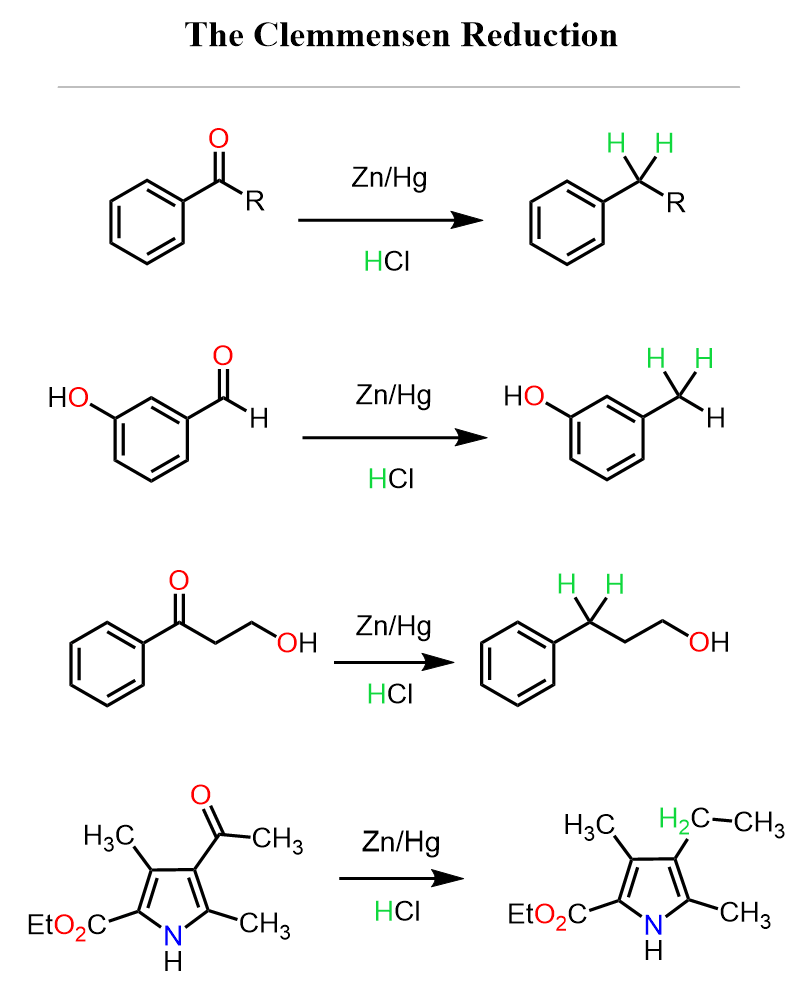
The given examples are from the book Comprehensive Organic Synthesis, so the compatibility of the functional groups was reported in the literature.
The mechanism of this reduction is more complicated and remains somewhat uncertain, so it is normally not covered in undergraduate coursework. However, a plausible representation of the mechanism involves the initial addition of the carbonyl group to the zinc metal, followed by a rearrangement to yield a zinc carbenoid intermediate. Protonation of this intermediate by the acidic medium then leads to the formation of the new methylene (CH2) bonds:
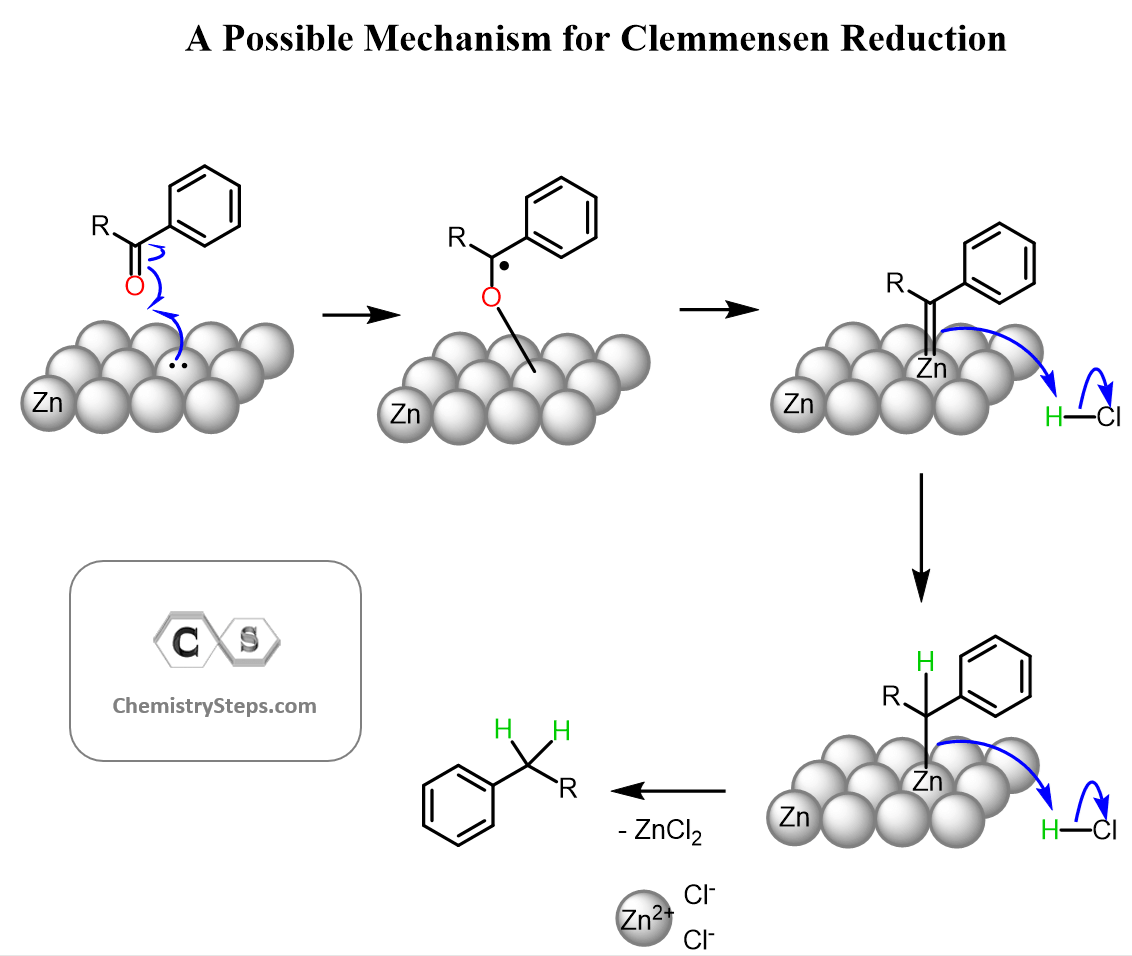
From a practical standpoint, however, it serves the same purpose as the Wolff-Kishner reduction – converting aldehydes and ketones into alkanes. The key difference is that the Clemmensen reduction is carried out under strongly acidic conditions, whereas the Wolff-Kishner reduction requires strongly basic conditions. Therefore, the choice between the two methods depends on the functional groups present in the molecule and their compatibility with acidic or basic reaction conditions.
The Clemmensen reduction is most commonly used to deoxygenate ketones adjacent to aromatic rings. One drawback of the original method reported by Clemmensen in 1913 is the toxicity of the zinc amalgam due to the presence of mercury. Because of this, a number of modifications to the reaction have been developed over the years, including procedures that use zinc dust instead of the amalgam.
The Application of Wolff-Kishner and Clemmensen Reductions
The main application of these two reductions that you are going to see in your organic chemistry course is the introduction of alkyl groups that are prone to rearrangements on the benzene ring.
We are talking about the Friedel-Crafts alkylation and acylation reactions. Remember, in the Friedel-Crafts alkylation, the alkyl group is introduced by using an alkyl halide in the presence of a Lewis acid catalyst such as AlCl3.
The main limitation of this method is the fact that the reaction proceeds via the formation of a carbocation intermediate, which, as we know, always comes with the risk of undesired rearrangements.
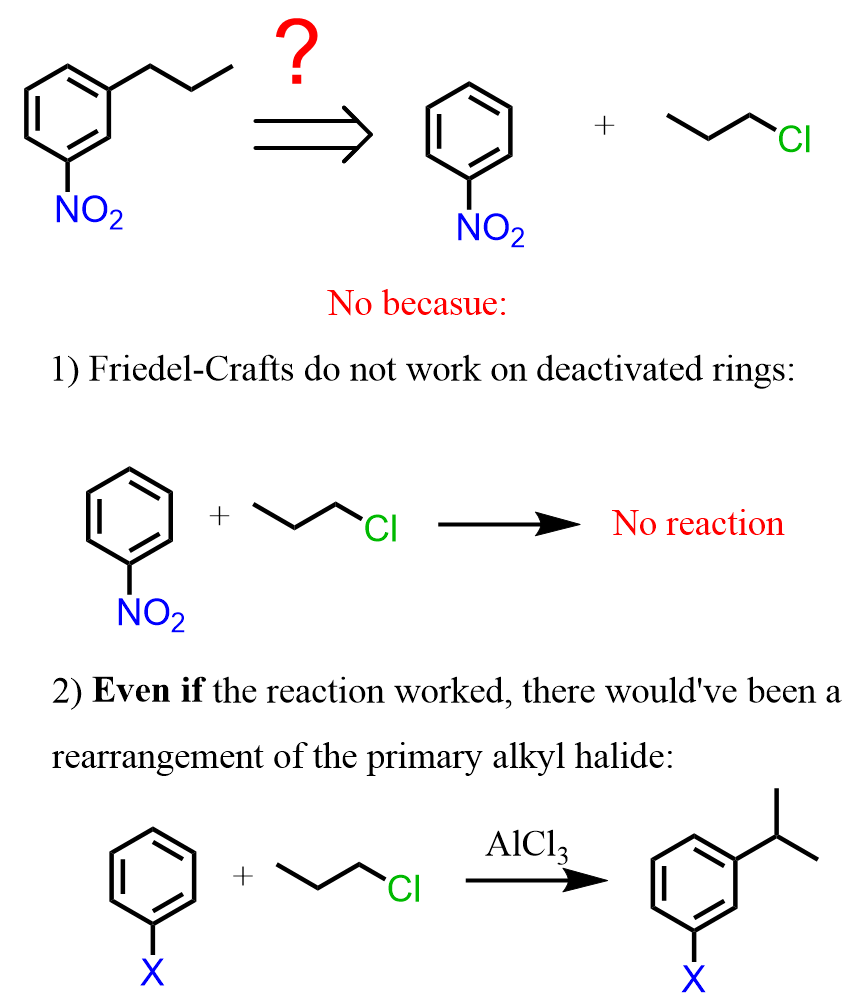
For example, isopropylbenzene is the major product of the Friedel-Crafts reaction between benzene and propyl chloride because the intermediate complex between propyl chloride and AlCl3 has a carbocation character and rearranges to the more stable isopropyl cation:

To overcome this problem, Friedel-Crafts acylation can be used instead. Unlike alkylation, acylation proceeds through an acylium ion, which is stabilized by resonance and therefore does not undergo rearrangement:

Once we have the acyl group on the benzene ring, we can remove the carbonyl by either the Wolff-Kishner or Clemmensen reduction, giving the desired alkylbenzene without any rearrangement:
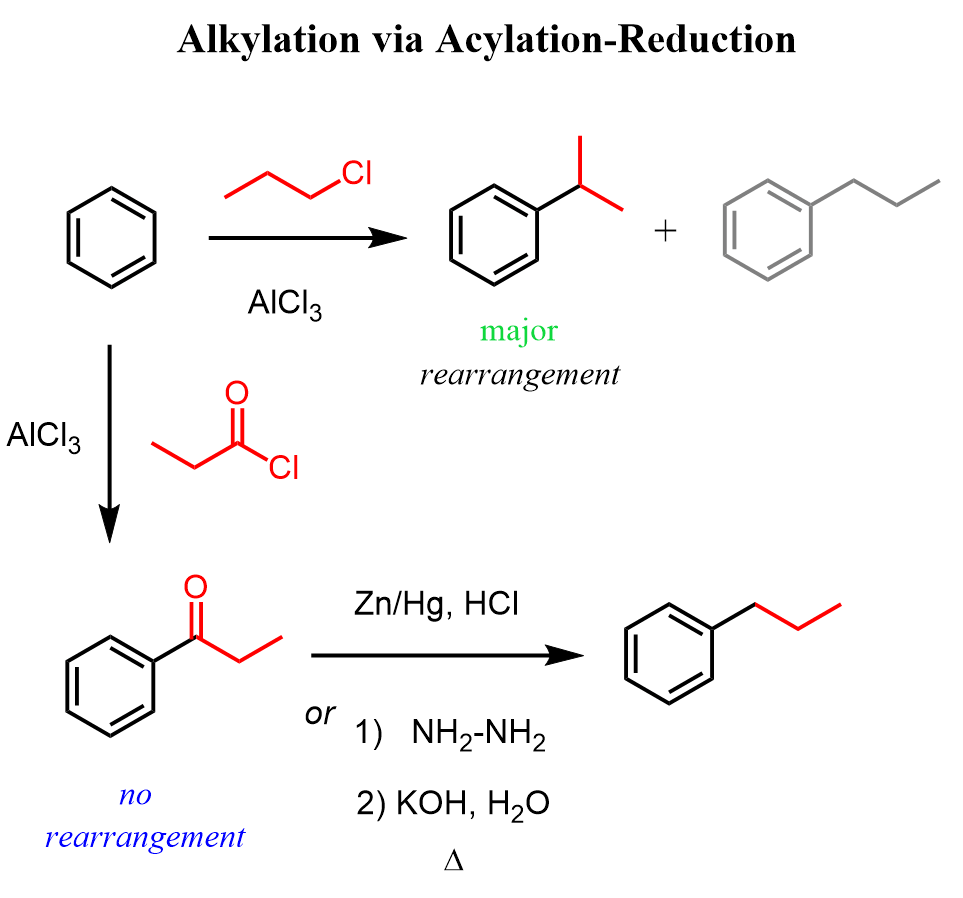
Overall, this two-step sequence is often referred to as the acylation-reduction strategy, which is used for alkylating the benzene ring and other aromatic compounds.
The Ortho and Meta Effects
Another important use of the Wolff-Kishner and Clemmensen reductions is the possibility of altering the ortho/para and meta directing effects. Remember, alkyl groups are activators, thus ortho/para directors, whereas carbonyl groups are deactivators and direct EAS to the meta positions.
So, if we want to synthesize a benzene ring with two activating groups in meta orientation, the acylation-reduction method is again very helpful.
For example, meta-propylaniline can be synthesized by first introducing the propyl chain in the form of an acyl group, then nitrating the ketone, and finally reducing both groups to the alkane and amine moieties correspondingly.
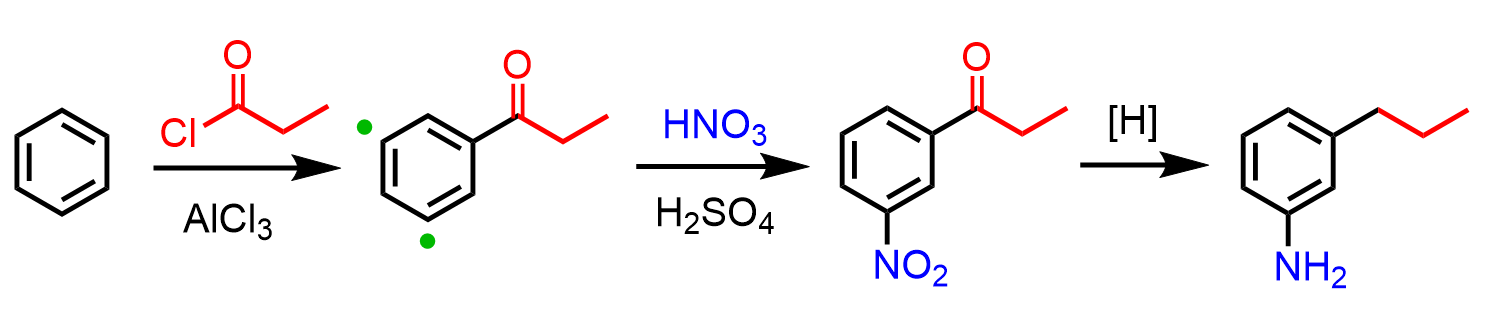
Notice that the reverse order would not be efficient here because Friedel-Crafts reactions are among the slowest in EAS, and they are not efficient on deactivated benzene rings such as nitrobenzene.
To summarize the Wolff-Kishner and Clemmensen reactions, remember that they are used for:
- Converting the C=O bond into CH2, so as a shortcut, you can simply “erase” the carbonyl group.
- Most often you are going to see them in the chapter on electrophilic aromatic substitution, and the key idea behind them is going to be the alkylation of the aromatic ring with alkyl halides that are prone to rearrangements.
- The other important use of these reactions is the alteration of ortho/para and meta effects by switching the carbonyl to an alkyl group on the benzene ring.
Reference
- Wolff, L. Justus Liebigs Ann. Chem. 1912, 394, 86–108. 6.
- Rice, H. L., J. Chem. Soc. 1952, 74, 3193–3194.
- Reusch, W. Deoxygenation of Carbonyl Compounds In Reduction; Augustine, R. L., Ed .; Dekker: New York, 1968, pp. 171171–211.
- Clemmensen E., Ber. 1913, 46, 1837–1843. 131.
- Vedejs, E., React. 1975, 22, 401–422. 132.
- Martin, E. L., React. 1942, 1, 155–209. 133.
- Motherwell, W.B.; Nutley, C. J., Org. Synth. 1994, 1, 219–241.
- JW Burton, Comprehensive Organic Synthesis
- Tetrahedron, Volume 57, Issue 23, 4 June 2001, Pages 4817-4824