We have seen in the reduction of alkynes that sodium metal dissolved in ammonia is a source of electrons, and these electrons can be used to reduce the triple bond to a trans alkene:

The same principles apply when benzene and its derivatives are treated with the Na/NH₃ system in an alcohol solution – two of the sp² carbons are reduced to sp³ carbons, and a nonconjugated diene is formed:
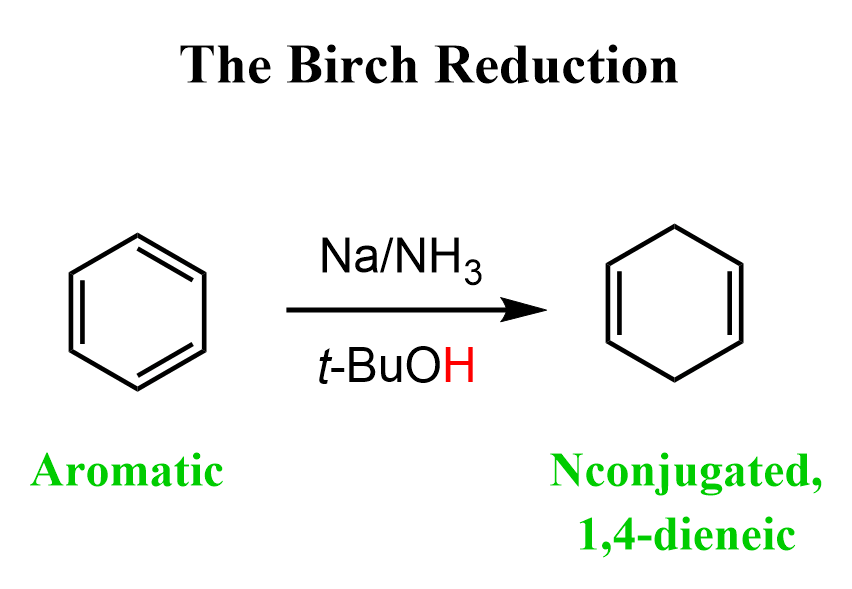
The alcohol here serves as a solvent and a proton donor for the anionic intermediates. Let’s take a look at the mechanism of the Birch reduction.
The Mechanism of Birch Reduction
The mix of sodium and ammonia forms a sea of electrons – it is indeed a blue solution of solvated electrons:
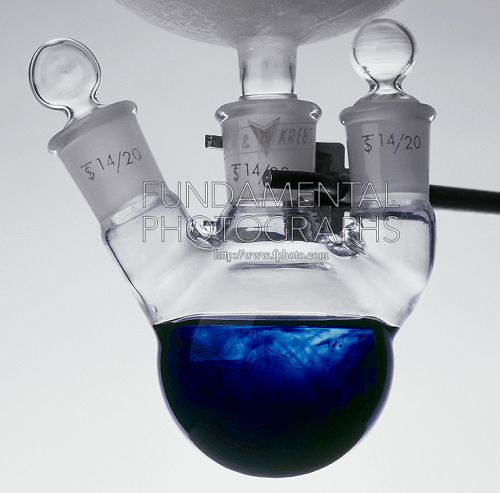
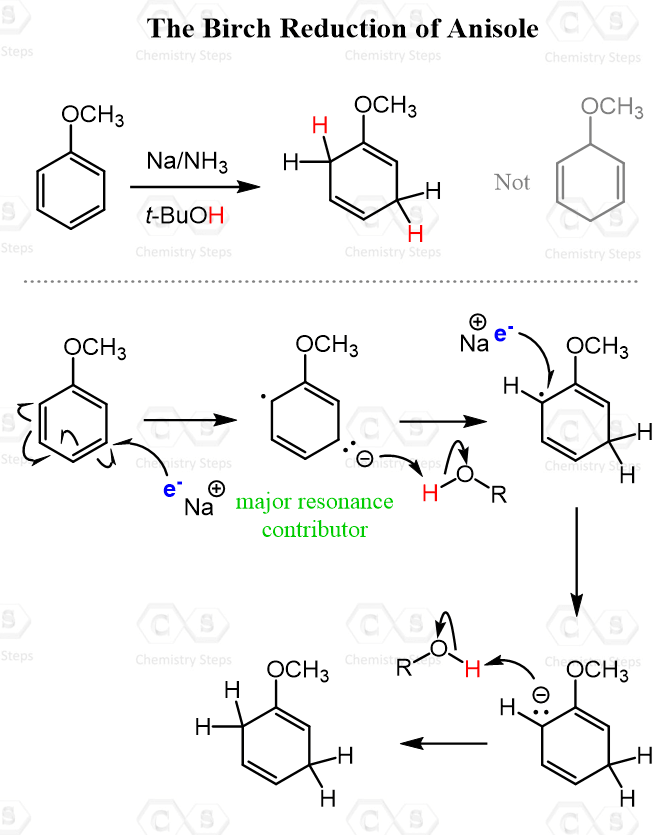
We have a solution “full of electrons,” and when the aromatic compound is added, a solvated electron from sodium in liquid ammonia is transferred to the aromatic ring, forming a benzene radical anion (Step 1). This highly reactive intermediate is then protonated by an alcohol, such as methanol or tert-butanol, to give a cyclohexadienyl radical (Step 2).
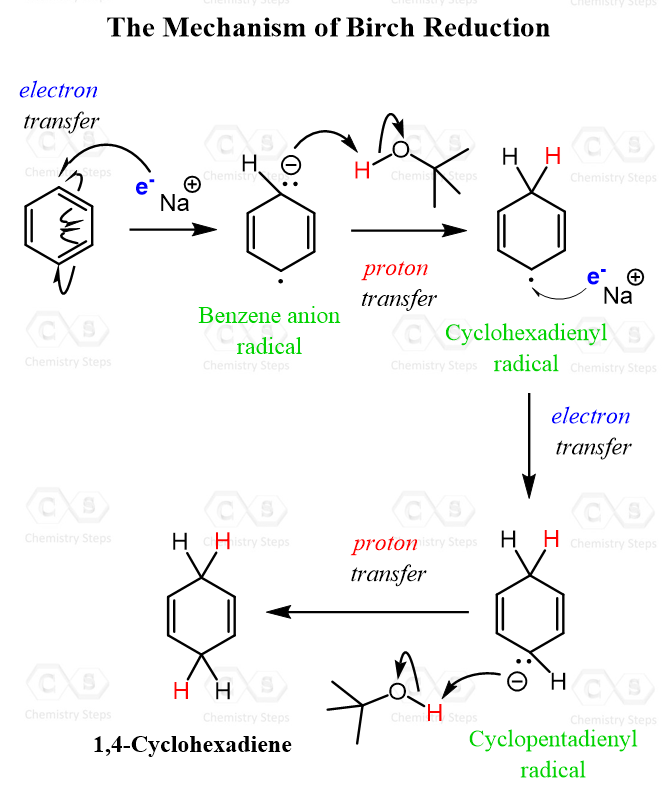
A second electron transfer generates an anion, which is protonated once again to form the nonconjugated 1,4-diene product. So, an easy way to remember the mechanism is: electron → proton → electron → proton.
One thing to mention here is that all the anionic and radical intermediates are resonance-stabilized; however, it turns out that the ones shown in the reaction scheme are the most significant contributors, and they define the outcome of the reaction. That is the fact that a 1,4-diene rather than a 1,3-diene is formed.
The Regiochemistry of Birch Reduction
When substituted benzene rings are reduced, the products are slightly different – more specifically, the position of the double bonds varies depending on the nature of the substituent.
The key here is to remember that the product is a nonconjugated 1,4-diene, and we will see shortly why this is the case. We use this as a shortcut to quickly predict the product of the Birch reduction when a substituted benzene ring is used.
Remember this:
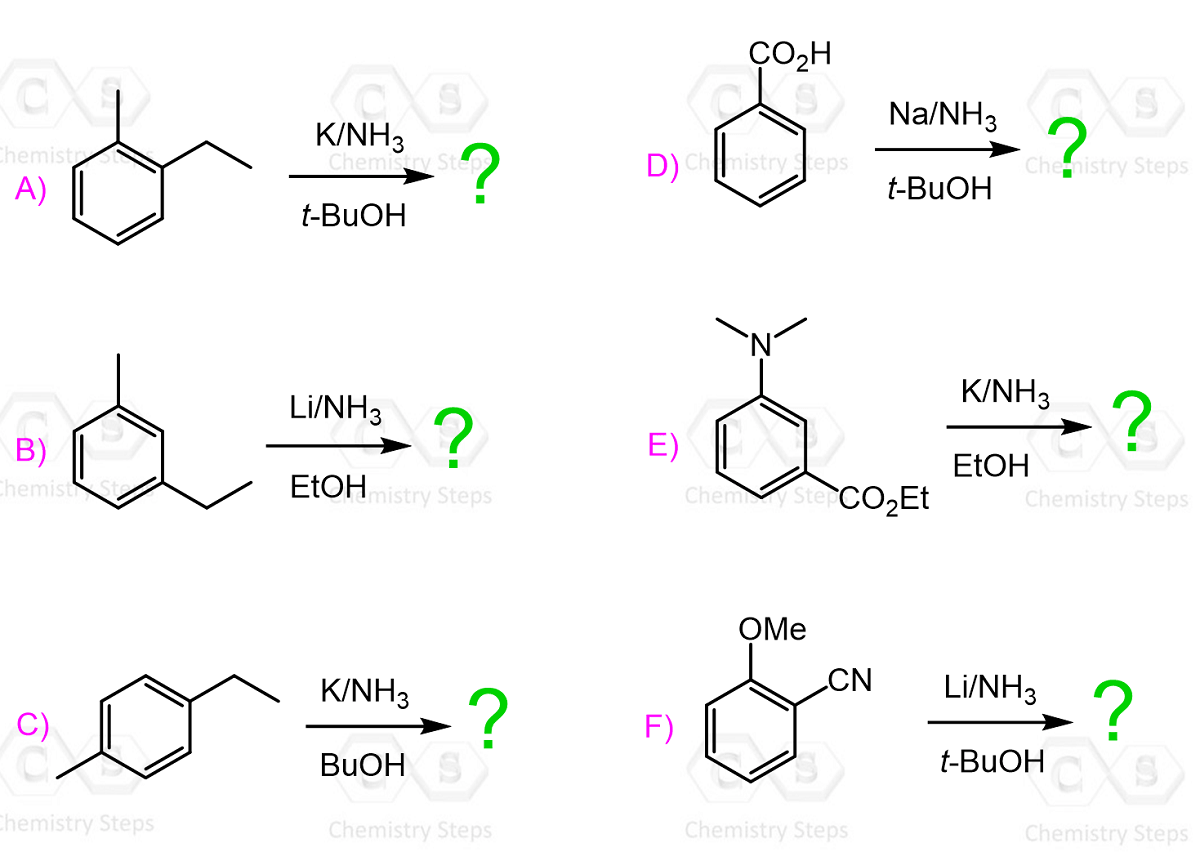
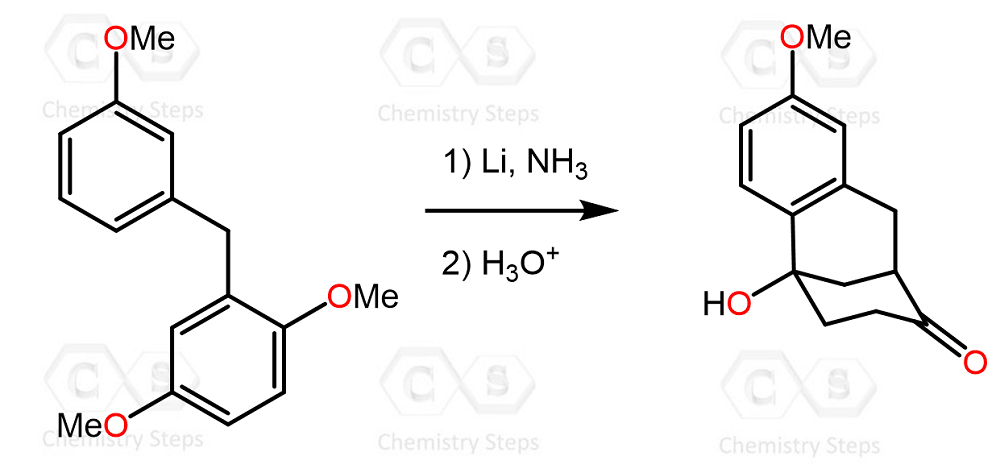
- When an electron-donating group (EDG) is present, the carbon connected to (ipso carbon) is not reduced – keep it sp² and add the second double bond accordingly.
- When an electron-withdrawing group (EWG) is present, the carbon connected to it is reduced to sp³, so we add the two double bonds accordingly:
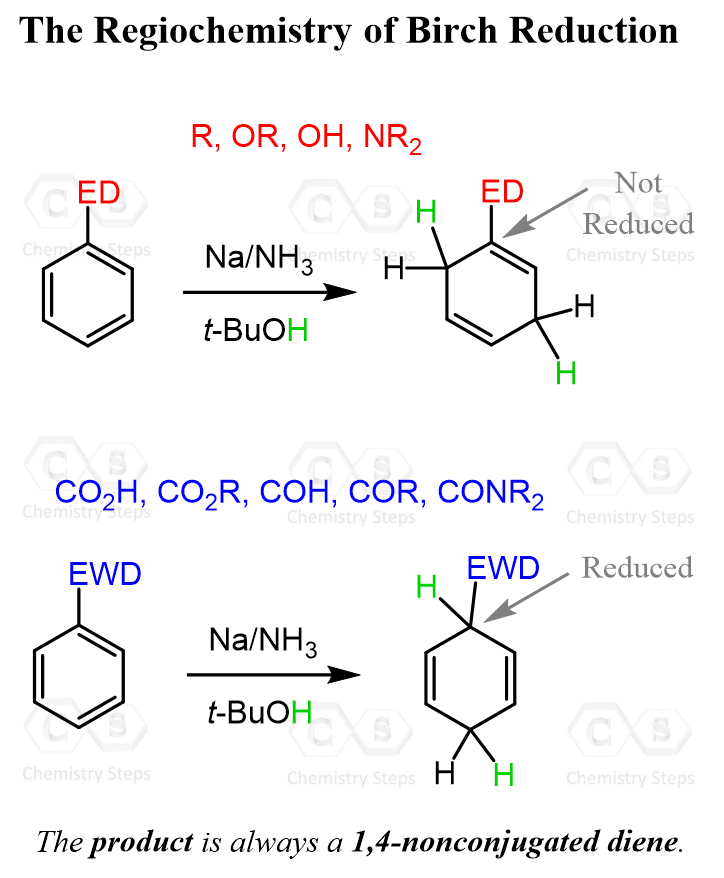
We can see this regioselectivity in the reduction of anisole as an example of a benzene ring with an electron-donating group, and acetophenone as an example of a Birch reduction on electron-deficient benzene rings.
In both cases, the idea is the stability of the intermediate carbanion – EWG stabilizes the negative charge, so it forms next to them, while electron-donating groups destabilize it, thus it forms farther away from them.
Birch Reduction of Rings with EWG Groups
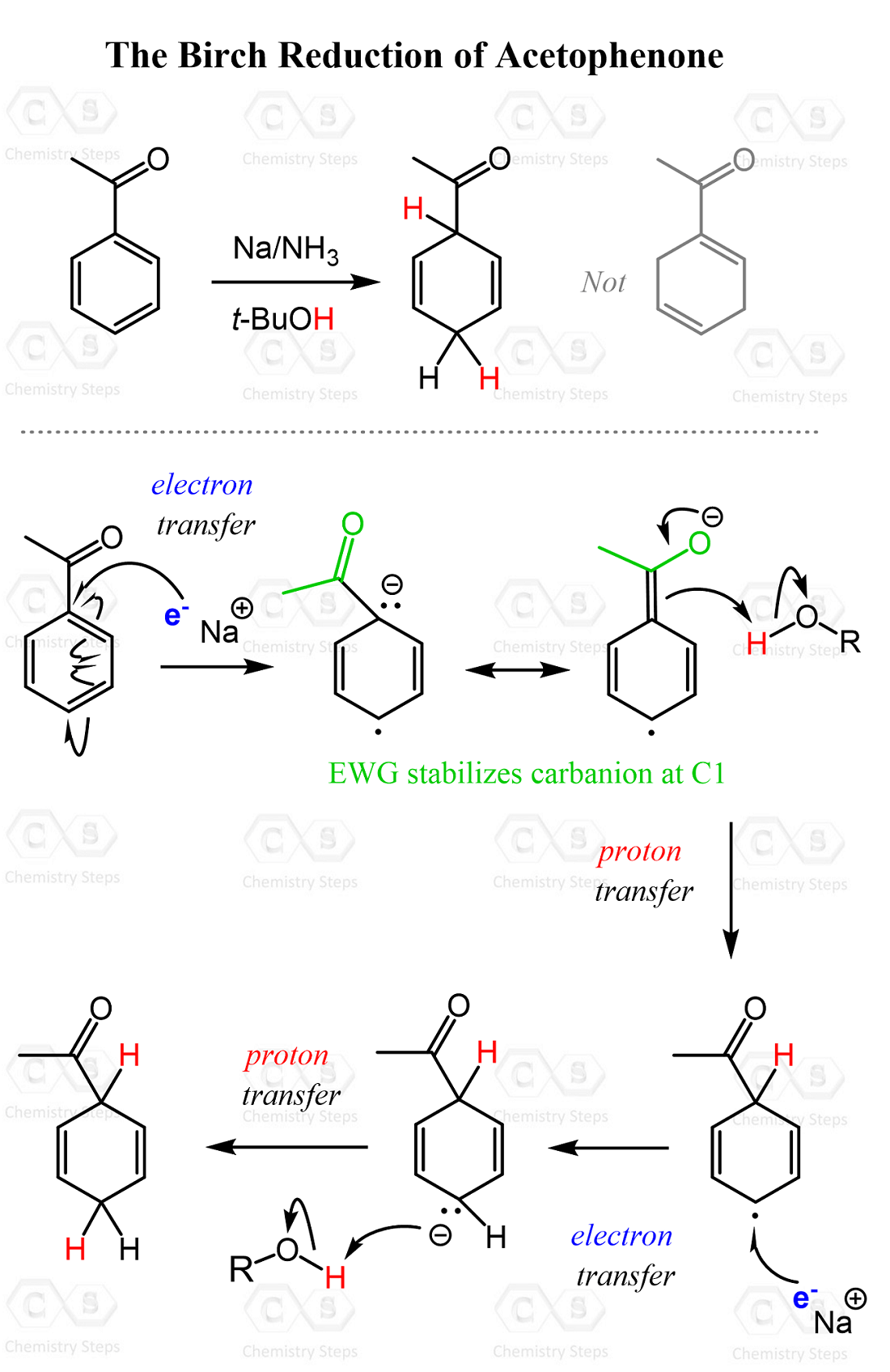
When acetophenone, or other such derivatives of benzene with an electron-withdrawing group, is treated with the Na/NH₃ system, the addition of the electron occurs at carbon 1 because the newly formed carbanion is stabilized by the electron-withdrawing group.
Birch Reduction with Electron-Donating Groups
The addition of the electron to anisole or a similar benzene derivative with an electron-donating group occurs in a way that avoids placing a negative charge adjacent to the substituent. To be more accurate, the major resonance contributor is the one with the negative charge at the meta position.
Birch Reduction with EDG and EWG
In most cases, when both an electron-donating group (EDG) and an electron-withdrawing group (EWG) are present on the ring, the regioselectivity is decided by the EWG substituent. This is because it stabilizes the negative charge much more strongly than an EDG can destabilize it.
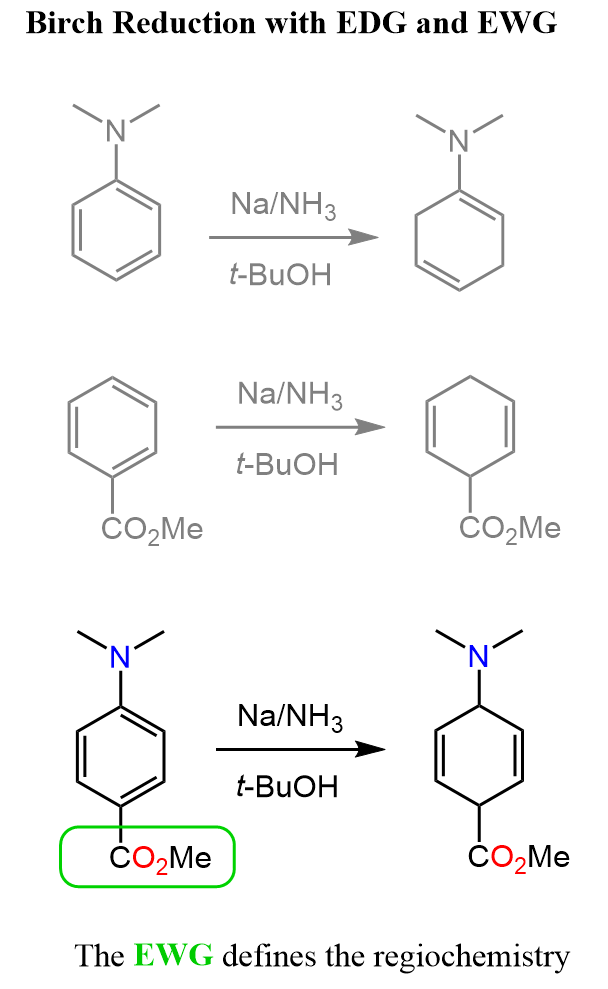
So, the electron addition and subsequent reduction are directed so that the carbanion forms next to the EWG, leading to reduction of the ipso carbon of the EWG (sp³ formation).
Alkylation During Birch Reduction
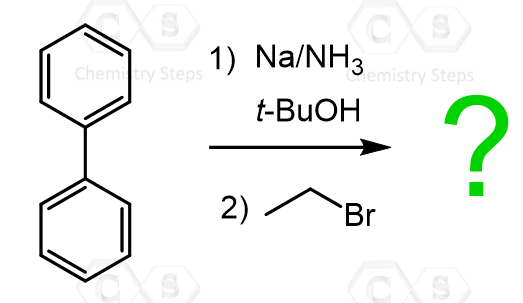
When a Birch reduction is carried out in the presence of an alkyl halide (or similar electrophile), the reaction can be modified to include alkylation of the intermediate carbanion. This happens because, after the first electron transfer and protonation steps, a cyclohexadienyl carbanion is formed.
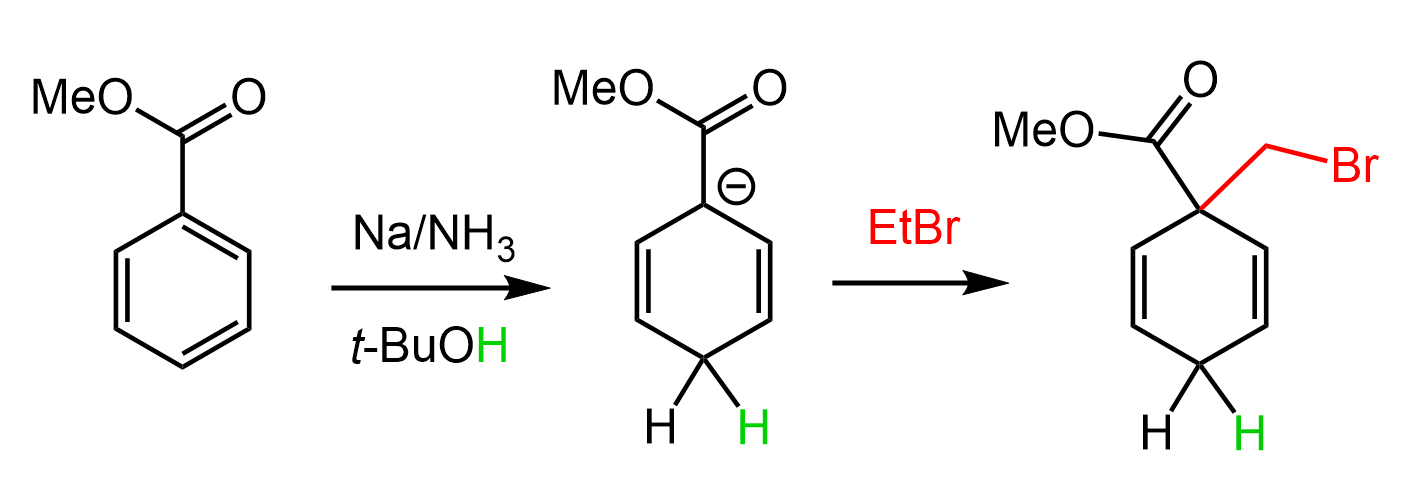
So, instead of being protonated immediately, this carbanion can act as a nucleophile and attack an alkyl halide in an SN2 reaction, forming a new C–C bond. After this alkylation step, protonation gives a substituted 1,4-cyclohexadiene.
Summary of Birch Reduction
To summarize, the Birch reduction is a dissolving metal reduction where sodium (Li and K work too) in liquid ammonia provides solvated electrons, giving a deep blue solution. The aromatic ring undergoes a sequence of electron and proton transfers: electron addition forms a radical anion, protonation gives a radical, a second electron forms a carbanion, and final protonation yields a nonconjugated 1,4-cyclohexadiene.
The key feature of the reaction is its regioselectivity, which depends on the substituent on the benzene ring. Electron-withdrawing groups (EWG) stabilize a nearby negative charge, directing reduction so that the ipso carbon is reduced (becomes sp³), while electron-donating groups (EDG) destabilize a nearby negative charge and therefore leave the ipso carbon sp². This simple electronic effect allows you to quickly predict the position of the double bonds in substituted benzene rings and the final product of the Birch reduction.