
We have learned in the discussions about Grignard reagents that they must be used in dry conditions and aprotic solvents because the organometallics are strong bases and are quenched in any medium with acidic protons:
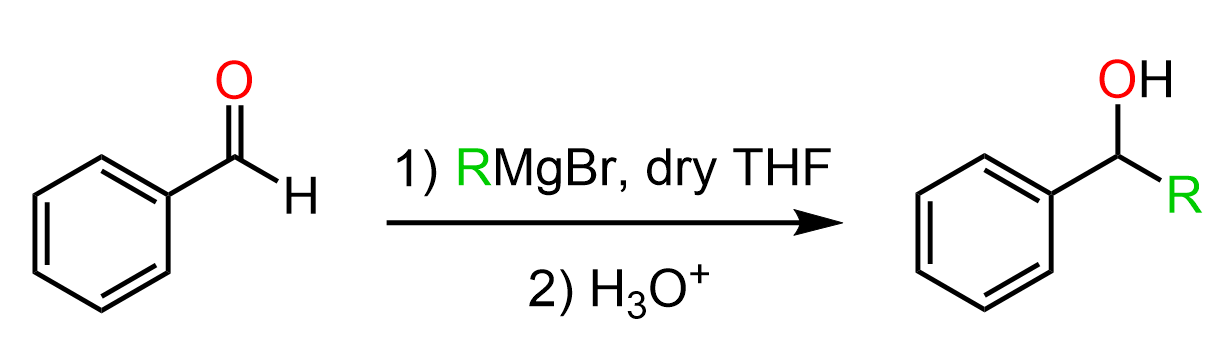
So, if we use a solvent that has not been properly dried, the reaction won’t work because the highly basic organometallic will react with the water present in the solvent.
Now, it is not only the solvent that may interfere with the reaction. Certain substrates are not compatible with Grignard, organolithium, or similar organometallics. One of them was alcohols, which are acidic enough to react with Grignard and organolithium reagents, and that is why we use protecting groups before treating these types of substrates with organometallic reagents:

Carboxylic acids are stronger acids than alcohols; therefore, if we use a Grignard reagent with a carboxylic acid, it will react with the acid, forming a carboxylate ion and the corresponding alkane, alkene, or whatever Grignard reagent was used. As a result, the reaction won’t work:

So, the question is, what if we use an excess of the Grignard reagent? Will the remaining part react with the carboxylate ion?
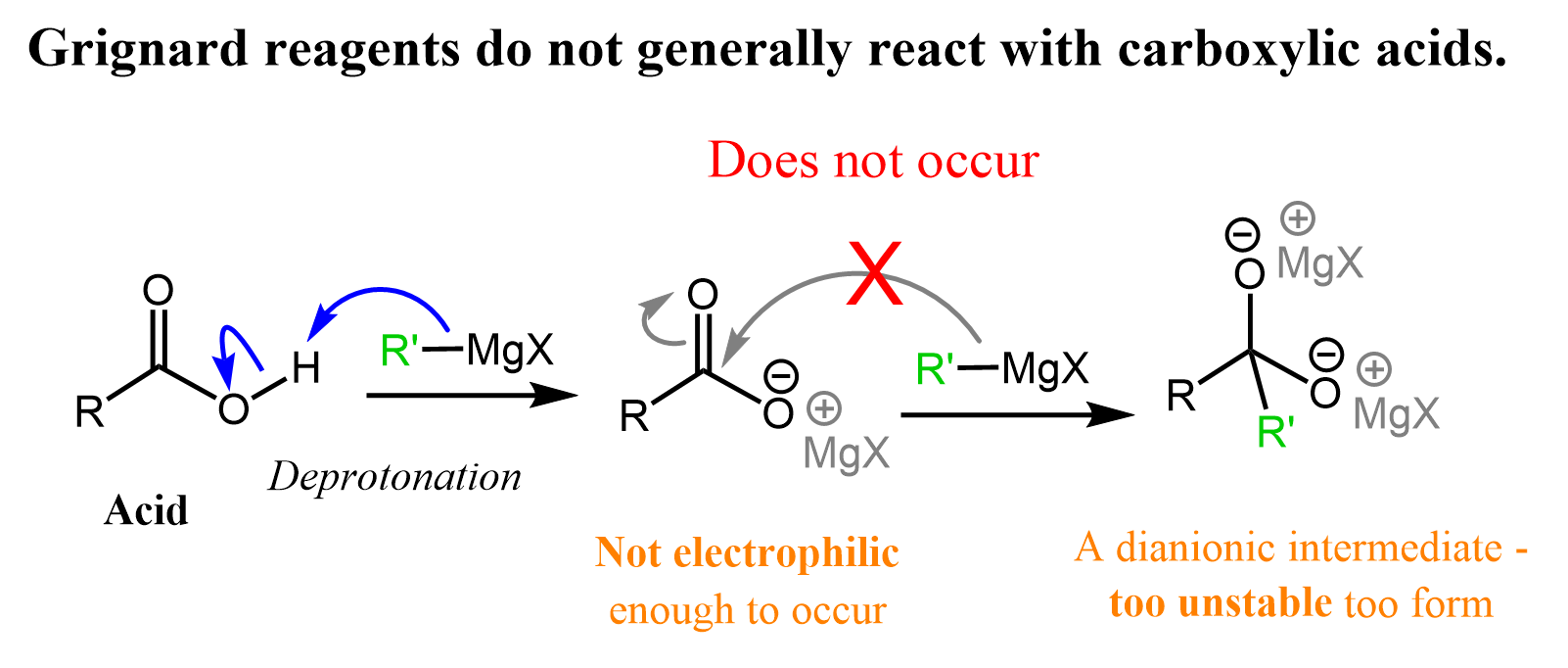
And the answer to this question is no – Grignard reagents are generally not suitable for synthetic transformations of carboxylic acids. The reason is that, first, the carboxylate is not electrophilic enough, and second, the nucleophilic attack of the Grignard reagent would generate a dianionic intermediate, which is simply too unstable to form under these conditions:
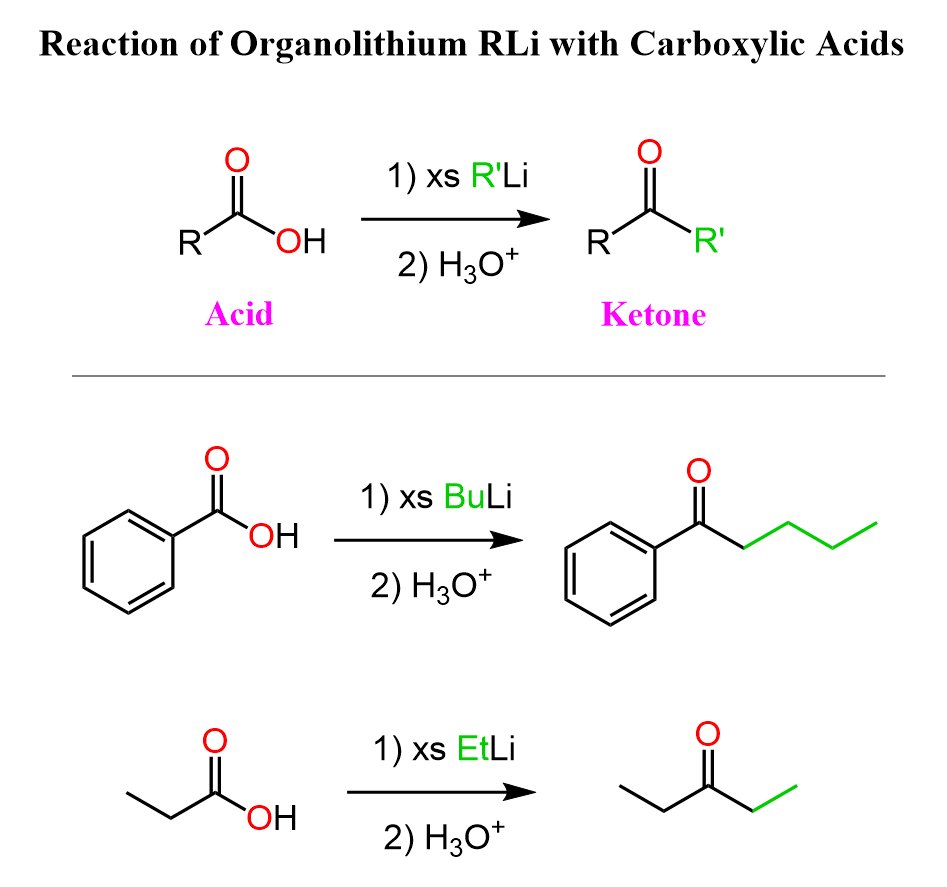
Now, the situation is different when an organolithium (RLi) is used. These are extremely strong bases and great nucleophiles, and it turns out that if we use an excess of an organolithium, it does react with a carboxylic acid, and a ketone is formed as the final product:
The Mechanism of the Reaction Between RLi and Carboxylic Acids
As expected, the reaction starts with a deprotonation of the acid, forming a carboxylate ion, which is then attacked by the second equivalent of the organolithium, and a tetrahedral intermediate with two negatively charged oxygens is formed. During the aqueous acid workup, this intermediate expels one of the OH groups, and after a proton transfer, the final product ketone is obtained:

To be on the safe side, three equivalents of an organolithium can be used for converting a carboxylic acid to a ketone. The first two are for the deprotonation and nucleophilic addition, and the third is just to be safe in case there is trace water or other impurities.
The reaction of organolithiums with carboxylic acids is what sets them apart from the Grignard and organocopper reagents (R2CuLi) that you need to know for your organic chemistry class. A reminder that organocuprates are less reactive than Grignard reagents, and they do not react with carboxylic acids in a meaningful way.
The use of organolithium is not the only way of converting carboxylic acids to ketones, and we have a separate post on different methods for this conversion, which you can find here.
Organic Chemistry Reaction Maps
Never struggle again to figure out how to convert an alkyl halide to an alcohol, an alkene to an alkyne, a nitrile to a ketone, a ketone to an aldehyde, and more! The comprehensive powerfull Reaction Maps of organic functional group transformations are here!
Check Also
- Preparation of Carboxylic Acids
- Naming Carboxylic Acids
- Naming Nitriles
- Naming Esters
- Naming Carboxylic Acid Derivatives – Practice Problems
- Fischer Esterification
- Ester Hydrolysis by Acid and Base-Catalyzed Hydrolysis
- What is Transesterification?
- Esters Reaction with Amines – The Aminolysis Mechanism
- Ester Reactions Summary and Practice Problems
- Preparation of Acyl (Acid) Chlorides (ROCl)
- Reactions of Acid Chlorides (ROCl) with Nucleophiles
- Reaction of Acyl Chlorides with Grignard and Gilman (Organocuprate) Reagents
- Reduction of Acyl Chlorides by LiAlH4, NaBH4, and LiAl(OtBu)3H
- Preparation and Reaction Mechanism of Carboxylic Anhydrides
- Amides – Structure and Reactivity
- Naming Amides
- Amides Hydrolysis: Acid and Base-Catalyzed Mechanism
- Amide Dehydration Mechanism by SOCl2, POCl3, and P2O5
- Amide Reduction Mechanism by LiAlH4
- Amides Preparation and Reactions Summary
- Amides from Carboxylic Acids-DCC and EDC Coupling
- The Mechanism of Nitrile Hydrolysis To Carboxylic Acid
- Nitrile Reduction Mechanism with LiAlH4 and DIBAL to Amine or Aldehyde
- The Mechanism of Grignard and Organolithium Reactions with Nitriles
- Carboxylic Acids to Ketones
- Esters to Ketones
- Carboxylic Acids and Their Derivatives Practice Problems
- Carboxylic Acids and Their Derivatives Quiz