
From the basics of valence bond theory and chemical bonding, we know that covalent bonds are formed by an overlap of atomic or hybrid orbitals. Let’s just collectively call them orbitals. So covalent bonds are formed by an overlap of orbitals through which the atoms start sharing a pair of electrons:
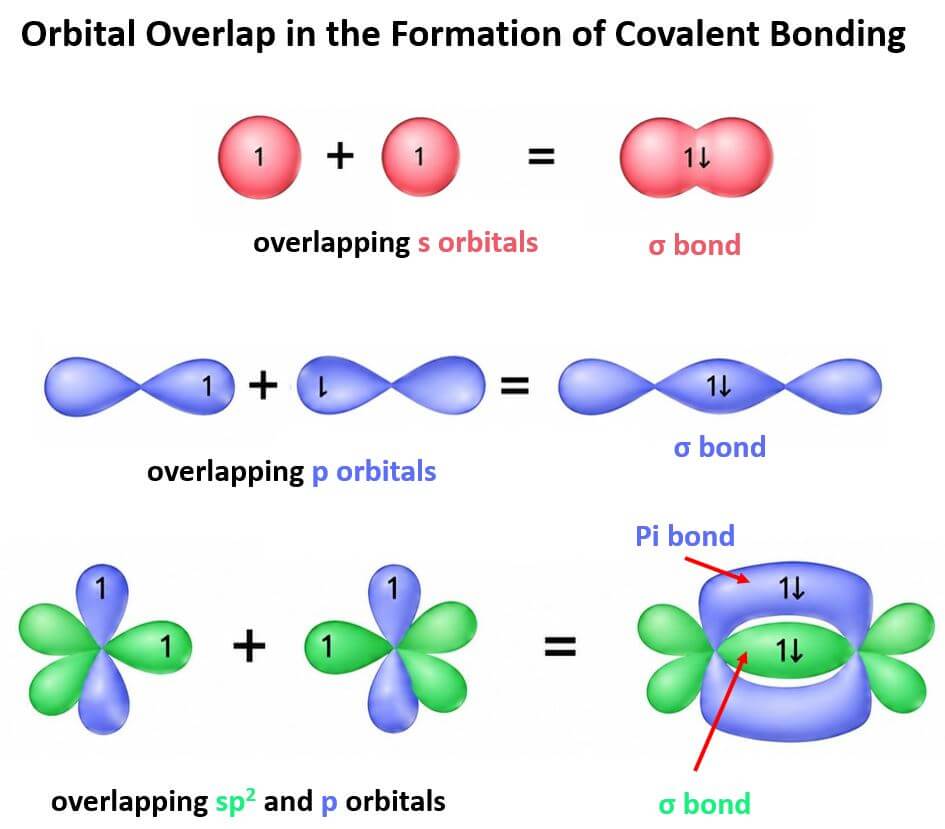
Recall also that there are sigma (σ) and pi (π) bonds. Sigma bonds are formed by an end-to-end (head-on) overlap of orbitals along the internuclear axis, whereas π bonds are formed by a side-by-side overlap of parallel p orbitals above and below the internuclear axis.
Sigma bonds are generally stronger than π bonds because the head-on overlap in a sigma bond is more effective and produces greater orbital overlap than the side-by-side overlap in a pi bond. As a result, the bonding electrons in a sigma bond are held more strongly between the two nuclei.
Alright, so what is molecular orbital theory about?
The good news is that it is still based on the idea of orbital overlap. However, there is an important difference: Instead of thinking of atomic orbitals as simply overlapping to form individual bonds, MO theory describes atomic orbitals as interacting and combining to form new molecular orbitals that can extend over the entire molecule.
In other words, instead of thinking of a covalent bond simply as two atoms sharing a pair of electrons between them, molecular orbital theory treats the electrons as occupying molecular orbitals that belong to the molecule as a whole.
As an example, let’s consider the molecular orbital diagram of hydrogen.
The Molecular Orbital Diagram of Hydrogen, H2
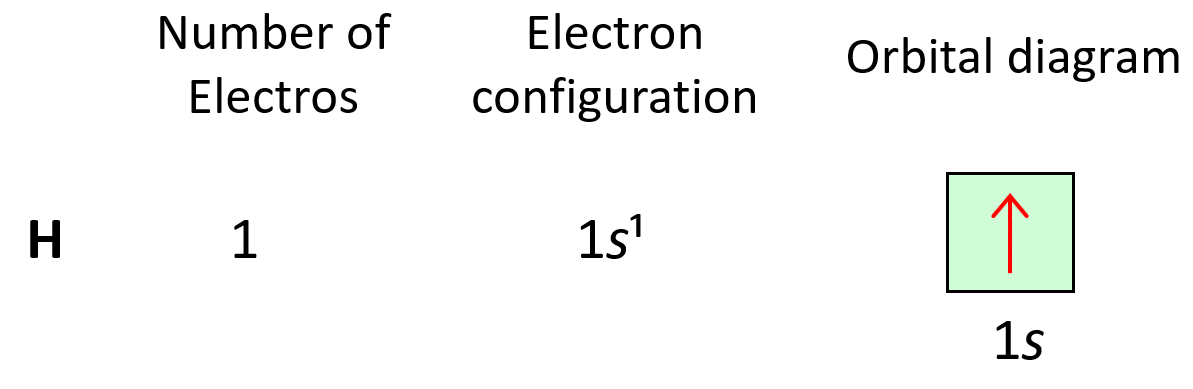
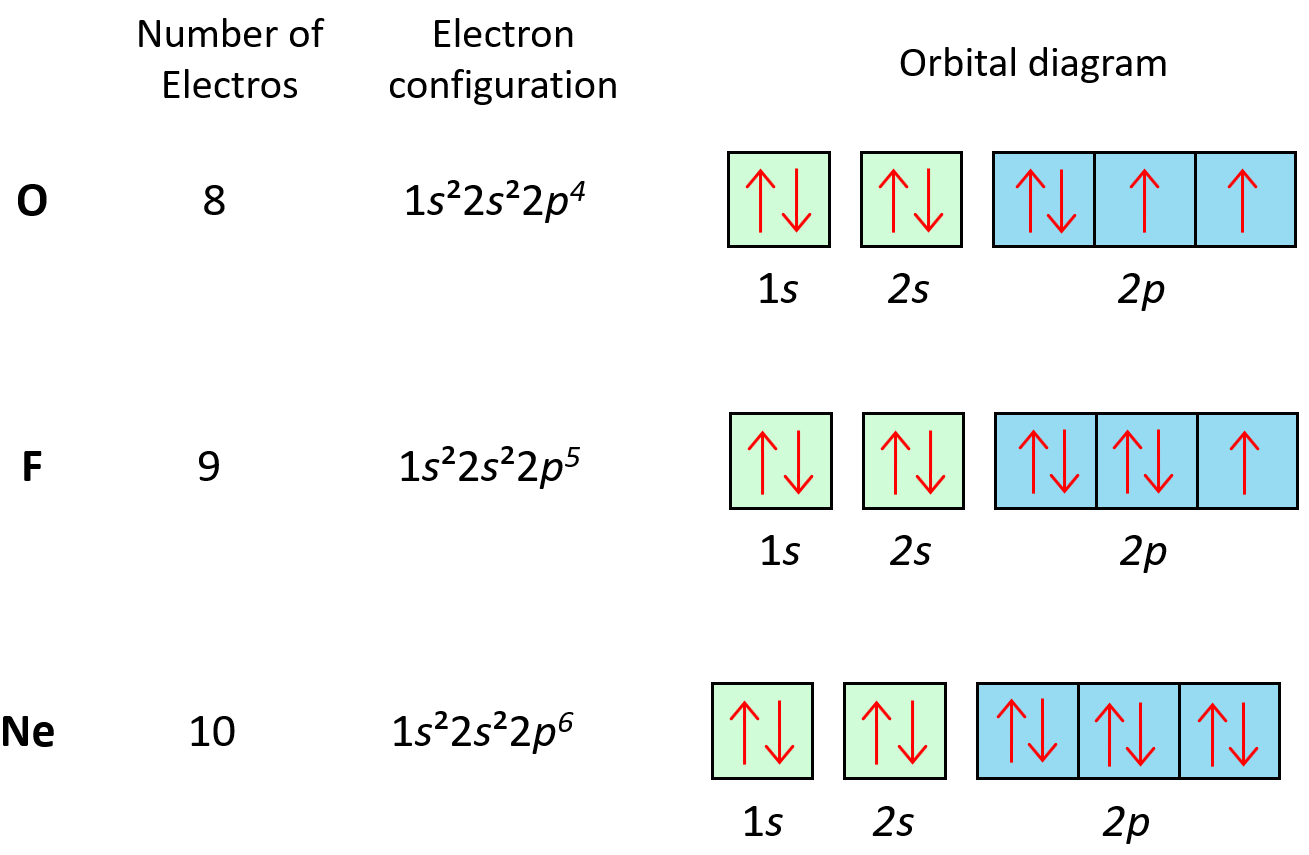
The first thing you need to do before getting to the molecular orbitals of any molecule is take a moment and refresh the principles of electron configurations and s and p atomic orbital diagrams. So, if you forget, take some time to go over the 1s22s22p6… stuff and recall that atomic orbitals can be shown as cells, where each cell represents one orbital, which, remember, can hold a maximum of two electrons.
For example, here are orbital diagrams of hydrogen, oxygen, fluorine, and neon as examples of larger elements:
The next concept you need to recall from general chemistry is that only valence electrons participate in chemical bonding. As a reminder, valence electrons are the electrons in the outermost shell of an atom.
So, except for hydrogen, in the examples above, only the 2s and 2p electrons are in the valence shell; thus, they are the ones that participate in chemical bonding. This is true for the molecular orbital theory too.
Ok, let’s go back to the simplest example – that is how we use the molecular orbital theory to explain the covalent bond in molecular hydrogen.
Hydrogen has an electron in the 1s level; therefore, it is the 1s orbital of each hydrogen atom that participates in the formation of the molecular bonding orbital. So it is no longer an overlap of two separate orbitals, but rather one orbital that has formed from the two atomic orbitals. Actually, it is two molecular orbitals, bonding and antibonding, which we will discuss in a little bit.
For comparison, we also show the sigma bond formation between s orbitals according to the valence bond theory as we depicted earlier:
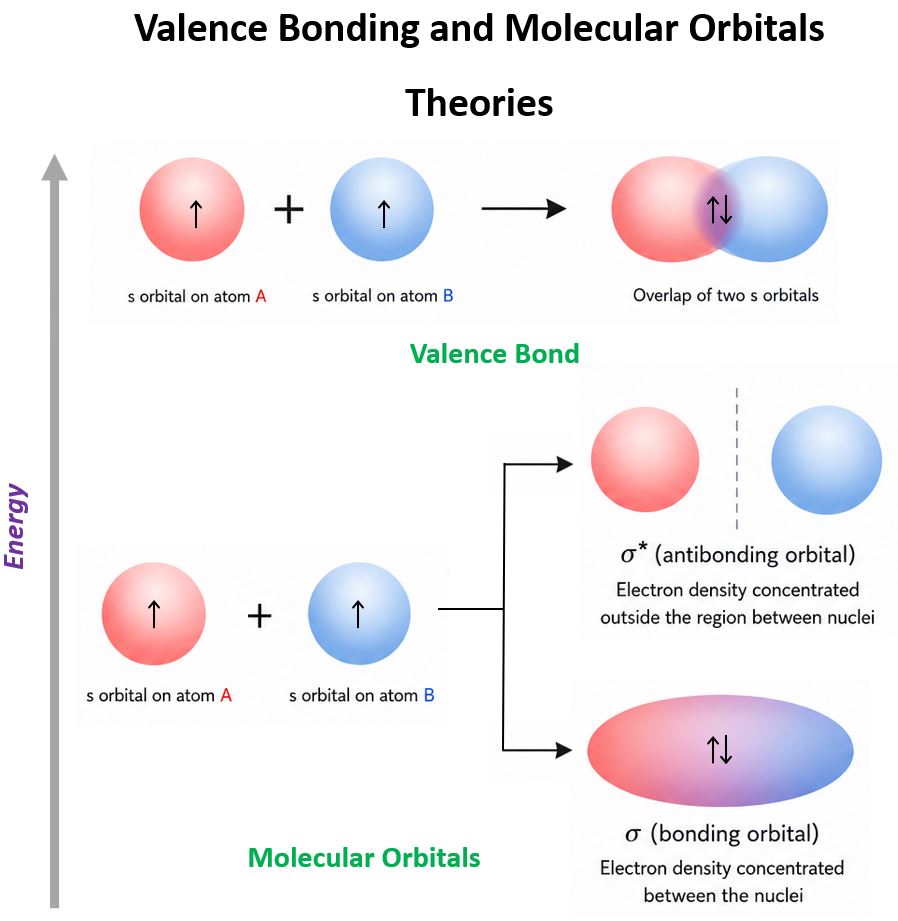
The molecular orbitals are formed when each hydrogen atom brings its 1s orbital, and they interact with each other. Now, there are many fancy (actually scientifically more accurate) ways of describing the interaction of atomic orbitals in the MO theory, but for the purpose of making this topic simple, we are going to look at this interaction as any other interaction between humans, animals, magnets, whatever comes to your mind.
The interaction can be positive/constructive and negative/destructive. There is also a neutral interaction, which we will talk about later on. When the interaction is constructive, the newly formed orbitals are lower in energy, meaning more stable. Think of the happy moments in human interactions. On the other hand, when the interaction is destructive, the second molecular orbital is formed, which is higher in energy, thus less stable:
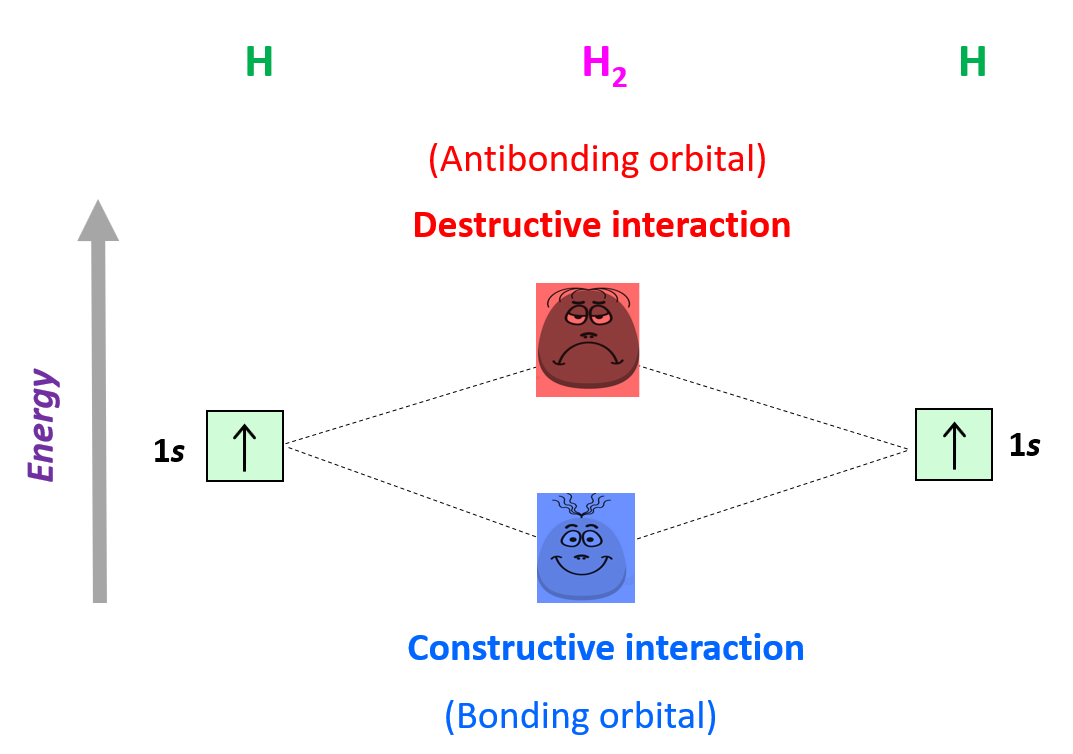
The happy orbitals – the ones lower in energy are called bonding orbitals, and they come with their pair of an antibonding orbital that goes higher in energy. We will see the significance of antibonding orbitals in the spectroscopic properties of many reactions of organic molecules later in the course.
So, when drawing a molecular orbital diagram, draw the atomic orbitals (the cells) of each atom on the left and the right side, and in the middle, we are going to have the newly-formed molecular orbitals – the constructive and destructive ones that are always there.
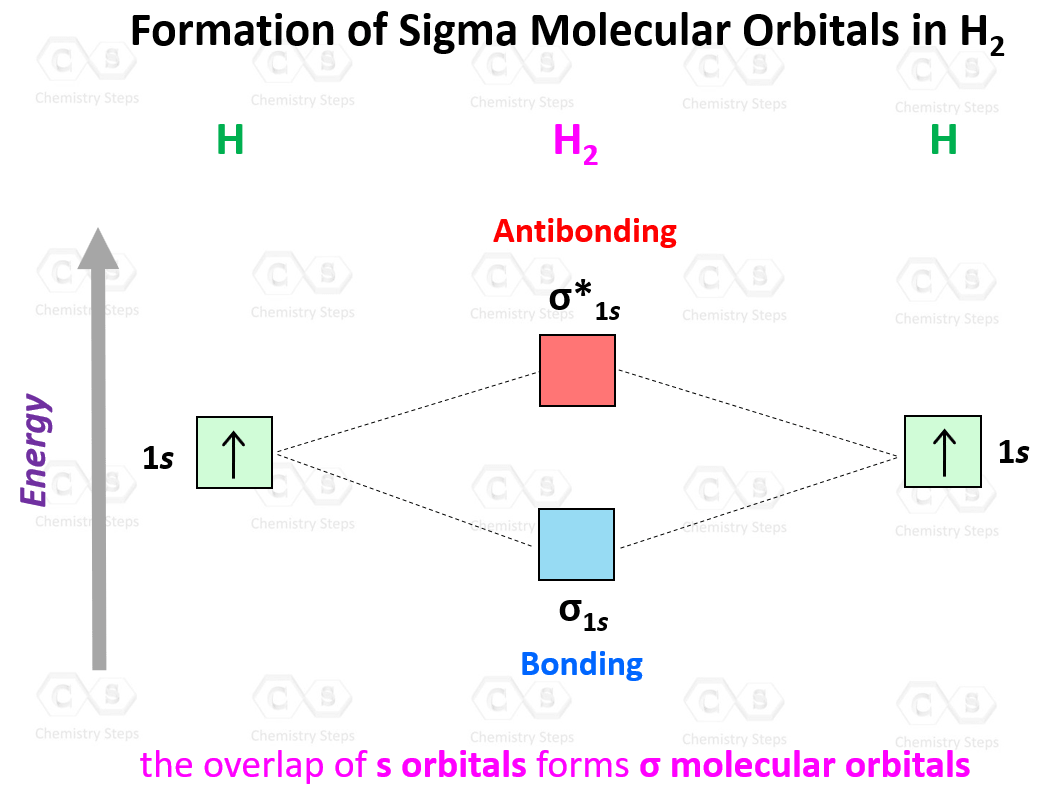
Depending on the types of atomic orbitals interacting, σ (sigma) or π (pi) molecular orbitals can be formed. More specifically, the overlap of s orbitals forms σ molecular orbitals, while the overlap of p orbitals can produce one σ and two π molecular orbitals.
We’ll get to the two π molecular orbitals later. For now, since hydrogen has only 1s orbitals, the interaction of the two 1s orbitals produces one bonding σ₁s orbital and one antibonding σ*1s orbital* in the MO diagram:
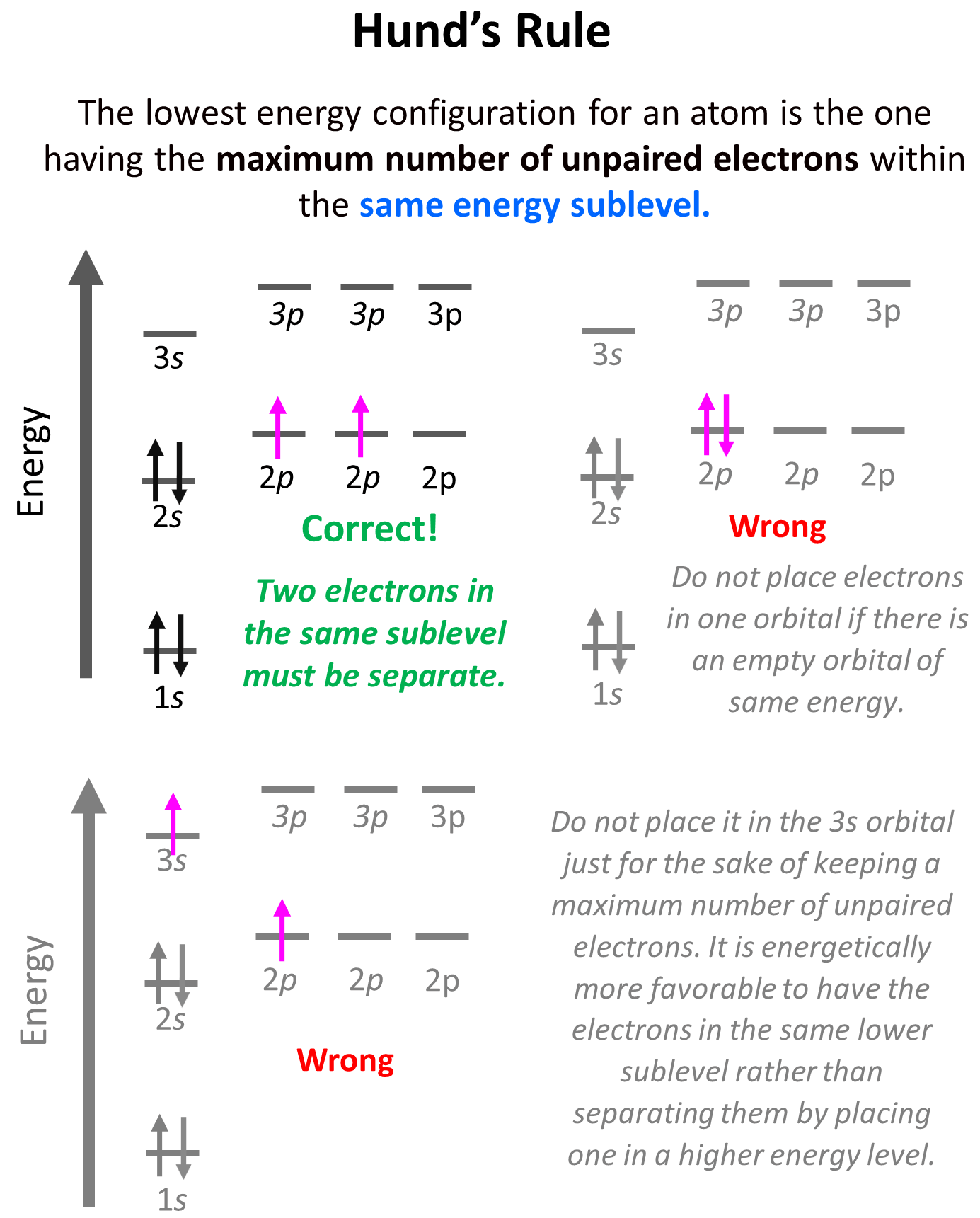
The last part is to fill out the molecular orbitals. The principle is the same – we add the electrons to lower-energy orbitals first, then keep going up until all the electrons are used. Recall the Aufbau principle, Hund’s rule, and Pauli’s exclusion principle. Electrons are filled from the lowest to higher-energy orbitals; we do not pair them until the same-energy orbitals already get one electron; and when we pair them, they must be of opposite spins:
Going back to the MO of H2, we are going to add both electrons to the bonding orbital, and the antibonding orbital is going to stay empty as there are no more electrons left:
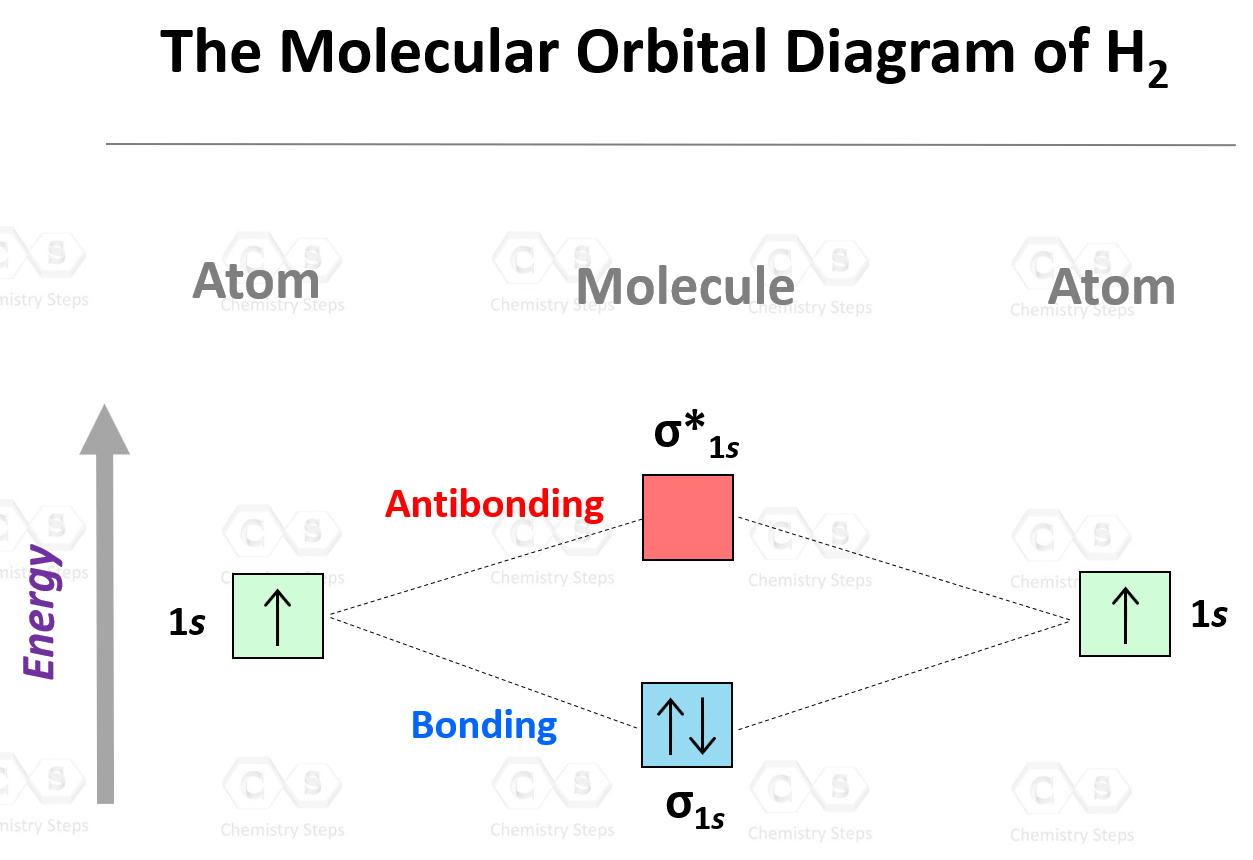
The way we interpret this molecular orbital diagram is that the two hydrogen atoms form an H₂ molecule through a σ (sigma) bond. This bond forms when the two 1s atomic orbitals overlap head-on, producing a bonding σ₁s molecular orbital. The two electrons from the hydrogen atoms occupy this lower-energy bonding orbital. Since both electrons are in the bonding orbital and none are in the antibonding orbital, the bond order is 1, indicating a stable single σ bond between the two hydrogen atoms. We will discuss the principle of bond order later in this post.
Let’s take a moment and summarize some key aspects and patterns from what we have learned so far about the molecular orbital theory:
- Molecular orbitals are formed by the interactions of atomic orbitals.
- From every interaction, two orbitals are formed: bonding and antibonding.
- Bonding molecular orbitals are lower in energy than their corresponding antibonding orbitals
- The interaction of s orbitals forms a pair of bonding and antibonding sigma orbitals
- The number of molecular orbitals is equal to the number of atomic orbitals: If two atomic orbitals interact, two molecular orbitals are formed: bonding and antibonding. If six atomic orbitals interact (three from each atom), six molecular orbitals are formed – three bonding and three antibonding.
The last part was also true for hybridization theory. Remember, in sp2 hybridization, for example, the three hybrid sp2 orbitals are formed through the interaction of three atomic orbitals: one s orbital and two p orbitals:

The Molecular Orbitals of Oxygen
Let’s now consider the molecular oxygen, which we know has a formula of O₂, so we are going to have two oxygen atoms bringing in their valence shell orbitals and electrons. You already know the electron configuration of oxygen, you know the valence shell, and the relative energy levels of the 2s and 2p orbitals, so without looking further, try to draw them on the left and right side of the paper by leaving some horizontal and vertical space between the orbitals:
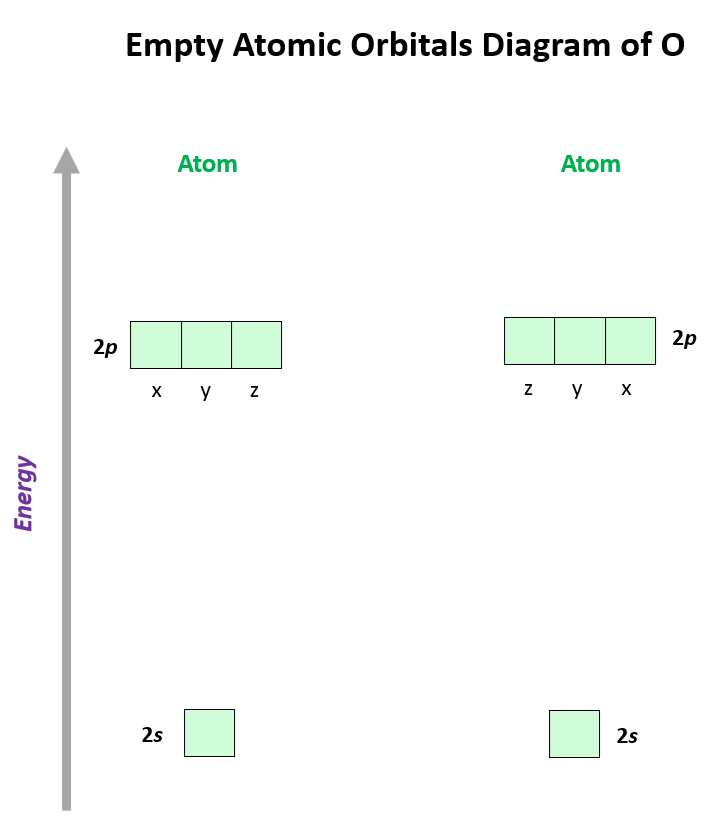
Notice that we place the 2p orbitals higher in energy because the p subshells are higher than the s subshell within the same level (second level in this case).
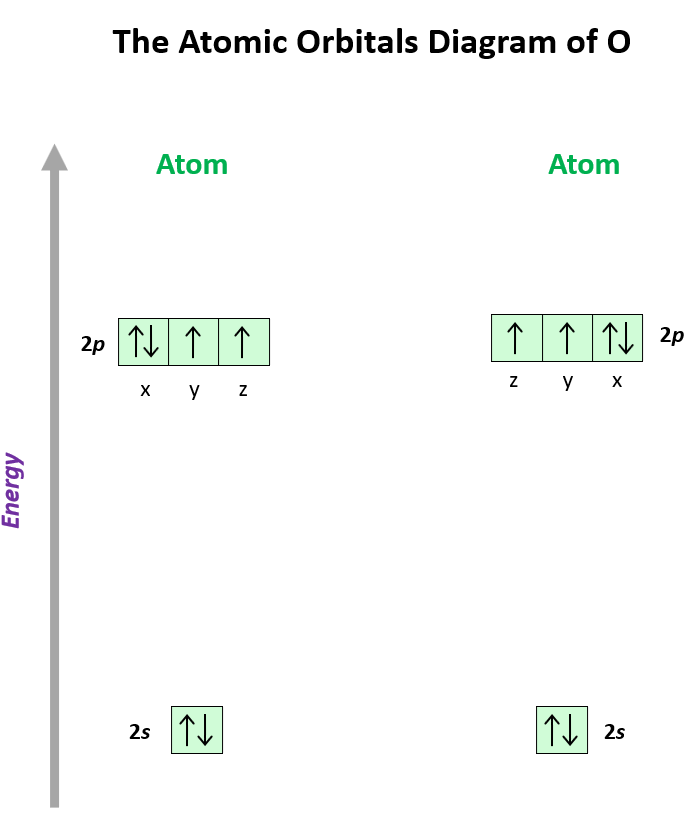
Next is adding the electrons. The electron configuration of oxygen is 1s22s22p4. The valence-shell electrons are in the 2s and 2p orbitals, and they have 2 and 4 electrons, respectively. Therefore, we add the electrons from the lowest to the highest atomic orbitals:
And now we draw two lines from the 2s orbitals to the middle, where the molecular orbitals are going to be shown. One bonding and one antibonding orbital are formed through the interaction of the 2s orbitals, and these result in the formation of σ2s bonding and σ*2s antibonding orbitals:
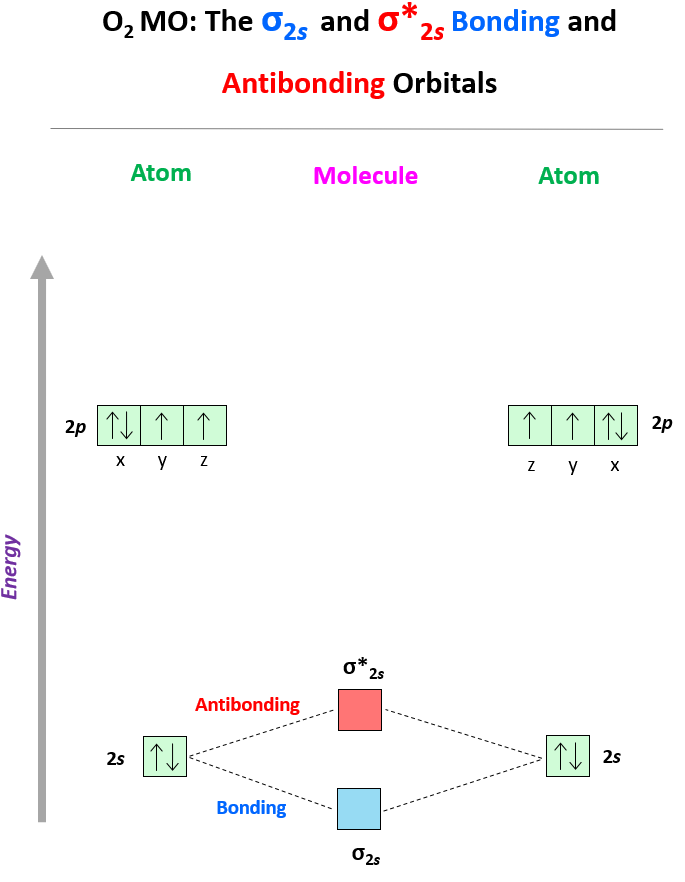
So, remember that the interaction of s orbitals forms sigma orbitals, again one bonding and one antibonding.
Now we get to the p orbitals. Each oxygen has three p orbitals, and when we mix, six orbitals are formed: three bonding and three antibonding. The bonding orbitals go lower than the atomic orbitals and the antibonding orbitals higher in energy than the atomic orbitals:
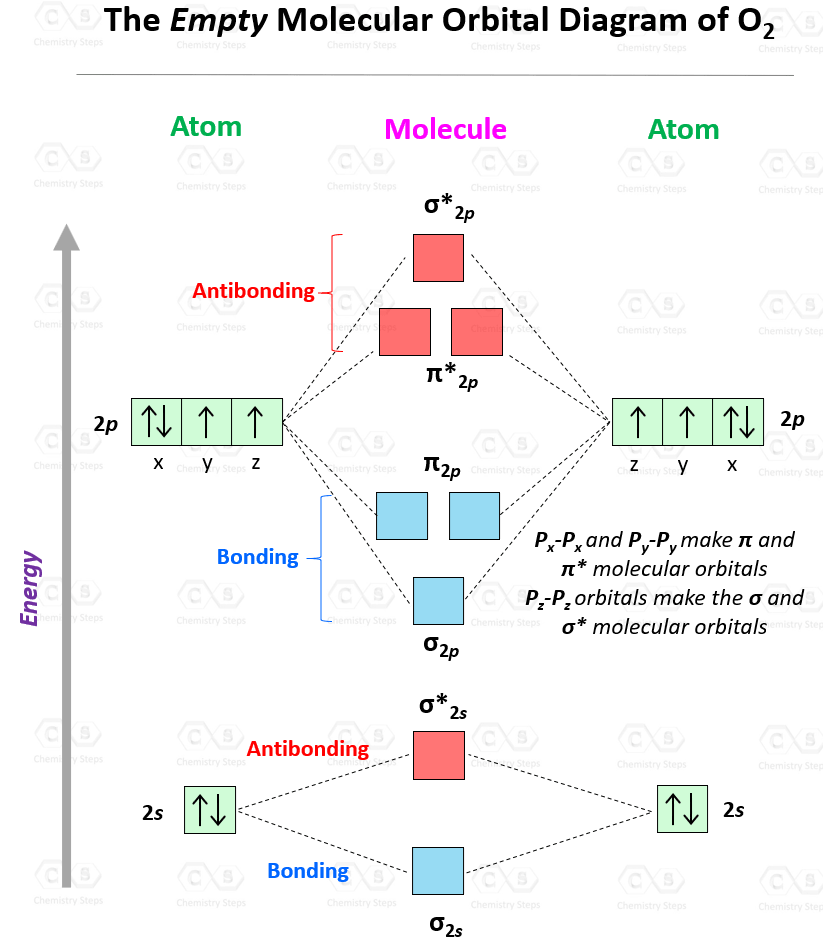
The question is what types of molecular orbitals are formed through the interaction of p orbitals. A reminder that the interaction of s orbitals always forms sigma orbitals.
You need to remember that one p+p interaction forms sigma bonds, and the other two p+p interactions form two pi bonds, of course with the corresponding antibonding orbitals:
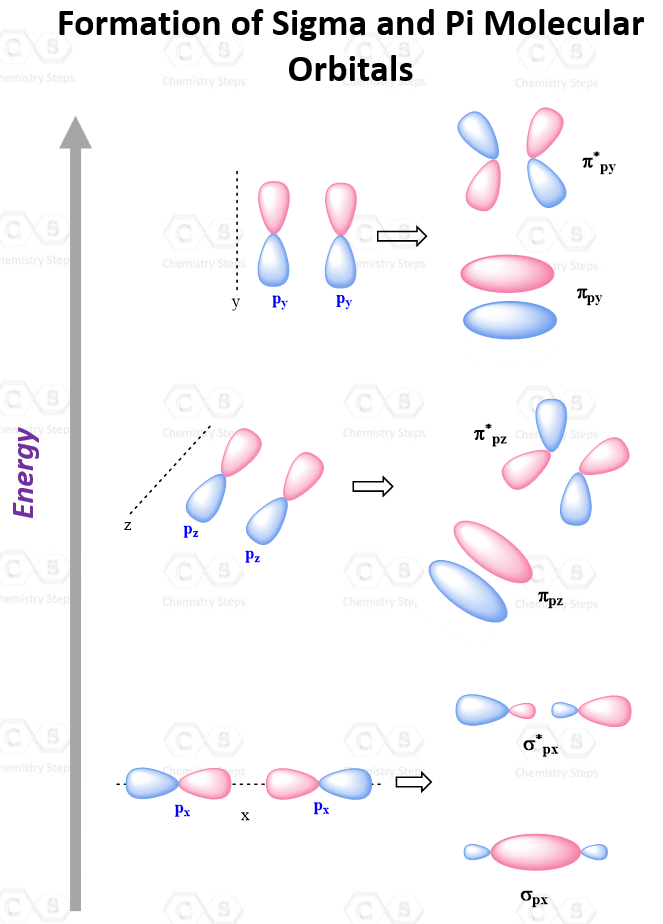
So, one pair of the p orbitals interacts axially, meaning they overlap head-on along the internuclear axis. This interaction forms a σ bonding orbital and a corresponding σ* antibonding orbital. The other two pairs of p orbitals interact side-by-side, forming two π bonding orbitals and two corresponding π* antibonding orbitals.
The sigma bonding orbitals are generally lower in energy than the pi bonding orbitals because sigma bonds are formed via head-on overlap, and they are more stable, meaning they are lower in energy:
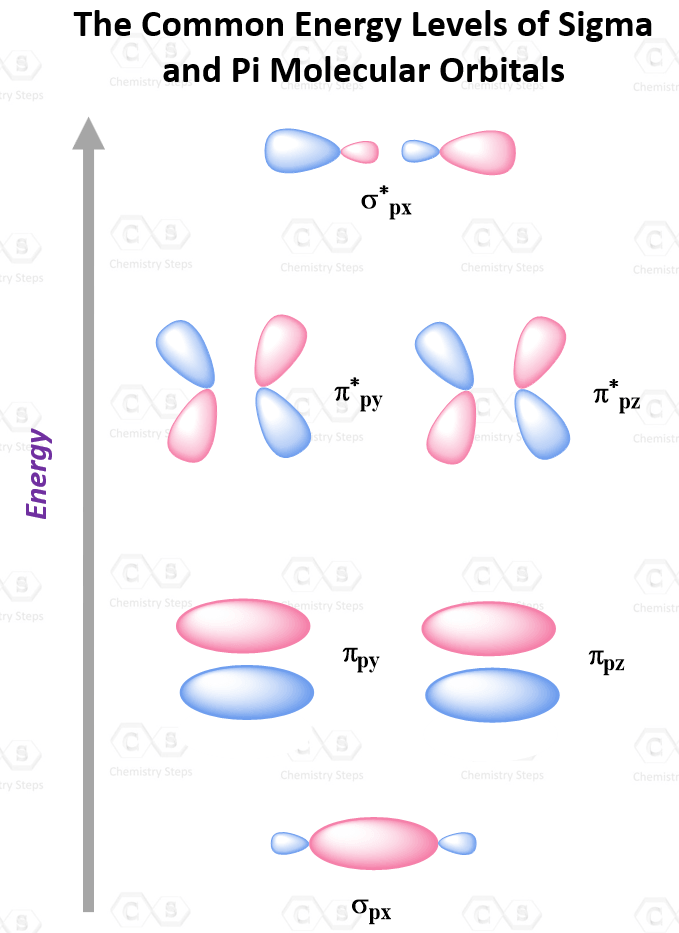
A quick note here to clarify any possible confusion is that we have just shown – the orbitals with their phase colors are not new. It is the same orbitals we have been showing as square cells. These are just different ways of showing MO diagrams, depending on the purpose and focus of the given diagram.
Alright, the last step to have a complete molecular orbital diagram of oxygen is adding the electrons from the atomic orbitals to the newly formed molecular orbitals. As always, we add them from the lowest to the highest energy levels, which means the σ2s is filled first, followed by the σ2s* orbital, then the σ2p orbitals. For oxygen, the σ2p orbital is filled before the π2p orbitals, so we continue with σ2p, followed by the two degenerate π2p orbitals. Finally, the remaining electrons are placed in the two degenerate π2p * antibonding orbitals according to Hund’s rule:
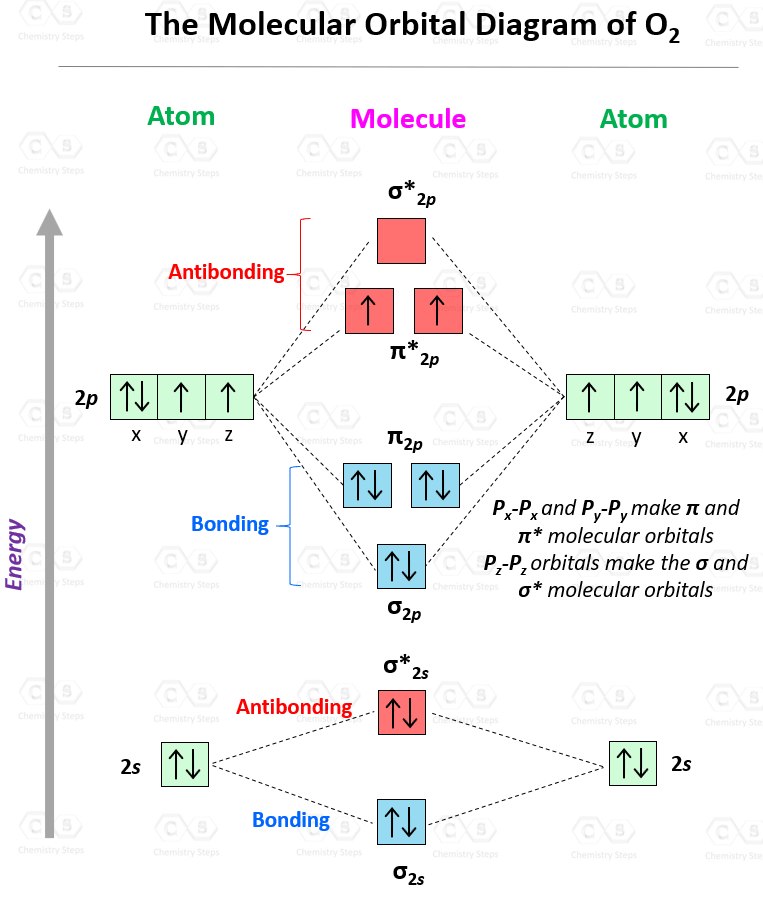
That is the MO diagram of molecular oxygen – we have arrived!
The Applications of Molecular Orbital Theory
In the last part of drawing the molecular orbital diagram of oxygen, we saw that two electrons went into the π* antibonding orbitals, and they are not paired because of Hund’s rule. What significance do you think these unpaired electrons have?
You may remember from the earlier chapters of chemistry and physics that the magnetic properties of substances are related to their electronic structures. The most familiar example is iron, which we could pick up with a magnet as a kid. The reason for this is that iron atoms have unpaired electrons, which give them magnetic moments. In solid iron, these magnetic moments can interact and align with one another, giving iron its strong ferromagnetic behavior:
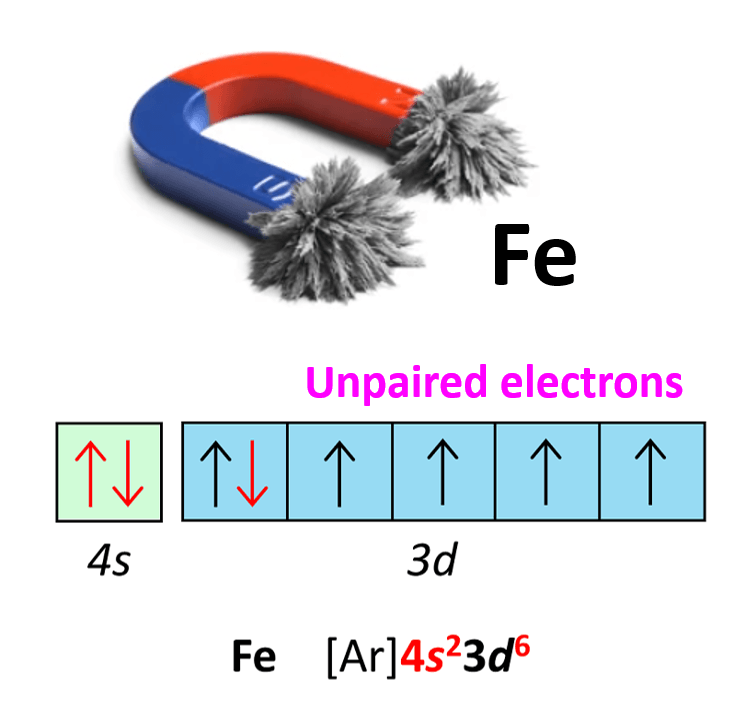
In general, substances with unpaired electrons are paramagnetic, meaning they are attracted to an external magnetic field, while substances with all their electrons paired are diamagnetic and are weakly repelled by a magnetic field.
Well, surprise, surprise, it turns out oxygen is paramagnetic too because of the aforementioned two unpaired electrons.
We can actually demonstrate this experimentally using a strong magnet. If we pour liquid oxygen between (boiling point: -183°C (−297.3°F) the poles of a strong magnet, the liquid oxygen is attracted toward the magnetic field and can even remain suspended between the magnet poles:
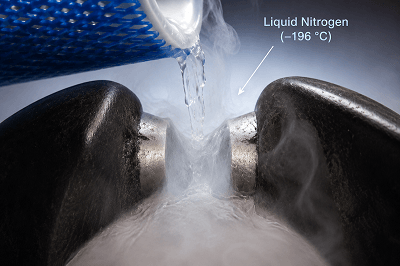
This happens because the magnetic moments associated with the unpaired electrons in O₂ interact with an external magnetic field.
In contrast, substances with all their electrons paired are diamagnetic and are weakly repelled by an external magnetic field.
This is a great example of how molecular orbital theory can explain certain properties of molecules that cannot be explained using Lewis structures and traditional valence bond theory.
Bond Order
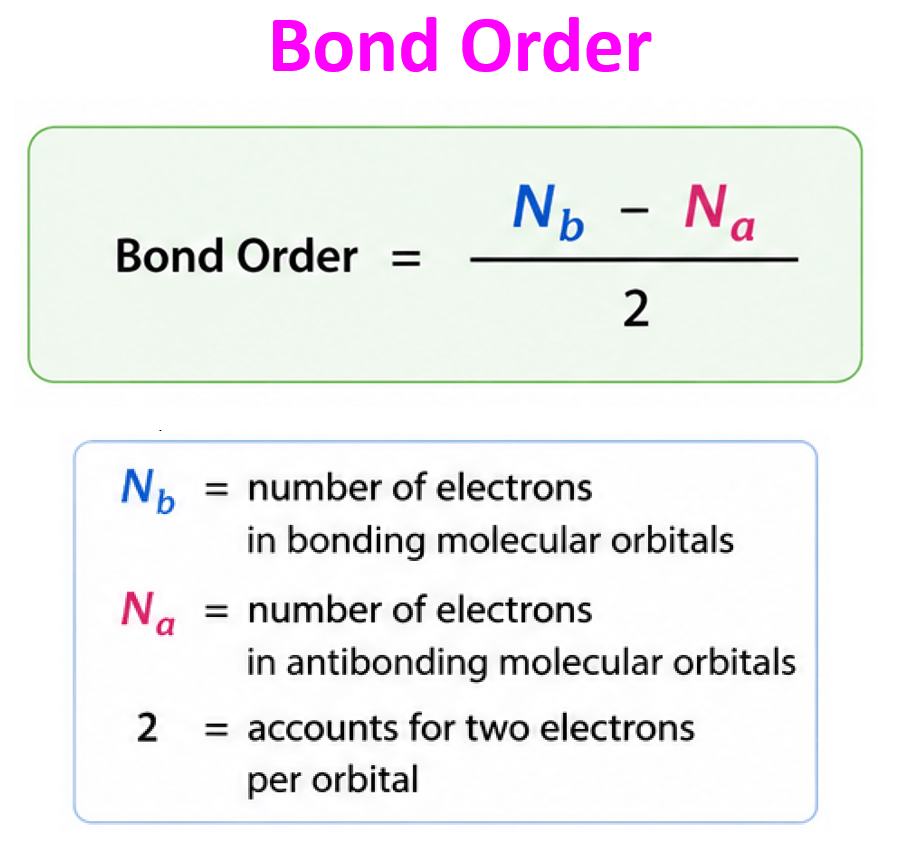
Another important piece of information that we can explain with MO theory is the bond order, which, simply put, tells us how many bonds exist between two atoms. In MO theory, we can determine the bond order by comparing the number of electrons in bonding molecular orbitals with the number of electrons in antibonding molecular orbitals. The higher the bond order, the stronger and shorter the bond generally is.
The bond order is calculated using:
For example, let’s go back to the molecular orbital diagram of hydrogen and determine the bond order in H₂:
There are 2 electrons in the bonding σ₁s orbital and no electrons in the antibonding σ₁s* orbital. Therefore, the bond order in H₂ is:
Bond order = ½(2 – 0) = 1
This means that H₂ contains a single covalent bond between the two hydrogen atoms.
In the case of O₂, we have 8 electrons in bonding molecular orbitals and 4 electrons in antibonding molecular orbitals. Therefore, the bond order is:
Bond order = ½(8 – 4) = 2
Therefore, O₂ has a double bond between the two oxygen atoms.
Bond Order of Zero
Let’s now consider an example where the bond order is 0. This indicates that there is no net bond between the atoms. In other words, the bonding and antibonding electrons cancel each other out, so the molecule is not stable and does not exist as a stable molecule.
We know that, unlike most gases such as O₂, N₂, and Cl₂, noble gases are monatomic, meaning that they exist as individual atoms rather than molecules. So why isn’t the formula of helium He₂?
To answer this question, go ahead and draw the molecular orbital diagram of He₂.
The electron configuration of helium is 1s². Therefore, when two helium atoms combine, their 1s atomic orbitals form one bonding molecular orbital, σ₁s, and one antibonding molecular orbital, σ₁s*. Since He₂ has a total of four electrons, both orbitals would be filled with electrons.
The bond order is therefore:
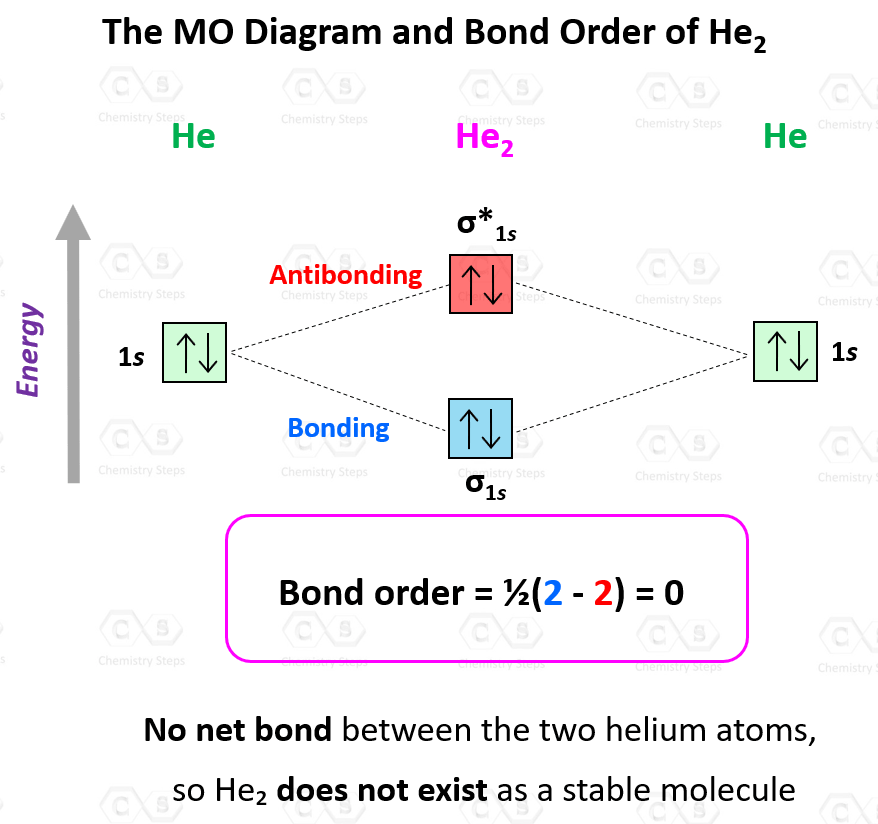
Because the bond order is zero, there is no net bond between the two helium atoms, so He₂ does not exist as a stable molecule. This is why helium exists as a monatomic gas, He, rather than as He₂.
Check Also
- Lewis Structures in Organic Chemistry
- Valency and Formal Charges in Organic Chemistry
- How to Determine the Number of Lone Pairs
- Bonding Patterns in Organic Chemistry
- sp3, sp2, and sp Hybridization in Organic Chemistry with Practice Problems
- How to Quickly Determine The sp3, sp2, and sp Hybridization
- Bond Lengths and Bond Strengths
- VSEPR Theory – Molecular and Electron Geometry of Organic Molecules
- Dipole-dipole, London Dispersion, and Hydrogen Bonding Interactions
- Dipole Moment and Molecular Polarity
- Boiling Point and Melting Point in Organic Chemistry
- Boiling Point and Melting Point Practice Problems
- Solubility of Organic Compounds
- General Chemistry Overview Quiz
Molecular Orbitals
- Molecular Hydrogen Ions
- Molecular Orbitals of Li₂
- MO diagrams of Heteronuclear Diatomic Molecules
- s-p Mixing in Molecular Orbital Diagrams
- The g and u Notation in MO Diagrams
- The Molecular Orbital Theory of Organic Molecules
- The Molecular Orbital of Acetylene
- The Molecular Orbitals of Carbonyls
- Orbital Coefficients, HOMO-LUMO Interactions, and Reactivity
- Molecular Orbitals and UV-Vis Spectroscopy
- Molecular Orbitals of 1,3-Butadiene
- 1,3,5-Hexatriene Pi Molecular Orbitals
- The Molecular Orbitals of Allylic Systems
- The Molecular Orbitals of Benzene
- Molecular Orbitals in Diels-Alder and Other Cycloaddition Reactions
- Diels-Alder Reactions: EWG, EDG, and MO Interactions
- Electrocyclic Reactions
- Claisen and Cope Rearrangements
- Sigmatropic Hydrogen Shifts