
We have learned that bicyclic compounds are cyclic molecules containing two rings that share two or more atoms. The shared atoms are called bridgehead carbons, and the atoms connecting them form the bridges of the bicyclic system.

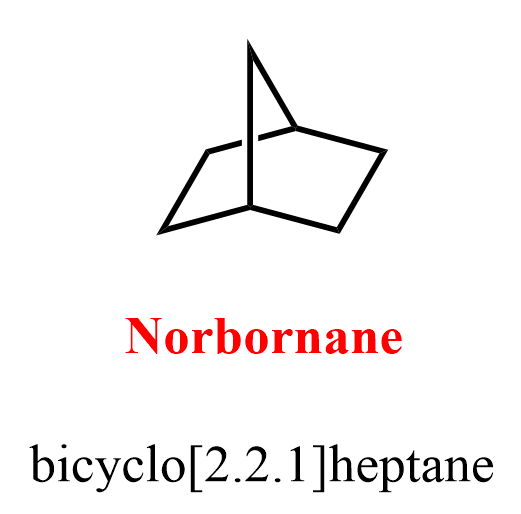
One of the most common examples of bicyclic compounds is norbornane, which is a bridged bicyclic hydrocarbon whose systematic name is bicyclo[2.2.1]heptane. It consists of seven carbon atoms arranged in two fused cyclopentane-like rings connected by a one-carbon bridge.
The alkene equivalent of norbornane is norbornene – it has a double bond in the ring.
So, the question is, where do we put this double bond? What do you think?
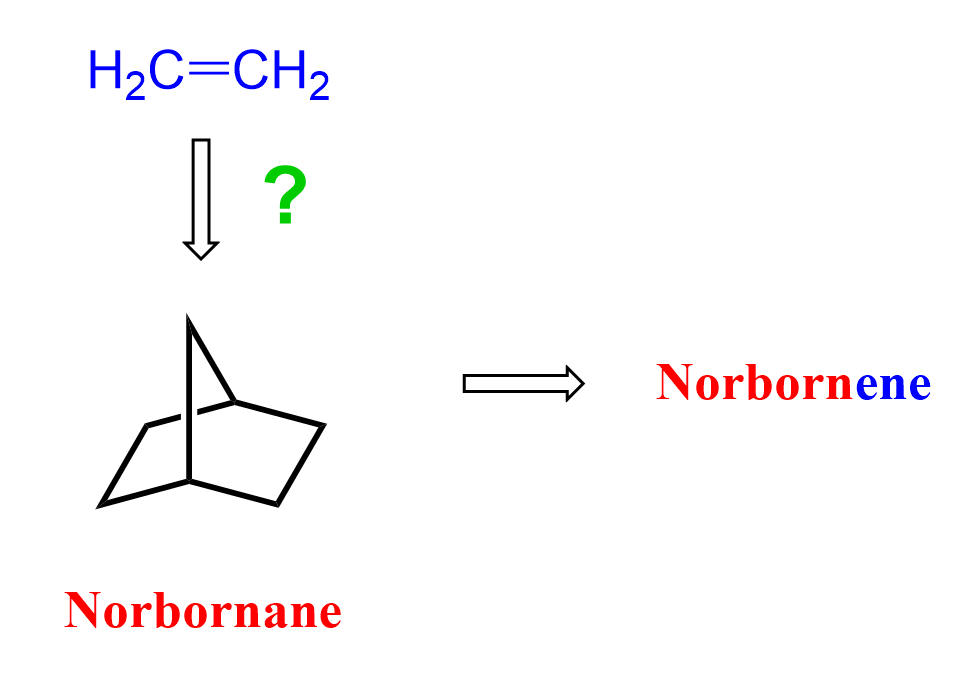
It turns out that there are not many options because most of them suggest impossible bond angles for the sp² and sp³ carbons of the ring. Well, there are actually only three positions where we can theoretically have the double bond:
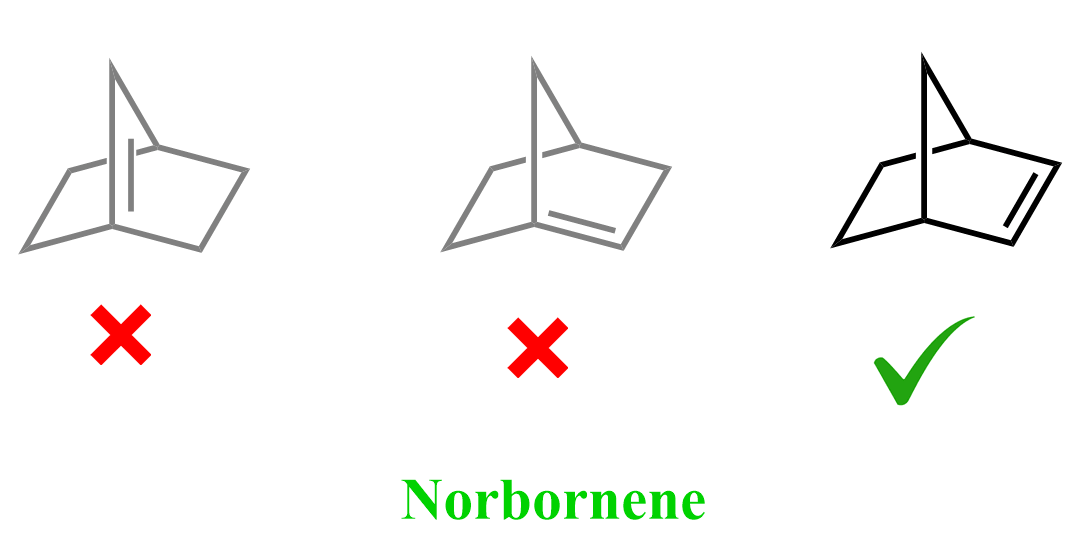
The two on the left should – and hopefully they do – hurt your eyes because, from all we have learned about the geometry of organic molecules, they simply do not fall into these patterns. The one on the right is the correct structure of norbornene.
This is essentially Bredt’s rule, which is formulated as follows: a double bond cannot be placed at the bridgehead position of a bridged bicyclic system unless the rings are large enough to accommodate the required planar geometry of the sp²-hybridized carbons.
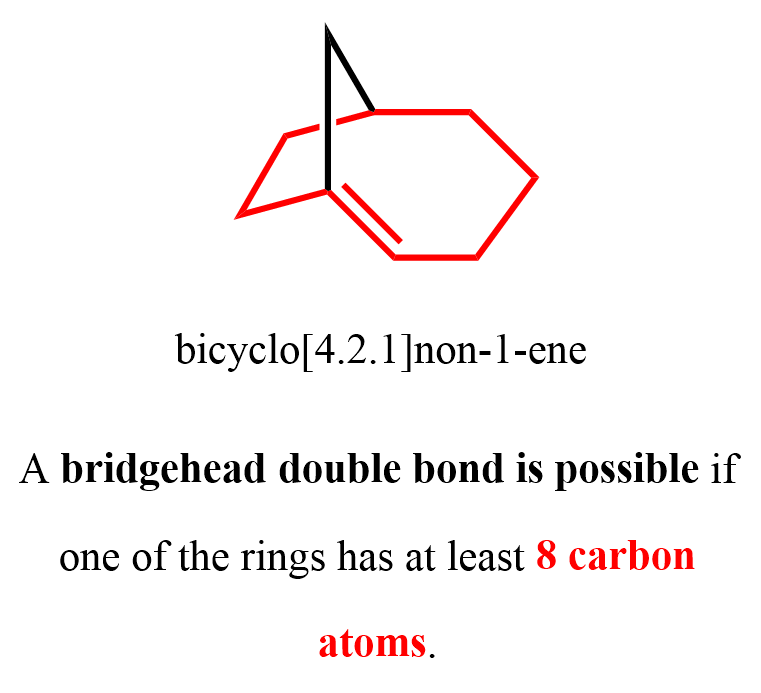
The part on “large enough” generally means 8 carbon atoms, so if one of the rings has 8 carbon atoms, then it is possible to have a double bond on the bridgehead carbon. For example, bicyclo[4.2.1]non-1-ene contains a double bond at the bridgehead carbon atom:
This restriction of not having a double bond on bridgehead carbon atoms of a bicyclic system is not the only factor we need to know about the stability of alkenes. We have a separate post dedicated to discussing stability based on the cis and trans configuration, and the degree of substitution of the C=C carbons, which you can find here.
Bredt’s Rule and E2 Elimination
Aside from the structural understanding of bicyclic compounds with a double bond, the main implication of Bredt’s rule goes to the elimination reactions of norbornane derivatives and other bicyclic compounds.
The simplest example is the reaction of exo-2-bromonorbornane with a strong base such as sodium ethoxide or t-BuOK:
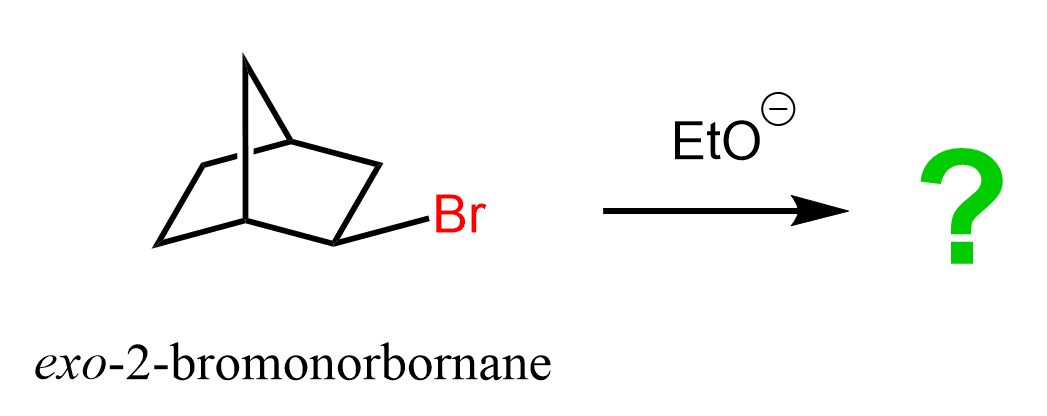
There are two beta hydrogens on one side and another one on the bridgehead carbon atom. As expected, the double bond is formed between carbon atoms 2 and 3 rather than on the bridgehead carbon:
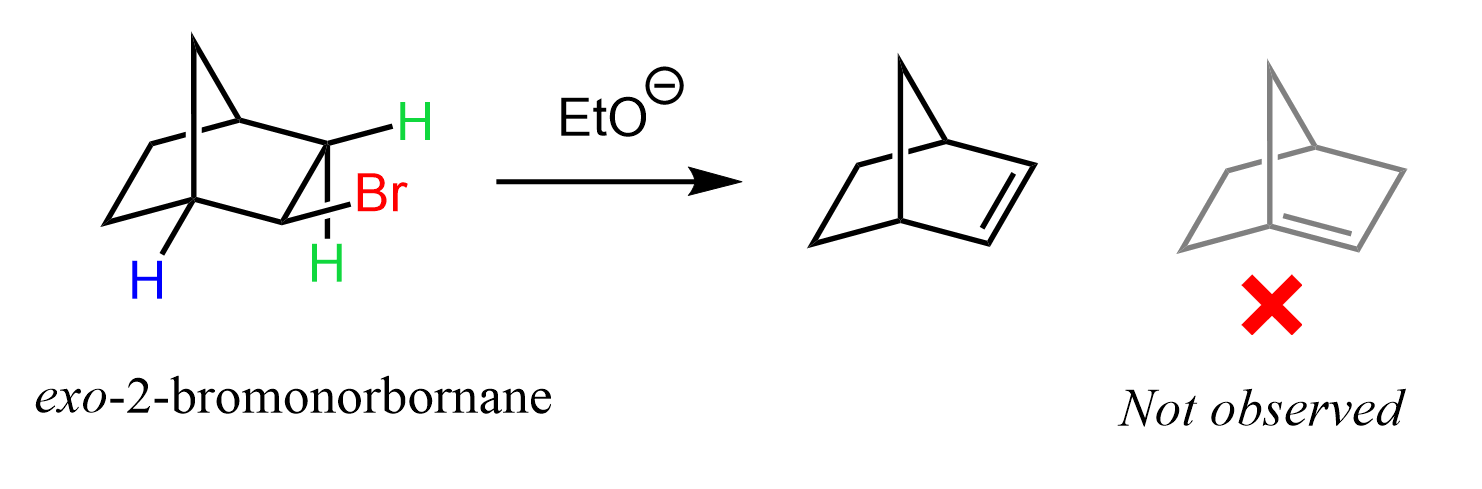
Another interesting point to discuss about the elimination of this bicyclic compound is the requirement of antiperiplanar orientation between the leaving group and the beta hydrogen.
As you may have noticed, none of the beta hydrogens of norbornane is antiperiplanar to the Br. In many bicyclic systems, the only accessible alignment between the β-hydrogen and the leaving group is a syn-periplanar arrangement, so syn elimination becomes the predominant pathway. This happens because the molecule simply cannot rotate into a proper anti-configuration, and therefore the reaction proceeds through the best available orbital alignment rather than the most stable one.
To identify which beta hydrogen is eliminated, let’s replace one of them with a deuterium and see whether the hydrogen or deuterium is abstracted by the base:
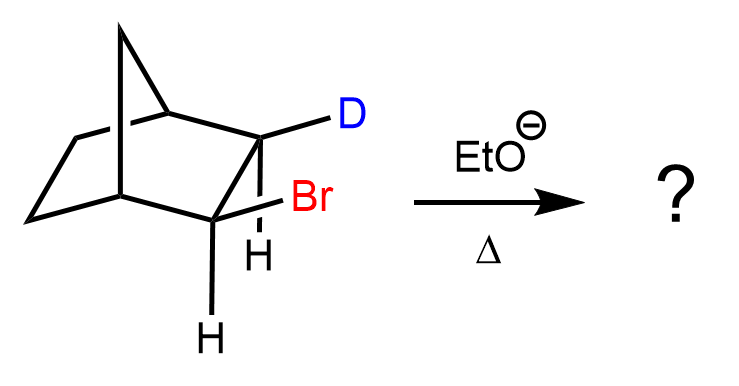
Like in the case of anti-orientation, in syn orientation, the orbitals of the leaving group and the beta hydrogen are also parallel, and therefore, E2 elimination can occur. They are not equally favorable, though, and syn elimination is possible when an antiperiplanar geometry cannot be achieved.
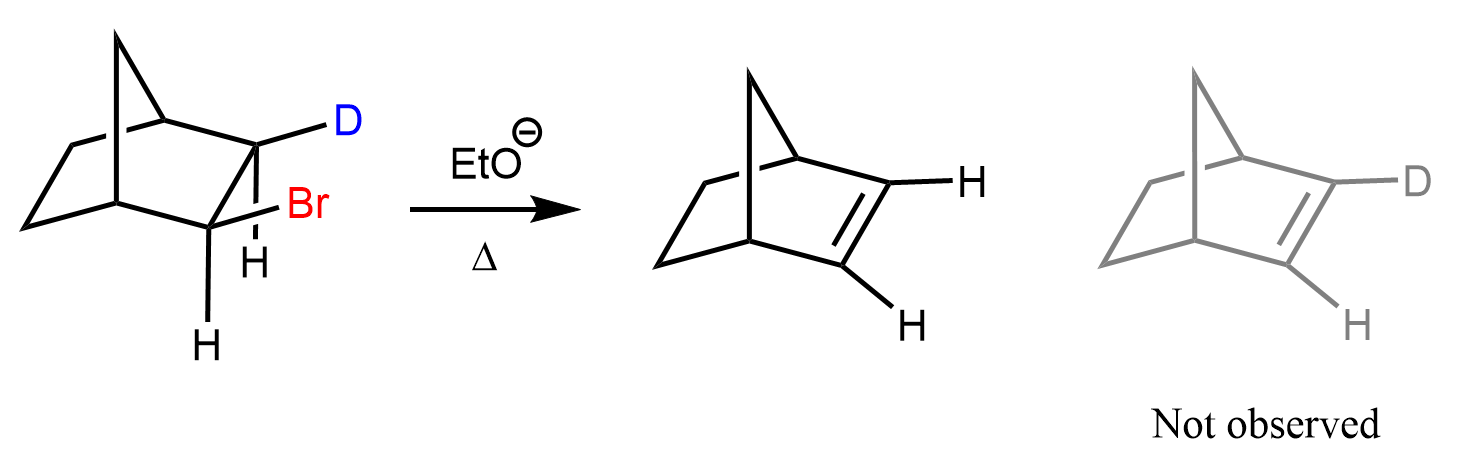
So, why is this not a common pattern, and why do we always say the groups must be antiperiplanar? In flexible acyclic systems, it is rare because it requires the less favorable eclipsed conformation, whereas trans–anti-elimination proceeds through the preferred staggered conformation.
On the other hand, syn elimination becomes significant in rigid or sterically constrained systems where conformational change is impossible, such as in certain polycyclic molecules. One such example is the norbornane shown in this question. The C-D is syn-parallel to the C-Br, while there are no antiperiplanar C–H bonds available, so the reaction proceeds exclusively through syn elimination.
So, keep this in mind: syn elimination is observed when a syn-periplanar arrangement can be adopted, but an antiperiplanar cannot.
Another example of making syn elimination possible is ion pairing of the base with the leaving group, which favors a syn pathway, but these are very rare in undergraduate organic chemistry classes.
You can read about this topic, for example, in Anslyn’s Advanced Organic Chemistry, page 591.
Check also the article “The Mechanism of Elimination Reactions. 11.’ Kinetic Preference for exo-cis Bimolecular Eliminations with trans-2,3-Dihalonorbornanes”, J. Am. Chem. Soc., 82, 623 (1960).
Bredt’s Rule and E1 Elimination
When a similar norbornane derivative with an OH group is treated with an acid, Bredt’s rule is still observed, and the product of the reaction is a norbornene derivative:
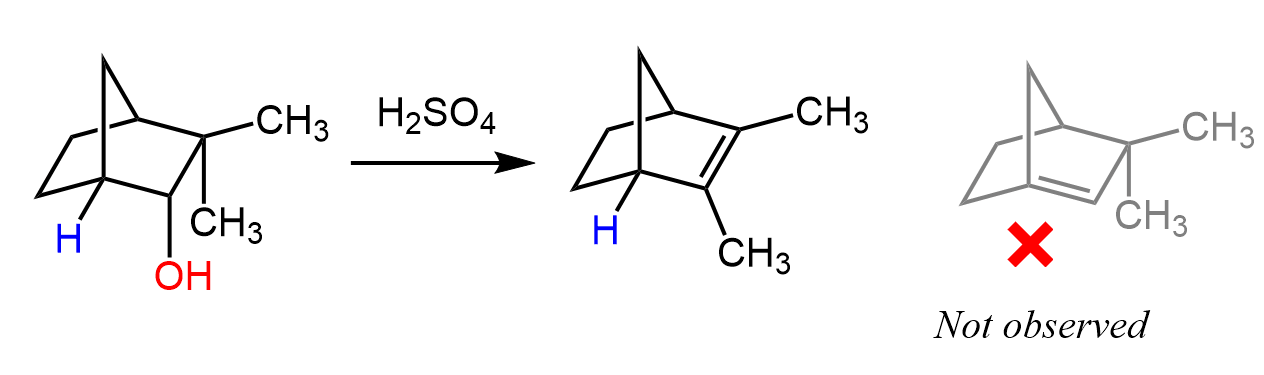
Let’s also understand how the methyl group ended up on the neighboring carbon.
Like any acid-catalyzed dehydration of alcohols, the reaction starts with a protonation of the OH group, and a carbocation is formed upon the loss of water. This is a secondary carbocation that is transformed into a more stable tertiary carbocation via a 1,2-methyl shift. After this, water abstracts the beta hydrogen, and the double bond is formed:
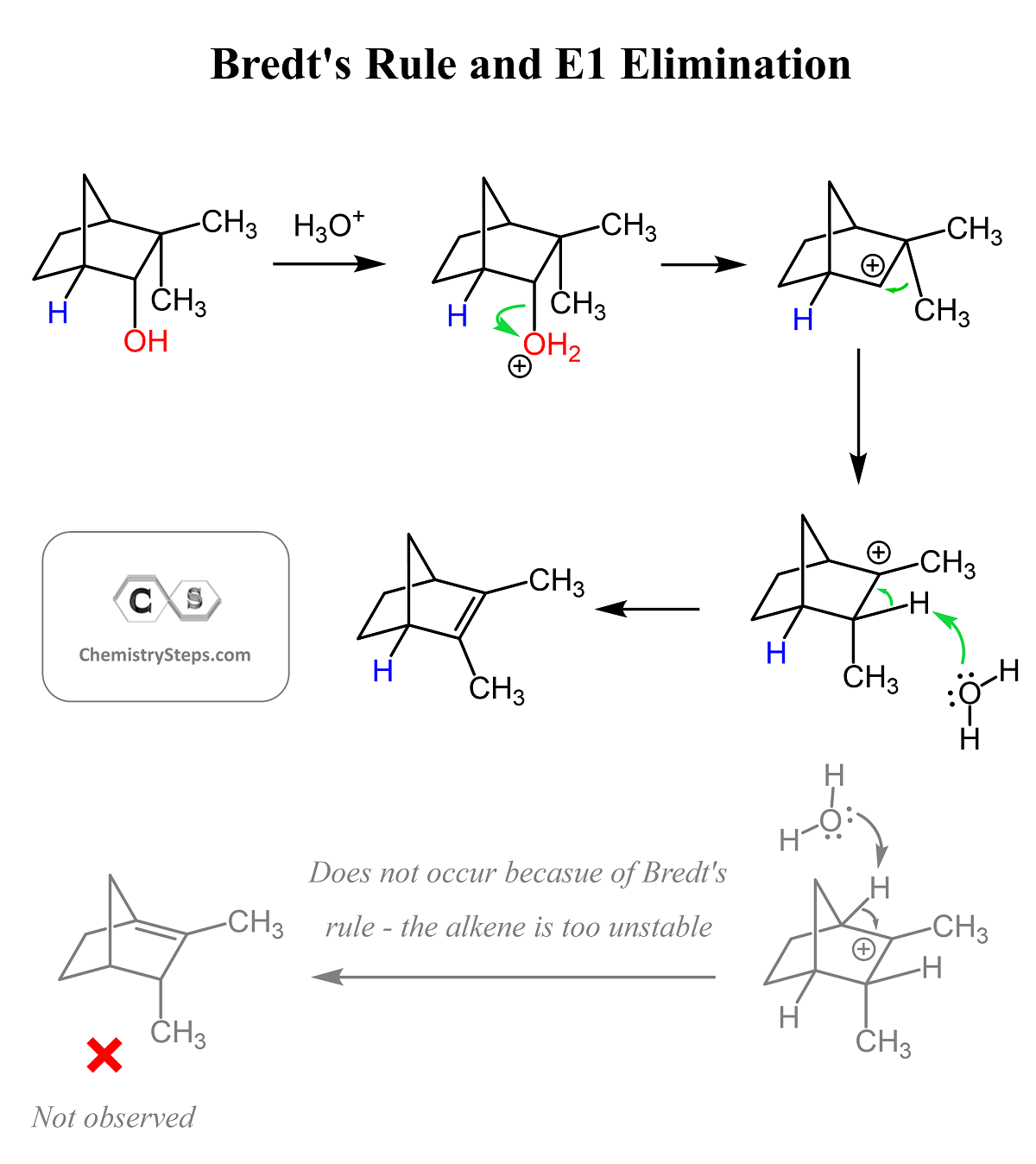
These types of alkyl shifts are very common in norbornane systems. They are known as Meerwein-Wagner rearrangements and often lead to complicated transformations. As an example, consider the following substitution reaction of substituted exo-2-bromonorbornane:
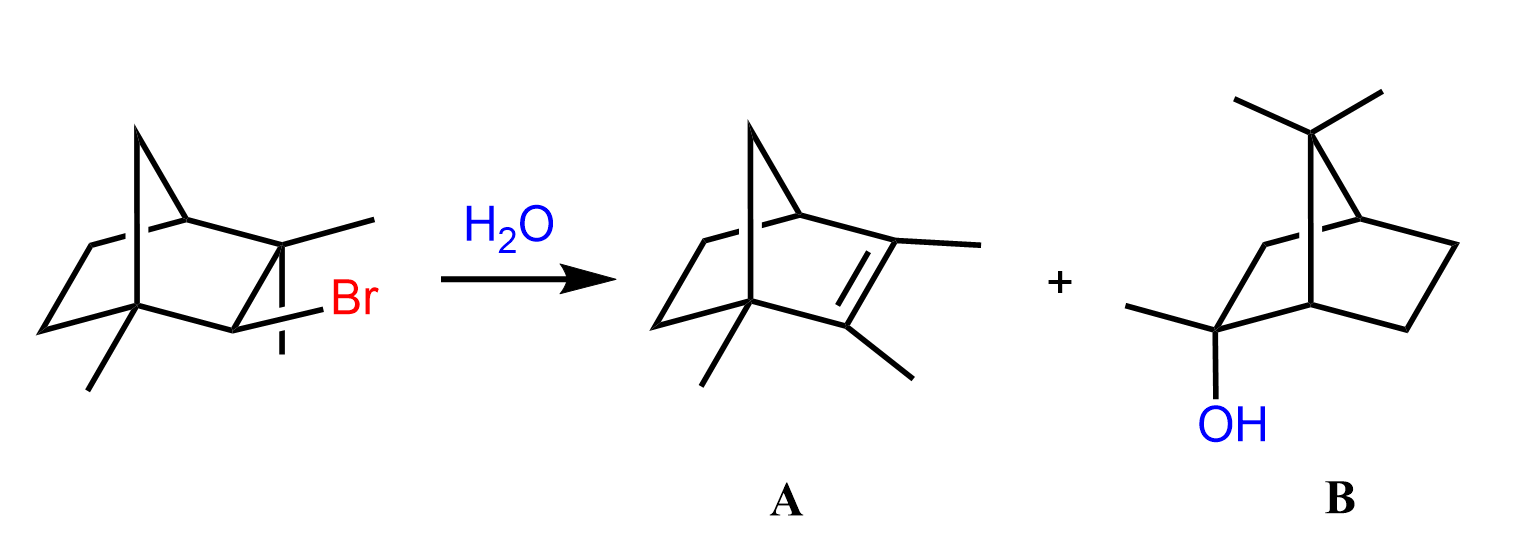
We have a dedicated post on this and other types of usual and unusual reactions of norbornane and norbornene derivatives, which you can find here.
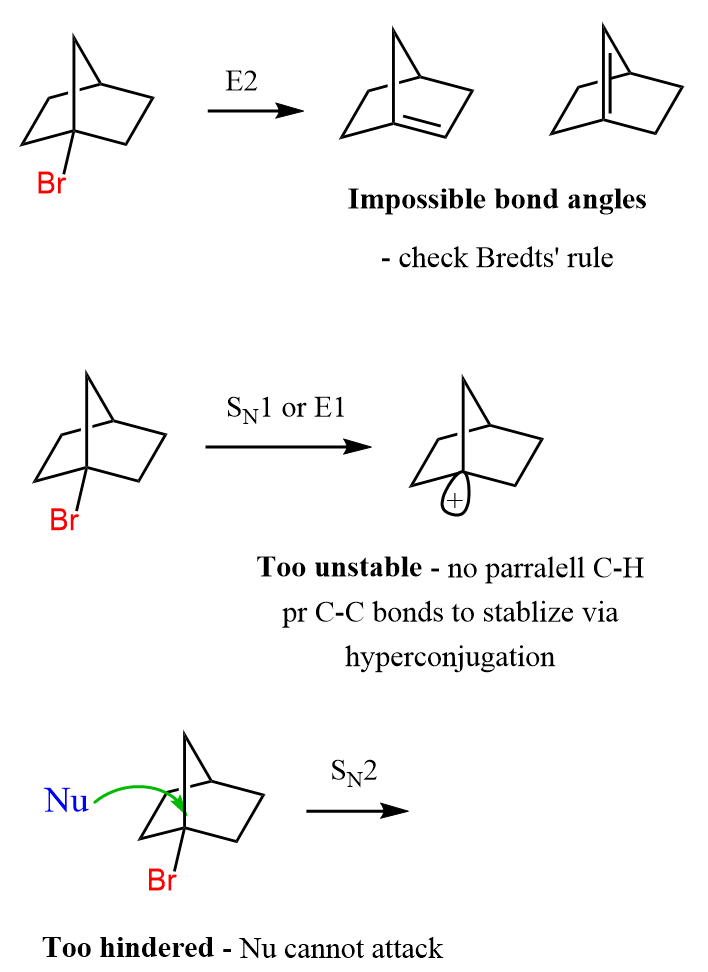
It is also worth mentioning that when the leaving group is connected to the bridgehead carbon, no substitution or elimination reaction occurs.
For example, the following alkyl norbornane does not undergo SN1, SN2, E1, or E2 reactions.
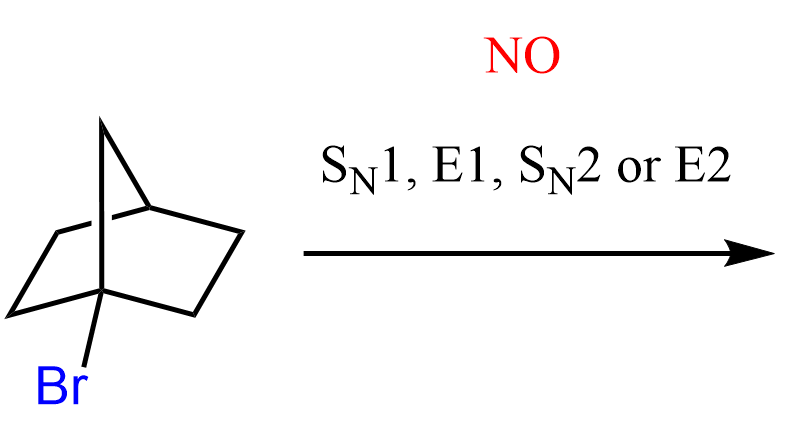
Here is the explanation for each mechanism that is not possible for this rigid structure:
On paper, it looks like a tertiary halide, and you might expect it to be reactive, as tertiary usually means SN1, E1, or at least E2 elimination is possible. But in practice, this compound just does not react by any of these mechanisms.
So, why not:
❌ SN1 and E1
SN1 and E1 occur via the formation of a carbocation. However, the geometry of the bridgehead carbon is locked, and it can’t flatten it into the planar sp² shape that a carbocation demands. The bicyclic framework forces the carbon to stay pyramidal, so the “empty p orbital” you need for carbocation stabilization simply can’t form. Besides, even if E1 were to occur, it would have formed a bridged double, which is not allowed/possible – see Bredt’s rule.
❌ SN2
SN2 requires a backside attack, which is simply impossible on the bridgehead carbon – it is caged, let alone being sterically hindered.
❌ E2
Two things to consider: 1) the β-hydrogens in norbornane cannot line up antiperiplanar to the C–Br bond at the bridgehead. And even if they could, the resulting double bond would sit at the bridgehead carbon. That’s a bridgehead alkene, which violates Bredt’s rule: small bicyclic systems can’t accommodate a planar sp² bridgehead because the rings force it out of alignment.
To summarize, remember Bredt’s rule in simple terms: don’t place a double bond at a bridgehead position in small bicyclic systems like norbornane, because the geometry just doesn’t allow the carbon to become properly planar.
Watch out for this when dealing with elimination reactions, including those with rearrangement. The final product still has to obey Bredt’s rule – meaning you cannot end up with a double bond at a bridgehead carbon in a strained bicyclic system.
Whenever a reaction seems to “want” to put a double bond at a bridgehead position, pause and check the structure. If the system is too small, that product simply won’t form, and the reaction will, if possible, give an alternative alkene that avoids the bridgehead position.
Check Also
- Alkenes: Structure and Stability
- Naming Alkenes by IUPAC Nomenclature Rules
- Cis and Trans Isomers
- E and Z Alkene Configuration with Practice Problems
- Naming Bicyclic Compounds
- Naming Bicyclic Compounds-Practice Problems
- Reactions of Norbornane Derivatives
- The E2 Mechanism
- E2 Elimination Practice Problems
- Carbocation Rearrangements in SN1 Reactions with Practice Problems
- Ring Expansion Rearrangements
- Ring Contraction Rearrangements
- Rearrangements in E1 Reactions