Skip to content
Chemistry Steps

Chemistry Steps

Chemistry Steps
  • Live Help
  • Topics
  • Study Guides
    • Reagent Guide 
  • Reaction Maps
  • Quizzes
  • Practice
  • CS Benefits
  • Log In
    • Register
Chemistry Steps
  • Live Help
  • Topics
  • Study Guides
    • Reagent Guide 
  • Reaction Maps
  • Quizzes
  • Practice
  • CS Benefits
  • Log In
    • Register

Aldehydes and Ketones

Imine and Enamine Hydrolysis Mechanism

by Dr. S. Gevorg
Imine and Enamine Hydrolysis Mechanism

 Imines and enamines can be hydrolyzed to aldehydes and ketones in acidic conditions:     Remember, the reactions of aldehydes and ketones with alcohols and amines are all reversible, and therefore, the products of these reactions – acetals, imines, and … Read more

Categories Aldehydes and Ketones 2 Comments

Acetal Hydrolysis Mechanism

by Dr. S. Gevorg
Acid-Catalyzed Hydrolysis of Acetals

We have learned that the reactions of aldehydes and ketones with alcohols and amines result in the formation of acetals, imines, and enamines, depending on the structure of the amine:     These reactions are reversible, and one application of … Read more

Categories Aldehydes and Ketones Leave a comment

Enamines from Aldehydes and Ketones with Secondary Amines

by Dr. S. Gevorg
aldehydes and ketones with amines forming imine and enamines

The reaction of aldehydes and ketones with secondary amines produces enamines. Enamines are amines with a double bond on the adjacent carbon (alkene + amine = enamine):     Let’s go over the mechanism of this transformation to see how … Read more

Categories Aldehydes and Ketones, Amines 4 Comments

Imines from Aldehydes and Ketones with Primary Amines

by Dr. S. Gevorg
aldehydes and ketones with amines forming imine and enamines

Aldehydes and ketones react with primary amines, in mildly acidic conditions, forming an imine (a Schiff base). The reaction with secondary amines produces enamines:     Just like the reaction with water and alcohols, this is also an addition reaction … Read more

Categories Aldehydes and Ketones, Amines Leave a comment

LiAlH4 and NaBH4 Carbonyl Reduction Mechanism

by Dr. S. Gevorg
LiAlH4 NaBH4 DIBAL reduction summary for aldehydes, ketones, esters, carboxylic acids and acid chlorides

Alcohols can be prepared from carbonyl compounds such as aldehydes, ketones, esters, acid chlorides, and even carboxylic acids by hydride reductions. These reductions are a result of a net addition of two hydrogen atoms to the C=O bond:     … Read more

Categories Aldehydes and Ketones, Reactions of Alcohols 6 Comments

The Wittig Reaction – Practice Problems

by Dr. S. Gevorg
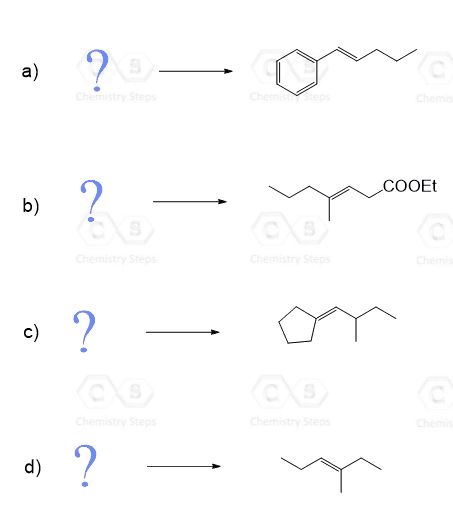
Wittig reaction-what starting materials are needed to prepare each alkene by a Wittig reaction

In the previous post, we discussed the principle and mechanism of the Wittig reaction. Go over those if you need to, and in the following practice problem, we will work on proposing a synthesis for Wittig reagents as well as … Read more

Categories Aldehydes and Ketones Tags Carbonyls, Organic Synthesis Practice Problems Leave a comment

Hydrolysis of Acetals, Imines and Enamines-Practice Problems

by Dr. S. Gevorg
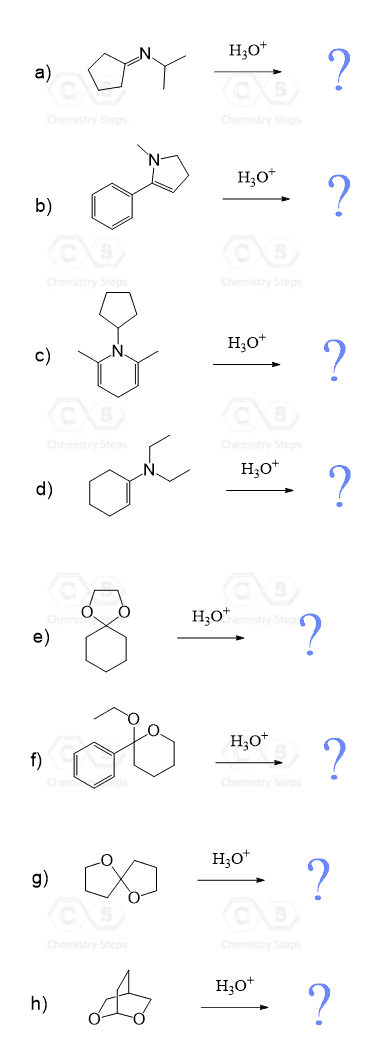
Acetal imine enamine hydrolysis practice problem

We discussed the mechanisms for the hydrolysis of acetals, imines, and enamine to aldehydes and ketones in the previous posts: Acetal Hydrolysis Mechanism Imine and Enamine Hydrolysis Mechanism So, here is a set of practice problems you can work on … Read more

Categories Aldehydes and Ketones Tags Carbonyls, Organic Synthesis Practice Problems Leave a comment

Reactions of Aldehydes and Ketones with Amines-Practice Problems

by Dr. S. Gevorg
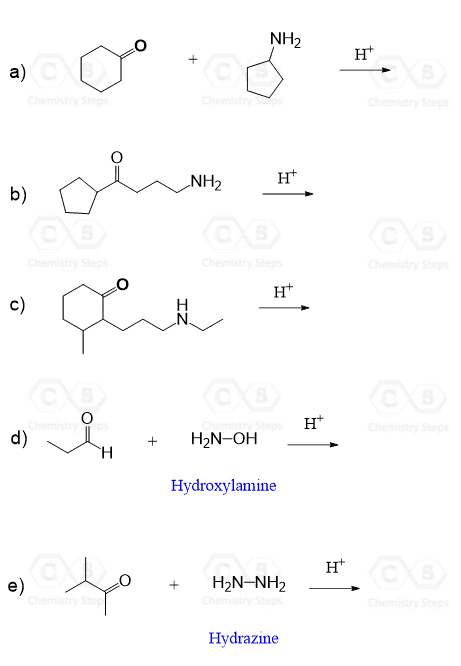
Imine and enamine formation by reaction of aldehydes and ketones with amines

In the previous two posts, we have seen that aldehydes and ketones react with primary amines, in mildly acidic conditions, forming an imine (a Schiff base). The reaction with secondary amines produces enamines:     Below are a few practice exmmples of these reactions :

Categories Aldehydes and Ketones Leave a comment

Acetals as Protecting Groups for Aldehydes and Ketones

by Dr. S. Gevorg
reduce ester in presence of aldehyde with lialh4 steps

Acetals are the protecting groups for aldehydes and ketones. They can be used, for example, when a selective reduction of an ester is needed in the presence of an aldehyde or a ketone:     Remember, aldehydes are more reactive … Read more

Categories Aldehydes and Ketones, Organic Synthesis Problems Tags Grignard Reaction, Organic Synthesis Practice Problems, Protecting Groups 2 Comments

The Addition-Elimination Mechanism

by Dr. S. Gevorg
Nucleophilic Acyl Substitution by Addition-Elimination Mechanism

The addition-elimination mechanism represents certain types of substitutions where the replacement of the leaving group is achieved in two consecutive steps – addition, and elimination. The most common example is the acyl substitution where one group connected to the carbonyl … Read more

Categories Aldehydes and Ketones, Carboxylic Acids and Their Derivatives Leave a comment
Older posts
Newer posts
← Previous Page1 Page2 Page3 Page4 Next →
Organic Chemistry Study Guides
Chemistry Steps Membership Benefits Organic Chemistry

Structure and Bonding

  • Lewis Structures in Organic Chemistry
  • Valency and Formal Charges in Organic Chemistry
  • How to Determine the Number of Lone Pairs
  • Bonding Patterns in Organic Chemistry
  • sp3, sp2, and sp Hybridization in Organic Chemistry with Practice Problems
  • How to Quickly Determine The sp3, sp2, and sp Hybridization
  • Bond Lengths and Bond Strengths
  • VSEPR Theory – Molecular and Electron Geometry of Organic Molecules
  • Dipole-dipole, London Dispersion and Hydrogen Bonding Interactions
  • Dipole Moment and Molecular Polarity
  • Boiling Point and Melting Point in Organic Chemistry
  • Boiling Point and Melting Point Practice Problems
  • Solubility of Organic Compounds
  • General Chemistry Overview Quiz

Molecular Representations

  • Bond-Line or Skeletal Structures
  • Functional Groups in Organic Chemistry with Practice Problems
  • Bond-line, Lewis, and Condensed Structures with Practice Problems
  • Curved Arrows with Practice Problems
  • Resonance Structures in Organic Chemistry with Practice Problems
  • Rules for Drawing Resonance Structures
  • Major and Minor Resonance Contributor
  • How to Choose the More Stable Resonance Structure
  • Drawing Complex Patterns in Resonance Structures
  • Localized and Delocalized Lone Pairs with Practice Problems
  • Molecular Representations Quiz

Acids and Bases

  • Acids and Bases – General Chemistry
  • Organic Acids and Bases
  • Organic Acid-Base Mechanisms
  • Acid Strength and pKa
  • How to Determine the Position of Equilibrium for an Acid-Base Reaction
  • Inductive and Resonance (Mesomeric) Effects
  • Factors That Determine the pKa and Acid Strength
  • How to Choose an Acid or a Base to Protonate or Deprotonate a Given Compound
  • Lewis Acids and Bases
  • Basicity of Amines
  • Organic Acids and Bases Practice Problems
  • Organic Acids and Bases Quiz

Alkanes and Cycloalkanes

  • Naming Alkanes by IUPAC Nomenclature Rules Practice Problems
  • Naming Bicyclic Compounds
  • Naming Bicyclic Compounds-Practice Problems
  • How to Name a Compound with Multiple Functional Groups
  • Primary, Secondary, and Tertiary Carbon Atoms in Organic Chemistry
  • Constitutional or Structural Isomers with Practice Problems
  • Degrees of Unsaturation or Index of Hydrogen Deficiency
  • The Wedge and Dash Representation
  • Sawhorse Projections
  • Newman Projections with Practice Problems
  • Staggered and Eclipsed Conformations
  • Conformational Isomers of Propane
  • Newman Projection and Conformational Analysis of Butane
  • Newman Projection of Chair Conformation
  • Gauche Conformation
  • Gauche Conformation, Steric, Torsional Strain Energy Practice Problems
  • Ring Strain
  • Steric vs Torsional Strain
  • Conformational Analysis
  • Drawing the Chair Conformation of Cyclohexane
  • Ring Flip: Drawing Both Chair Conformations with Practice Problems
  • 1,3-Diaxial Interactions and A value for Cyclohexanes
  • Ring-Flip: Comparing the Stability of Chair Conformations with Practice Problems
  • Cis and Trans Decalin
  • IUPAC Nomenclature Practice Problems
  • IUPAC Nomenclature Summary Quiz
  • Alkanes and Cycloalkanes Practice Quiz

Stereochemistry

  • How to Determine the R and S Configuration
  • The R and S Configuration Practice Problems
  • What is Nonsuperimposable in Organic Chemistry
  • Chirality and Enantiomers
  • Diastereomers-Introduction and Practice Problems
  • Enantiomers vs Diastereomers
  • Cis and Trans Isomers
  • E and Z Alkene Configuration with Practice Problems
  • Enantiomers, Diastereomers, the Same or Constitutional Isomers with Practice Problems
  • Configurational Isomers
  • Optical Activity
  • Specific Rotation
  • Racemic Mixtures
  • Enantiomeric Excess (ee): Percentage of Enantiomers from Specific Rotation with Practice Problems
  • Symmetry and Chirality. Meso Compounds
  • Fischer Projections with Practice Problems
  • R and S Configuration in the Fischer Projection
  • R and S configuration on Newman projections
  • R and S Configuration of Allenes
  • Converting Bond-Line, Newman Projection, and Fischer Projections
  • Resolution of Enantiomers: Separate Enantiomers by Converting to Diastereomers
  • Stereochemistry Practice Problems
  • Stereochemistry Practice Quiz

Energy Changes In Organic Chemistry

  • Energy and Organic Chemistry Reactions
  • Bond Lengths and Bond Strengths
  • Homolytic and Heterolytic Bond Cleavage
  • The Heat of Reaction from Bond Dissociation Energies

Nucleophilic Substitution Reactions

  • Introduction to Alkyl Halides
  • Nomenclature of Alkyl Halides
  • Substitution and Elimination Reactions
  • Nucleophilic Substitution Reactions – An Introduction
  • All You Need to Know About the SN2 Reaction Mechanism
  • The SN2 Mechanism: Kinetics, Thermodynamics, Curved Arrows, and Stereochemistry with Practice Problems
  • The Stereochemistry of SN2 Reactions
  • Stability of Carbocations
  • The SN1 Nucleophilic Substitution Reaction
  • Reactions of Alkyl Halides with Water
  • The Stereochemistry of the SN1 Reaction Mechanism
  • The SN1 Mechanism: Kinetics, Thermodynamics, Curved Arrows, and Stereochemistry with Practice Problems
  • Steric Hindrance in SN2 and SN1 Reactions
  • Carbocation Rearrangements in SN1 Reactions with Practice Problems
  • Ring Expansion Rearrangements
  • Ring Contraction Rearrangements
  • When Is the Mechanism SN1 or SN2?
  • Reactions of Alcohols with HCl, HBr, and HI Acids
  • SOCl2 and PBr3 for Conversion of Alcohols to Alkyl Halides
  • Alcohols in SN1 and SN2 Reactions
  • How to Choose Molecules for Doing SN2 and SN1 Synthesis-Practice Problems
  • Exceptions in SN2 and SN1 Reactions
  • Nucleophilic Substitution and Elimination Practice Quiz
  • Reactions Map of Alkyl Halides

Alkenes: Structure, Stability, and Nomenclature

  • Alkenes: Structure and Stability
  • Naming Alkenes by IUPAC Nomenclature Rules
  • Cis and Trans Isomers
  • E and Z Alkene Configuration with Practice Problems

Elimination Reactions

  • Substitution and Elimination Reactions
  • The E2 Mechanism
  • E2 Elimination Practice Problems
  • Zaitsev's Rule - Regioselectivity of E2 Elimination Reactions
  • The Hofmann Elimination of Amines and Alkyl Fluorides
  • Stereoselectivity of E2 Elimination Reactions
  • Stereospecificity of E2 Elimination Reactions
  • SN2 and E2 Rates of Cyclohexanes
  • Elimination Reactions of Cyclohexanes with Practice Problems
  • POCl3 for Dehydration of Alcohols
  • The E1 Mechanism with Practice Problems
  • Regioselectivity of E1 Reactions
  • Stereoselectivity of E1 Reactions
  • How to tell if it is E2 or E1 Mechanism
  • SN1 vs E1 Reactions
  • SN2 vs E2 Reactions
  • Dehydration of Alcohols by E1 and E2 Elimination
  • Mesylates and Tosylates as Good Leaving Groups
  • Mitsunobu Reaction
  • SN1 SN2 E1 E2 – How to Choose the Mechanism
  • Polar Protic and Polar Aprotic Solvents
  • SN1 SN2 E1 or E2 - the Largest Collection of Practice Problems
  • The Hammond Postulate
  • The E1cB Elimination Mechanism
  • Nucleophilic Substitution and Elimination Practice Quiz
  • Reactions Map of Alkyl Halides

Addition Reactions of Alkenes

  • Electrophilic Addition Reactions to Alkenes
  • Markovnikov's Rule
  • Markovnikov's Rule with Practice Problems
  • Addition of Water to Alkenes
  • Acid-Catalyzed Hydration of Alkenes with Practice Problems
  • Rearrangements in Alkene Addition Reactions
  • Oxymercuration-Demercuration
  • Addition of Alcohols to Alkenes
  • Free-Radical Addition of HBr: Anti-Markovnikov Addition
  • Hydroboration-Oxidation: The Mechanism
  • Hydroboration-Oxidation of Alkenes: Regiochemistry and Stereochemistry with Practice Problems
  • Halogenation of Alkenes and Halohydrin Formation
  • The Regiochemistry of Alkene Addition Reactions
  • The Stereochemistry of Alkene Addition Reactions
  • Cis product in an anti-Addition Reaction of Alkenes
  • Ozonolysis of Alkenes with Practice Problems
  • Syn Dihydroxylation of Alkenes with KMnO4 and OsO4
  • Anti-Dihydroxylation of Alkenes with MCPBA and Other Peroxides with Practice Problems
  • Oxidative Cleavage of Alkenes with KMno4 and O3
  • Alkene Reactions Practice Problems
  • Changing the Position of a Double Bond
  • Changing the Position of a Leaving Group
  • Alkenes Multi-Step Synthesis Practice Problems
  • Alkene Addition Reactions Practice Quiz
  • Reactions Map of Alkenes

Alkynes

  • Introduction to Alkynes
  • Naming Alkynes by IUPAC Nomenclature Rules - Practice Problems
  • Preparation of Alkynes by Elimination Reactions
  • Hydrohalogenation of Alkynes
  • Addition of Water to Alkynes
  • Acid-Catalyzed Hydration of Alkynes with Practice Problems
  • Reduction of Alkynes
  • Halogenation of Alkynes
  • Hydroboration-Oxidation of Alkynes with Practice Problems
  • Ozonolysis of Alkynes with Practice Problems
  • Alkylation of Terminal Alkynes in Organic Synthesis with Practice Problems
  • Reactions of Acetylide Ions
  • Alkyne reactions summary practice problems
  • Alkyne Synthesis Reactions Practice Problems
  • Alkyne Naming and Reactions Practice Quiz
  • Reactions Map of Alkynes

Nuclear Magnetic Resonance (NMR) Spectroscopy

  • NMR Spectroscopy – An Easy Introduction
  • NMR Chemical Shift
  • NMR Chemical Shift Range and Value Table
  • NMR Number of Signals and Equivalent Protons
  • Homotopic, Enantiotopic, Diastereotopic, and Heterotopic
  • Homotopic Enantiotopic Diastereotopic Practice Problems
  • Integration in NMR Spectroscopy
  • Splitting and Multiplicity (N+1 rule) in NMR Spectroscopy
  • NMR Signal Splitting N+1 Rule Multiplicity Practice Problems
  • 13C Carbon NMR
  • DEPT NMR: Signals and Problem Solving
  • NMR Spectroscopy-Carbon-Dept-IR Practice Problems

Organic Structure Determination

  • NMR Spectroscopy-Carbon-Dept-IR Practice Problems
  • Infrared (IR) Spectroscopy Practice Problems
  • Solving Mass Spectrometry Practice Problems

Radical Reactions

  • Free-Radical Addition of HBr: Anti-Markovnikov Addition
  • Initiation, Propagation, Termination in Radical Reactions
  • Selectivity in Radical Halogenation
  • Stability of Radicals
  • Resonance Structures of Radicals
  • Stereochemistry of Radical Halogenation with Practice Problems
  • Allylic Bromination by NBS with Practice Problems
  • Radical Halogenation in Organic Synthesis

Reactions of Alcohols

  • Nomenclature of Alcohols: Naming Alcohols based on IUPAC Rules with Practice Problems
  • Preparation of Alcohols via Substitution or Addition Reactions
  • Reaction of Alcohols with HCl, HBr, and HI Acids
  • Mesylates and Tosylates as Good Leaving Groups
  • SOCl2 and PBr3 for Conversion of Alcohols to Alkyl Halides
  • Alcohols in Substitution Reactions  Practice Problems
  • POCl3 for Dehydration of Alcohols
  • Dehydration of Alcohols by E1 and E2 Elimination
  • The Oxidation States of Organic Compounds
  • LiAlH4 and NaBH4 Carbonyl Reduction Mechanism
  • Alcohols from Carbonyl Reductions - Practice Problems
  • Grignard Reaction in Preparing Alcohols with Practice Problems
  • Grignard Reaction in Organic Synthesis with Practice Problems
  • Protecting Groups For Alcohols in Organic Synthesis
  • Oxidation of Alcohols: PCC, PDC, CrO3, DMP, Swern, and All of That
  • Diols: Nomenclature, Preparation, and Reactions
  • NaIO4 Oxidative Cleavage of Diols
  • The Pinacol Rearrangement
  • The Williamson Ether Synthesis
  • Alcohol Reactions Practice Problems
  • Naming Thiols and Sulfides
  • Reactions of Thiols
  • Alcohols Quiz – Naming, Preparation, and Reactions
  • Reactions Map of Alcohols

Ethers and Epoxides

  • Preparation of Epoxides
  • Ring-Opening Reactions of Epoxides
  • Reactions of Epoxides under Acidic and Basic Conditions
  • Reactions of Epoxides Practice Problems
  • The Grignard Reaction of Epoxides
  • Naming Ethers
  • The Williamson Ether Synthesis
  • Reactions of Ethers-Ether Cleavage

Conjugated Systems

  • Resonance and Conjugated Dienes
  • Allylic Carbocations
  • 1,2 and 1,4 Electrophilic Addition to Dienes
  • Kinetic vs Thermodynamic Control of Electrophilic Addition to Dienes

The Diels-Alder Reaction

  • Diels-Alder Reaction: Dienes and Dienophiles
  • Predict the Products of the Diels-Alder Reaction with Practice Problems
  • Endo and Exo Products of Diels-Alder Reaction with Practice Problems
  • Regiochemistry of the Diels–Alder Reaction with Practice Problems
  • Identify the Diene and Dienophile of the Diels-Alder reaction with Practice Problems
  • Diels-Alder Reaction in Organic Synthesis Practice Problems

Aromatic Compounds

  • Naming Aromatic Compounds
  • Introduction to Aromatic Compounds
  • Benzene – Aromatic Structure and Stability
  • Aromaticity and Huckel's Rule
  • The 4n+2 Rule
  • Identify Aromatic, Antiaromatic, or Nonaromatic Compounds
  • Frost Circle
  • Annulenes

Electrophilic Aromatic Substitution

  • Electrophilic Aromatic Substitution – The Mechanism
  • The Halogenation of Benzene
  • The Nitration of Benzene
  • The Sulfonation of Benzene
  • Activating and Deactivating Groups
  • Friedel-Crafts Alkylation with Practice Problems
  • Friedel-Crafts Acylation with Practice Problems
  • Vilsmeier-Haack Reaction
  • The Alkylation of Benzene by Acylation-Reduction
  • Ortho, Para, Meta in EAS with Practice Problems
  • Ortho, Para, and Meta in Disubstituted Benzenes
  • Why Are Halogens Ortho-, Para- Directors yet Deactivators?
  • Is Phenyl an Ortho/Para or Meta Director?
  • Limitations of Electrophilic Aromatic Substitution Reactions
  • Orientation in Benzene Rings With More Than One Substituent
  • Synthesis of Aromatic Compounds From Benzene
  • Arenediazonium Salts in Electrophilic Aromatic Substitution
  • Reactions at the Benzylic Position
  • Benzylic Bromination
  • Nucleophilic Aromatic Substitution
  • Nucleophilic Aromatic Substitution Practice Problems
  • Reactions of Phenols
  • Reactions of Aniline
  • Meta Substitution on Activated Aromatic Ring
  • Electrophilic Aromatic Substitution Practice Problems
  • Aromatic Compounds Quiz
  • Reactions Map of Aromatic Compounds

Aldehydes and Ketones

  • Nomenclature of Aldehydes and Ketones
  • How to Name a Compound with Multiple Functional Groups
  • Preparation of Aldehydes and Ketones
  • Nucleophilic Addition to Carbonyl Groups
  • Reduction of Aldehydes and Ketones
  • Reactions of Aldehydes and Ketones with Water
  • Reactions of Aldehydes and Ketones with Alcohols: Acetals and Hemiacetals
  • Acetals as Protecting Groups for Aldehydes and Ketones
  • Formation and Reactions of Imines and Enamines
  • Reductive Amination
  • Acetal Hydrolysis Mechanism
  • Imine and Enamine Hydrolysis Mechanism
  • Hydrolysis of Acetals, Imines, and Enamines-Practice Problems
  • Reaction of Aldehydes and Ketones with CN, Cyanohydrin Formation
  • The Wittig Reaction: Examples and Mechanism
  • The Wittig Reaction: Practice Problems
  • Aldehydes and Ketones to Carboxylic Acids
  • Reactions of Aldehydes and Ketones - Practice Problems
  • Aldehydes and Ketones Reactions Practice Quiz
  • Reactions Map of Aldehydes
  • Reactions Map of Ketones

Carboxylic Acids and Their Derivatives-Nucleophilic Acyl Substitution

  • Preparation of Carboxylic Acids
  • Naming Carboxylic Acids
  • Naming Nitriles
  • Naming Esters
  • Naming Carboxylic Acid Derivatives – Practice Problems
  • The Addition-Elimination Mechanism
  • Fischer Esterification
  • Ester Hydrolysis by Acid and Base-Catalyzed Hydrolysis
  • What is Transesterification?
  • Esters Reaction with Amines – The Aminolysis Mechanism
  • Ester Reactions Summary and Practice Problems
  • Preparation of Acyl (Acid) Chlorides (ROCl)
  • Reactions of Acid Chlorides (ROCl) with Nucleophiles
  • R2CuLi Organocuprates - Gilman Reagent
  • Reaction of Acyl Chlorides with Grignard and Gilman (Organocuprate) Reagents
  • Reduction of Acyl Chlorides by LiAlH4, NaBH4, and LiAl(OtBu)3H
  • Reduction of Carboxylic Acids and Their Derivatives
  • Preparation and Reaction Mechanism of Carboxylic Anhydrides
  • Amides - Structure and Reactivity
  • Naming Amides
  • Amides Hydrolysis: Acid and Base-Catalyzed Mechanism
  • Amide Dehydration Mechanism by SOCl2, POCl3, and P2O5
  • Amide Reduction Mechanism by LiAlH4
  • Reduction of Amides to Amines and Aldehydes
  • Amides Preparation and Reactions Summary
  • Amides from Carboxylic Acids-DCC and EDC Coupling
  • The Mechanism of Nitrile Hydrolysis To Carboxylic Acid
  • Nitrile Reduction Mechanism with LiAlH4 and DIBAL to Amine or Aldehyde
  • The Mechanism of Grignard and Organolithium Reactions with Nitriles
  • The Reactions of Nitriles
  • Converting Nitriles to Amides
  • Carboxylic Acids to Ketones
  • Esters to Ketones
  • Carboxylic Acids and Their Derivatives Practice Problems
  • Carboxylic Acids and Their Derivatives Quiz
  • Reactions Map of Carboxylic Acid Derivatives

Alpha Carbon Chemistry: Enols and Enolates

  • Keto-Enol Tautomerization
  • Alpha Halogenation of Enols and Enolates
  • The Haloform and Iodoform Reactions
  • Alpha Halogenation of Carboxylic Acids
  • Alpha Halogenation of Enols and Enolates Practice Problems
  • The E1cB Elimination Mechanism
  • Aldol Reaction – Principles and Mechanism
  • Aldol Condensation – Dehydration of Aldol Addition Product
  • Intramolecular Aldol Reactions
  • Aldol Addition and Condensation Reactions – Practice Problems
  • Crossed Aldol And Directed Aldol Reactions
  • Crossed Aldol Condensation Practice Problems
  • The Cannizzaro reaction
  • Alkylation of Enolates Alpha Position
  • Enolate Alkylation Practice Problems
  • Acetoacetic Ester Synthesis
  • Acetoacetic Ester Enolates Practice Problems
  • Malonic Ester Synthesis
  • Decarboxylation
  • Michael Reaction: The Conjugate Addition of Enolates
  • Robinson Annulation, Shortcut, and Retrosynthesis
  • Claisen Condensation
  • Dieckmann condensation – An Intramolecular Claisen Reaction
  • Crossed Claisen and Claisen Variation Reactions
  • Claisen Condensation Practice Problems
  • Stork Enamine Synthesis
  • Mannich Reaction
  • Enolates in Organic Synthesis – a Comprehensive Practice Problem

Amines

  • Naming Amines: Systematic and Common Nomenclature
  • Preparation of Amines
  • The Gabriel Synthesis of Primary Amines
  • Imines from Aldehydes and Ketones with Primary Amines
  • Enamines from Aldehydes and Ketones with Secondary Amines
  • The Hofmann Elimination of Amines and Alkyl Fluorides
  • The Reaction of Amines with Nitrous Acid
  • Reactions of Amines Practice Problems
  • The Cope elimination
  • Basicity of Amines
  • Boc Protecting Group for Amines

Organic Synthesis Problems

  • Organic Chemistry Multistep Synthesis Practice Problems
  • Organic Synthesis Puzzles
  • Acetals as Protecting Groups for Aldehydes and Ketones
  • How to Choose Molecules for Doing SN2 and SN1 Synthesis-Practice Problems
  • Alkene Reactions Practice Problems
  • Changing the Position of a Double Bond
  • Changing the Position of a Leaving Group
  • Alkenes Multi-Step Synthesis Practice Problems
  • Alkyne Synthesis Reactions Practice Problems
  • Radical Halogenation in Organic Synthesis
  • Grignard Reaction in Organic Synthesis with Practice Problems
  • Ortho Para Meta in EAS with Practice Problems
  • Orientation in Benzene Rings With More Than One Substituent

Carbohydrates

  • Carbohydrates – Structure and Classification
  • Erythro and Threo
  • R and S Configuration on Fischer Projections
  • D and L Sugars
  • Aldoses and Ketoses: Classification and Stereochemistry
  • Epimers and Anomers
  • Converting Fischer, Haworth, and Chair forms of Carbohydrates
  • Mutarotation
  • Glycosides
  • Isomerization of Carbohydrates
  • Ether and Ester Derivatives of Carbohydrates
  • Oxidation of Monosaccharides
  • Reduction of Monosaccharides
  • Kiliani–Fischer Synthesis
  • Wohl Degradation
  • Carbohydrates Practice Problem Quiz

Chemistry Steps LLC

Organic Chemistry Study Materials, Practice Problems, Summary Sheet Guides, Multiple-Choice Quizzes. It’s all here – Just keep browsing.


5900 Balcones Drive, Austin, TX 78731

info@chemistrysteps.com

  • YouTube
  • Facebook
  • Pinterest
  • Instagram

Study Guides

Tutoring

Reaction Maps

Sign Up

General Chemistry

About

Terms

Privacy Policy

Contact

Reviews

Copyright © 2016 - 2026 Chemistry Steps
Next Page »