
We have seen earlier that esters react with two equivalents of Grignard reagent to form tertiary alcohols after acidic workup. The reaction occurs through two successive nucleophilic additions: the first addition forms a tetrahedral intermediate that collapses by expelling the alkoxy group, producing a ketone intermediate, which is then attacked by a second equivalent of the Grignard reagent to give the tertiary alcohol.

Grignard reagents react with lactones by nucleophilic attack on the carbonyl carbon, opening the ring to form a magnesium alkoxide intermediate. Because the ring-opening yields a ketone intermediate, a second equivalent of the Grignard reagent is usually added, ultimately producing a tertiary alcohol after acidic workup.
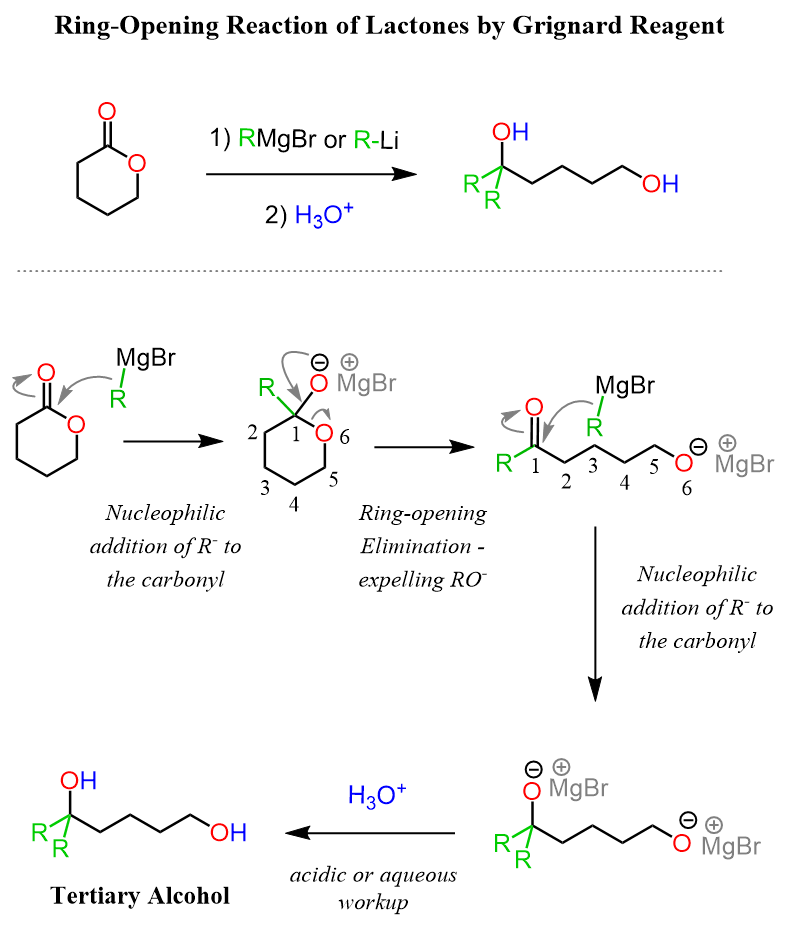
This double addition significantly expands the carbon framework of the molecule, adding two new carbon-carbon bonds. Grignard reactions with lactones are therefore powerful methods for generating tertiary alcohols with predictable carbon extension, provided the reaction is carried out under strictly anhydrous conditions to prevent the reagent from being quenched.
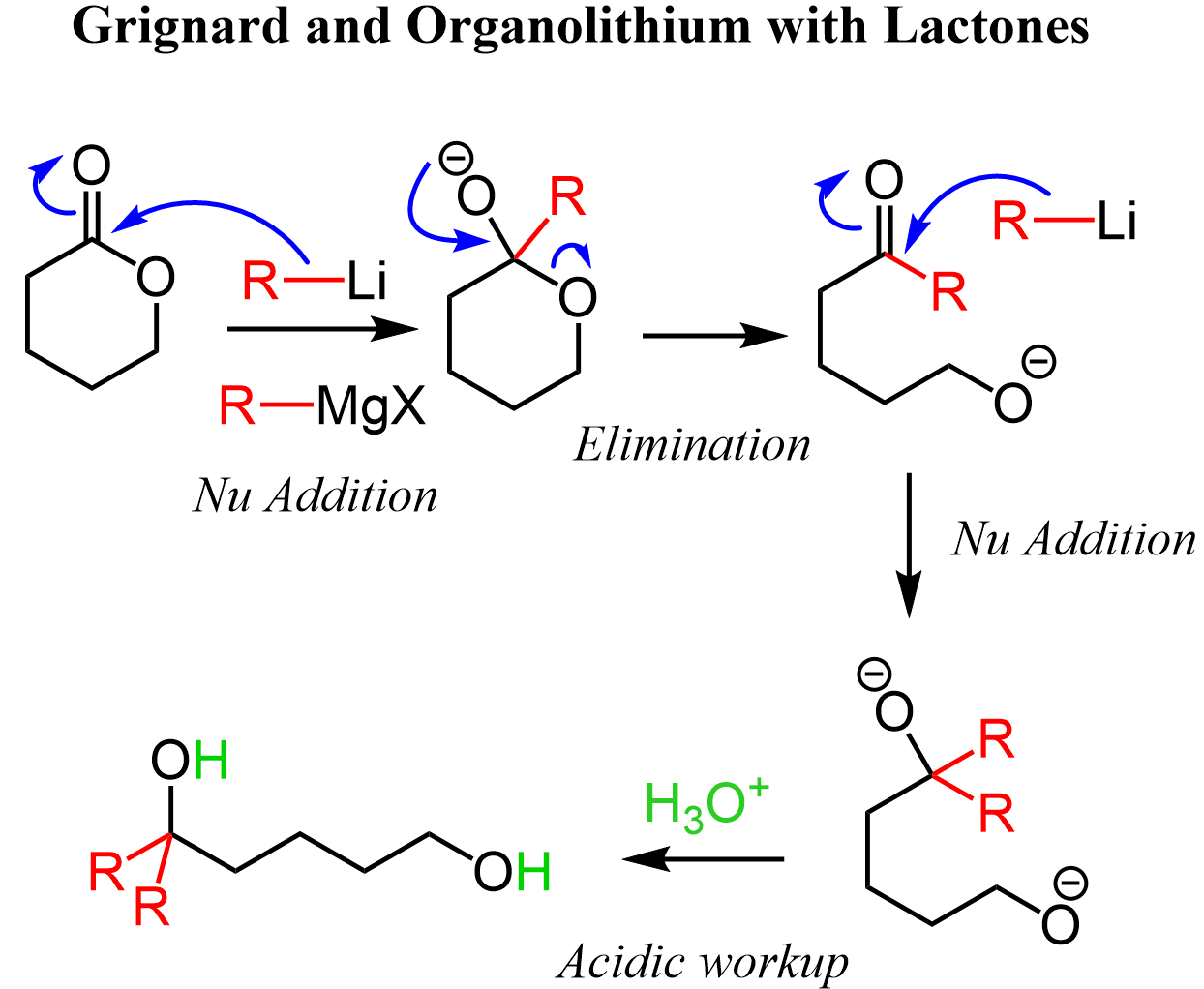
Although quite similar, I will also add the reaction of lactones with organolithiums:
We have a dedicated post on the reactions of Lactones and Lactams with lots of practice problems here.
Check Also
- Preparation of Carboxylic Acids
- Naming Carboxylic Acids
- Naming Nitriles
- Naming Esters
- Naming Carboxylic Acid Derivatives – Practice Problems
- The Addition-Elimination Mechanism
- Fischer Esterification
- Ester Hydrolysis by Acid and Base-Catalyzed Hydrolysis
- What is Transesterification?
- Esters Reaction with Amines – The Aminolysis Mechanism
- Ester Reactions Summary and Practice Problems
- Preparation of Acyl (Acid) Chlorides (ROCl)
- Reactions of Acid Chlorides (ROCl) with Nucleophiles
- R2CuLi Organocuprates – Gilman Reagent
- Reaction of Acyl Chlorides with Grignard and Gilman (Organocuprate) Reagents
- Reduction of Acyl Chlorides by LiAlH4, NaBH4, and LiAl(OtBu)3H
- Reduction of Carboxylic Acids and Their Derivatives
- Preparation and Reaction Mechanism of Carboxylic Anhydrides
- Amides – Structure and Reactivity
- Naming Amides
- Amides Hydrolysis: Acid and Base-Catalyzed Mechanism
- Amide Dehydration Mechanism by SOCl2, POCl3, and P2O5
- Amide Reduction Mechanism by LiAlH4
- Reduction of Amides to Amines and Aldehydes
- Amides Preparation and Reactions Summary
- Amides from Carboxylic Acids-DCC and EDC Coupling
- The Mechanism of Nitrile Hydrolysis To Carboxylic Acid
- Nitrile Reduction Mechanism with LiAlH4 and DIBAL to Amine or Aldehyde
- The Mechanism of Grignard and Organolithium Reactions with Nitriles
- The Reactions of Nitriles
- Converting Nitriles to Amides
- Carboxylic Acids to Ketones
- Esters to Ketones
- Synthesis and Reactions of Lactones and Lactams
- Carboxylic Acids and Their Derivatives Practice Problems
- Carboxylic Acids and Their Derivatives Quiz
- Reactions Map of Carboxylic Acid Derivatives