
We have seen that amides can be hydrolyzed to carboxylic acids and amines under acidic or basic conditions.
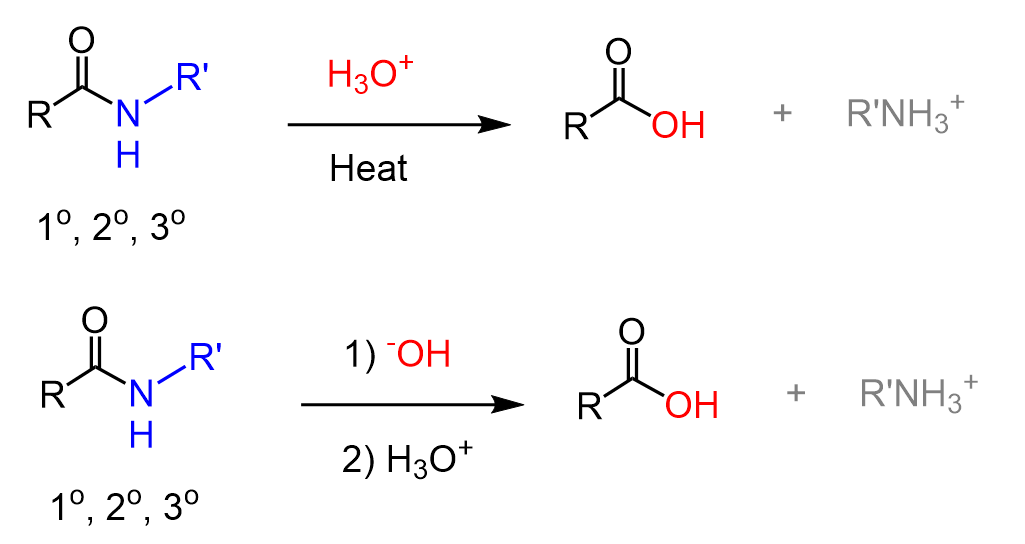
Lactams are cyclic amides, and the amino and carboxyl groups are part of the same molecule; therefore, the products of the hydrolysis of lactams are amino acids.
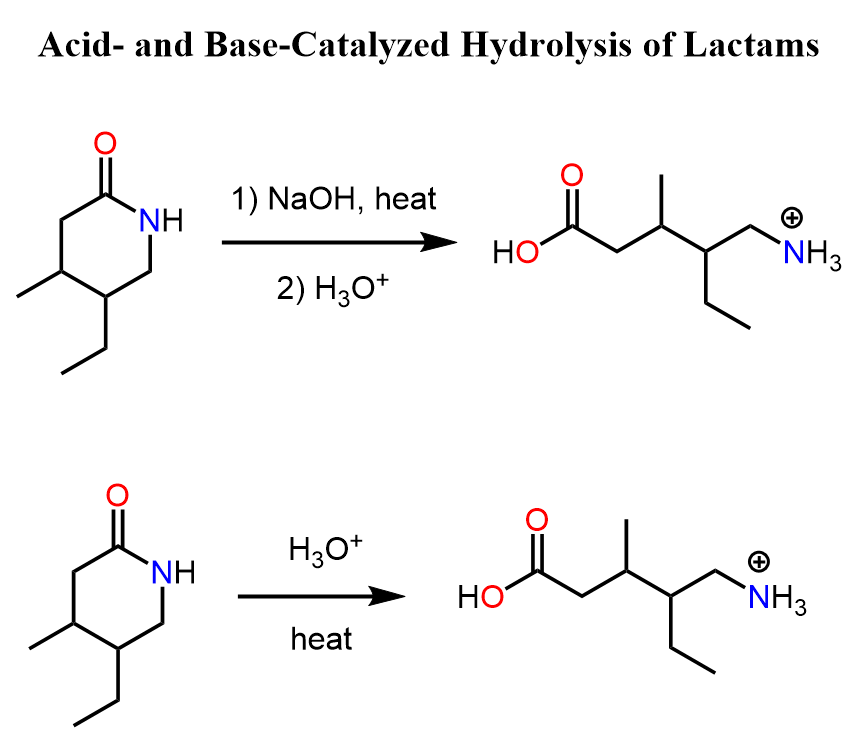
Like the regular amides, lactams are generally among the least reactive carboxylic acid derivatives because the conjugate base of an amine (RHN⁻) is a very poor leaving group. The same fundamental reactivity also applies to lactams, which are cyclic amides, but with some important mechanistic features related to the poor leaving group ability of nitrogen. So, let’s discuss the mechanism of acid and base-catalyzed hydrolysis of lactams.
Base-Catalyzed Hydrolysis of Lactams
The mechanism begins with nucleophilic addition of hydroxide to the lactam carbonyl, forming a tetrahedral intermediate. This intermediate is unstable and converts back into a carbonyl group by expelling one of the groups connected to the central carbon atom.
While the –OH is a much better leaving group than the conjugate base of the nitrogen, the latter still occurs to a small extent until the complete conversion of the lactam to the corresponding conjugate base of the amino acid. We are effectively comparing the leaving group abilities between hydroxide and an amine-derived anion. Based on pKa values (water ≈ 1 5.7, amines ≈ 38), hydroxide is a much weaker base and therefore a much better leaving group than the conjugate base of an amine.
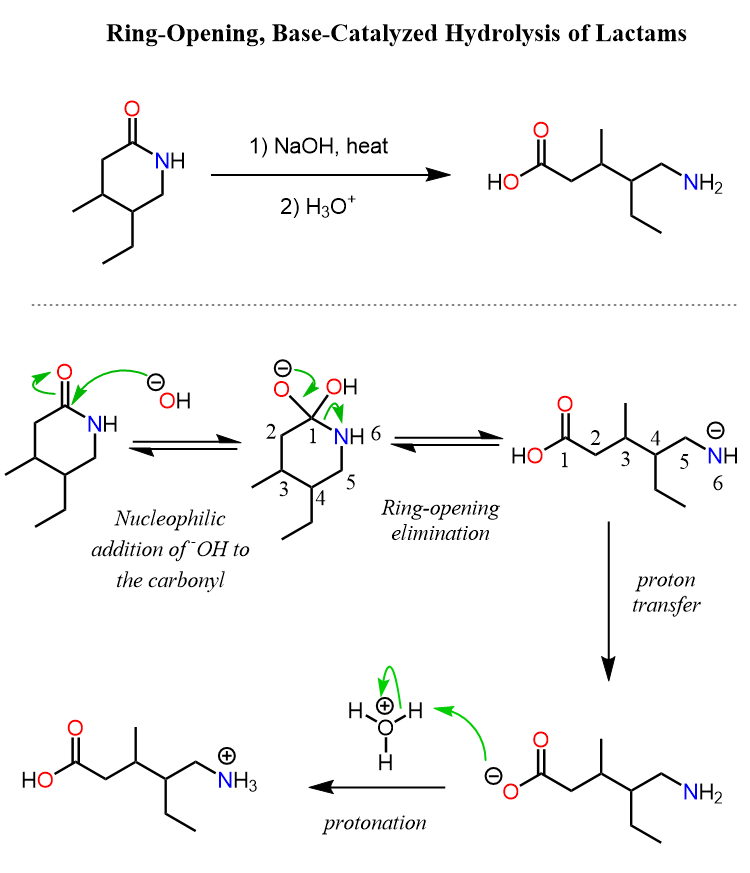
It is important to emphasize that the final irreversible deprotonation step drives the reaction forward, giving a carboxylate and an amine functionality within the same molecule. The reason for this is that the carboxylate group is mech less electrophilic than the carboxylic acid group, which makes the steps in the acid-catalyzed hydrolysis reversible.
Acid-Catalyzed Hydrolysis of Lactams
Under acidic conditions, lactam hydrolysis follows a mechanism analogous to ester or amide hydrolysis. The reaction starts with the protonation of the carbonyl oxygen, which activates the carbonyl group for a nucleophilic attack of water. Compared to the base-catalyzed hydrolysis, the key difference is that the leaving group in the tetrahedral intermediate is not the conjugate base of the amine, but a protonated amine (RNH₃⁺), which is a significantly better leaving group.
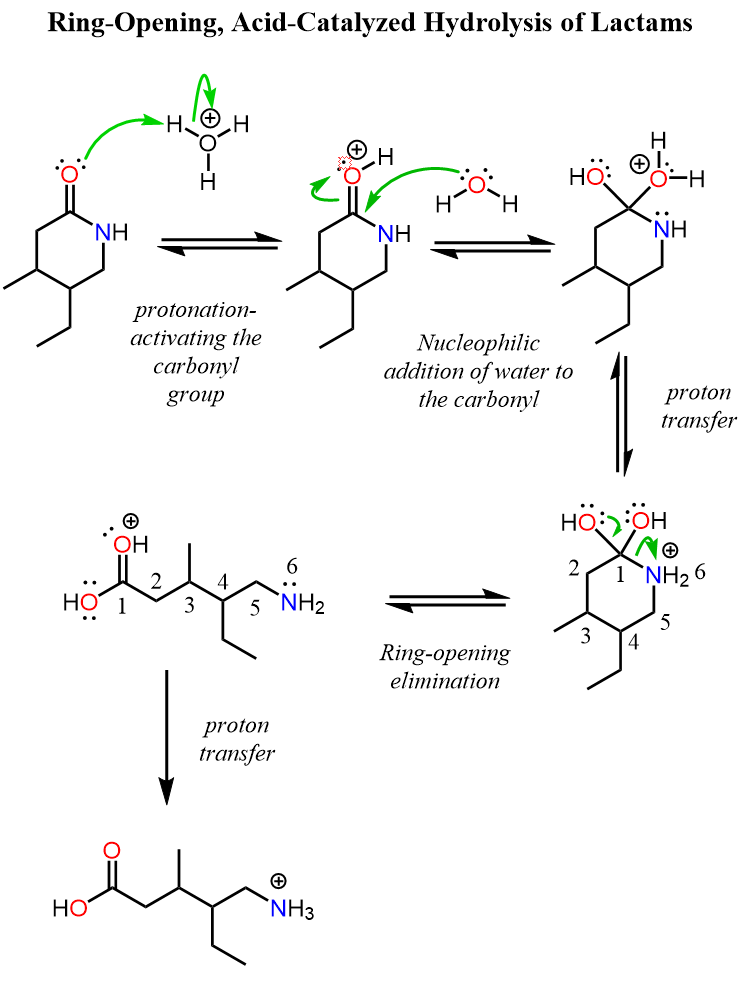
In both acid- and base-catalyzed conditions, heat and excess reagent are typically required to drive the reaction to completion, reflecting the intrinsic stability of the amide bond.
Overall, lactam hydrolysis leads to complete ring opening under forcing conditions, ultimately yielding amino carboxylic acid derivatives depending on the reaction medium.
The Hydrolysis of β-lactam Antibiotics
We discussed earlier that β-lactams make up the fundamental structural core of penicillin antibiotics.
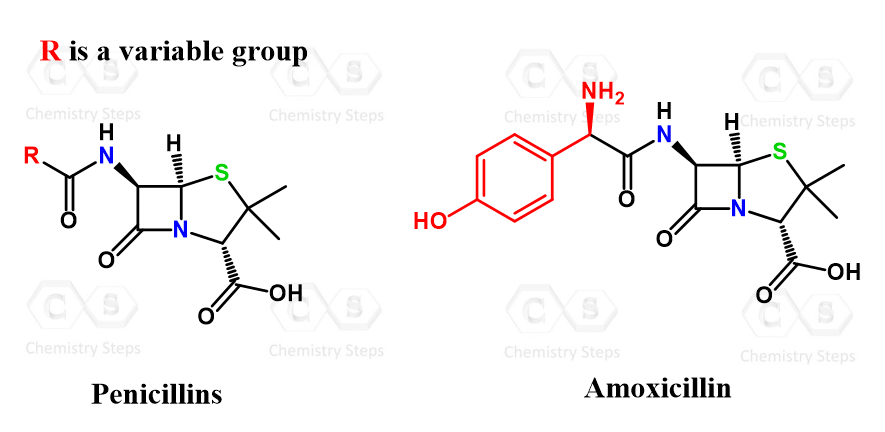
Recall from the stability of cycloalkanes that three– and four-membered rings are associated with higher ring strain because their bond angles are forced far away from the ideal tetrahedral angle (109.5°), leading to significant angle strain, along with torsional strain from eclipsing interactions in the constrained ring system.
So, how does this correlate to the reactivity, and in particular, the hydrolysis of β-lactams? The good news is that, as expected, the strained four-membered ring makes β-lactam antibiotics susceptible to hydrolysis, and this is exactly what is responsible for their antibacterial activity.
Why is this good news?
β-Lactams act by targeting and deactivating transpeptidase, an enzyme required for the biosynthesis of bacterial cell walls. The active site of this enzyme contains a key nucleophilic hydroxyl group (Ser–OH), which attacks the carbonyl carbon of the β-lactam in a nucleophilic addition-elimination sequence. This forms a tetrahedral intermediate, which then collapses with cleavage of the C–N bond of the four-membered ring. The strain in the β-lactam ring increases the leaving ability of the nitrogen-containing fragment, making ring opening highly favorable.
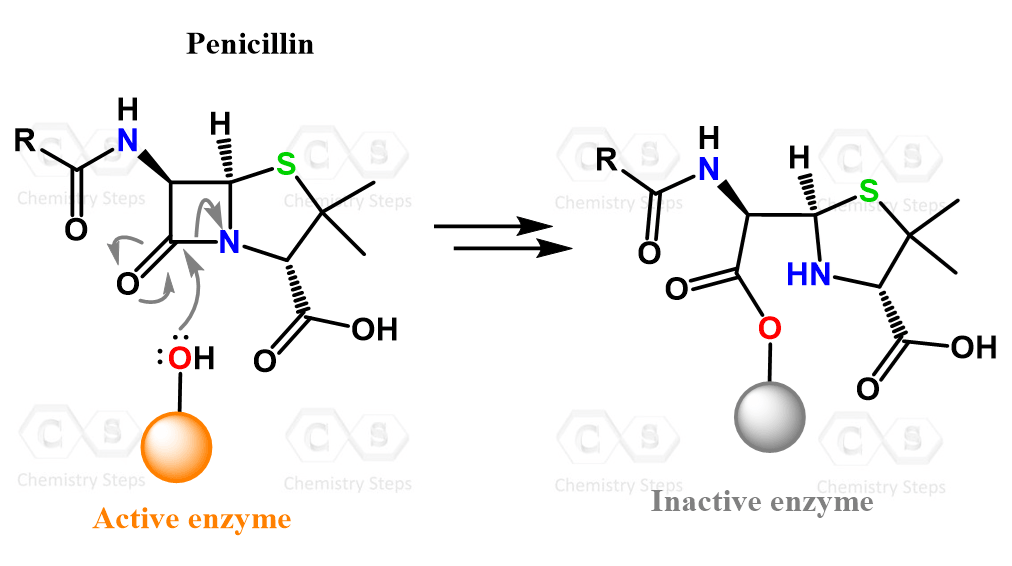
This process results in acylation of the enzyme, forming a covalent acyl-enzyme complex in which the transpeptidase enzyme is inactivated. Once acylated, the enzyme can no longer catalyze the cross-linking reactions required for bacterial cell wall synthesis. As a result, bacterial growth is halted, and the organism becomes vulnerable to the immune system.
Some bacteria have evolved resistance by producing β-lactamase enzymes, which catalyze this hydrolysis before the antibiotic can react with transpeptidase. To overcome β-lactamase resistance, antibiotics are modified so they are less easily hydrolyzed, or they are co-administered with β-lactamase inhibitors that block the enzyme. In some cases, entirely new antibiotic scaffolds are developed that bypass β-lactamase recognition altogether.
Overall, the unique chemistry of β-lactams lies in this balance between useful strain-driven reactivity (enzyme acylation) and destructive hydrolysis (drug inactivation).
We have a dedicated post on the reactions of Lactones and Lactams with lots of practice problems here.
Polymerization of Caprolactam to Nylon 6
Another important application of the ring-opening hydrolysis of lactams is the polymerization of caprolactam, which is a seven-membered cyclic amide used in the industrial synthesis of Nylon 6.
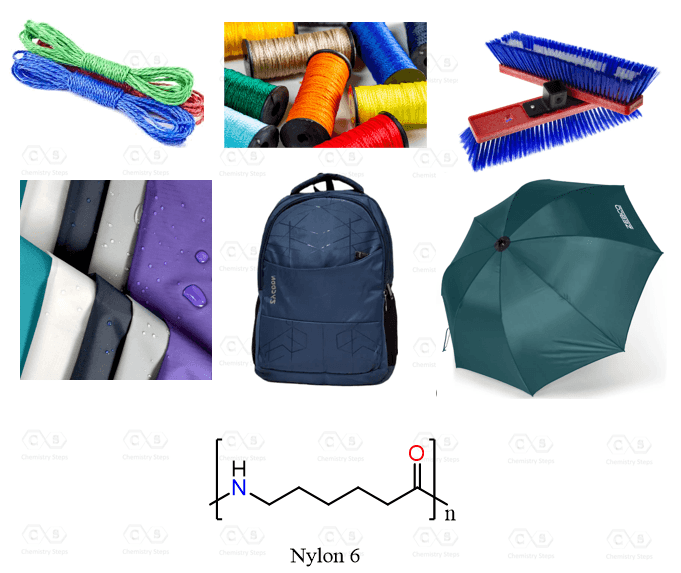
Nylon 6 is one of the most important synthetic polymers and is widely used in textiles, ropes, engineering plastics, carpets, and automotive components because of its high strength, elasticity, abrasion resistance, and durability.
The reaction starts with ring-opening hydrolysis of caprolactam, as we have described above, forming 6-aminohexanoic acid. Afterward, the amino group of the newly formed molecule attacks the carbonyl carbon of another caprolactam (or another growing polymer chain), leading to nucleophilic acyl substitution and formation of a new amide bond. Repetition of this process results in chain propagation and the formation of the polyamide Nylon 6. Overall, the polymerization is driven by the formation of strong amide bonds and the conversion of the strained cyclic lactam into a stable open-chain polymer structure.
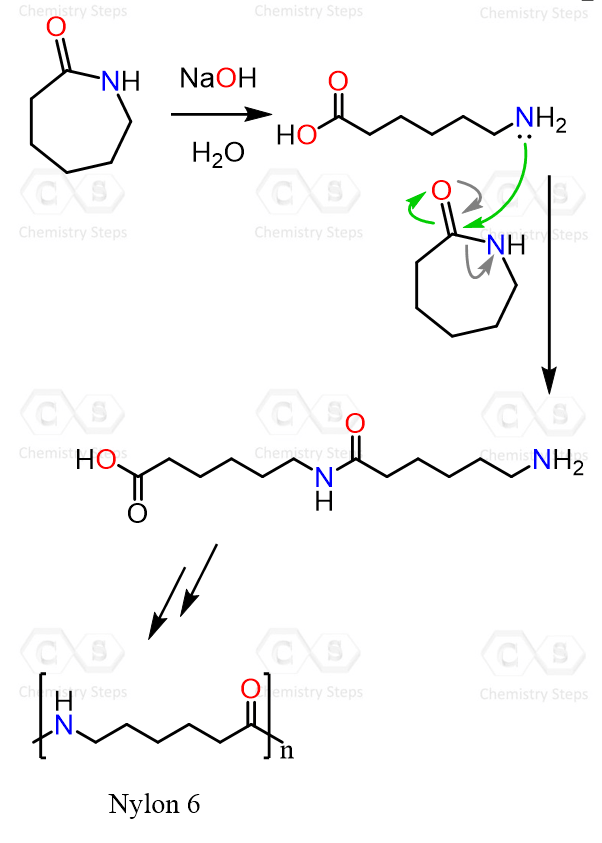
It is worth noting that the actual industrial process is more complex than this simplified stepwise description, involving a network of reversible equilibria between caprolactam, ring-opened amino acid species, and growing polymer chains, with water content playing a key role in controlling the reaction. However, this representation captures the general mechanistic idea of how the polymer chain is formed.
You can read more about the polymerization of caprolactam in Journal of Polymer Science, 1970; Part A-1 Vol. 8, 335-349
Check Also
- Preparation of Carboxylic Acids
- Naming Carboxylic Acids
- Naming Nitriles
- Naming Esters
- Naming Carboxylic Acid Derivatives – Practice Problems
- The Addition-Elimination Mechanism
- Fischer Esterification
- Ester Hydrolysis by Acid and Base-Catalyzed Hydrolysis
- What is Transesterification?
- Esters Reaction with Amines – The Aminolysis Mechanism
- Ester Reactions Summary and Practice Problems
- Preparation of Acyl (Acid) Chlorides (ROCl)
- Reactions of Acid Chlorides (ROCl) with Nucleophiles
- R2CuLi Organocuprates – Gilman Reagent
- Reaction of Acyl Chlorides with Grignard and Gilman (Organocuprate) Reagents
- Reduction of Acyl Chlorides by LiAlH4, NaBH4, and LiAl(OtBu)3H
- Reduction of Carboxylic Acids and Their Derivatives
- Preparation and Reaction Mechanism of Carboxylic Anhydrides
- Amides – Structure and Reactivity
- Naming Amides
- Amides Hydrolysis: Acid and Base-Catalyzed Mechanism
- Amide Dehydration Mechanism by SOCl2, POCl3, and P2O5
- Amide Reduction Mechanism by LiAlH4
- Reduction of Amides to Amines and Aldehydes
- Amides Preparation and Reactions Summary
- Amides from Carboxylic Acids-DCC and EDC Coupling
- The Mechanism of Nitrile Hydrolysis To Carboxylic Acid
- Nitrile Reduction Mechanism with LiAlH4 and DIBAL to Amine or Aldehyde
- The Mechanism of Grignard and Organolithium Reactions with Nitriles
- The Reactions of Nitriles
- Converting Nitriles to Amides
- Carboxylic Acids to Ketones
- Esters to Ketones
- Synthesis and Reactions of Lactones and Lactams
- Carboxylic Acids and Their Derivatives Practice Problems
- Carboxylic Acids and Their Derivatives Quiz
- Reactions Map of Carboxylic Acid Derivatives