Predict the Products of the Diels-Alder Reaction with Practice Problems

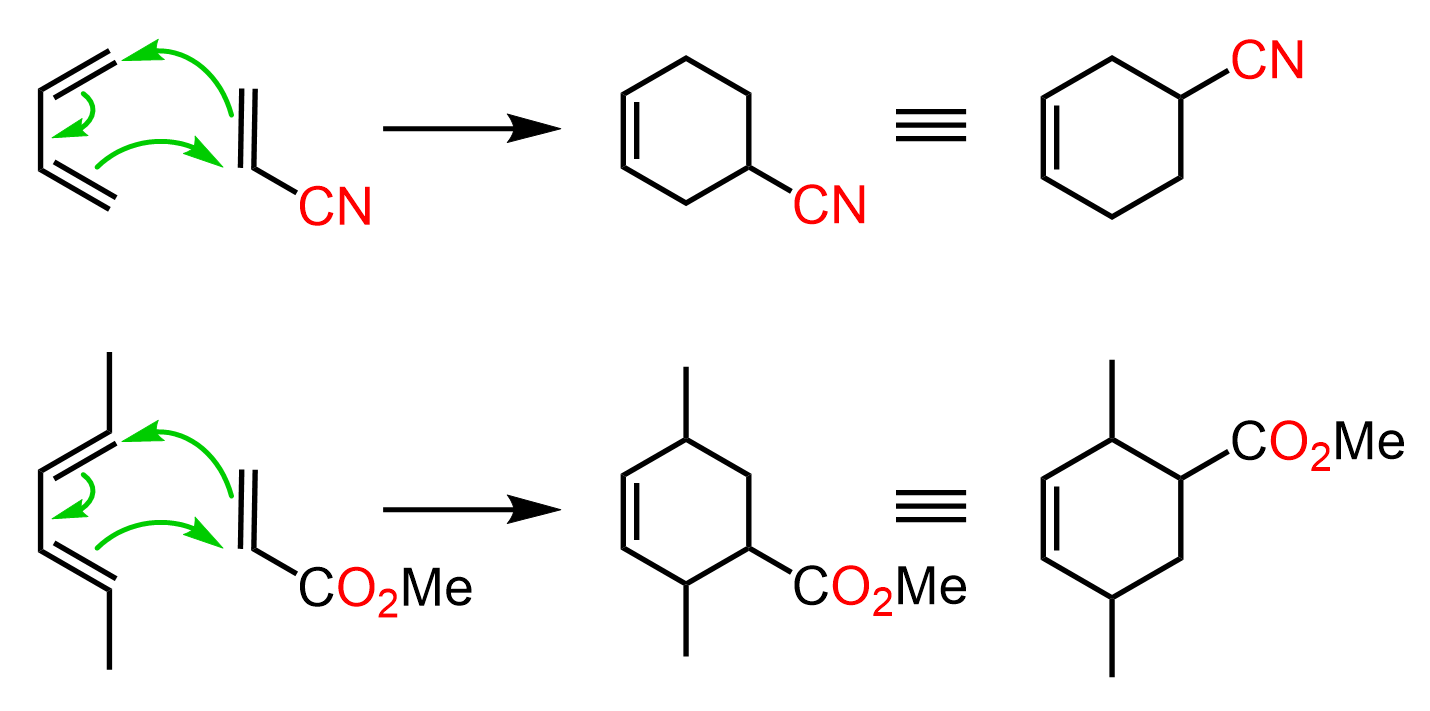
In this post, we will discuss how to predict the product of Diels–Alder reactions. The key idea is that you are forming two new σ bonds between the diene and the dienophile in a single step, so you need to align the diene and the dienophile such that a flow pi electrons is possible between the two atoms of the diene and the four atoms of the dienophile – it is a 4+2 cycloaddition reaction.

To do this, draw the diene on the left side and place the dienophile in line with the middle of the two double bonds.
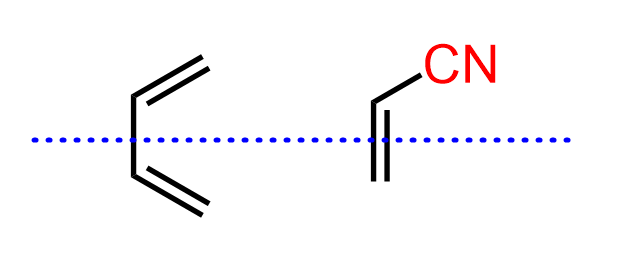


If the diene is given in the trans conformation, redraw it so that the double bonds are on the same side (s-cis). Start an arrow from the middle of one of the double bonds of the diene and connect it to the carbon atom of the dienophile. The next arrow goes from the middle of the double bond of the dienophile and connects to the carbon atom of the diene, which in turn pushes the double bond between the middle two carbon atoms of the diene.


Notice that the product of the reaction is a substituted cyclohexene, and this is a pattern that you are going to see in almost all Diels-Alder reactions in your organic chemistry class. We have a separate article on the applications of the Diels-Alder reaction in organic synthesis, where you can see more examples of this cyclohexene motif.

Before we go to the next section, it is worth mentioning that if the diene is symmetrical, the orientation of the dienophile is not important. For example, in the reaction shown above, we could have placed the nitrile (CN) group pointing down – the product was still going to the same:


Unsymmetrical Dienes and Dienophiles

For unsymmetrical dienes and dienophiles, it is important to place the molecules in the correct alignment. For example, the following Diels-Alder reactions involve symmetrical and unsymmetrical dienes. The first one is a reaction between a symmetrical diene and a dienophile, and the second one is a reaction of an unsymmetrical diene and a dienophile.


Once again, recall that the first reaction produces only one product (we will disregard the stereochemistry for now), while the second one can give two regioisomers (constitutional isomers). These isomers are formed as a result of the two possible orientations (A and B) that the diene and dienophile can adopt. 
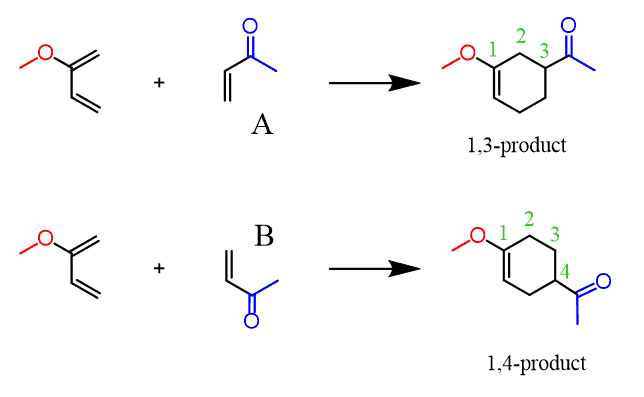


So, which one is actually formed?

This brings us to the regiochemistry, or regioselectivity, of the Diels-Alder reaction, and it turns out, in this specific example, the 1,4-product is favored, which means that the diene and dienophile align according to orientation B in the transition state of the reaction.

Why is it the case?

We have a separate post on the regiochemistry of Diels-Alder reactions and the strategies you can use to address this question, so be sure to check it out as well, but for now, here are some intro practice problems on predicting the product of Diels-Alder reactions.

Practice

1.

Predict the major product(s) with correct stereochemistry for each of the following Diels–Alder reactions:

a)
Answer


b)
Answer

This content is for registered users only.

Click here to Register!

By joining Chemistry Steps, you will gain instant access to the answers and solutions for all the Practice Problems, including over 40 hours of problem-solving videos, Multiple-Choice Quizzes, Puzzles, Reaction Maps, and the powerful set of Organic Chemistry 1 and 2 Summary Study Guides.

c)
Answer

This content is for registered users only.

Click here to Register!

By joining Chemistry Steps, you will gain instant access to the answers and solutions for all the Practice Problems, including over 40 hours of problem-solving videos, Multiple-Choice Quizzes, Puzzles, Reaction Maps, and the powerful set of Organic Chemistry 1 and 2 Summary Study Guides.

d)
Answer

This content is for registered users only.

Click here to Register!

By joining Chemistry Steps, you will gain instant access to the answers and solutions for all the Practice Problems, including over 40 hours of problem-solving videos, Multiple-Choice Quizzes, Puzzles, Reaction Maps, and the powerful set of Organic Chemistry 1 and 2 Summary Study Guides.

e)
Answer

This content is for registered users only.

Click here to Register!

By joining Chemistry Steps, you will gain instant access to the answers and solutions for all the Practice Problems, including over 40 hours of problem-solving videos, Multiple-Choice Quizzes, Puzzles, Reaction Maps, and the powerful set of Organic Chemistry 1 and 2 Summary Study Guides.

f)
Answer

This content is for registered users only.

Click here to Register!

By joining Chemistry Steps, you will gain instant access to the answers and solutions for all the Practice Problems, including over 40 hours of problem-solving videos, Multiple-Choice Quizzes, Puzzles, Reaction Maps, and the powerful set of Organic Chemistry 1 and 2 Summary Study Guides.

Solution

This content is for registered users only.

Click here to Register!

By joining Chemistry Steps, you will gain instant access to the answers and solutions for all the Practice Problems, including over 40 hours of problem-solving videos, Multiple-Choice Quizzes, Puzzles, Reaction Maps, and the powerful set of Organic Chemistry 1 and 2 Summary Study Guides.

2.

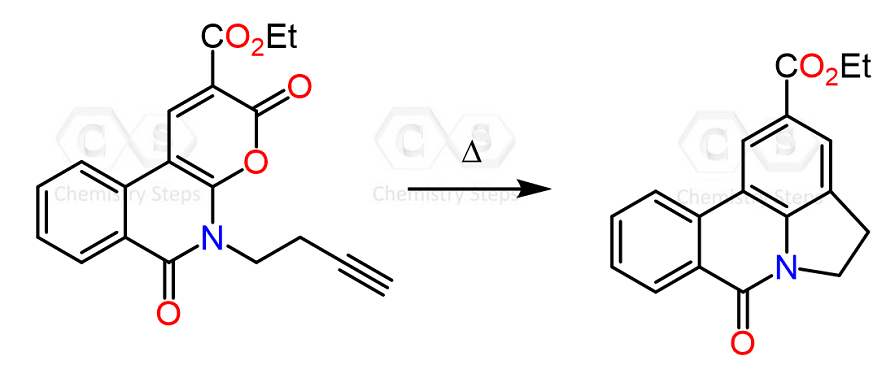
Draw a mechanism for the following synthetic transformation that involves a Diels-Alder reaction:

Answer

This content is for registered users only.

Click here to Register!

By joining Chemistry Steps, you will gain instant access to the answers and solutions for all the Practice Problems, including over 40 hours of problem-solving videos, Multiple-Choice Quizzes, Puzzles, Reaction Maps, and the powerful set of Organic Chemistry 1 and 2 Summary Study Guides.

3.

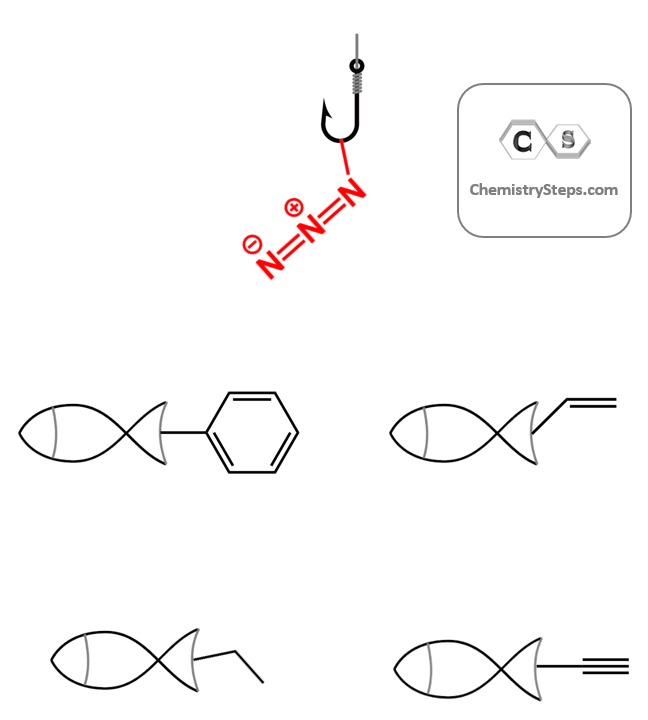
Bonus Question! Which fish is going to click?


Answer

This content is for registered users only.

Click here to Register!

By joining Chemistry Steps, you will gain instant access to the answers and solutions for all the Practice Problems, including over 40 hours of problem-solving videos, Multiple-Choice Quizzes, Puzzles, Reaction Maps, and the powerful set of Organic Chemistry 1 and 2 Summary Study Guides.

Share Your Thoughts, Ask that Question!

Stuck? Need a Quick Guidance?

🔴 Our Live Board is Here! 🖥️✏️