
We have seen earlier that resonance structures, whether they involve carbocations or carbanions, always involve a π bond(s). This is because in resonance structures, we can only make and break π bonds, but we can never break or form σ bonds because that would change the connectivity of the atoms, which is against the definition of resonance structures:

Now, radicals are not different from carbocations in this sense – we can either make or break pi bonds when drawing resonance structures of radicals. Not only do they follow the same resonance principles, but they also have a similar structure and stability pattern to carbocations.
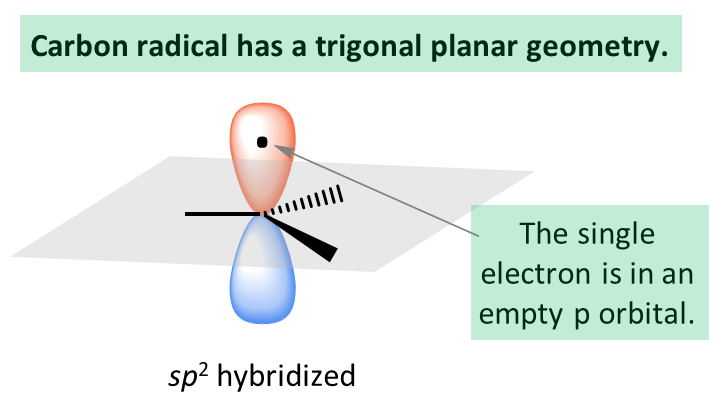
Both carbocations and radicals are sp2-hybridized, and the difference is that a carbocation has an empty p orbital, whereas a radical has a p orbital containing one unpaired electron:
The stability of radicals also increases with the number of alkyl groups attached to the reactive center. Therefore, more substituted radicals are generally more stable than less substituted radicals:
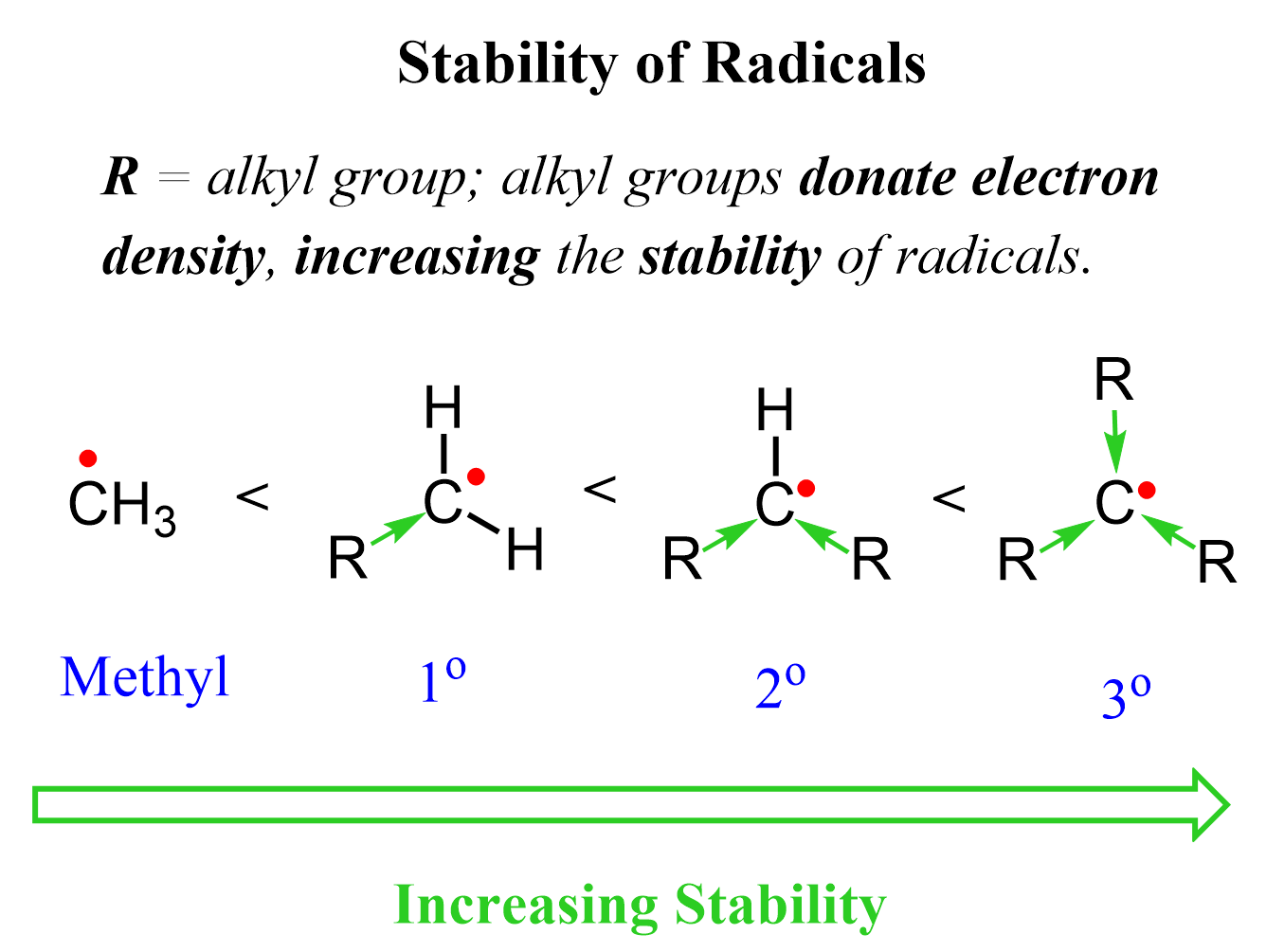
This again has to do with the electron-deficient nature of radicals, which, like carbocations, are stabilized by electron-donating groups. Alkyl groups stabilize radicals through hyperconjugation and inductive donation, helping to reduce the electron deficiency at the radical center:
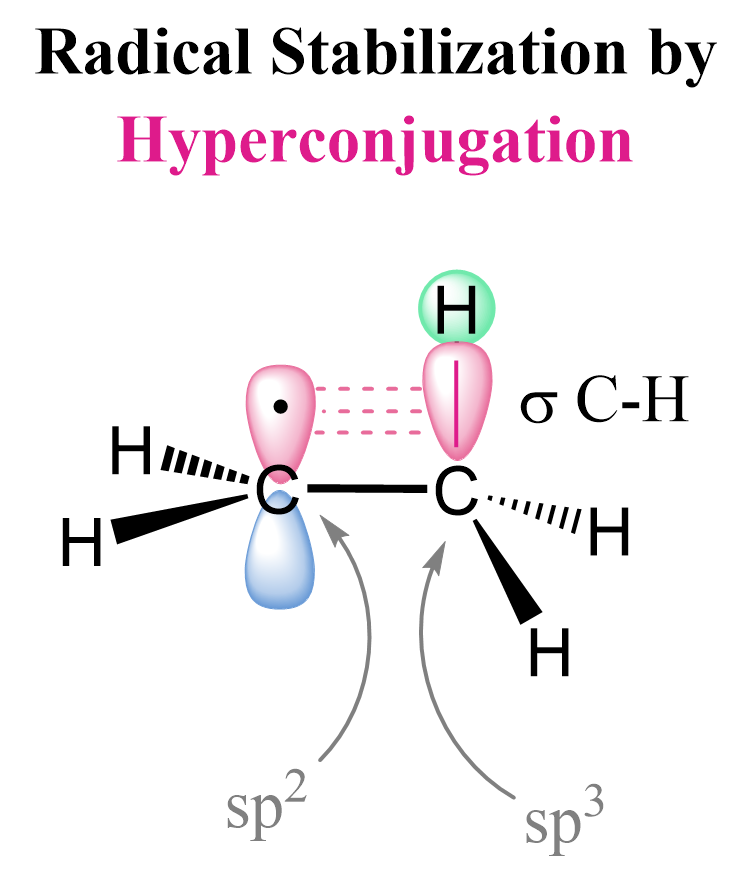
Of course, the other major factor influencing the stability of radicals is resonance delocalization.
The orbital containing the unpaired electron is stabilized by the adjacent π bond through resonance. One electron from the π bond moves to form a new π bond, while the other electron remains on the adjacent carbon, creating a new radical center. As a result, the unpaired electron is delocalized over two carbon atoms, which significantly stabilizes the allylic radical intermediate:
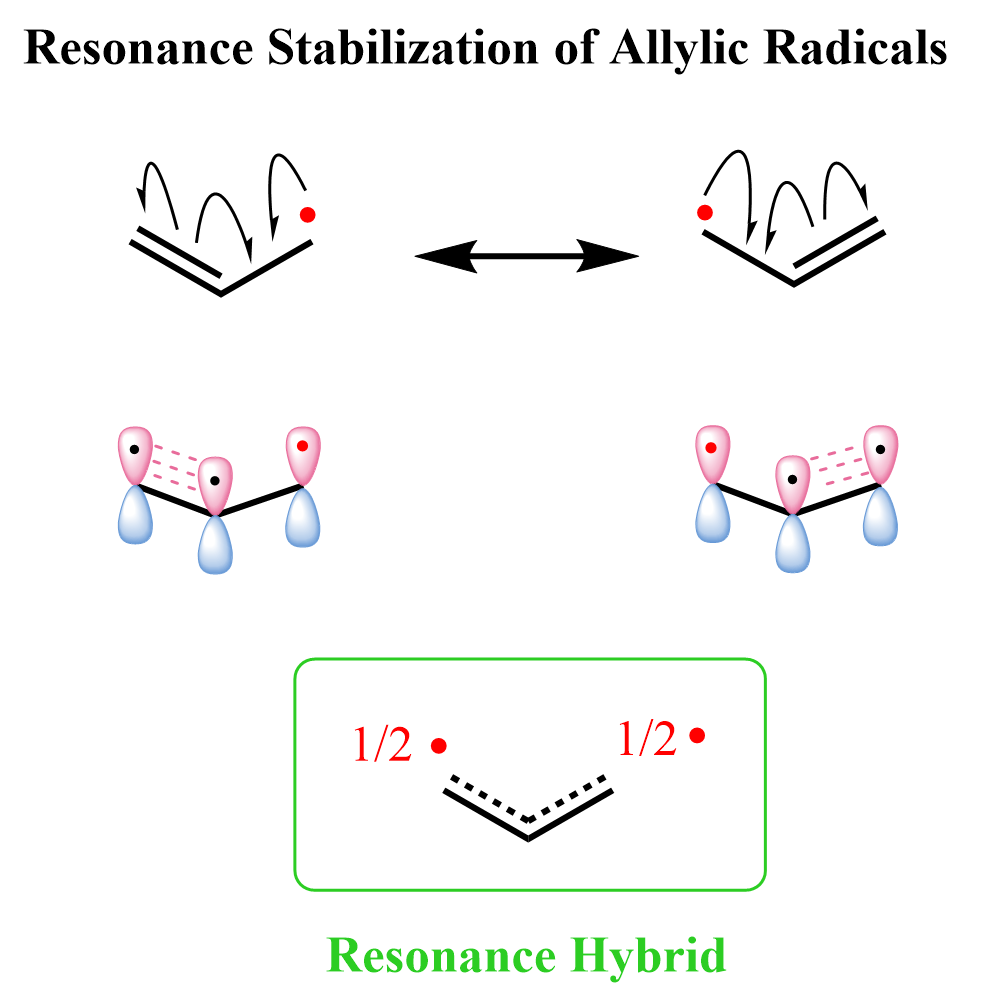
For this reason, benzylic and allylic radicals are among the most stable carbon radicals because the unpaired electron can be delocalized over a conjugated π system:
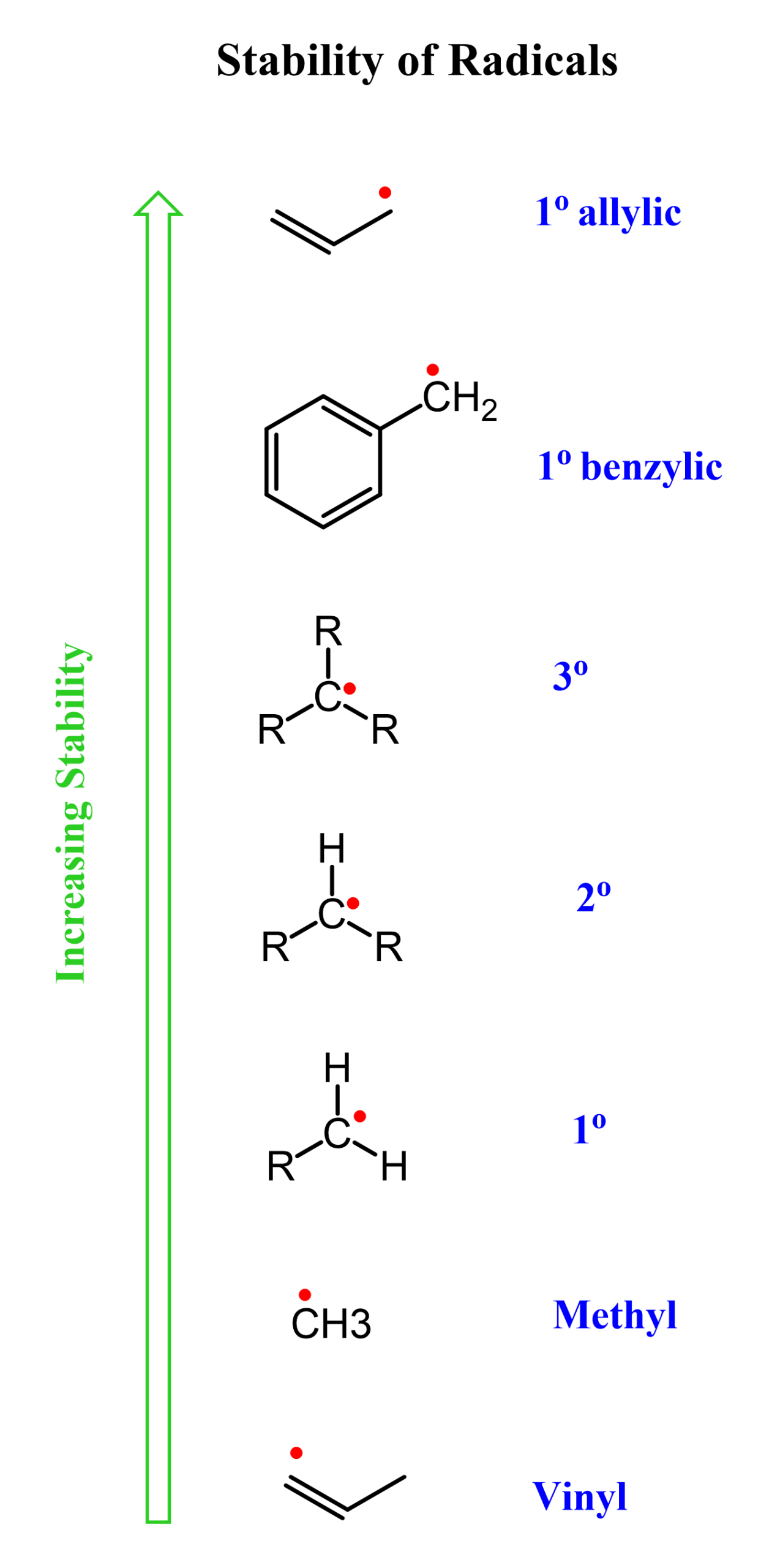
Just like allylic and benzylic carbocations, this resonance stabilization spreads the electron deficiency over several atoms, lowering the energy of the radical and making it significantly more stable.
As a result, allylic and benzylic C-H bonds are more readily broken during radical halogenation reactions because the resulting allylic and benzylic radicals are resonance stabilized. Consequently, allylic and benzylic brominations occur selectively at these positions:

The stability of allylic and benzylic radicals can also be explained by comparing the bond dissociation energies of their C-H bonds with those of regular C-H bonds:
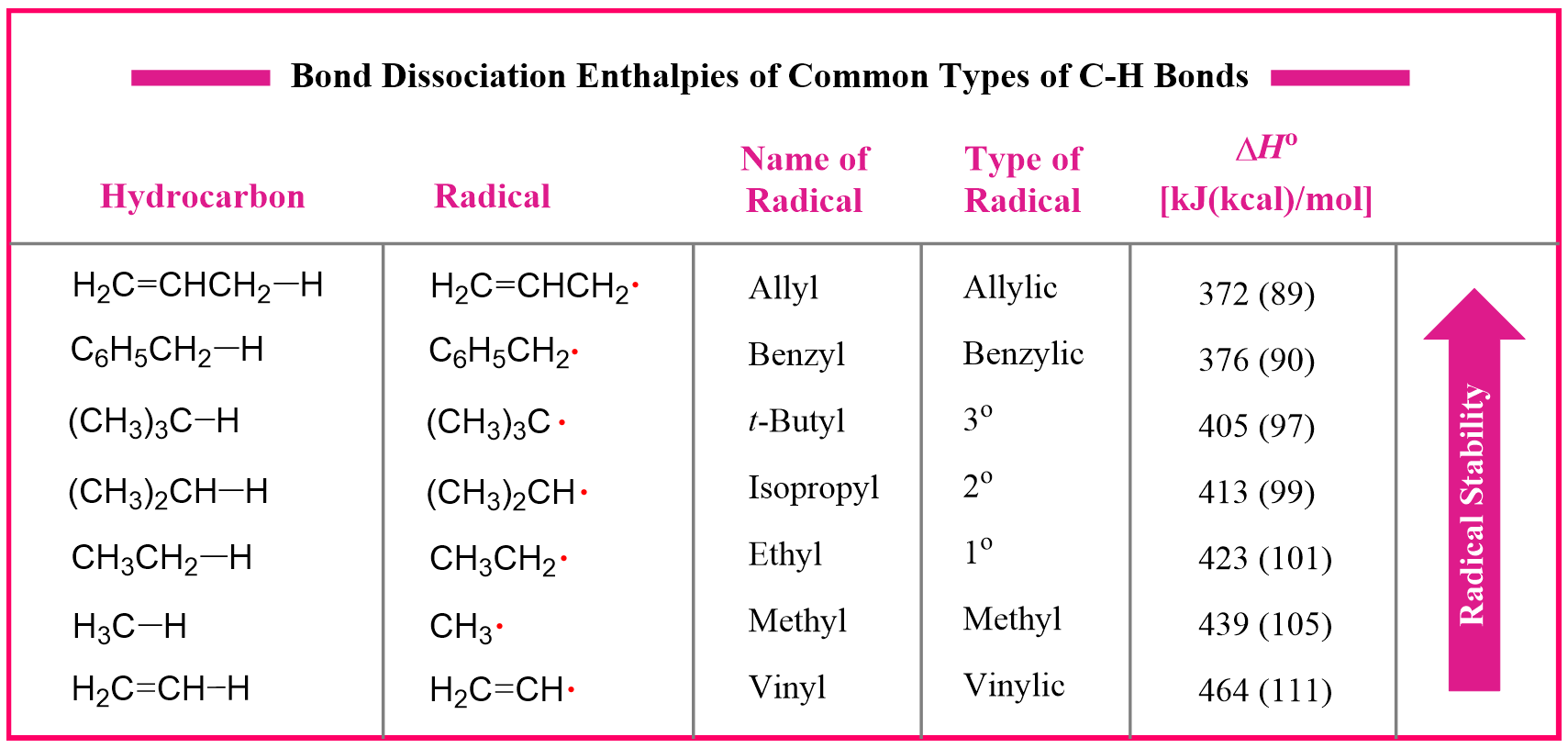
You may be wondering how to reconcile the fact that benzylic radicals have more resonance structures, while allylic radicals have a lower C-H bond dissociation energy. One possible explanation is that when drawing resonance structures of benzylic radicals, some resonance contributors involve disruption of the aromaticity of the benzene ring, which is energetically unfavorable. Therefore, despite having more resonance structures, benzylic radicals are slightly less stable than allylic radicals.
Resonance Structures of Radicals
We have discussed the structure and stability of radicals, and now it is time to see how to draw their resonance structures.
The key difference between radical reactions and other types of reactions is the use of fishhook arrows, which represent the movement of a single electron. Recall how we show the formation and reaction of radicals in the initiation and propagation steps of radical halogenation:

Therefore, when drawing a resonance structure of a radical, we must remember that two arrows moving towards each other make a new pi bond, and if only one is moving, then it breaks a pi bond, forming a new radical center:

Summary
Summarizing the radical stability and the effect of resonance delocalization, remember that radicals are electron-deficient species that, like carbocations, are sp2-hybridized and can be stabilized by electron donation and resonance delocalization.
Alkyl groups increase radical stability through inductive effect and hyperconjugation, while allylic and benzylic radicals are especially stable because the unpaired electron can be delocalized over a conjugated π system.
We use fishhook arrows to represent resonance structures and reactions of radicals.
This resonance stabilization explains the high reactivity and selectivity of allylic and benzylic radical reactions, such as allylic and benzylic bromination.
Check Also
- Free-Radical Addition of HBr: Anti-Markovnikov Addition
- Initiation, Propagation, and Termination in Radical Reactions
- Selectivity in Radical Halogenation
- Stability of Radicals
- Resonance Structures of Radicals
- Stereochemistry of Radical Halogenation
- Allylic Bromination
- Allylic Carbocations
- Radical Halogenation in Organic Synthesis
Hi, there is no content on this page + the previous one