tBuOK Elimination

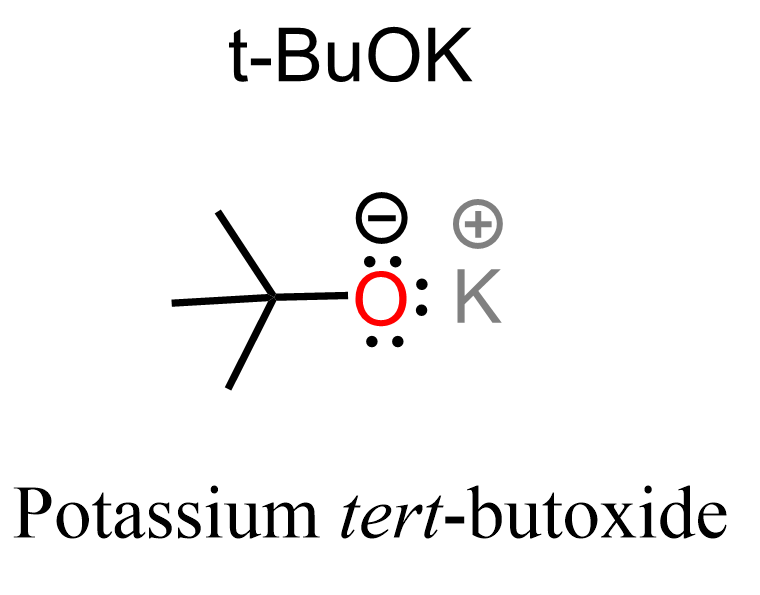
Let’s first reveal who this t-BuOK that you see every day is: t-BuOK stands for potassium tert-butoxide, which is the conjugate base of tert-butanol. It features a negatively charged oxygen bonded to a tertiary carbon, making t-BuOK a strong but sterically hindered base.


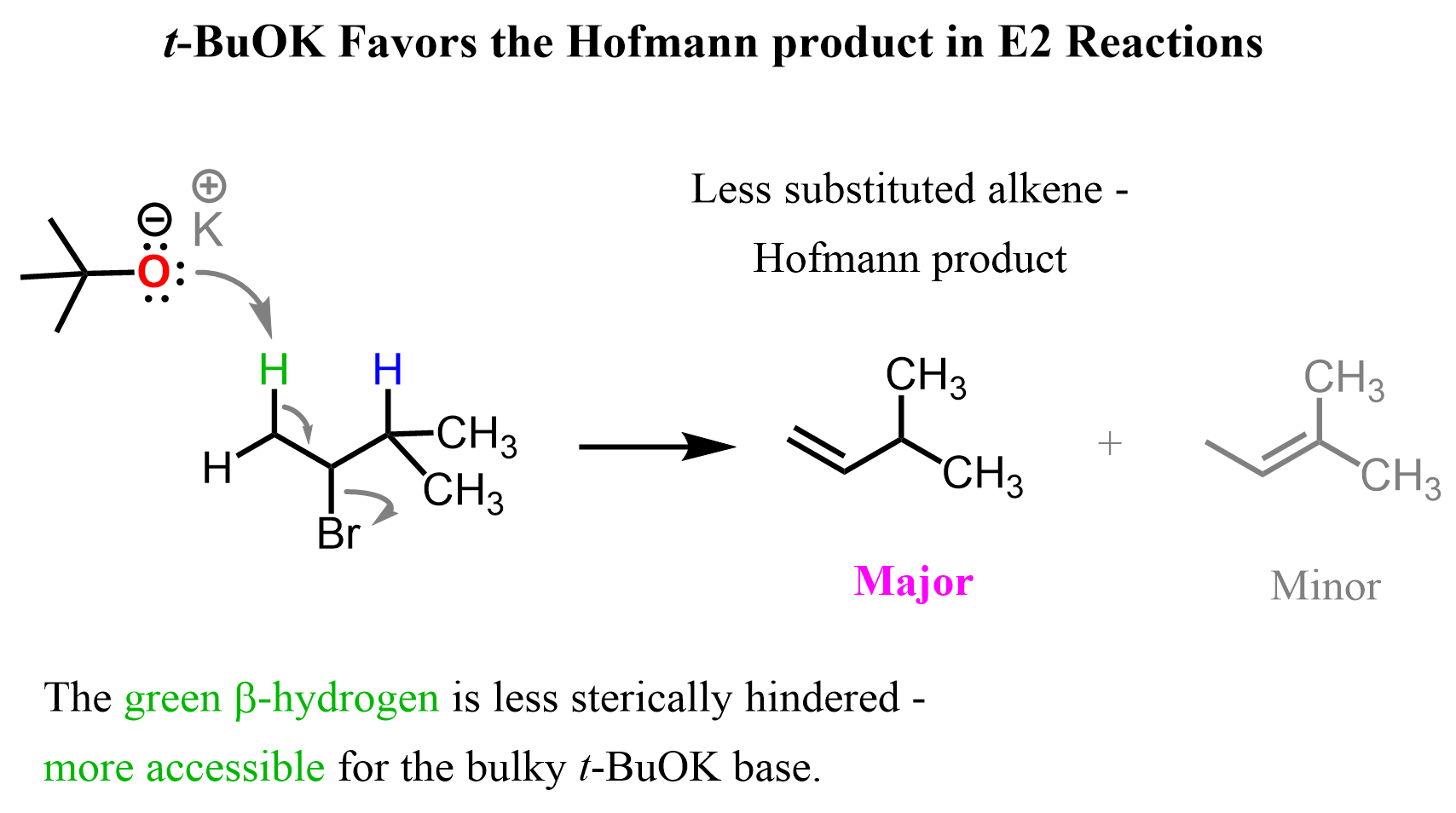
Because of its bulkiness, t-BuOK tends to abstract the least hindered (most accessible) β-hydrogen. As a result, the major product in E2 elimination reactions with t-BuOK is typically the less substituted alkene, also known as the Hofmann product.
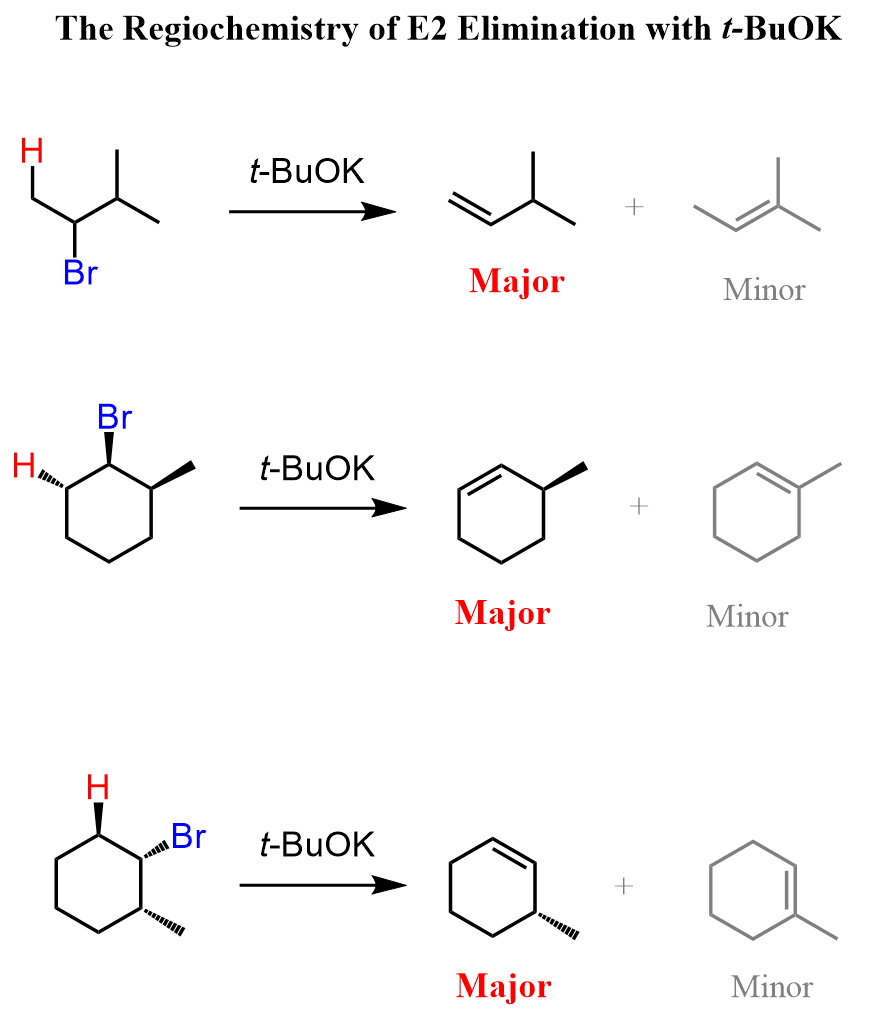


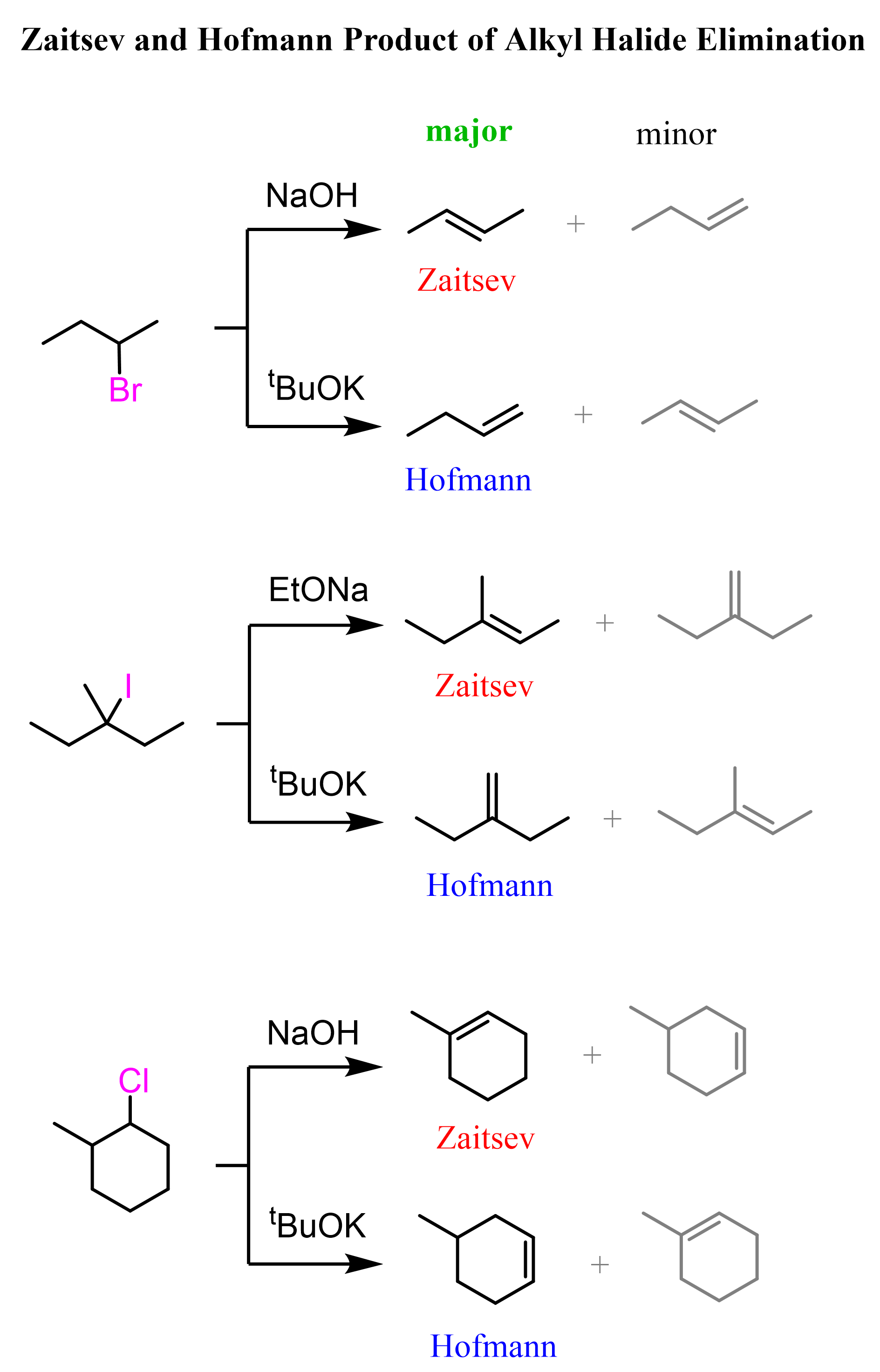
This is in contrast to what we observe with smaller, sterically unhindered bases like hydroxide (OH⁻) or ethoxide (EtO⁻), which tend to give the Zaitsev product, that is, the more substituted alkene.
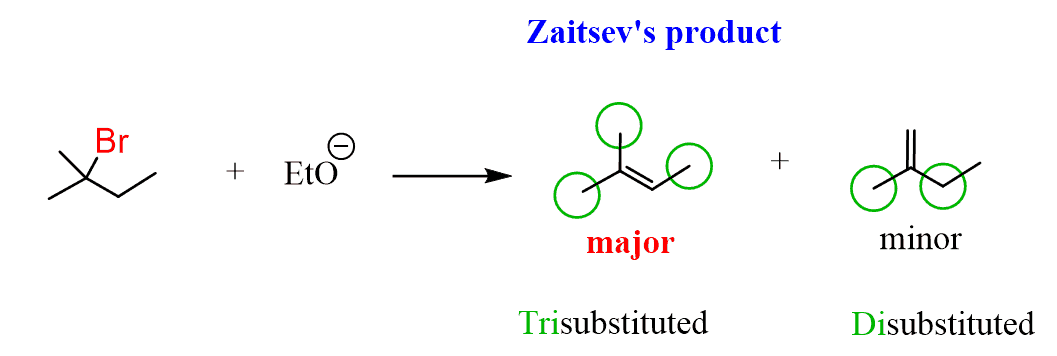


The alkyl groups on the double bond are highlighted to remind you that the stability of alkenes increases with the number of alkyl groups on the double bond. So, the Zaitsev product is the more stable alkene (thermodynamically favored), while the Hofmann product, formed when t-BuOK is used, is the kinetic product. The kinetic product is the one that is formed more easily, i.e., it has a lower activation energy.

Aside from t-BuOK, other strong, bulky bases are LDA, potassium tert-pentoxide, and DBU or DBN. These, together with sterically unhindered strong bases/good nucleophiles, are summarized below.
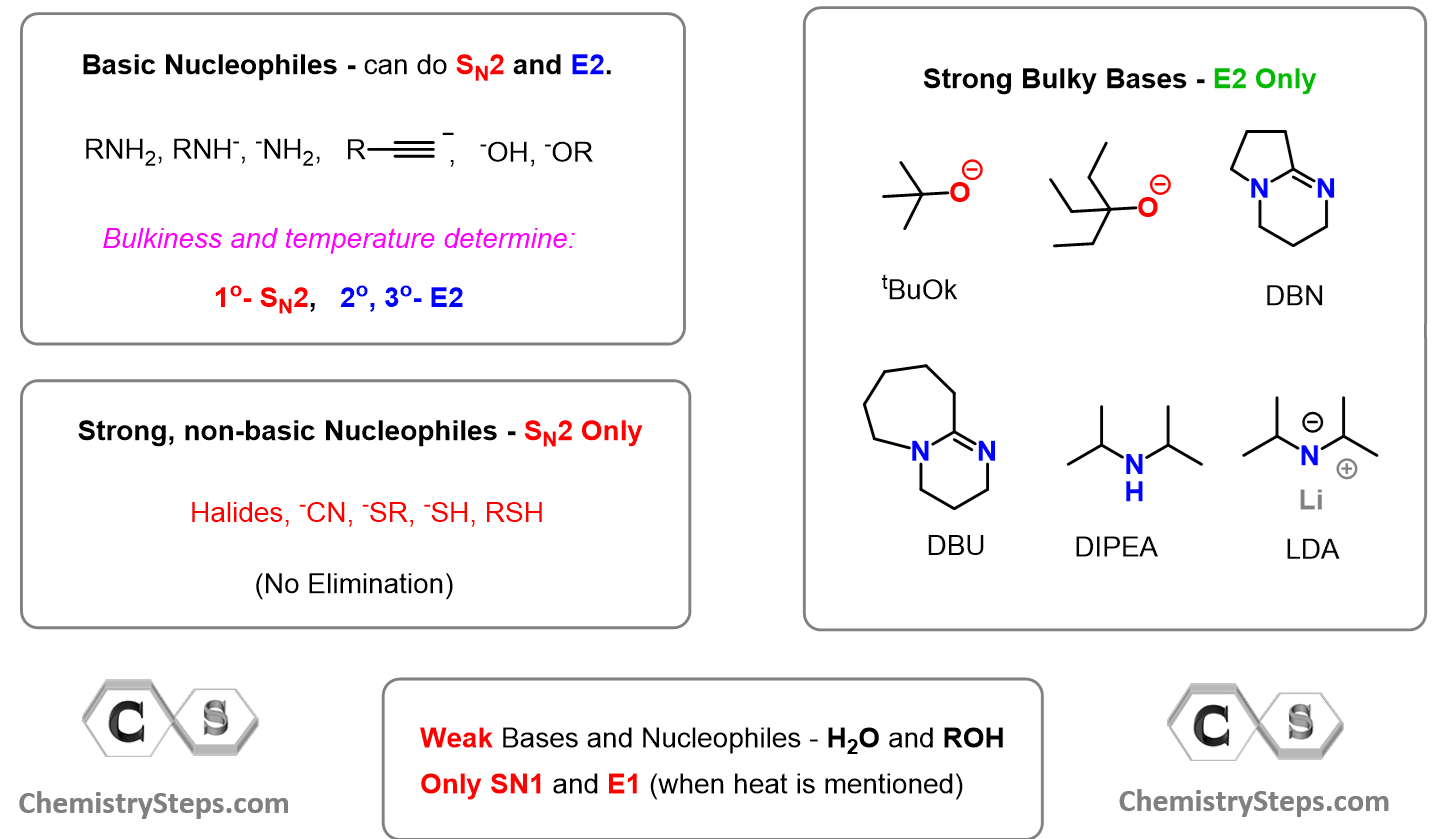


Remember that sterically unhindered bases often perform SN2 substitution, which is always in competition with E2 elimination.

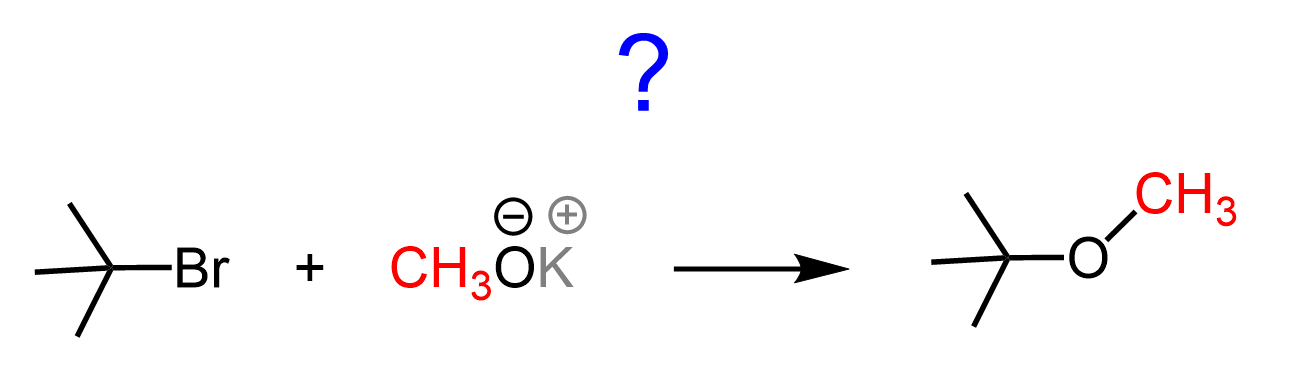
Perhaps the only exception when t-BuOK does SN2 substitution is its reaction with methyl halides, since E2 elimination simply cannot occur with these substrates.
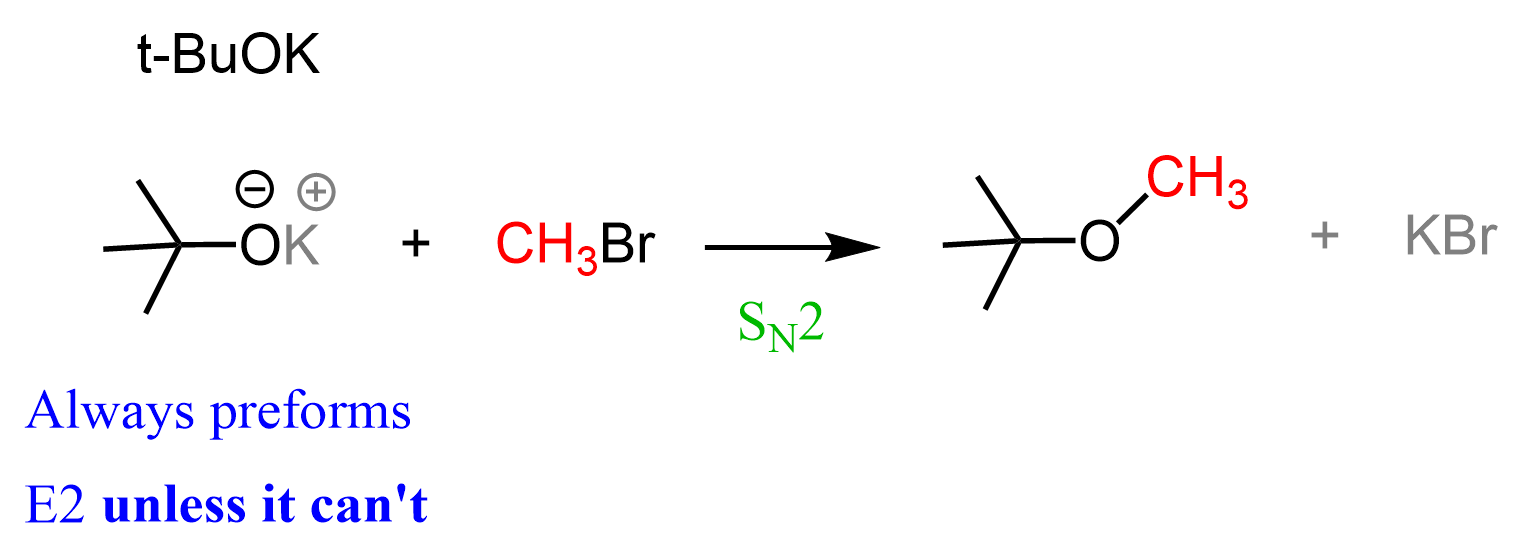


Do you think this reaction would work?


Check this post for details and strategies on deciding between SN2 and E2 reactions.


The Mechanism of t-BuOK Elimination

The mechanism is identical to what we learned about E2 eliminations. It is a one-step, concerted process where the base abstracts a β-hydrogen while the leaving group departs from the α-carbon, resulting in the formation of a π bond.


The reaction follows anti-periplanar geometry, meaning the β-hydrogen and leaving group must be aligned in opposite directions to allow for electron donations from the bonding C-H orbital to the antibonding C-Br orbital. Let’s demonstrate this on the last example, cyclohexane elimination shown above:
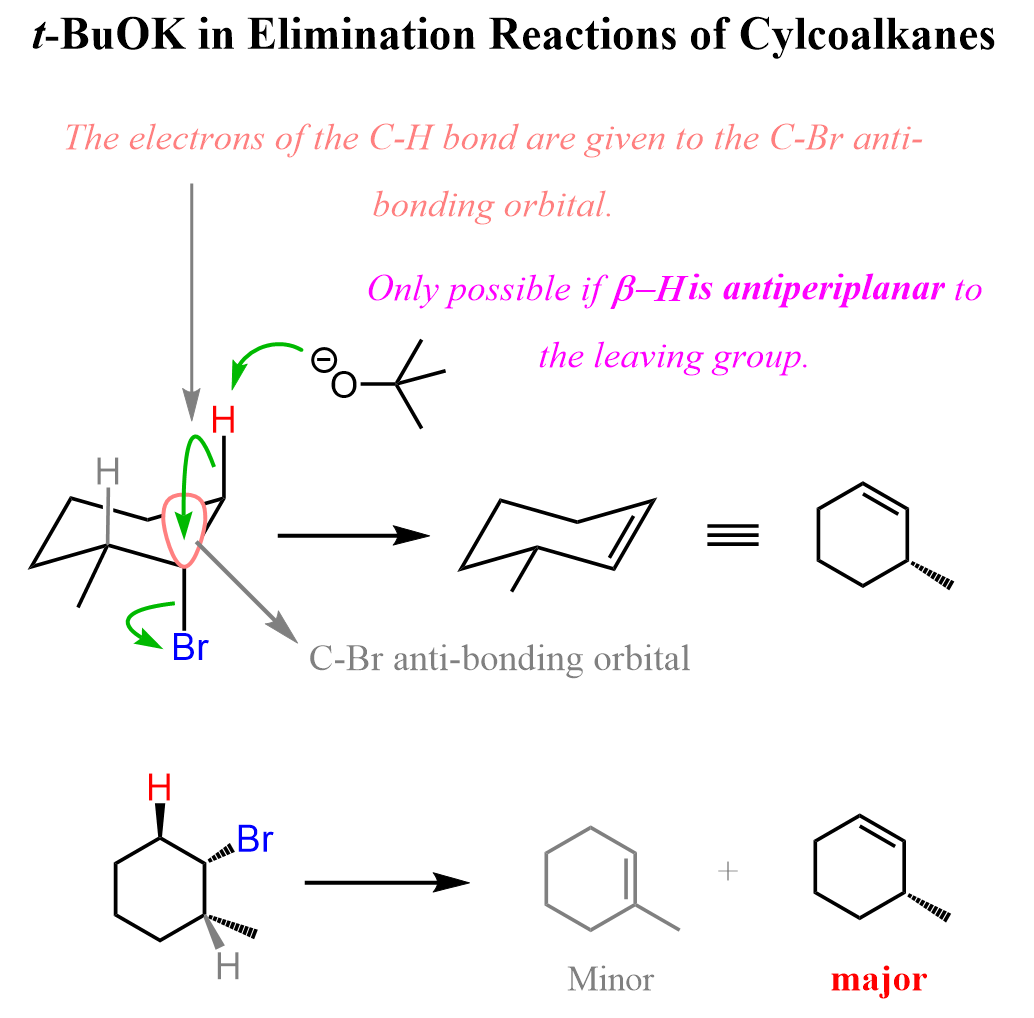


Notice that in E2 eliminations, the β-hydrogen and the leaving group must be positioned 180° apart, known as the antiperiplanar geometry. For cycloalkanes, you can reliably determine this using wedge-and-dash notation. If the leaving group is on a wedge, the β-hydrogen must be on a dash (and vice versa) for the elimination to occur. Check out this article for more details and examples on E2 and SN2 reactions of cycloalkanes.

For the stereochemistry of E2 elimination with open-chain alkyl halides, refer to the post “Stereospecificity of E2 Elimination.”

Below are some more examples comparing E2 eliminations using t-BuOK and less hindered bases:


Summary of tBuOK Elimination

t-BuOK, or potassium tert-butoxide, is a strong, sterically hindered base that favors elimination over substitution and typically forms the Hofmann product, which is the less substituted alkene. This happens because t-BuOK prefers to remove the least hindered β-hydrogen. In contrast, smaller bases like hydroxide or ethoxide lead to the Zaitsev product, which is the more substituted and more stable alkene.

Like any E2 reaction, elimination with t-BuOK is a one-step, concerted mechanism that requires an antiperiplanar arrangement between the β-hydrogen and the leaving group. In cycloalkanes, this geometry can be identified using wedge-and-dash notation, where one group must be axial up and the other axial down for the reaction to proceed.


Practice

1.

Determine the major and minor products in each E2 elimination reaction when EtONa or tBuOK is used:

Answer

This content is for registered users only.

Click here to Register!

By joining Chemistry Steps, you will gain instant access to the answers and solutions for all the Practice Problems, including over 40 hours of problem-solving videos, Multiple-Choice Quizzes, Puzzles, Reaction Maps, and the powerful set of Organic Chemistry 1 and 2 Summary Study Guides.

Solution

This content is for registered users only.

Click here to Register!

By joining Chemistry Steps, you will gain instant access to the answers and solutions for all the Practice Problems, including over 40 hours of problem-solving videos, Multiple-Choice Quizzes, Puzzles, Reaction Maps, and the powerful set of Organic Chemistry 1 and 2 Summary Study Guides.

2.

Provide a base to prepare the following major products for each of the following E2 reactions:

Answer

a) The major product here is the less substituted hence less stable alkene, so any bulky base such as tBuOK, DBN will achieve the desired transformation.

b)

This content is for registered users only.

Click here to Register!

By joining Chemistry Steps, you will gain instant access to the answers and solutions for all the Practice Problems, including over 40 hours of problem-solving videos, Multiple-Choice Quizzes, Puzzles, Reaction Maps, and the powerful set of Organic Chemistry 1 and 2 Summary Study Guides.

3.

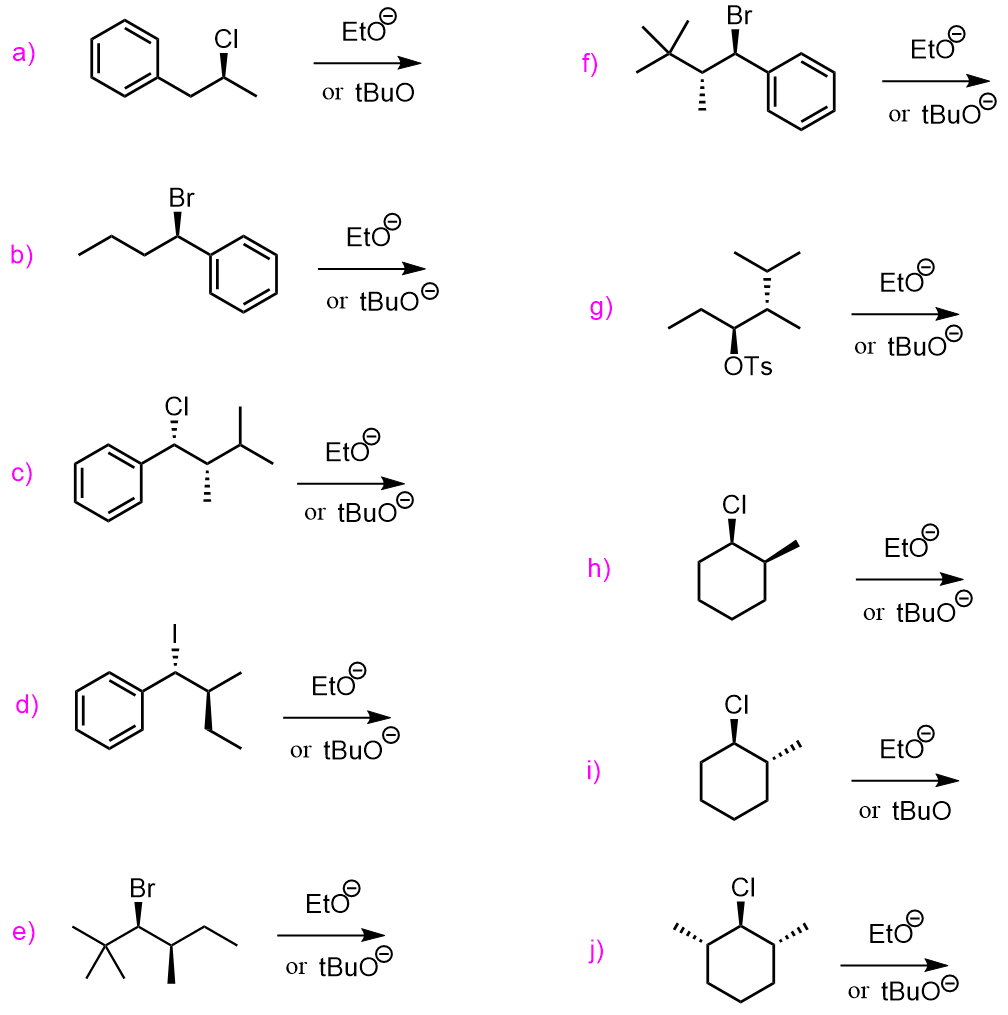
Consider the regiochemistry and stereochemistry to identify the major product for the E2 reaction that occurs when each of the following substrates is treated with a strong base, such as ethoxide (EtO) and tert-butoxide (tBuO) ion:


a)
Answer

This content is for registered users only.

Click here to Register!

By joining Chemistry Steps, you will gain instant access to the answers and solutions for all the Practice Problems, including over 40 hours of problem-solving videos, Multiple-Choice Quizzes, Puzzles, Reaction Maps, and the powerful set of Organic Chemistry 1 and 2 Summary Study Guides.

b)
Answer

This content is for registered users only.

Click here to Register!

By joining Chemistry Steps, you will gain instant access to the answers and solutions for all the Practice Problems, including over 40 hours of problem-solving videos, Multiple-Choice Quizzes, Puzzles, Reaction Maps, and the powerful set of Organic Chemistry 1 and 2 Summary Study Guides.

c)
Answer

This content is for registered users only.

Click here to Register!

By joining Chemistry Steps, you will gain instant access to the answers and solutions for all the Practice Problems, including over 40 hours of problem-solving videos, Multiple-Choice Quizzes, Puzzles, Reaction Maps, and the powerful set of Organic Chemistry 1 and 2 Summary Study Guides.

d)
Answer

This content is for registered users only.

Click here to Register!

By joining Chemistry Steps, you will gain instant access to the answers and solutions for all the Practice Problems, including over 40 hours of problem-solving videos, Multiple-Choice Quizzes, Puzzles, Reaction Maps, and the powerful set of Organic Chemistry 1 and 2 Summary Study Guides.

e)
Answer

This content is for registered users only.

Click here to Register!

By joining Chemistry Steps, you will gain instant access to the answers and solutions for all the Practice Problems, including over 40 hours of problem-solving videos, Multiple-Choice Quizzes, Puzzles, Reaction Maps, and the powerful set of Organic Chemistry 1 and 2 Summary Study Guides.

f)
Answer

This content is for registered users only.

Click here to Register!

By joining Chemistry Steps, you will gain instant access to the answers and solutions for all the Practice Problems, including over 40 hours of problem-solving videos, Multiple-Choice Quizzes, Puzzles, Reaction Maps, and the powerful set of Organic Chemistry 1 and 2 Summary Study Guides.

g)
Answer

This content is for registered users only.

Click here to Register!

By joining Chemistry Steps, you will gain instant access to the answers and solutions for all the Practice Problems, including over 40 hours of problem-solving videos, Multiple-Choice Quizzes, Puzzles, Reaction Maps, and the powerful set of Organic Chemistry 1 and 2 Summary Study Guides.

h)
Answer

This content is for registered users only.

Click here to Register!

By joining Chemistry Steps, you will gain instant access to the answers and solutions for all the Practice Problems, including over 40 hours of problem-solving videos, Multiple-Choice Quizzes, Puzzles, Reaction Maps, and the powerful set of Organic Chemistry 1 and 2 Summary Study Guides.

i)
Answer

This content is for registered users only.

Click here to Register!

By joining Chemistry Steps, you will gain instant access to the answers and solutions for all the Practice Problems, including over 40 hours of problem-solving videos, Multiple-Choice Quizzes, Puzzles, Reaction Maps, and the powerful set of Organic Chemistry 1 and 2 Summary Study Guides.

j)
Answer

This content is for registered users only.

Click here to Register!

By joining Chemistry Steps, you will gain instant access to the answers and solutions for all the Practice Problems, including over 40 hours of problem-solving videos, Multiple-Choice Quizzes, Puzzles, Reaction Maps, and the powerful set of Organic Chemistry 1 and 2 Summary Study Guides.

Solution

These problems are slightly modified; however, you can find the video solutions to the original ones and some more under the corresponding topics:


4.

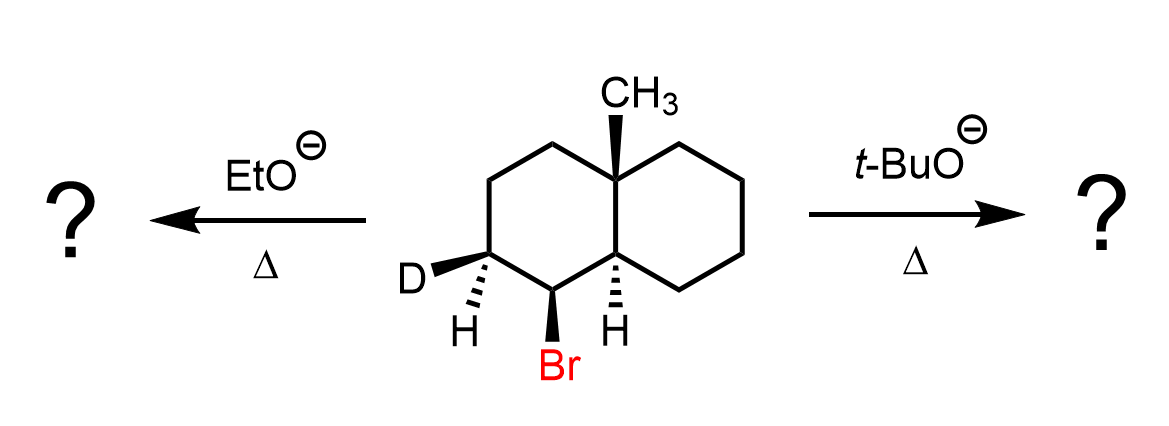
Draw the major product of each elimination reaction:

Answer

This content is for registered users only.

Click here to Register!

By joining Chemistry Steps, you will gain instant access to the answers and solutions for all the Practice Problems, including over 40 hours of problem-solving videos, Multiple-Choice Quizzes, Puzzles, Reaction Maps, and the powerful set of Organic Chemistry 1 and 2 Summary Study Guides.

5.

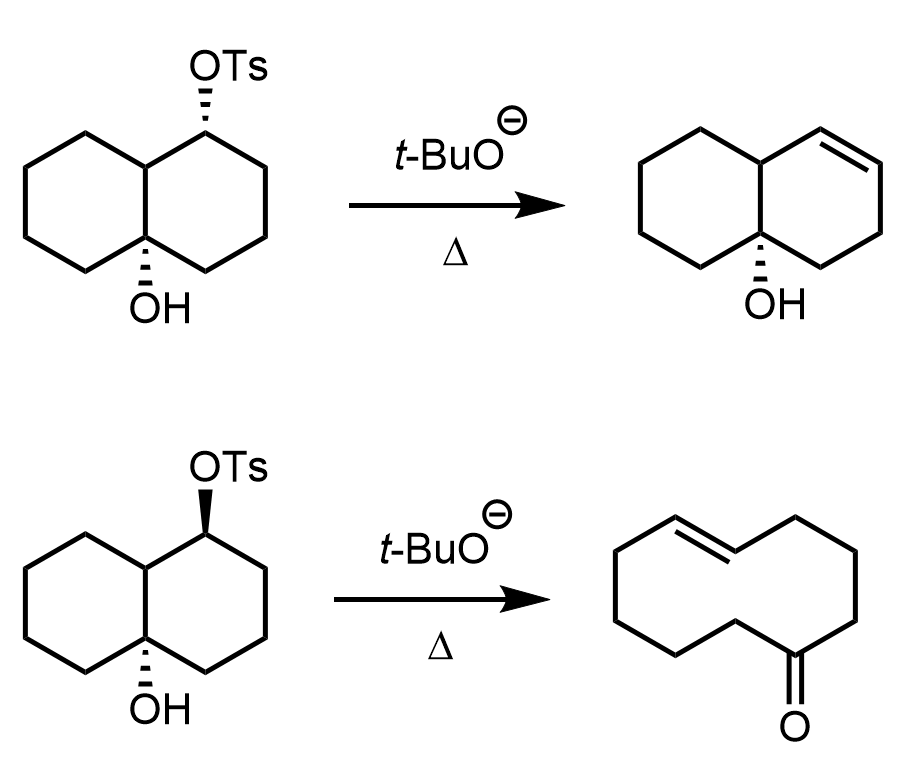
Draw a plausible curved arrow mechanism to explain the formation of each product when the following bicyclic compounds are treated with tBuOK:


Answer

This content is for registered users only.

Click here to Register!

By joining Chemistry Steps, you will gain instant access to the answers and solutions for all the Practice Problems, including over 40 hours of problem-solving videos, Multiple-Choice Quizzes, Puzzles, Reaction Maps, and the powerful set of Organic Chemistry 1 and 2 Summary Study Guides.

Share Your Thoughts, Ask that Question!

Stuck? Need a Quick Guidance?

🔴 Our Live Board is Here! 🖥️✏️