

Chemistry Steps Study Hall
Have a question, need clarification, or want a quick walkthrough?
- Dr. S. Gevorg : On the easier side, any molecule that is not cyclic is nonaromatic - it has nothing to do with aromatic or antiaromatic. The tricky part is when it is cyclic, and you need to determine if it is aromatic, antiaromatic, or nonaromatic. The nonwritten rule is that if there is a way to be aromatic, the molecule generally will be. The same applies to antiaromaticity: if it can avoid being antiaromatic, it generally will by adopting a nonplanar geometry. There are, of course, exceptions, but if you go over this post, with lots of examples you can work on, it should help you get comfortable with this topic: https://www.chemistrysteps.com/identify-aromatic-antiaromatic-or-nonaromatic-compounds/
- justwanttofinishorgo : How can I tell if a molecular is planar? I got aromatic and antiaromatic down, but nonaromatic is a little confusing. Do I just need to look at the hybridization of the carbons?
- Dr. S. Gevorg : Hello, Hydride shifts and other reactions do not occur whenever it is convenient for us. In a Grignard reaction in particular, you have strongly basic conditions, whereas hydride shifts typically occur when a carbocation can rearrange into a more stable one. Considering this and the acid-base concepts you mentioned, I’d recommend going over these earlier chapters for a good review before attempting Grignard reactions and other topics in Organic 2. As far as the synthesis of 2-propanol from formaldehyde, you won’t be able to do this in one step. The carbonyl carbon of formaldehyde becomes the carbon bearing the OH group, so you cannot directly connect two methyl groups to it in a single Grignard reaction. Think about an intermediate carbonyl compound that you need to make.
- ajr_son_of_God : Dear Dr. S. Gevorg, Thank you very much for your message and your kind willingness to help. To address your question about the areas where I find the process challenging, I would like to share the following points: Board Interaction: I find it quite difficult to interact fluently on the board (virtually or in person). Academic Rigor: At my university, the challenge is very high when it comes to designing and building complex molecules with an elevated degree of difficulty. Practical Application: Although I understand the basic concepts and know how to theoretically identify the reagents to use, when it comes to applying it in practice, I struggle to "build the requested molecule," and I often get confused by mixing up acids and bases or vice versa. Taking advantage of this opportunity, I would like to ask you a specific question: How is it possible to synthesize 2-propanol using only formaldehyde and a magnesium compound? I tried analyzing a route starting from 1-propanol (via formaldehyde and a Grignard reagent), intending to protonate it and trigger a 1,2-hydride shift through a carbocation. However, another professor mentioned to me that primary alcohols do not undergo hydrolysis. Therefore, I am quite confused about how I should properly proceed or if this pathway is incorrect. Could you please guide me on the correct approach? Thank you in advance for your patience, time, and valuable guidance. Sincerely, ajr_son_of_God
- Dr. S. Gevorg : Hi, Thank you for reaching out. I’d be happy to help, but I am not quite sure what you are looking for based on your message. Could you tell me about the subject or specific topics you are having difficulty with, and what kind of help you are looking for? Have you seen my answer to your previous questions regarding the mechanism on the board?
- ajr_son_of_God : Subject: Inquiry Regarding Program Guidance and Tutoring Support Dear Dr. S. Gevorg, I hope this email finds you well. I am writing to respectfully request your advice on how to best navigate and utilize the program, as I have been finding it somewhat challenging to arrange tutoring sessions or receive guidance on the specific topics of interest for my studies. Could you kindly advise me on the proper use of the program's resources or point me toward alternative ways to access academic support for these subjects? Thank you very much for your time, consideration, and ongoing support. I look forward to your guidance. Sincerely, ajr_son_of_God
- guest_5884 : C has a single bond
- Dr. S. Gevorg : @5967: It depends on which isomer we are talking about. The cis isomer is a meso compound because it has an internal plane of symmetry. The trans isomer exists as a pair of enantiomers because the two structures are nonsuperimposable mirror images. Check out this post on stereoisomerism in substituted cycloalkanes, where I go through the different isomers and how to determine their relationships: https://www.chemistrysteps.com/stereoisomerism-in-cyclohexanes/
- Dr. S. Gevorg : @Nat21: I don't know what happened to the question, so I don't remember all the details, but the stereochemistry of the product in electrocyclic reactions depends on the conditions and the geometry of the conjugated system. Depending on whether it is under thermal or photochemical conditions, you get conrotatory or disrotatory motion of the C-C bonds. I drew an example on the board below, and you can find more in this detailed post on electrocyclic reactions: https://www.chemistrysteps.com/electrocyclic-reactions/
- guest_5967 : Having a hard time identifying isomers of 1,3 dimethyl cyclohaxane. Are they enantiomers?
- Dr. S. Gevorg : Sulfur stabilizes the negative charge better - https://www.chemistrysteps.com/major-and-minor-resonance-contributors/
- guest_7043 : In a resonance structure that has oxygen and sulfur minus, which one is major? Is the electronegativity important?
- Dr. S. Gevorg : @ajr_son_of_God : You did actually paste the structures, and I saw them. The problem is that there is a mistake in one of them because there cannot be a carbon appearing from nowhere when you treat the starting material with acid. I have mentioned this on the board, and you can see the comments by clicking on the avatar that is in the structures area. Check the structures again and add them to a clean area of the board by holding the right click and navigating the board.
- ajr_son_of_God : I have tried, but unfortunately without success. I drew the structures in ChemSketch; however, I have not been able to export, upload, or paste them into the board. I would therefore appreciate an explanation of how to do this correctly, so that I can upload the structures and we can review them together.
- Dr. S. Gevorg : @guest_192 : If it is regarding the daily quiz, you may want to check this post about localized and delocalized lone pairs https://www.chemistrysteps.com/localized-delocalized-lone-pairs/
- guest_192 : question d answer
- Dr. S. Gevorg : I see that you did draw some structures, but they are quite difficult to interpret. Nonetheless, you may want to check out the Claisen and Cope rearrangements: https://www.chemistrysteps.com/claisen-and-cope-rearrangements/. This post and the examples should help with the mechanism, so let me know how it goes.
- Dr. S. Gevorg : @ajr_son_of_God : Please use the board to draw or upload the structures, preferably with any suggestions you have, so we can take a look together.
- ajr_son_of_God : Dear, may you help me with this synthese? 3-hydroxy-2-[(2E)-1-hydroxypenta-2,4-dien-2-yl]cyclopent-2-en-1-one + H3O+ = (2E)-3-methylidene-2-(2H-pyran-3(6H)-ylidene)cyclopentan-1-one. thanks
- ajr_son_of_God : Dear
- Dr. S. Gevorg : The chemistry of aldehydes and ketones covers many reactions, so unless you have a specific question, check the reactions on the topics page.
- guest_4703 : The chemistry of aldehydes and ketone
- Dr. S. Gevorg : Indeed, it is not. Does that make it the right answer?
- guest_4850 : B is not a ring
- Dr. S. Gevorg : Yes, the reaction of an aldehyde and a primary amine forms an imine. The mechanism is shown here https://www.chemistrysteps.com/formation-of-imines-and-enamines/
- guest_3721 : Search formation of imines
- guest_4240 : Hi i am looking into some organic synthesis specifically the synthesis of salicylaldimine from the condensation of salicylaldehyde and an primary amine, i am really struggling to find information about the reaction mechanism that includes curly arrows. Can anyone help?
- Dr. S. Gevorg : Hello and welcome, Naaman
- Naaman Odyek : hello! may i join your discussions, please!
- Naaman Odyek : hello! may you include me in your discussion, please!
- Dr. S. Gevorg : The absolute configuration of a chiral substrate changes in SN2 reactions. For SN1, it is racemized meaning regardless if it is R or S, it gives a mixture of an R and S. Check the following two posts for more details: https://www.chemistrysteps.com/sn2-nucleophilic-substitution-reaction-mechanism/ https://www.chemistrysteps.com/the-sn1-nucleophilic-substitution-reaction/
- guest_5111 : Do you have a material on the stereochemistry of SN1 and SN2 reactions? How do I know when it changes
- Dr. S. Gevorg : @ guest_1017: There are two main components to the reactions of alcohols: 1) The substitution and elimination and 2) Oxidation reactions. You have most likely covered the first part in Organic Chemistry 1 - these are the substitution and elimination reactions of alcohols which are carried out mainly by converting the OH into a good leaving group. https://www.chemistrysteps.com/alcohols-in-sn1-and-sn2-reactions/ The second part is the oxidation reactions of alcohols using mild and strong oxidizing agents which often form aldehydes and ketones. https://www.chemistrysteps.com/oxidation-of-alcohols/ Some instructors would go from here to cover the nucleophilic addition reactions to aldehydes and ketones such as their reduction with LiAlH₄ and NaBH₄, and also the Grignard reaction of aldehydes and ketones. So, go ahead and review the substitution and elimination reactions, then go over the oxidation reactions of alcohols, then the reduction of carbonyl compounds, and finally the Grignard reaction (https://www.chemistrysteps.com/grignard-reaction-in-preparing-alcohols).
- guest_1017 : What are the main reactions of alcohols we should learn for this semester?
- Dr. S. Gevorg : Just draw seven carbon atoms and add a double bond somewhere unless you need the specific isomer of heptene.
- guest_9120 : I want alkene line formula of heptene
- guest_9120 : i want line formula of alkene heptane
- Dr. S. Gevorg : Please email us using the same address you used when purchasing the Study Guides. We can either issue a refund for the Study Guides or grant you a 5-month access when you sign up for the monthly plan. The second option is honestly preferred for us because of the fees and explanations we may need to give to the payment processor for the refund, but feel free to mention which option you'd like.
- KCA : I was interested in becoming a CS member for one month. I see that the study guides are included. However, I already bought the study guides. Do I get a discount if I become a member or are the study guides different?
- Dr. S. Gevorg : Grignard reagents react with esters by adding twice to the carbonyl carbon. The first addition forms a ketone intermediate, which is more reactive than the ester and undergoes a second Grignard addition, and a tertiary alcohol is formed after the aqueous workup. https://www.chemistrysteps.com/esters-with-grignard/
- guest_7141 : reaction of ester with grignard mechanism
- Dr. S. Gevorg : Also, please do not spam with the same question.
- Dr. S. Gevorg : If you mean 1-phenylcyclohexan-1-ol, check this post on how POCl3 is used for dehydration of alcohols https://www.chemistrysteps.com/pocl3-alcohol-elimination-dehydration/
- guest_2345 : Mechanism reaction on 1-Phenylcycloheaxane with POCL3 and Pyridine
- guest_2345 : Mechanism reaction on
- Dr. S. Gevorg : The terms cis/trans describe the stereochemistry of alkenes with idental groups on the C=C carbon atoms. The E/Z notation is universal and can be applied to any alkene, while cis/trans works only for simpler cases where each double-bond carbon has a common substituent that can be compared directly. https://www.chemistrysteps.com/e-and-z-alkene-configuration-practice-problems/ https://www.chemistrysteps.com/cis-and-trans-isomers/
- taylorhoustoncarden@gmail.com : What is the difference between E/Z and cis/trans bonds?
- guest_2950 : Thank you once again Dr Gevorg!
- Dr. S. Gevorg : No worries. This is a very specific question, and I honestly haven’t dedicated that much time to the detailed mechanistic studies on the nuances of ozonolysis. You’d have to look up some research papers for a certain answer. According to the studies mentioned here, there is some preference, and the more electron-rich end forms a carbonyl oxide https://chemistry.stackexchange.com/questions/188469/in-the-ozonolysis-mechanism-which-end-of-an-unsymmetrical-alkene-forms-the-ca
- guest_2950 : Thank you Dr Gevorg! I would also like to ask a question about the ozonolysis mechanism. When an asymmetric alkene with two different R groups is treated with ozone to form the molozonide, is there any selectivity involved over which R group is attached to the aldehyde and the other to the carbonyl oxide when the molozonide collapses? Or is this trivial since the two fragments recombine to form the more stable ozonide?
- Dr. S. Gevorg : @guest_2950 : Not that I know of. The use of organocadmium compounds for the synthesis of ketones is known as the Cason–Gilman reaction. Although they share the same advantages as Gilman reagents over Grignard reagents, they are more toxic. They were used until less toxic cuprates became available.
- guest_2950 : Hi, I was wondering if there are any advantages in using an organocadmium reagent over an organocuprate in order to convert, for instance, an acyl chloride to a ketone?
- Dr. S. Gevorg : Let me know if you have more questions
- Dr. S. Gevorg : Hi there, I am not sure about the context of the question, but it generally does - on the right-hand side, they must be drawn pointing to the right, and on the left-hand side, they are pointing to the left. It is not accurate to show them the other way around. You can read about the chair conformation here: https://www.chemistrysteps.com/drawing-chair-conformation-cyclohexane/
- guest_6047 : Hi I am wondering if it matters if my equatorial substituents are pointing to the left or right in my chair confirmations.
- Dr. S. Gevorg : Solving Mass Spectrometry Practice Problems - https://www.chemistrysteps.com/solving-mass-spectrometry-practice-problems/ Mass Spectrometry Practice Problems - https://www.chemistrysteps.com/mass-spectrometry-practice-problems/ IR Spectroscopy Practice Problems - https://www.chemistrysteps.com/infrared-ir-spectroscopy-practice-problems/ NMR Spectroscopy Practice Problems - https://www.chemistrysteps.com/nmr-spectroscopy-carbon-dept-ir-practice-problems/
- Dr. S. Gevorg : Have you checked the ones under that posy?
- Dr. S. Gevorg : Hello,
- GreyKindCat : Good evening. I would like to ask of you have a other different tests like this? https://www.chemistrysteps.com/unknown-from-ir-nmr-and-mass-spectrometry/
- GreyKindCat : GreyKindCat.
- Dr. S. Gevorg : Copy-paste works too
- Dr. S. Gevorg : Open the board - on the left sidebar, there is an arrow pointing up.
- Reddy : how can i upload a picture here
- Dr. S. Gevorg : @jsonchen858 - Yes, refunded $46 as the Study Guides are part of the CS memberships.
- jsonchen858 : Hello, I initially purchased the Organic Chemistry Reagent Guide separately. Later, I mistakenly bought the Study Guides + Reagent Guide Bundle, which contains the same Reagent Guide I already purchased. This resulted in a duplicate purchase. Could you please issue a refund for the duplicate Organic Chemistry Reagent Guide? Thank you very much
- Dr. S. Gevorg : Yes, charges are possible as long as you keep the numberof lone pairs and bonds correct.
- Markus : what about this, is it posible that the positive charge end on either the O or the N?
- Markus : true
- Dr. S. Gevorg : You'd need to redo that:)
- Dr. S. Gevorg : Yes, let's see
- Markus : I have one last Resonance structure i would like for you to look at if you dont mind? and i think i have them all.
- Markus : i have put it in the drawing board next to my other ones
- Dr. S. Gevorg : yes, of course
- Markus : i think it is correct
- Markus : can i show another resonance structure i have drawn?
- Dr. S. Gevorg : They are all contributors to one resonance hybrid, but we show them to explain/understand the properties and reactivities of molecules as they indicate how the electrons are distributed over the atoms
- Dr. S. Gevorg : None of the resonance structures exists, just like a hybrid fruit is not composed of two hybrid fruits , i fthat maks sense
- Dr. S. Gevorg : You can find them from the homepage
- Dr. S. Gevorg : If you put a negative and positive charge on neighboring carbons, then they would normally be less stable. One thing to keep in mind is that resonance structures are not real, so we cannot say they exist in one condition but not in another. They simply show the electron density/distribution in the molecule. I recommend you go over these posts- Rules for Drawing Resonance Structures • Major and Minor Resonance Contributor • Significant Resonance Structures • How to Choose the More Stable Resonance Structure
- Markus : but are they less stable? or would the somehow only realy exist is specific conditions?
- Dr. S. Gevorg : They are not wrong as such since they do not violate the rules of resonance by, for example, exceeding octet, or breaking a single bond, but this is how we show the resonance forms of aromatic compounds
- Markus : so the first ones was not right?
- Markus : something like this i put in now?
- Markus : yes i think i have now
- Dr. S. Gevorg : Can you paste these structures above?
- Markus : It says to show all posible resonance structures
- Dr. S. Gevorg : In any case, feel free to draw it on the board above and we'ss see how it goes
- Markus : I have come up with 5 Resonance structures for this compound, where we move the charge around the benzenering and once make a double bond to C=N and the back the benzene ring.
- Dr. S. Gevorg : Does the question say it must involve only the nitro group or you should also include the aromatic ring?
- Markus : I am stuck trying to draw a resonans structure of a Toulene with af NO2 group placed para to each other. The N is positive and the O with single bond is negatively charged. Where do i start? do I break a double bond in N=O to satisfy the N+ or push af pi-bond back to O and take the lonepair from the other O and make a new Pi-bond?
- Dr. S. Gevorg : You are most welcome - let me know if you have any questions
- lzhang71 : Thank you so much for your help!
- lzhang71 : Sorry for the gap in time. I've drawn out the first part of the reaction. How come it is a secondary amine, and not a tertiary?
- Dr. S. Gevorg : Feel free to draw it on the board above, and I will try to help you out.
- Dr. S. Gevorg : It is a double reductive amination - https://www.chemistrysteps.com/reductive-amination/. The first reaction creates a secondary amine, which now attacks the other carbonyl group.
- lzhang71 : Yes, this is practice problem D for proposing reagents to achieve each transformation on the reactions of amines practice problems page
- Dr. S. Gevorg : Sure. Is it a specific reaction you are referring to?
- lzhang71 : Can you explain the mechanism for the reaction of dicarbonyl with an amine to produce a 5 or 6-membered ring? Does the amine attack both carbonyls, or just one?
- guest_5298 : Yes I have seen that page but, at the bottom there are all the topics in one big list but not broken down into Ogo1 and Orgo2. Understand that some topics will depend on the instructor, but if they are categorize based on general acceptance of whats orgo1 and orgo2, it would help, that would also include all the practice questions broken down into orgo1 and orgo2.... thank you.
- guest_715 : I want to study chemistry from here is it possible?
- Dr. S. Gevorg : Have you seen this page? https://www.chemistrysteps.com/organic-chemistry-practice-problems/ Most Organic 1 classes would go up into the reactions of alkenes and alkynes, but the exact syllabus depends on your instructor.
- guest_396 : A page like this would help and make it easy to focus with link to specific quizes and practise questions: https://www.masterorganicchemistry.com/organic-chemistry-practice-problems/
- guest_396 : What I am asking is, if you can create 1 page on your website and categorize Orgo1 and orgo2 topics. that was we can just go to the page and see what is covered under each Orgo.
- guest_396 : Hi, What I am asking is.
- Dr. S. Gevorg : If you tell me your curriculum or what topics you’re covering, I can point you to the right guides, and in general, feel free to ask your questions here.
- Dr. S. Gevorg : The curriculum for organic chemistry is not uniform across schools or instructors. Topics are often ordered differently, and some courses include or exclude certain material. Because of this variation, a fixed Organic 1 vs Organic 2 split would not reliably match what students are covering in their specific class. Instead, the structure is organized by topics so students can select what aligns with their course syllabus or what they have not yet covered. This allows the material to be used flexibly regardless of how a particular course is sequenced. With that said, you can refer to this page for practicing synthesis, which is largely based on Organic Chemistry 1 concepts: https://www.chemistrysteps.com/organic-orgo-1-synthesis-practice-problems/
- guest_396 : I had purchased the study guides, for orgo they seem pretty good, it would be helpful to have a page which list all Orgo1 topi can link to practise questions and quizes for orgo 1. and a similar page for Orgo2. that way we can focus on ogo1 instead of trying to identify topics for ogo1 and 2. a dedicatde page with for each with topics/questions etc will help a lot.
- guest_396 : On you website do you have list of topics for organic 1 and list of topics for Organic2.
- guest_396 : On you website do you have list of topics for organic 1 and list of topics for Organic2.
- guest_396 : I had purchased the study guides, for orgo they seem pretty good,
- Dr. S. Gevorg : Conceptually, it is not different from anything we discuss in conformational analysis (https://www.chemistrysteps.com/conformational-analysis/). You need to choose (or be given) the bond through which you are looking and draw all the conformers. The one with the largest groups farther apart is the most stable. Watch out for hydrogen bonding, as it can stabilize some eclipsing conformations.
- abcd : Can you please generate an image on most stable newmans projection for isoflurane, fosfomycin and guaifenesin. please guide me with instructions for drawing
- Dr. S. Gevorg : @fadhlmahboba : It is a collection of problems from all the topics in the chapter, and each problem has a link to the corresponding topic where you can find the answers.
- guest_9047 : For each of the following compounds predict and sketch the number of signals in a ¹³C NMR spectrum
- fadhlmahboba : there isnt a answer key to see if i did it right and also there isnt a quiz for the topic
- fadhlmahboba : Enolates in Organic Synthesis – a Comprehensive Practice Problem
- fadhlmahboba : the enolates practice problems there is no answer key
- Dr. S. Gevorg : Could you clarify which specific example you are referring to? In general, the idea of an “axis” is not the main criterion for determining whether molecules are enantiomers or diastereomers. The more relevant concept is the presence or absence of a plane of symmetry. For enantiomers, each molecule must be chiral, meaning it has no internal plane of symmetry. Two enantiomers are related as non-superimposable mirror images, but this does not require identifying a physical “axis” within the molecule. Instead, you conceptually compare the molecule to its mirror image. For diastereomers, the molecules are stereoisomers that are not mirror images of each other. Again, this is not determined by an axis, but by comparing configurations at stereocenters and checking whether the relationship is mirror-image or not. https://www.chemistrysteps.com/enantiomers-vs-diastereomers/
- guest_6659 : Can you explain how to find the axis for determining enantiomers and diastereomer? In the example given for enantiomer and diastereomer both of them do not seem to have an axis across which they are mirror images of each other
- Dr. S. Gevorg : https://www.chemistrysteps.com/crossed-aldol-and-directed-aldol-reactions/
- Dr. S. Gevorg : https://www.chemistrysteps.com/aldol-condensation-dehydration-of-aldol-addition-product/
- Dr. S. Gevorg : https://www.chemistrysteps.com/cannizzaro-reaction/
- Dr. S. Gevorg : It will depend on the exact conditions, but you'd need to consider the aldol reaction and possibly the Canizzaro reaction. On the simplest level, benzaldehyde has no alpha hydrogens, so the implication of this question may be figuring out which carbonyl compound will be deprotonated, thus acting as the nucleophile.
- guest_7179 : How many products will the reaction between benzaldehyde and propanal in NaOH produce?
- guest_4944 : 4-(4-chlorophenyl)-1H-benzo[d][1,2]oxazin-1-one covert into 3-(4-chlorophenyl)isoindolin-1-one reaction mechanism
- Dr. S. Gevorg : What do you mean by 2D experiment?
- SHARIQ SULTAN : HOW CAN WE CONFORM WHICH ONE IS NH AND WHICH ONE IS OH,,WHICH 2D EXPERIMENNT SHOULD I TRY????
- Dr. S. Gevorg : The addition is still anti, but the starting alkene is cis, while the product is shown in a regular zig-zag form. So, there has been a rotation about the single bond to show the carbon chain of the product in a "normal" way, and it put the halogens in syn/cis orientation. You can read more about it at https://www.chemistrysteps.com/cis-product-anti-addition-reaction-alkene/
- Dr. S. Gevorg : I saw it
- Dr. S. Gevorg : Yes, if you show me the reaction
- ralmachnee : Can you please help me understand why they are adding syn? If x2 additions are anti?
- Dr. S. Gevorg : Is it the 4 alcohols?
- ralmachnee : Can you tell me if these are the same? Because I drew it differently as a structure. I drew the bottom one.
- Dr. S. Gevorg : I am assuming it refers to the alkyne that undergoes a hydration. These terms are to indicate the position of the triple bond. You can read more about it at: https://www.chemistrysteps.com/alkynes-to-aldehydes-and-ketones/, https://www.chemistrysteps.com/acid-catalyzed-hydration-alkynes/
- ralmachnee : What is the difference between terminal and internal for either making a ketone or an aldehyde?
- Dr. S. Gevorg : Yes, essentially that's what it is. The classic examples are the SN2 and E2 reactions (concerted), and E1 and SN1 for the stepwise. You can read about the halohydrins here https://www.chemistrysteps.com/halohydrins-from-alkenes/
- ralmachnee : I am doing an alkene halohydrin reaaction.
- ralmachnee : So because things are happening at the same time... it is concetred?
- Dr. S. Gevorg : Hi there, this post should give you a good idea of what they are: https://www.chemistrysteps.com/concerted-mechanism/
- ralmachnee : Hi.. Do you have anything on concetred vs stepwise reactions? What does this even mean?
- Boss : I wanna study from this website.....
- ralmachnee : I uploaded it. Is my election pushing arrows correct?
- Dr. S. Gevorg : Yes, there is an upload button on the left side. You can also draw it
- ralmachnee : is there a way to upload a picture?
- Dr. S. Gevorg : Sure
- ralmachnee : Okay! I’ll put it on the board
- Dr. S. Gevorg : Hello, If the problem explicitly shows that the intermediates or products have different energies, that usually means the alkene is not symmetric, and most likely, there is a chiral center in the molecule which makes the two faces of the double bond nonequivalent. If the alkene were symmetric, it wouldn’t matter which face the bromine adds to as both pathways would be identical in energy, and a pair of enantiomers would be formed. You can read more about the halogenation of alkenes here: https://www.chemistrysteps.com/halogenation-of-alkenes-and-halohydrin-formation/ Feel free to post the structure on the board above, and we can discuss it. And just to clarify, Markovnikov vs anti-Markovnikov applies to additions of HX (like HBr or HCl). In Br₂ bromination, the reaction proceeds through a bromonium ion and gives anti addition. The regioselectivity only applies here if a nucleophile or a nucleophilic solvent such as water, and alcohol, amine, or thiol is used..
- ralmachnee : I am studying the reaction of a cyclic alkene with Br₂ in CH₂Cl₂, which is an inert solvent. The alkene appears symmetric. The reaction shows two bromonium ion intermediates: one where the bromine is wedged and higher in energy, and another where the bromine is dashed and lower in energy (0.0 kcal/mol). I think these intermediates are diastereomers, which would explain why they have different energies and form at different rates. I also know the addition is anti, but I am unsure how to determine whether Markovnikov or anti-Markovnikov addition applies.
- Dr. S. Gevorg : @ nicolekhay: The OH proton may show up in ¹H NMR, but it’s not always reliable. It typically appears as a broad singlet, and its chemical shift can vary quite a bit. It largely depends on the solvent and conditions. Because OH protons exchange rapidly, especially if there’s trace water or a protic solvent, the signal can become broad, weak, shifted, or sometimes hard to see clearly. It doesn’t behave in a clean, predictable way as most C-H protons do, so not seeing a signal does not mean there is no OH in the molecule. You can check this post for more details: https://www.chemistrysteps.com/nmr-chemical-shift-values-table/
- nicolekhay : Does an OH show up on HNMR ?
- Dr. S. Gevorg : English please
- Aufa : https://www.chemistrysteps.com/nitration-of-benzene/#:~:text=Nitrasibenzenaatauturunannyamemasukkan,untukmembuatgaramarenadiazonium: artikel ini kapan release?
- Aufa : https://www.chemistrysteps.com/nitration-of-benzene/#:~:text=Nitrasibenzenaatauturunannyamemasukkan,untukmembuatgaramarenadiazonium: artikel ini Reales tanggal berapa?
- Dr. S. Gevorg : @lexigwaku: All the Study Guides can be downloaded at https://www.chemistrysteps.com/chemistry-steps-benefits/
- lexigwaku : I can not find the spectroscopy study guides. Can you help?
- guest_8527 : Draw a Fisher Projection for Benzoin.
- Dr. S. Gevorg : This is about the structure and stability of carbocations, if that's what you meant: https://www.chemistrysteps.com/stability-of-carbocations/
- Dr. S. Gevorg : https://www.chemistrysteps.com/carbocation-rearrangements-sn1-reactions/, https://www.chemistrysteps.com/ring-expansion-rearrangements/, https://www.chemistrysteps.com/ring-contraction-rearrangements/, https://www.chemistrysteps.com/rearrangements-in-alkene-addition-reactions/, https://www.chemistrysteps.com/carbocation-rearrangements-sn1-reactions/, https://www.chemistrysteps.com/rearrangement-in-an-e1-reactions/
- ralmachnee : anything about carbocation arrangment?
- Dr. S. Gevorg : They are lower in energy compared to the syn conformation, but gauche is still higher than anti - check this post: https://www.chemistrysteps.com/newman-projections/. Go over these posts to see the difference between steric and torsional strain: https://www.chemistrysteps.com/steric-vs-torsional-strain/, then this one describing the energies of different conformations: https://www.chemistrysteps.com/gauche-conformation-steric-torsional-strain-energy-practice-problems/
- ralmachnee : How do i describe the sterics of a staggered gauche compared to a staggered anti when they are both low in energy?
- Dr. S. Gevorg : Frost circles have some too - https://www.chemistrysteps.com/frost-circle/, the endo product in Diels Alder reactions - https://www.chemistrysteps.com/endo-and-exo-products-of-diels-alder-reaction/. Depends in what context you need it, your textbook should give you the foundations.
- Dr. S. Gevorg : There is a section about it in the post on the SN2 mechanism - https://www.chemistrysteps.com/sn2-nucleophilic-substitution-reaction-mechanism/, but no dedicated discussion as such.
- guest_5112 : Where can I find stuff about the antibonding and bonding orbital?
- Dr. S. Gevorg : Regarding conjugation and hyperconjugation, they are related concepts because both involve electron delocalization that stabilizes a molecule. However, they are not the same. Conjugation refers to the overlap of adjacent π orbitals or p orbitals, while hyperconjugation involves the donation of electron density from a σ bond (usually C–H or C–C) into a neighboring empty or partially filled p orbital or π system. They both require parallel orbital alignment: https://www.chemistrysteps.com/localized-delocalized-lone-pairs/, https://www.chemistrysteps.com/resonance-and-conjugated-dienes/
- Dr. S. Gevorg : The reason for stabilization via hyperconjugation is the decrease ofthe overall energy level of the molecule. In general, bonding orbitals are lower energy/more stable compared to nonbonding/empty orbitals, so when the empty orbital is supplied with tlectron it "becomes" or resembles a bonding orbital and the system gets some stabilization.
- Dr. S. Gevorg : An empty p orbital can be present in different species, such as Lewis acids and carbocations, which, in turn, can form, for example, by loss of a leaving group or protonation of a C=C double bond. The key at this point is that you go over the hybridization theory, which will help you understand why a carbon with three bonds and no lone pairs has an empty p orbital, as well as how pi bonds are formed. Do not overlook the importance of hybridization and VSEPR theory, as they are the foundation of understanding organic structures.
- ralmachnee : Can you also explain why hyperconjugation is stabilizing?
- ralmachnee : And is hyper conjugation not related to pi conjugation?
- ralmachnee : So what is an empty p orbital? And Pi bonds are formed from unhybridized p orbitals correct?
- Dr. S. Gevorg : Newman projections are just one way of showing molecules, so they are not related to hypercojugation as such. You may have seen it represented with Newman projections because they are great for showing bond and orbital alignment, but that is all there is to correlating Newman projections with hyperconjugation. The interaction does not restrict the number of electron-donating orbitals, and yes, it occurs most often between C-H sigma bonds and empty p orbitals of carbocations.
- ralmachnee : Like I am confused on it because is it always in newman projections and is it always one filled orbital overalps with one empty orbital and does that orbital have to be a p orbital or does it not matter?
- Dr. S. Gevorg : Is there a specific question you are working on?
- Dr. S. Gevorg : @ralmachnee: A few posts, including https://www.chemistrysteps.com/stability-of-carbocations/, have it mentioned.
- ralmachnee : Do you have anything about hyperconjugation?
- Adithya : I have sent it
- Dr. S. Gevorg : No worries, it's on the contact page.
- Adithya : Thanks a Million Mr Gevorg. Would you give the the id
- Dr. S. Gevorg : Send me an email
- Adithya : Ok But how do I post an image here
- Dr. S. Gevorg : Feel free to post it here if you have a specific example of a molecule with more than one complex substituent, and we'll discuss it.
- Dr. S. Gevorg : 5-ethyl should go before all the dimethyls. I will need to think about such an example where two bis or tri determine the alphabetical priority. They don't normally do that - we ignore the prefixes.
- Adithya : If possible would you be kind enough to give me an example involving a tiebreaker for the complex Substituent part
- Adithya : So what is the name of the organic compound which I have given. Is the same which I have mentioned or is it different
- Dr. S. Gevorg : None of the prefixes such as di, tri, tetra, sec-, tert- are considered for alphabetical priority except the -iso.
- Dr. S. Gevorg : Adithya : Ok, so there is only one complex substituent in this molecule, and that is 1,1-dimethylethyl, which is tert-butyl. The ones you mentioned earlier – bis, tris, tetrakis, etc. – are used to tell the number of complex substituents, so you won’t need them here. As for the regular di-, tri-, etc., we do not consider them unless they are the only tiebreakers. For example, dimethyl beats trimethyl, and methyl itself will have a higher priority than a methyl with any prefix.
- Adithya : The doubt arose, when I was dealing with the below question : 5-(1,1-dimethylethyl)-5-ethyl-4,6-dimethyldecane . In this is the di in the methyl of Complex Substituent (in the brackets) considered and the di int the methyl of Simple Substituent coming just before the word root not considered
- Dr. S. Gevorg : @Adithya: I would say no, unless everything else is the same in the names, then we'd look at the alphabetical order of these prefixes.
- Adithya : In naming of Complex Substituent, Do we have to consider the alphabetical order of bis, tetrakis etc and the bi, tri, (which comes inside the complex Substituent part)
- Adithya : In naming of Complex Substituent, Do we have to consider
- Dr. S. Gevorg : @guest_758Shahana: I have replied to your question in the comments below - please check there.
- Dr. S. Gevorg : @Varu T: Constitutional isomers are compounds with the same molecular formula but different connectivity of atoms. Therefore, all isomers of C₃H₆O must satisfy this rule. So yes, for C₃H₆O, the different structures you can draw are constitutional (functional) isomers as long as the atoms are connected differently. Keto–enol tautomers are also constitutional isomers because of the connectivity changes, even though they can interconvert.
- guest_758Shahana : I face trouble to elucidate structure while reading of HSQC and HMBC . how to elucidate structure from HSQC and HMBC .plz can you guide me how i clear my confusion related the topic in NMR . I mostly face problem to search mechanism of different organic reactions . is there any website where i can check mechanism of any reaction?
- Varu T : Sir please reply.
- Varu T : Thankyou so much sir, sir I have one more doubt, for the molecular formula C3H6O, there are 6 functional isomers( propanal, propanone, methoxy ethene, oxirane, oxitane and prop-2-en-1-ol ). Am i right?? And sir prop-1-enol and prop-1-en-2-ol will not be considered functional isomers because they will show tautomerism . Is this correct? This is what my chemistry tution teacher told me. By the way sir I am from New Delhi. Have you ever been to India?
- Dr. S. Gevorg : @Varu T: All students are welcome. Yes, these two represent the same compound, although 1-Chloro-2-methylbenzene is likely the official IUPAC name.
- guest_6778 : ☹️ plz tell sir
- Varu T : 1 chloro 2 methyl benzene and 2 chlorotoluene are the iupac names of same compound?
- Varu T : Sir do you answer questions of indian students? I also have some doubts
- Dr. S. Gevorg : @guest_3289: Hi there, nice to hear from you! Feel free to ask any questions here.
- guest_3289 : im not a member though
- guest_3289 : and thanks for this amazing useful website
- guest_3289 : I just want to say hi
- Dr. S. Gevorg : @ MattTan: Yes, please check the board
- MattTan : Could someone tell me a quick way to approach the problem I posted for Ozonolysis?
- Dr. S. Gevorg : https://www.chemistrysteps.com/is-phenyl-an-ortho-para-or-meta-director/
- guest_6934 : g
- guest_6934 : is beneze+i or -i and ist it +m or -m
- guest_6934 : is ph a bulky group?
- Dr. S. Gevorg : https://www.chemistrysteps.com/acetal-hydrolysis-mechanism/
- guest_57 : hydrolysise of aceta
- Dr. S. Gevorg : @guest_4122 - Hello, I do have an entire section on General Chemistry at https://general.chemistrysteps.com/
- guest_4122 : Hi, do you have a guide that covers the course Chem 30A : basic chemical principles: nomenclature, atomic structure, quantum theory, molecular structure and bonding, periodic properties, chemical reactions, stoichiometry, thermochemistry, states of matter, gas laws, solutions, oxidation-reductions, and molecular equilibrium?
- Dr. S. Gevorg : @Anna: Sure, you can use the board to ask your question
- Anna : Need help with structure elucidation
- Dr. S. Gevorg : @Joujoulou: Hi there, you can read about the general trends of acidity in these posts: https://www.chemistrysteps.com/how-resonance-affects-acidity-and-basicity/, https://www.chemistrysteps.com/factors-determine-pka-acid-strength/
- Joujoulou : Good afternoon, do you have practice problems on the structure and properties of carboxylic acid and substituent effects on acidity?
- Dr. S. Gevorg : @Joujoulou: Hello, You can find most topics on carboxylic acids, including practice problems on specific functional groups, from the home page or the index page. For example, practice problems on the reactions of esters: https://www.chemistrysteps.com/ester-reactions-summary-and-practice-problems/ In addition, you can download the Study Guides on carboxylic acid derivatives at https://www.chemistrysteps.com/cs-benefits/ , as well as the reaction map of carboxylic acid derivatives at https://www.chemistrysteps.com/organic-chemistry-reaction-maps/. We also have multiple-choice quizzes, including one on carboxylic acid derivatives. It is quite a long chapter and, although you will need to memorize certain things, try to recognize the patterns. Most of the reactions are nucleophilic addition-elimination reactions, which you should be familiar with from the aldehydes and ketones chapter. Doing lots of practice problems is what ultimately makes it possible.
- Joujoulou : im currently learning about carboxylic acid and derivatives
- Joujoulou : Also, how would you memorize reagents? I was thinking of doing practice problems on each reagent individually and then doing it all together
- Joujoulou : Hi, are there any practice problems where I can only do practice problems on one thing, like esters, for example?
- Dr. S. Gevorg : @edentippets Although it is a topic of discussion on its own, there are really a handful of nucleophiles that you need to know. These are mainly oxygen-, nitrogen-, sulfur-containing species, and their negative counterparts, i.e. the conjugate bases are stronger nucleophiles. Carbanions are also excellent nucleophiles and strong bases. When it is a strong base and nucleophile, you always need to watch out for E2 reactions. Here, we have the most common nucleophiles listed according to their reactivity: https://www.chemistrysteps.com/nucleophiles-and-electrophiles/. Check also the post on comparing the SN2 and E2 reactions: https://www.chemistrysteps.com/sn2-vs-e2/
- edentippets : How do I know if a nucleophile is strong or weak?
- Dr. S. Gevorg : @guest_5893 That is an SN2 reaction, and more specifically, we can classify it as a Williamson ether synthesis. Check these two posts for more details: https://www.chemistrysteps.com/sn2-nucleophilic-substitution-reaction-mechanism/, https://www.chemistrysteps.com/williamson-ether-synthesis/
- guest_5893 : Need help with bimolecular transition state of guaifenesin synthesis. Drawing the curved arrow mechanism between 2-methoxyphenoxide and 3 chloro-1,2-propanediol
- khalum : I have a question on reaction arrows
- guest_5206 : structure for Start: Draw AMC with -NH2 at position 7 and -CH3 at position 4.Step 1: Show AMC with Boc on the amino group (replace -NH2 with -NH-Boc).Step 2: Draw Boc-Phe-OH (Boc-NH-CH(R)-COOH, R = phenyl).Step 3: Arrow showing coupling reaction with DCC/HOBt. Show formation of amide bond between AMC’s amino nitrogen (deprotected) and Phe’s carboxyl carbon.Step 4: Show removal of Boc from Phe’s amino group with TFA.Step 5: Add next amino acid with Boc protection and repeat coupling arrow.S
- Dr. S. Gevorg : @djtka - Hello, please tell me how I can help you. You can use the board to draw structures
- djtka : hi, I need help with e and z. im confused and would like to talk this through the way I do it
- Dr. S. Gevorg : @eyee0000 Check this post for finding the most acidic proton, and the related articles for other topics in acid-base chemistry: https://www.chemistrysteps.com/how-to-find-the-most-acidic-proton/
- eyee0000 : I need help finding the most acidic H atom on a molecule and reaction arrows of reactions based on pKa values and PES for reactions
- Dr. S. Gevorg : @guest_1908 Hi there
- guest_1908 : hello good evening
- Dr. S. Gevorg : @ guest_7827ab : Please ask a specific question so people can help you.
- guest_7827ab : help with stereoisomers
- guest_7827ab : Help with stereoisomers
- guest_9455 : Nomenclature of Thiols, Ethers, Alkyl Halides, and Others
- guest_9455 : Nomenclature of Thiols, Ethers, Alkyl Halides, and Others
- Dr. S. Gevorg : Hello, no, not about polymers
- bahareh.moalemia : Hi, Do we have a Topic of Monomers and Polymer in this chemistry program?
- Dr. S. Gevorg : Welcome to the Study Hall! Be the first to ask your question.
🧩 Daily Quiz
📚 Resources
- 📝 Practice Problems →
- 🧪 MC Quizzes →
- 📕 Study and Reagent Guides →
- 🗺️ Reactions Map →
- 🖥️ Live Board Help ⬇️
Welcome everyone!
Creating this Study Hall is my continuous attempt to provide the best learning experience for all of you. The Study Hall is the next step in bringing all our students together in a collaborative space.
Here, you can:
-
Ask and answer questions.
-
Work in groups with your peers.
-
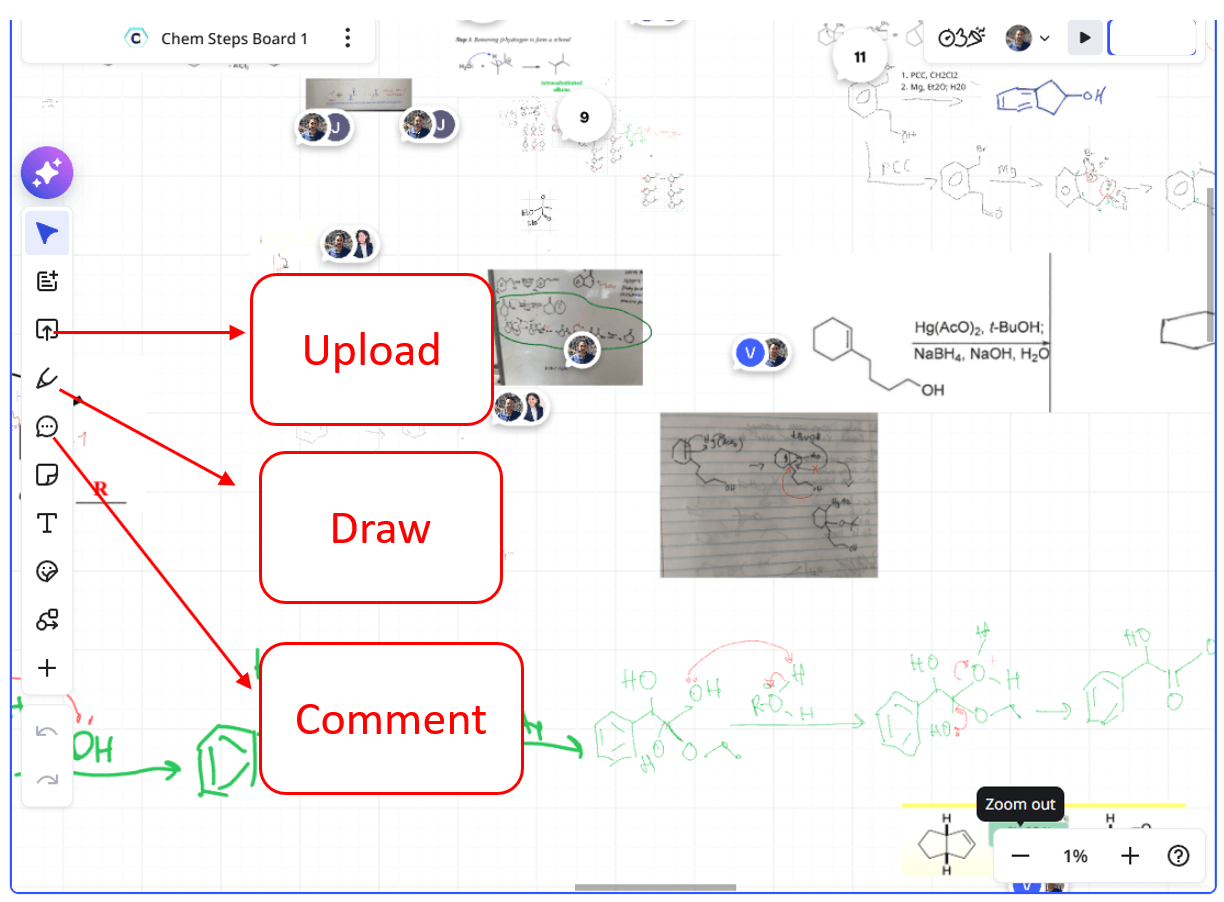
Use the collaborative board to draw structures, upload images and files, and comment on any part of the board to ask or answer questions.
I will also be around whenever time permits to help, guide, and answer your questions.
Let’s make this a productive, friendly, and interactive space for everyone!
🏫 Study Hall Community Rules
-
Be Respectful
-
Treat all members with kindness and respect.
-
Avoid personal attacks, insults, or belittling others’ work.
-
-
No Vulgar or Offensive Language
-
Do not use swear words, slurs, or any language that could offend other members.
-
Keep the environment professional and friendly.
-
-
Be supportive of Others
-
Focus on helping each other learn and solve problems.
-
Do not make fun of mistakes or give sarcastic comments.
-
-
Stay On Topic
-
Keep all discussions related to chemistry, exams, homework, etc.
-
You can, of course, discuss your college life and stuff – in short, anything academic.
-
-
No Spamming or Self-Promotion
-
Avoid posting unrelated links, self-promotion, or repetitive messages.
-
Share helpful resources only if relevant to the Study Hall topic.
-
-
Protect Your Work and Respect Others’ Work
- Respect the integrity of shared boards and exercises.
- Be mindful of other users’ contributions – do NOT erase or overwrite your and someone else’s work! The board is for everyone, and any content on may be helpful to you or others.
-
Report Issues
-
If you notice rule violations, inappropriate behavior, or technical problems, let me know in the comments or via email.
-
 ❗️ ❗️ ❗️ Students with CS membership get exclusive access to an interactive chemistry board where you can get help in real time by drawing structures, uploading files, communicating via chat, and even hop on a video call to walk through mechanisms, problem sets, or exam questions. Whether you’re stuck on a synthesis, confused about stereochemistry, or just want quick clarification, the board gives you a direct, hands-on way to get help exactly when you need it.
Whenever online, you can also join a video call with me right in the board for a mini tutoring session. 📕💻
1) Click “See the Board”.
On the right-side panel, you will see all the tools you need to draw, comment, add text, or upload images.
-
If a tool you need is missing, click the “+” icon to access additional options.
-
Hover over any tool to see a tooltip explaining its function.
- Be mindful of other users’ contributions – do NOT erase or overwrite your and someone else’s work! The board is for everyone, and any content on it may be helpful to you or others.
The board is essentially infinite, so depending on the zoom, you may not see some items, or they might appear too large or too small. Drag the board and/or zoom to locate the needed item or add a new one.
The board is view-only on mobile devices, so use your computer to access all the tools.
This content is for registered users only.
By joining Chemistry Steps, you will gain instant access to the answers and solutions for all the Practice Problems, including over 40 hours of problem-solving videos, Multiple-Choice Quizzes, Puzzles, Reaction Maps, and the powerful set of Organic Chemistry 1 and 2 Summary Study Guides.
which one is smallest aromatic compounds benzene or train gul shap with 1 singer bond and one positive charge on it?
You need to explain yourself better. What is train gul shap ?
Nomenclature of Thiols, Ethers, Alkyl Halides, and Others
Can you explain this
Yes, they can be found here, and if you have a specific question, you can ask here or under the comments of these posts.
Hi
I need help with stereoisomers, chiral centres, R and S con figuration
Go ahead, Raphaella
I’m having difficulties finding naming R and S configurations
There are two components there, yes? 1) You need to know the IUPAC rules to name the molecule. 2) You need to be able to determine the R and S configuration. First, name the molecule as if it does not have any chiral centers, then add the configurations of these chiral centers with the corresponding locants, i.e., 4R, 3S. Do you have a specific example? You can draw that on the board.
I face trouble to elucidate structure while reading of HSQC and HMBC . how to elucidate structure from HSQC and HMBC .plz can you guide me how i clear my confusion related the topic in NMR .
I mostly face problem to search mechanism of different organic reactions . is there any website where i can check mechanism of any reaction?
HSQC and HMBC are 2D NMR correlation techniques – HSQC shows direct ¹H–¹³C (one-bond) correlations, while HMBC shows long-range (2-3 bond) H–C correlations. If you already know how to interpret ¹H and ¹³C NMR, using HSQC and HMBC together is usually not very difficult, they mainly help you connect protons to the correct carbons. That said, without a specific spectrum or example, it’s hard to generalize how to solve every case.
As for reaction mechanisms, don’t we all wish there were a website that could draw the mechanism for any reaction 🙂 Unfortunately, chemistry doesn’t quite work that way. However, most common mechanisms and recurring patterns in undergraduate organic chemistry are covered here on Chemistry Steps, as well as on other organic chemistry websites and YouTube channels. Once you learn the patterns, you can usually reason out the mechanism yourself.
Thank you sir for answering. Sir I somehow able to interpret structure of organic compound by taking help from HNMR and C-NMR spectra and some how from Molecular formula .but in our course there is topics of COSY, HSQC ,HMBC .and I get sometimes failed to interpret and elucidate structure and in simple way the use of HSQC and HMBC . how I can read and elucidate any structure . can you plz sir guide me or having any notes etc or recommended video etc. Plz sir I will be much grateful.
Hello Shahana,
Glad to hear you’re making progress with ¹H and ¹³C NMR! As I mentioned before, HSQC and HMBC are just tools to connect protons to the right carbons and reveal longer-range correlations. If you keep practicing with specific examples and spectra, it will gradually become much easier to interpret.
Other than your professor’s notes, you may also want to check out textbooks on organic structure determination and look for additional online materials and videos. Sorry for not being too specific – this is a specialized topic, and I would recommend asking your professor for further guidance to really master it. With practice, reading 2D NMR becomes a natural extension of what you already know from 1D NMR.
Ok sir thank you so much for guidance.