
We have seen that in the aldol condensation, the nucleophile is the alpha carbon that is activated in the form of an enolate. An interesting example of the aldol condensation is the crossed-aldol condensation, where one of the carbonyl compounds lacks alpha hydrogens:
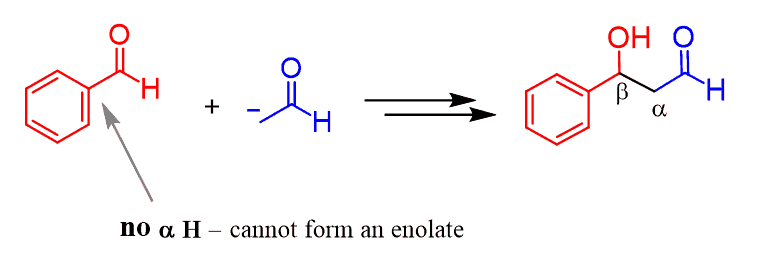
In these types of crossed aldol condensations, we have more control over which carbonyl acts as the nucleophile and which serves as the electrophile.
So, this reminds us that the presence of at least one alpha hydrogen is a requirement for the carbonyl to act as a nucleophile.
Now, let’s say we only have benzaldehyde, or two aldehydes, where none of them has any alpha hydrogens. How can we make them react? How do we turn the electrophilic carbon atom into a nucleophile that attacks another carbonyl?
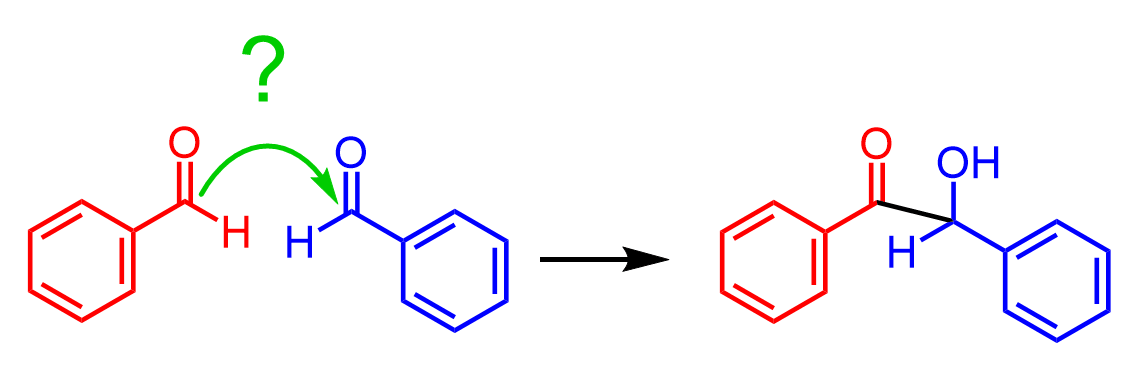
The benzoin condensation is the “magic” way of making the carbonyl carbon act as the nucleophile that attacks the carbonyl of another molecule:
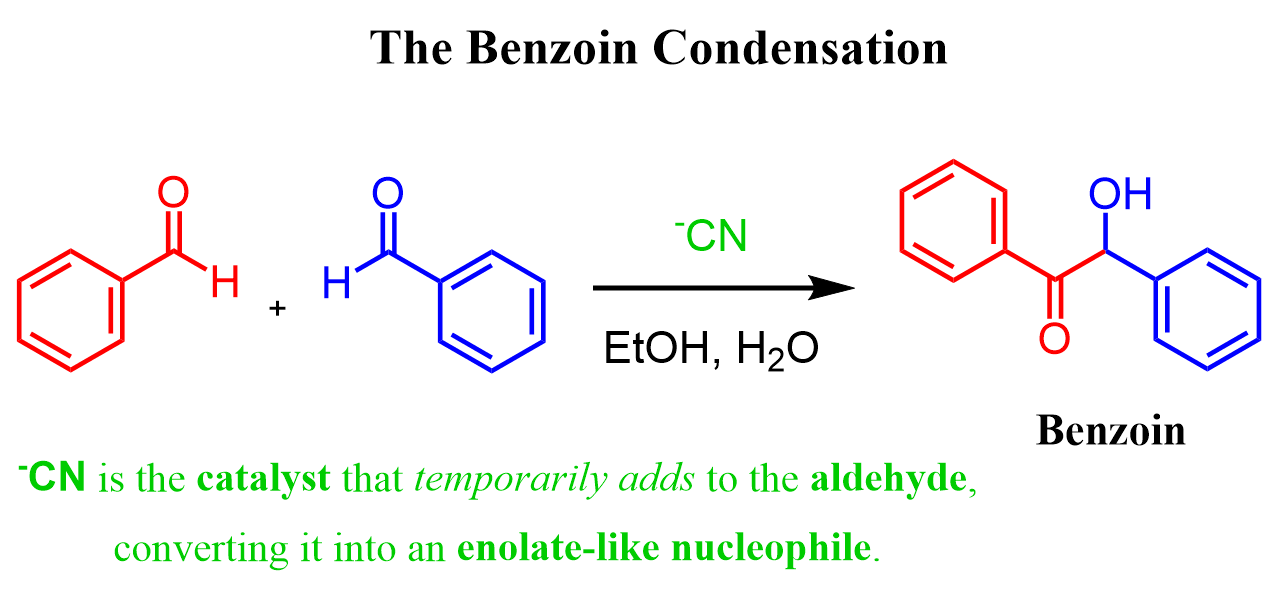
The strategy in the benzoin condensation is the temporary installation of a nitrile group, which allows for the removal of the aldehyde proton via formation of a nitrile enolate.
So, this essentially helps transform the aldehyde into a nucleophile.
Once this nitrile enolate is formed, it attacks the carbonyl of the other molecule, forming a tetrahedral alkoxide intermediate, more specifically, a cyanohydrin-type alkoxide. In the next step, we have deprotonation of the OH group, which expels the cyanide ion, restoring the original carbonyl bond:
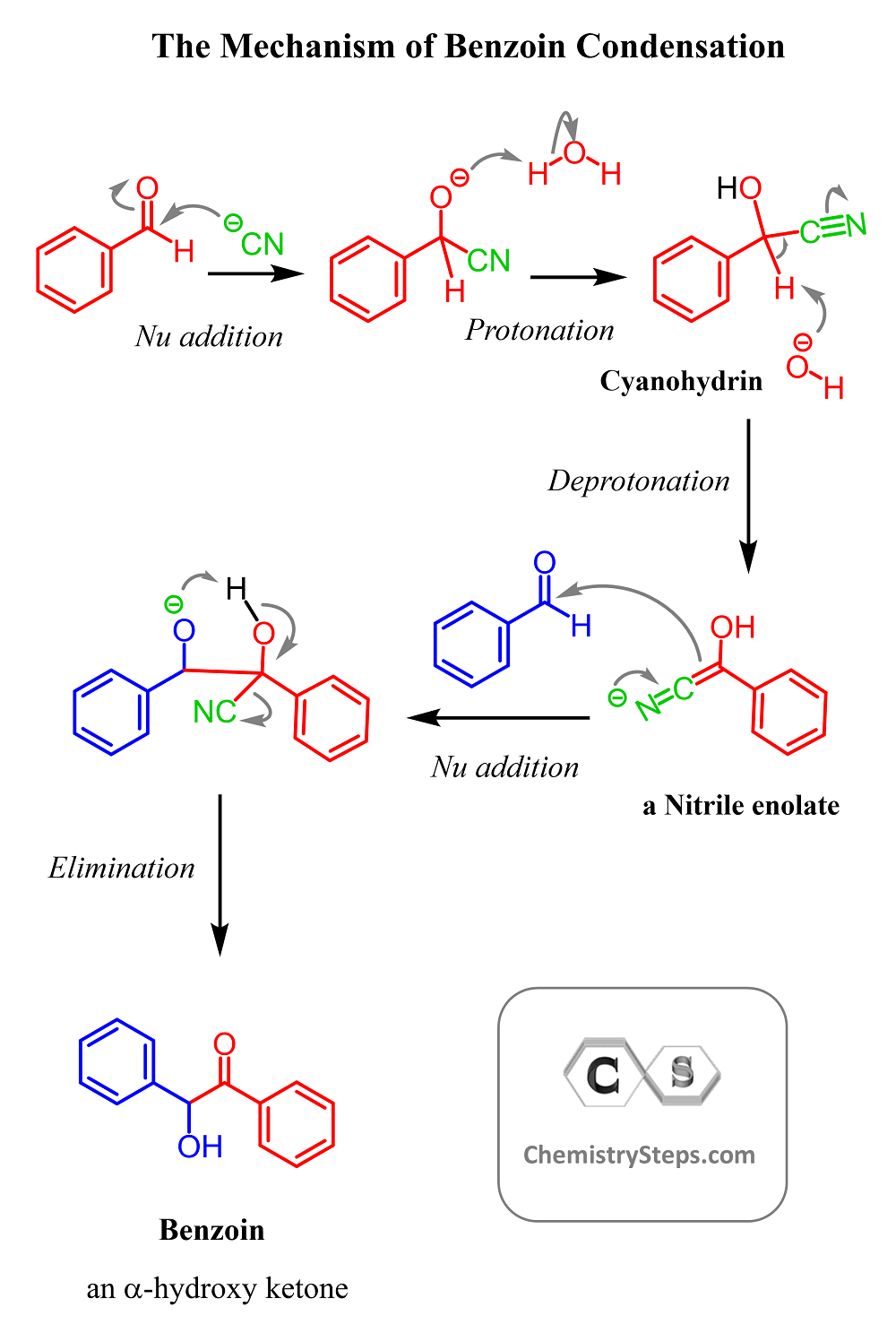
The final product of the benzoin condensation of benzaldehyde is benzoin, which is an α-hydroxy ketone.
Although benzaldehyde is the most common example used for the demonstration of the benzoin condensation, the reaction is certainly not restricted to it. Especially, the role of the electrophile can be carried by other carbonyl compounds such as aldehydes, ketones and esters.
Check Also
- Keto-Enol Tautomerization
- Alpha Halogenation of Enols and Enolates
- The Haloform and Iodoform Reactions
- Alpha Halogenation of Carboxylic Acids
- Alpha Halogenation of Enols and Enolates Practice Problems
- The E1cB Elimination Mechanism
- Aldol Reaction – Principles and Mechanism
- Aldol Condensation – Dehydration of Aldol Addition Product
- Intramolecular Aldol Reactions
- Aldol Addition and Condensation Reactions – Practice Problems
- Crossed Aldol And Directed Aldol Reactions
- Crossed Aldol Condensation Practice Problems
- The Cannizzaro reaction
- Alkylation of Enolates Alpha Position
- Enolate Alkylation Practice Problems
- Acetoacetic Ester Synthesis
- Acetoacetic Ester Enolates Practice Problems
- Malonic Ester Synthesis
- Decarboxylation
- Michael Reaction: The Conjugate Addition of Enolates
- Robinson Annulation, Shortcut, and Retrosynthesis
- Claisen Condensation
- Dieckmann Condensation – An Intramolecular Claisen Reaction
- Crossed Claisen and Claisen Variation Reactions
- Claisen Condensation Practice Problems
- Stork Enamine Synthesis
- The Reformatsky Reaction
- Mannich Reaction
- The Knoevenagel Condensation
- Enolates in Organic Synthesis – a Comprehensive Practice Problem