
In the previous post, we saw that butane has two isomers: n-Butane and isobutane, which have the same chemical formula of C4H10 but a different connectivity of the atoms:
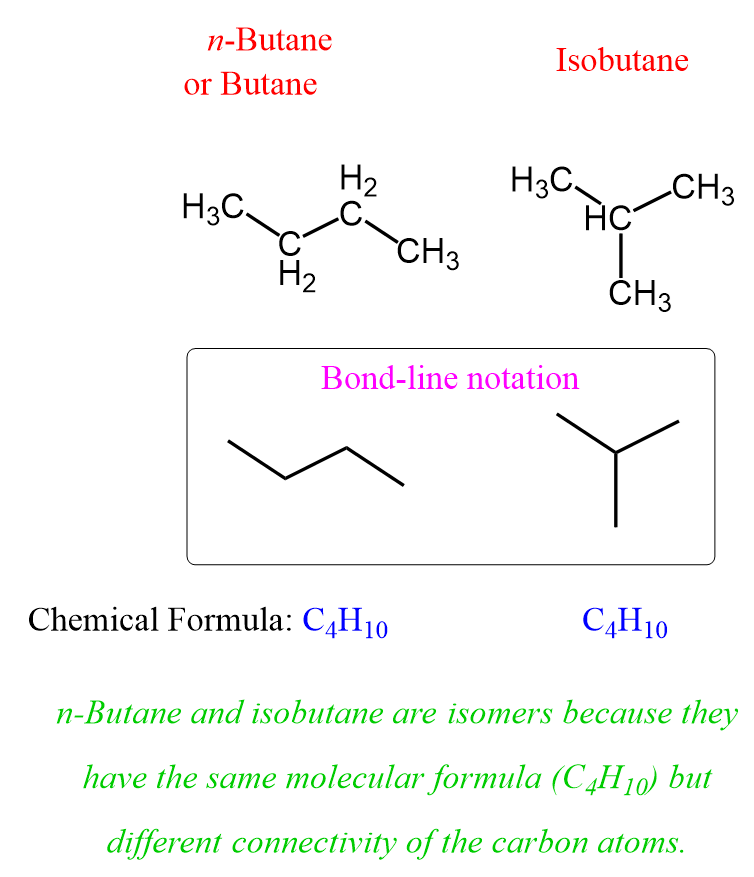
A quick reminder that isomers, or more specifically constitutional isomers, are compounds that have the same molecular formula but differ in the connectivity of their atoms.
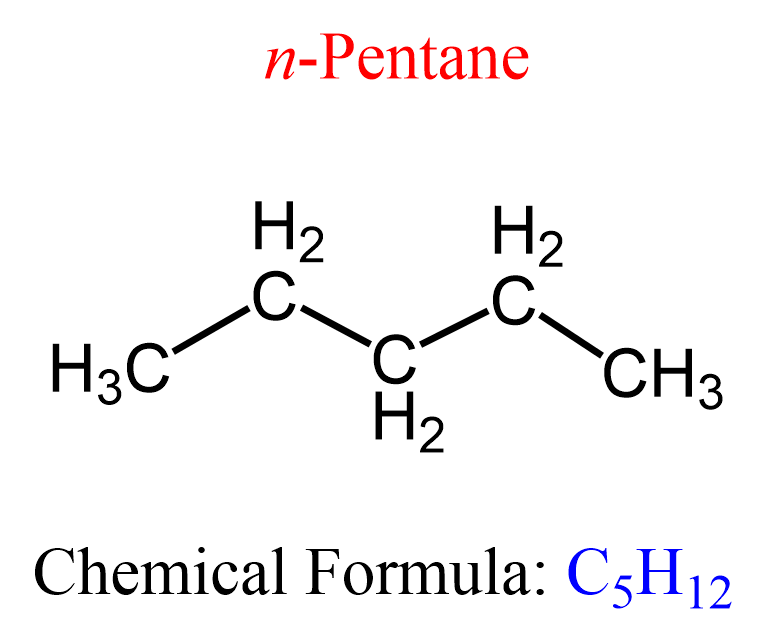
So, let’s see how many isomers pentane has. The chemical formula of pentane is C₅H₁₂, and the first isomer we identify is the one with a straight chain. This is n-pentane:
To identify the others, move one of the terminal CH₃ groups to any of the CH₂ groups in the middle. Do not forget to change the CH₂ to CH to keep the correct valency of the carbon:
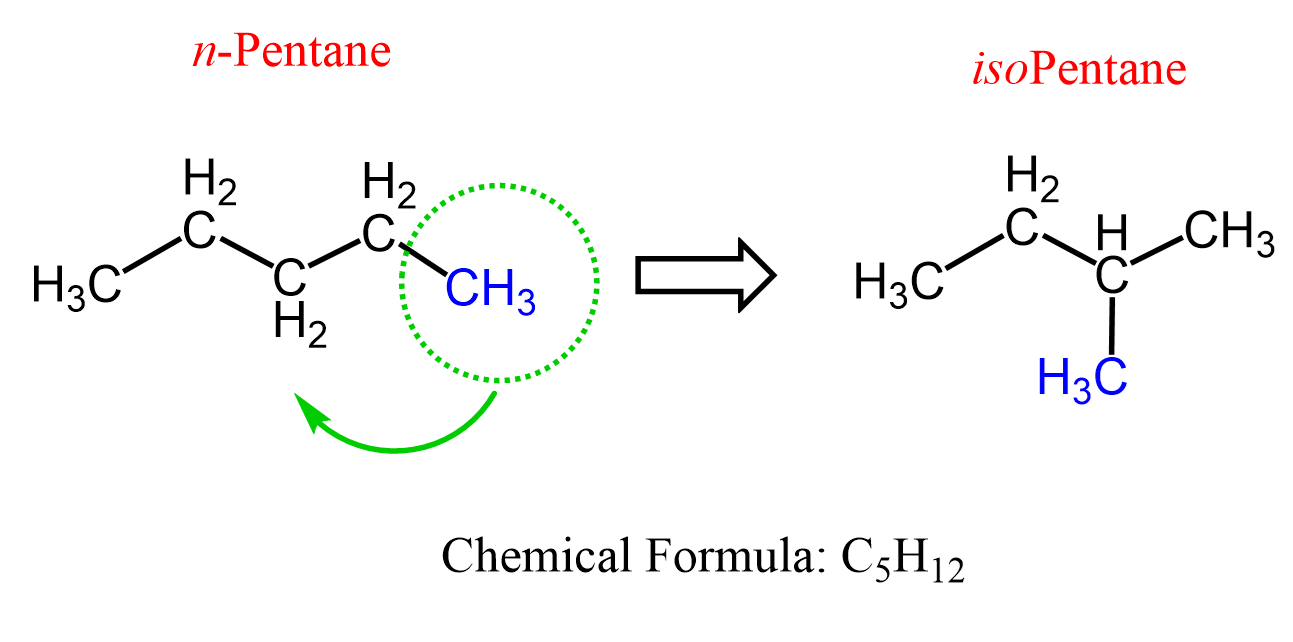
The structure we obtain is isopentane (2-methylbutane), where the carbon chain is branched. In this structure, a three-carbon chain forms the main backbone, and one methyl (CH₃) group is attached to the second carbon of that chain. Like n-pentane, it has the molecular formula C₅H₁₂, but the atoms are connected differently, making it a constitutional isomer.
2-methylbutane is the IUPAC name of this compound, and if you have already covered ha in class, feel free to check out this post on the IUPAC rules for naming alkanes.
If we take another CH₃ group from the end of the chain and move it to the central carbon, we obtain a carbon atom bonded to four CH₃ groups.
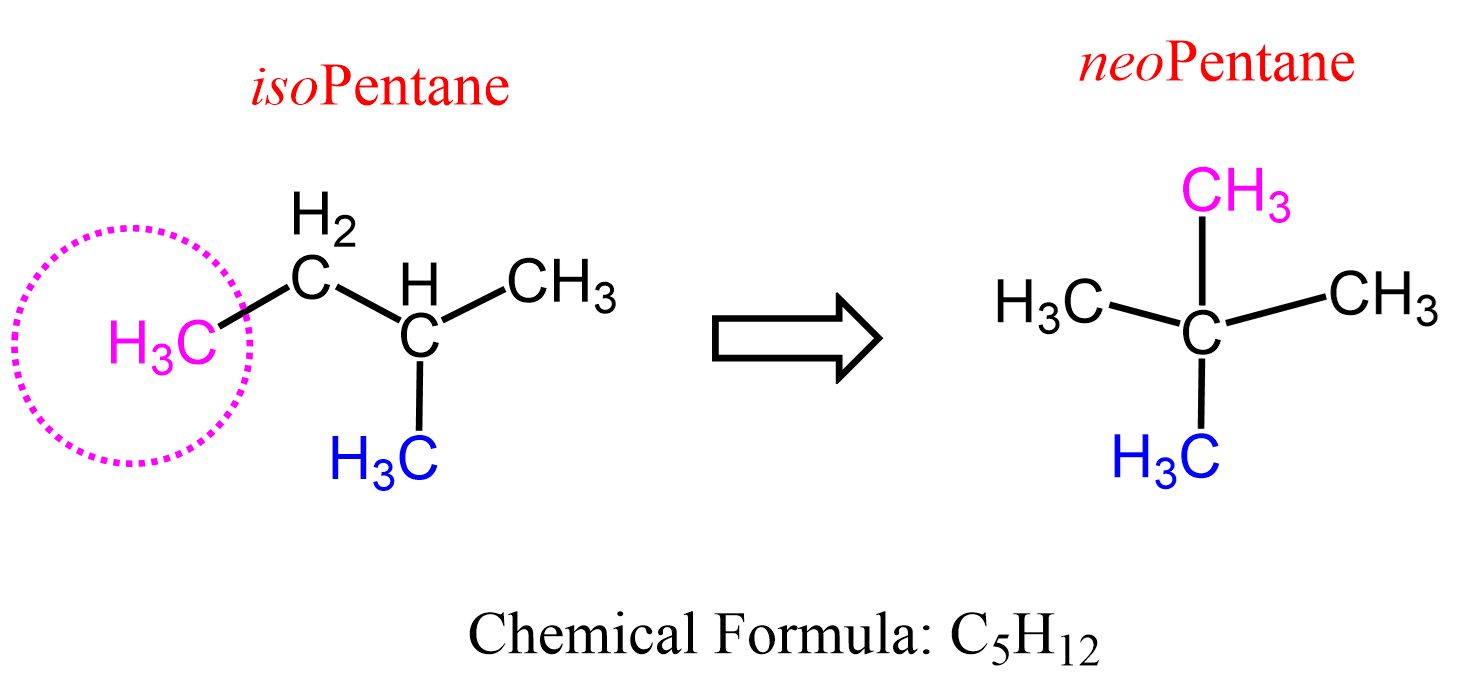
This molecule is neopentane (2,2-dimethylpropane), another compound with the molecular formula C₅H₁₂.
These are all the constitutional isomers of pentane, and if you try to rotate or flip a molecule or move it in space to get another isomer, feel free to do that-this will confirm that there are no more isomers. There are only pentane, isopentane, and neopentane that satisfy the chemical formula of C5H12.
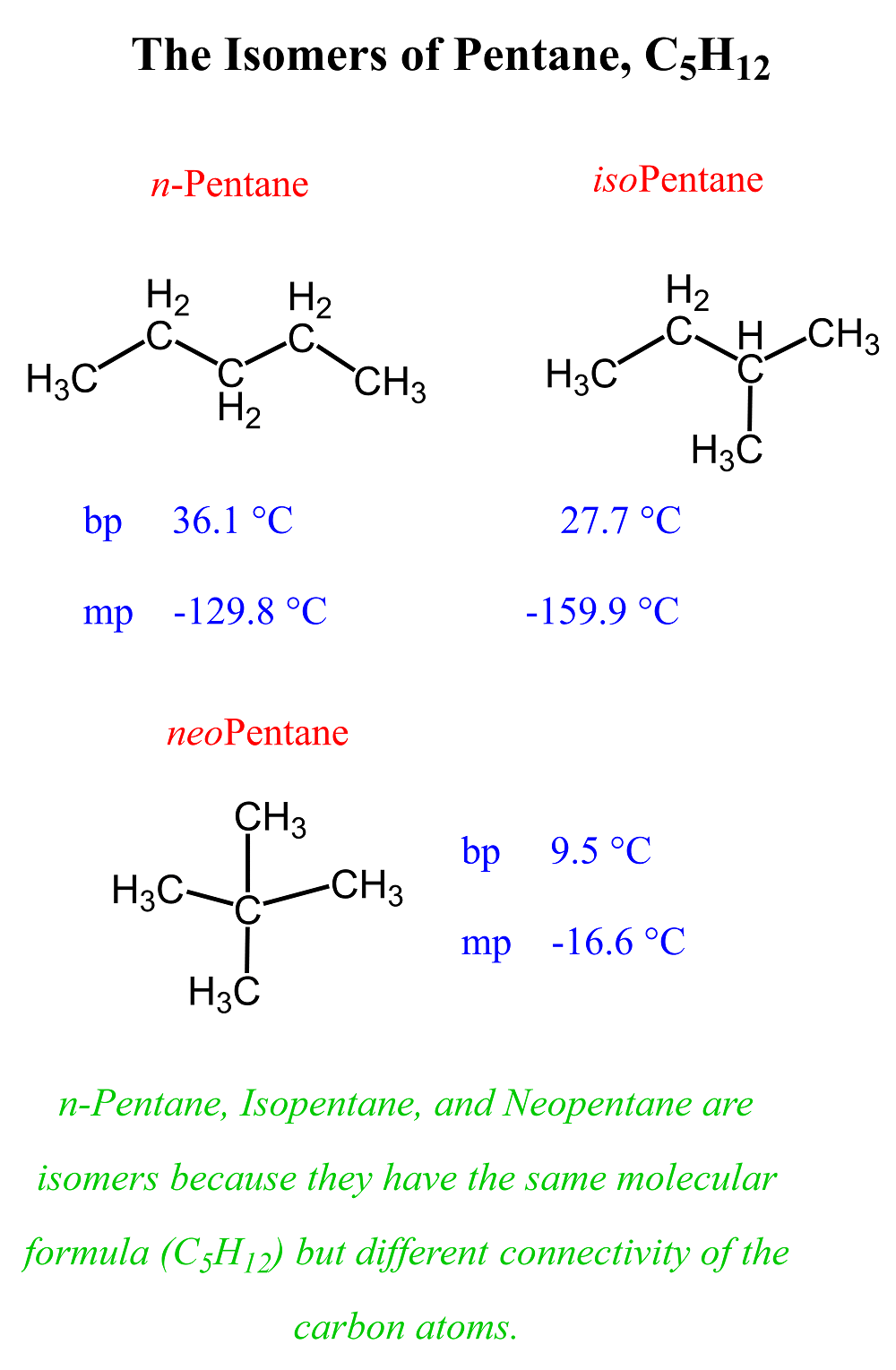
Anything else that appears to be a different isomer is simply the same molecule drawn in a different way, which can sometimes cause confusion.
The abbreviations “bp” and “mp” stand for boiling point and melting point, and we will discuss them below as well.
The Structure and Geometry of Pentane
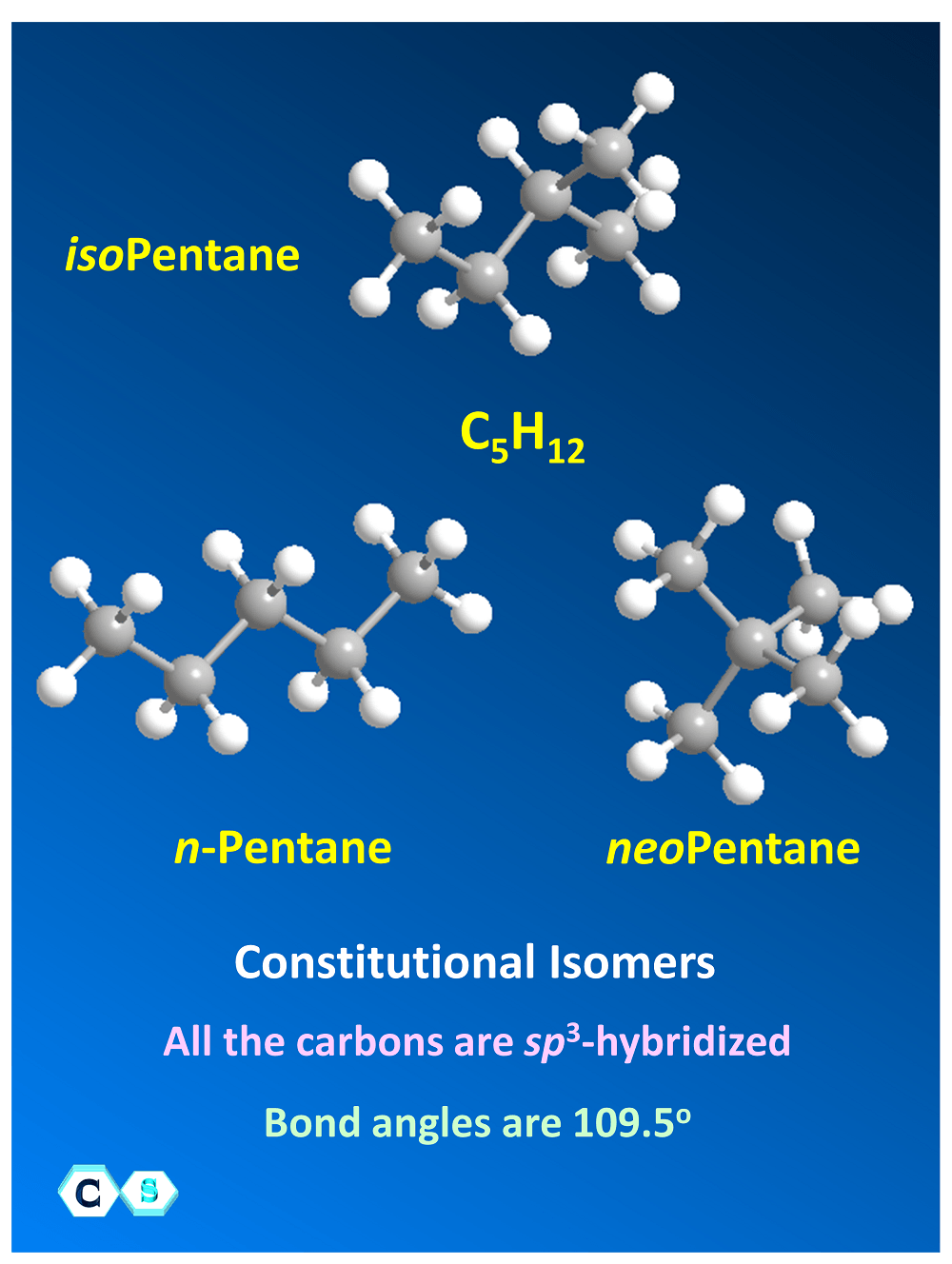
Bonding in all the isomers of pentane follows the same general pattern seen in methane, ethane, and propane. All carbon atoms are sp³-hybridized, all bonds are σ bonds, and the bond angles are close to the ideal tetrahedral 109.5o. This description applies to all alkanes, regardless of chain length or branching:
The Physical Properties of Butane
Because of these structural differences, the isomers of pentane also have different physical properties. All three are liquids at room temperature (with neopentane being close to the lower end of volatility), but their boiling points vary depending on the degree of branching. n-Pentane has the highest boiling point at about 36.1 °C, followed by isopentane (2-methylbutane) at about 27.7 °C, while the most branched isomer, neopentane (2,2-dimethylpropane), has the lowest boiling point at about 9.5 °C. This trend reflects the fact that increased branching reduces surface area, weakens London dispersion forces, and therefore lowers the boiling point:

This is consistent with what we learned about the boiling and melting point patterns of straight and branched alkanes. Remember, the boiling point decreases quite significantly as we move towards the more branched isomers. And this is a demonstration of a direct relationship between the surface area and the boiling point. Pentane is unbranched and provides a large surface for intermolecular interactions. The 2-methylbutane has one substituent, so it is a little more branched than pentane. This reduces the surface for intermolecular interactions and lowers the boiling point by about 8 oC. The highly branched 2,2-dimethylpropane, on the other hand, lacks this surface interaction and has the lowest boiling point.
The analog of this can be the regular stacking of regular vs crumpled paper sheets.

To summarize, branching tends to decrease the boiling point of alkanes with the same molecular weight.
The melting point of n-pentane is lower than that of neopentane because neopentane forms a more efficient crystal lattice in the solid state. However, the general trend for melting points is not as straightforward as for boiling points, since it depends strongly on crystal packing and intermolecular interactions, rather than following a simple increase or decrease with branching alone:

Check this post for more details on how intermolecular forces influence melting and boiling point trends in organic compounds.
Check Also
- Naming Alkanes by IUPAC Nomenclature Rules Practice Problems
- Naming Bicyclic Compounds
- Naming Bicyclic Compounds-Practice Problems
- How to Name a Compound with Multiple Functional Groups
- Primary, Secondary, and Tertiary Carbon Atoms in Organic Chemistry
- Constitutional or Structural Isomers with Practice Problems
- Degrees of Unsaturation or Index of Hydrogen Deficiency
- The Wedge and Dash Representation
- Sawhorse Projections
- Newman Projections with Practice Problems
- Staggered and Eclipsed Conformations
- Conformational Isomers of Propane
- Newman Projection and Conformational Analysis of Butane
- Newman Projection of Chair Conformation
- Gauche Conformation
- Gauche Conformation, Steric, Torsional Strain Energy Practice Problems
- Ring Strain
- Steric vs Torsional Strain
- Conformational Analysis
- Drawing the Chair Conformation of Cyclohexane
- Ring Flip: Drawing Both Chair Conformations with Practice Problems
- 1,3-Diaxial Interactions and A value for Cyclohexanes
- Ring-Flip: Comparing the Stability of Chair Conformations with Practice Problems
- Cis and Trans Decalin
- IUPAC Nomenclature Summary Quiz
- Alkanes and Cycloalkanes Practice Quiz