
The Gattermann–Koch reaction is a method for preparing aromatic aldehydes by reacting benzene and its derivatives with carbon monoxide (CO) and hydrogen chloride (HCl) in the presence of a strong acid and a Lewis acid catalyst such as AlCl₃.
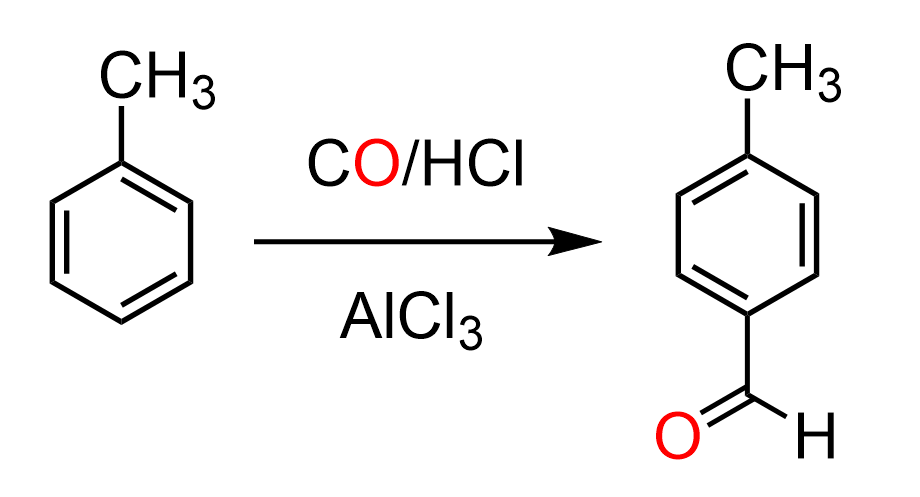
The reaction starts with CO reacting under acidic conditions in the presence of HCl to form a very unstable intermediate, formyl chloride (HCOCl). This intermediate is not stable and is immediately activated by the Lewis acid catalyst (AlCl₃/CuCl), which converts it into a highly electrophilic formyl cation (HCO⁺), similar to the generation of the acylium ion in Friedel–Crafts acylation.
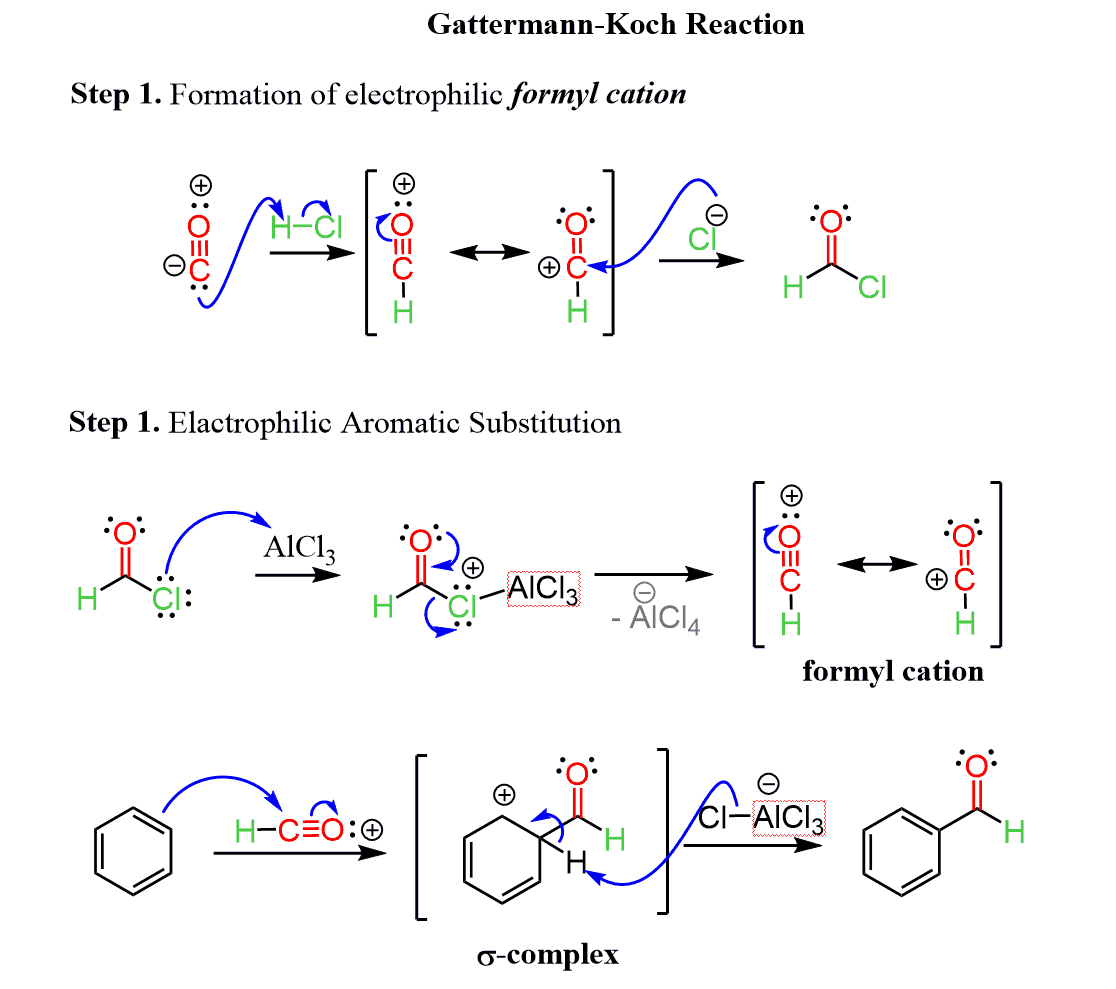
Although it is debatable whether formyl chloride is actually formed or not, it is still a useful way of visualizing and understanding the mechanism. Different instructors and textbooks may present the mechanism differently, so it is always a good idea to ask your instructor how exactly they want the mechanism to be shown. If formyl chloride is not used, the mechanism can be shown directly through the formation of the formyl cation, generated upon activation of CO in the presence of HCl and the Lewis acid.
This electrophile is then attacked by the aromatic π electrons in an electrophilic aromatic substitution reaction, forming a sigma complex. Finally, deprotonation restores aromaticity, and after workup, the corresponding aromatic aldehyde (Ar–CHO) is obtained.
Check Also
- Electrophilic Aromatic Substitution – The Mechanism
- The Halogenation of Benzene
- The Nitration of Benzene
- The Sulfonation of Benzene
- Activating and Deactivating Groups
- Friedel-Crafts Alkylation with Practice Problems
- Friedel-Crafts Acylation with Practice Problems
- The Wolff-Kishner and Clemmensen Reductions
- Vilsmeier-Haack Reaction
- The Alkylation of Benzene by Acylation-Reduction
- Ortho, Para, Meta in EAS with Practice Problems
- Ortho, Para, and Meta in Disubstituted Benzenes
- Why Are Halogens Ortho-, Para- Directors yet Deactivators?
- Is Phenyl an Ortho/Para or Meta Director?
- Limitations of Electrophilic Aromatic Substitution Reactions
- Orientation in Benzene Rings With More Than One Substituent
- Synthesis of Aromatic Compounds From Benzene
- Arenediazonium Salts in Electrophilic Aromatic Substitution
- Reactions at the Benzylic Position
- Benzylic Bromination
- Nucleophilic Aromatic Substitution
- Nucleophilic Aromatic Substitution Practice Problems
- Reactions of Phenols
- Reactions of Aniline
- Meta Substitution on Activated Aromatic Ring
- Birch Reduction
- Electrophilic Aromatic Substitution Practice Problems
- Aromatic Compounds Quiz
- Reactions Map of Aromatic Compounds