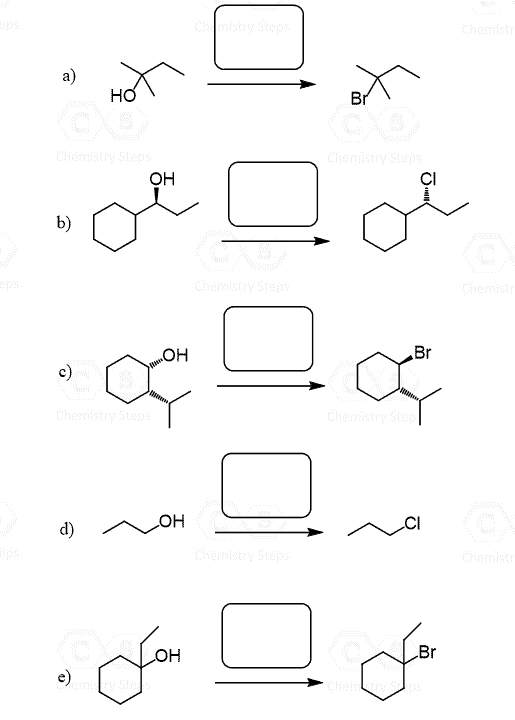
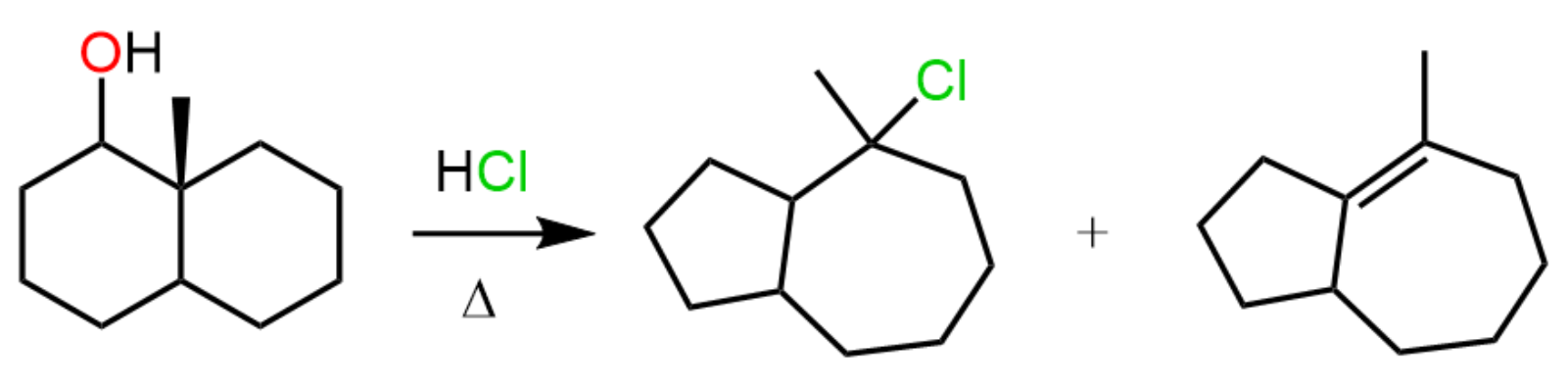
We have seen earlier that alcohols can be converted to the corresponding alkyl halides by reacting them with hydrohalic acids such as HCl, HBr, and HI. The key principle here is the conversion of the OH group into a better leaving group by protonating it, thereby turning it into water:
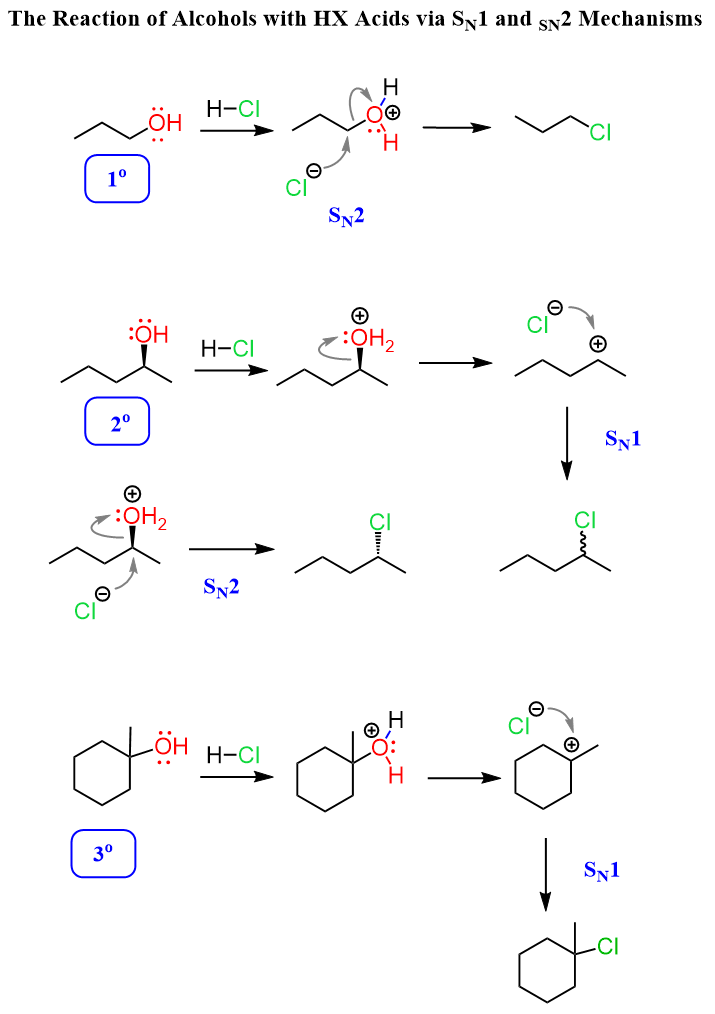
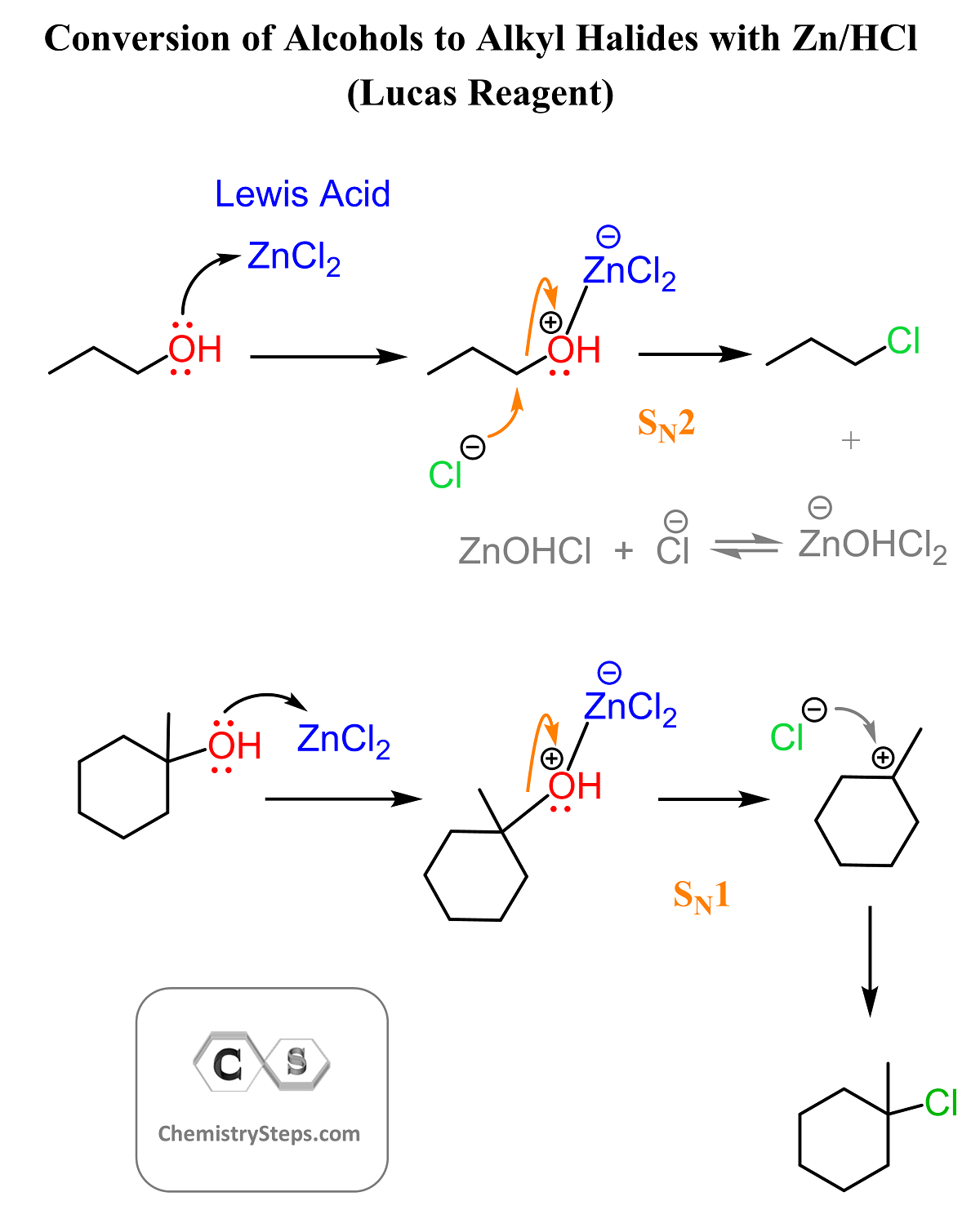
Notice that, depending on the structure of the alcohol, the conversion can occur via either an SN1 or SN2 mechanism. Primary alcohols react via SN2, while tertiary alcohols react only via SN1 substitution. The reason for the preference of primary substrates for the SN2 pathway is that primary carbocations are too unstable to form. Conversely, tertiary substrates are too sterically hindered for SN2, and therefore react via SN1, where the rate-determining step is the loss of the leaving group through cleavage of the C-O sigma bond.
Secondary alcohols can and do proceed via both mechanisms, which is generally acceptable unless control of the stereochemistry is required. This, in addition to the possibility of rearrangements, tells us to direct the conversion of secondary alcohols toward the SN2 pathway by first converting the OH into a mesylate or tosylate, or by using reagents such as SOCl₂ or PBr₃.
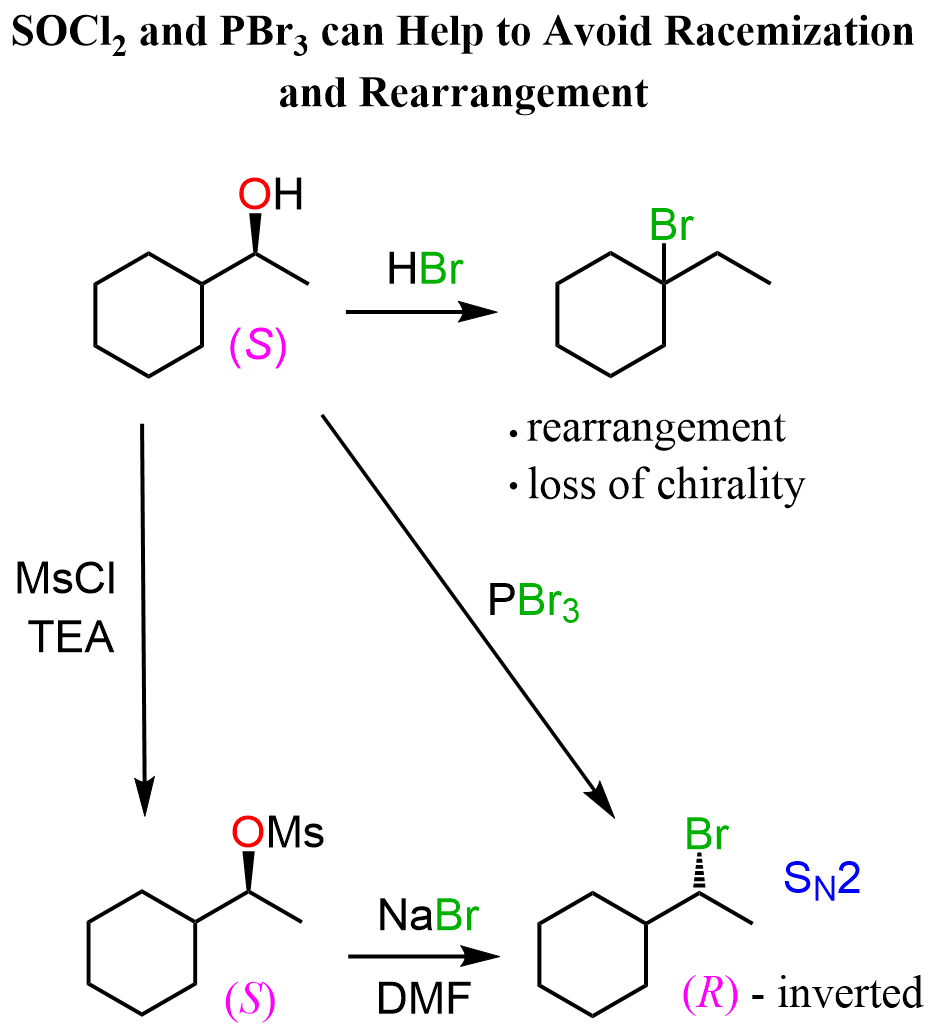
We have a detailed coverage of all these methods in the corresponding articles, which you can find below this post, so be sure to check them out as well.
Lucas Reagent and Lucas Test
Let’s now go back to the reaction of alcohols with hydrohalic acids. One way to make the conversion to alkyl halides more efficient is by using a Lewis acid such as ZnCl₂. The combination of HCl and ZnCl₂ is known as the Lucas reagent, which is commonly used to convert alcohols to alkyl chlorides and can also serve as a qualitative test for primary, secondary, and tertiary alcohols. The zinc chloride coordinates to the oxygen atom of the alcohol, increasing the polarization of the C-O bond and making the hydroxyl group a much better leaving group:
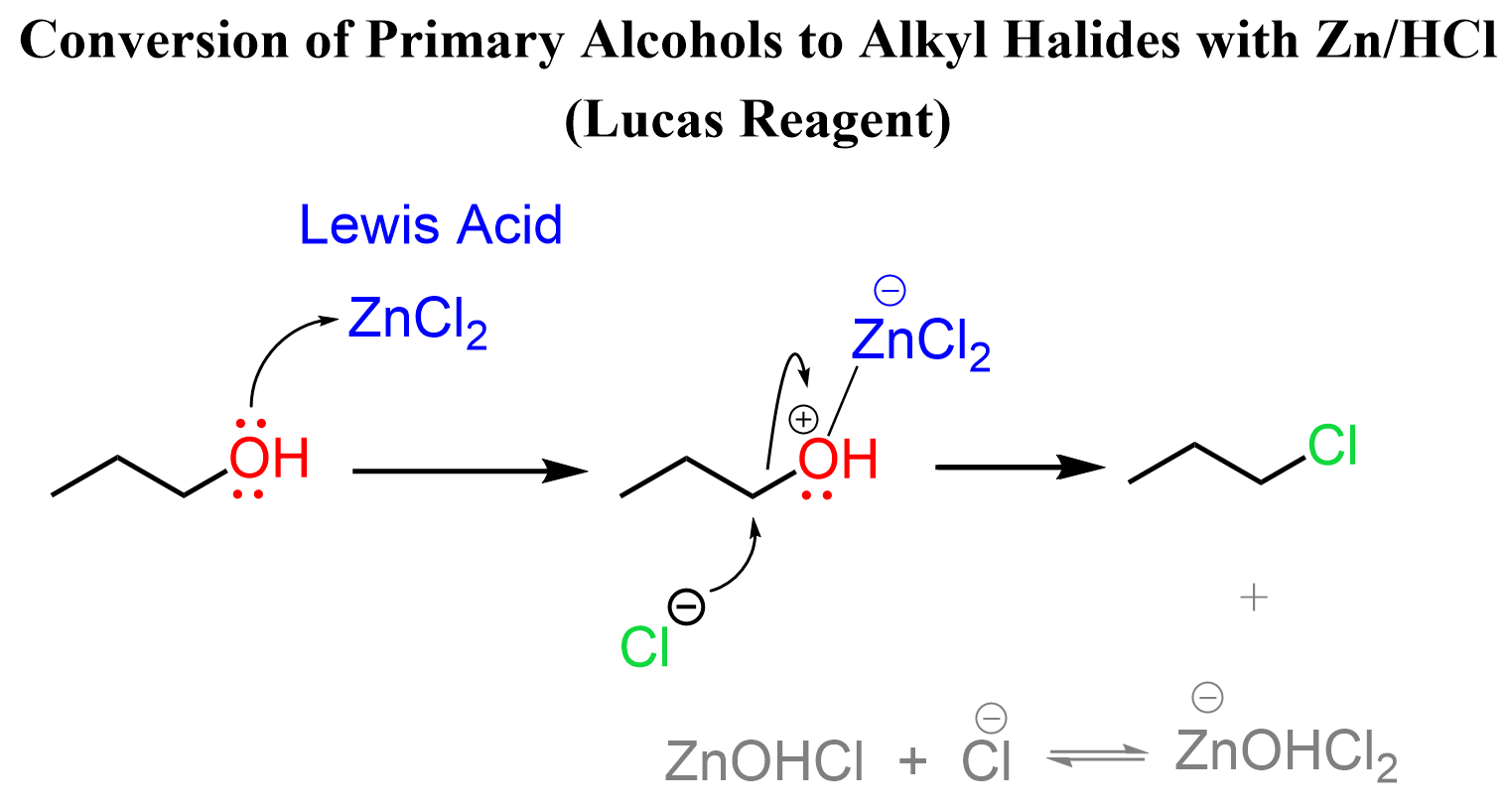
Once complexation with ZnCl₂ occurs, there is essentially no difference in the overall mechanism. The role of ZnCl₂ is simply to activate the alcohol toward substitution. The next step depends on the structure of the substrate and can proceed either through nucleophilic attack by the halide ion (SN2) or through loss of the leaving group to form a carbocation intermediate (SN1).
The Lucas test is performed by mixing the alcohol with the Lucas reagent and observing the appearance of turbidity (cloudiness) in the solution. The cloudiness is caused by the formation of the alkyl chloride product, which is insoluble in the aqueous reaction mixture.
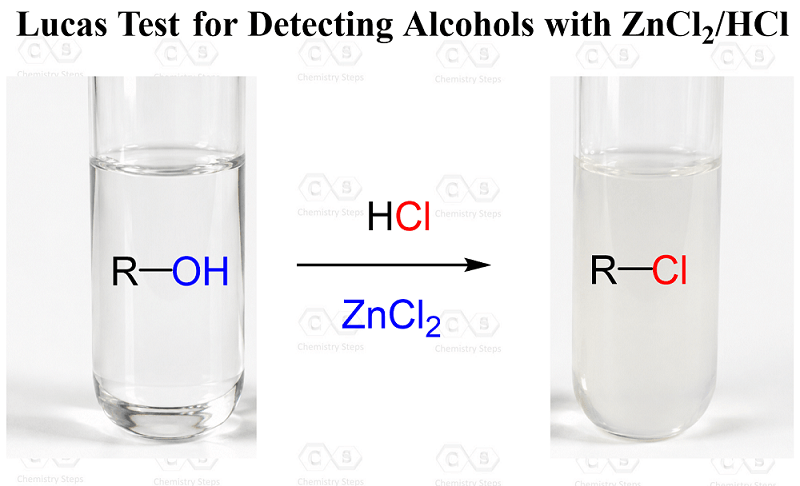
Tertiary alcohols react almost immediately, producing turbidity within seconds. Secondary alcohols react more slowly, typically becoming cloudy within a few minutes. Primary alcohols are generally less reactive at room temperature and therefore remain clear for an extended period.
Therefore, the reactivity in the Lucas test increases in the order primary < secondary < tertiary, reflecting the increasing stability of the carbocation intermediate formed during the reaction.
Organic Chemistry Reaction Maps
Never struggle again to figure out how to convert an alkyl halide to an alcohol, an alkene to an alkyne, a nitrile to a ketone, a ketone to an aldehyde, and more! The comprehensive powerfull Reaction Maps of organic functional group transformations are here!
Check Also
- Converting Alkyl Halides to Alcohols
- Introduction to Alkyl Halides
- Nomenclature of Alkyl Halides
- Nucleophilic Substitution Reactions – An Introduction
- All You Need to Know About the SN2 Reaction Mechanism
The SN2 Mechanism: Kinetics, Thermodynamics, Curved Arrows, and Stereochemistry with Practice Problems - The Stereochemistry of SN2 Reactions
- The Stereochemistry of SN1 Reactions
- The SN1 Nucleophilic Substitution Reaction
- Reactions of Alkyl Halides with Water
- The SN1 Mechanism: Kinetics, Thermodynamics, Curved Arrows, and Stereochemistry with Practice Problems
- The Substrate and Nucleophile in SN2 and SN1 Reactions
- Carbocation Rearrangements in SN1 Reactions with Practice Problems
- Ring Expansion Rearrangements
- When Is the Mechanism SN1 or SN2?
- Reactions of Alcohols with HCl, HBr, and HI Acids
- SOCl2 and PBr3 for Conversion of Alcohols to Alkyl Halides
- Alcohols in Substitution Reactions with Tons of Practice Problems
- How to Choose Molecules for Doing SN2 and SN1 Synthesis-Practice Problems
- Exceptions in SN2 and SN1 Reactions
- Nucleophilic Substitution and Elimination Practice Quiz