
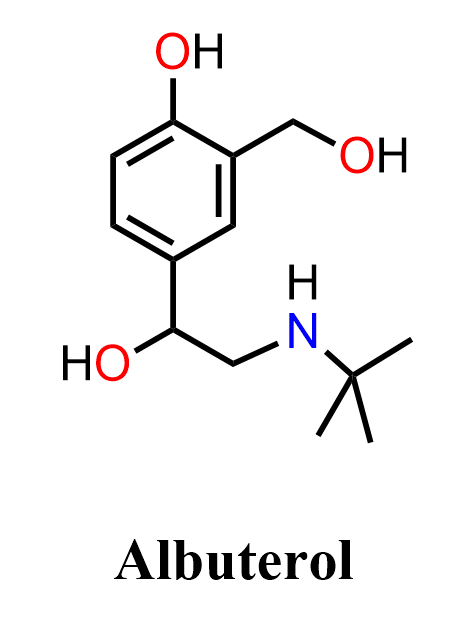
 Albuterol is a short-acting β2-adrenergic receptor agonist widely used in the treatment of asthma and other conditions involving bronchospasm. Structurally, it is a substituted phenethylamine derivative, featuring a resorcinol (1,3-dihydroxybenzene) ring, a β-hydroxylated side chain, and a tert-butyl-substituted amine. Its biological activity arises from binding to β2-adrenergic receptors and triggering smooth muscle relaxation in the airways. Because of its structure, albuterol is commonly discussed in organic chemistry in the context of aromatic substitution patterns, stereochemistry (chiral secondary alcohols), and functional group interconversions. In the following practice problem, we will focus on the organic synthesis of albuterol rather than its pharmacological properties. Specifically, we will examine how the substituted phenethylamine framework can be constructed starting from phenol, using key transformations including electrophilic aromatic substitution, side-chain installation via carbonyl chemistry, and reduction reactions to form the β-amino alcohol motif. The synthesis also highlights the introduction of the tert-butylamino group, illustrating nucleophilic substitution and reductive amination strategies. The goal is to practice multistep synthesis design while understanding how these reactions are combined to build the functionalized aromatic ring and side chain of albuterol.
As with all examples in this section, this discussion is presented solely for educational purposes and is not intended to represent a practical or real-world method of preparation.
Practice
Add the missing intermediates and reagents in the following synthesis of Albuterol.
This content is for registered users only.
By joining Chemistry Steps, you will gain instant access to the answers and solutions for all the Practice Problems, including over 40 hours of problem-solving videos, Multiple-Choice Quizzes, Puzzles, Reaction Maps, and the powerful set of Organic Chemistry 1 and 2 Summary Study Guides.