
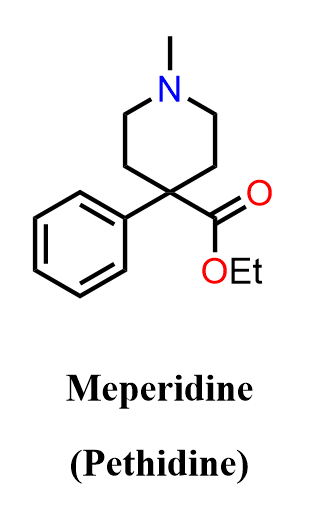
 Pethidine, also known as meperidine and marketed under the name Demerol, is a fully synthetic opioid of the phenylpiperidine class. Unlike morphine-based analgesics, its structure arises entirely from laboratory synthesis, making it a classic example of how multiple fundamental organic reactions combine to build a bioactive molecule. Originally prepared in 1938 by Otto Eisleb during research on anticholinergic agents, its potent analgesic properties were later recognized by Otto Schaumann at IG Farben.
From a synthetic perspective, Pethidine is an instructive molecule: its preparation features benzylic transformations, alkylation at the α-carbon of electron-withdrawing groups such as nitriles and carbonyls, construction of the piperidine ring through nucleophilic additions, and the use of Grignard reactions to assemble key carbon–carbon bonds. The synthesis also includes a Fischer esterification to generate the characteristic ethyl ester side chain. Together, these steps illustrate how core reactions from Electrophilic Aromatic Substitution, carbonyl chemistry, C–C bond formation, and heterocycle synthesis converge in the multistep construction of this important pharmaceutical.
Practice
Pethidine can be synthesized by two similar approaches, which are blended in the following synthetic scheme. Add the missing reagents and intermediates in the synthesis of Pethidine.
This content is for registered users only.
By joining Chemistry Steps, you will gain instant access to the answers and solutions for all the Practice Problems, including over 40 hours of problem-solving videos, Multiple-Choice Quizzes, Puzzles, Reaction Maps, and the powerful set of Organic Chemistry 1 and 2 Summary Study Guides.