
Alkyl groups are derivatives of the corresponding alkanes, formed by removing one hydrogen atom. For example, methyl is the alkyl derivative of methane, ethyl is the alkyl derivative of ethane, propyl is derived from propane, hexyl from hexane, and so on:

Before we continue our discussion about alkyl groups, I want to mention that alkyl groups do not normally exist on their own, and they are not formed by a chemical reaction where we somehow remove a hydrogen atom. Rather, they appear as parts of larger molecules, and we classify them as alkyl groups to distinguish the different parts of a molecule, name them by IUPAC nomenclature or common names, identify functional groups, and describe organic reactions.
For example, we do not prepare propyl chloride by reacting a propyl group with a chlorine molecule, atom, or chloride ion. It is prepared by reacting propane with chlorine, both of which are stable molecules:
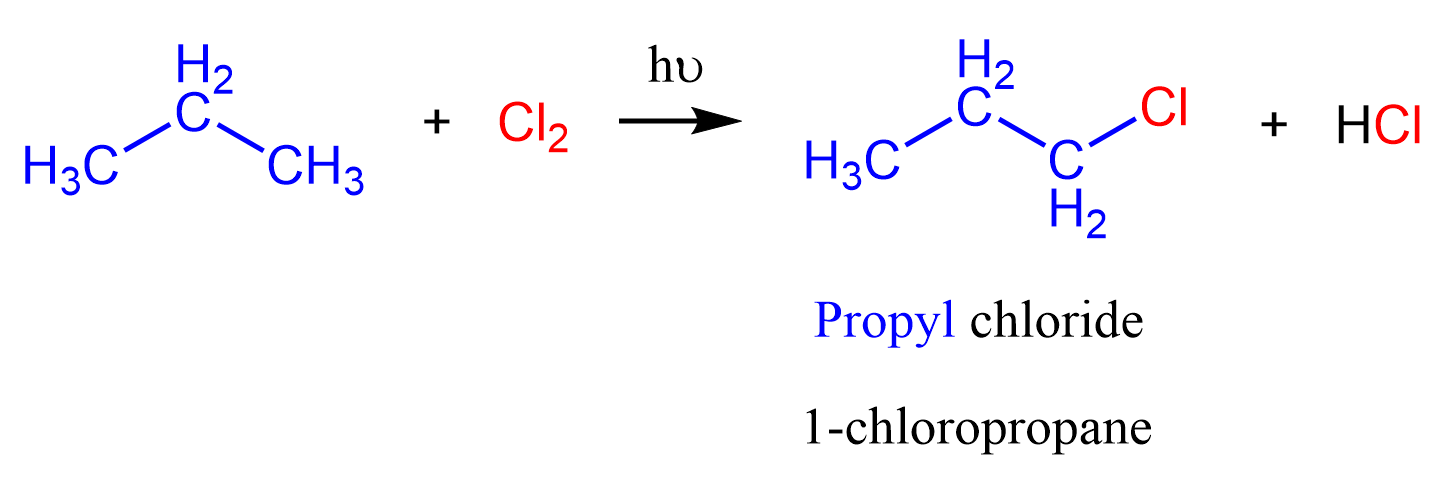
So, going back to alkyl groups, how do we recognize and name them? The first thing you need to do is learn the names of the first ten alkanes. These are going to be the basis for naming molecules containing any functional group in organic chemistry:

Once you know the names of the alkanes, it is straightforward to name the alkyl groups derived from simple alkanes. Now, why do I emphasize the word “simple”? It is because the tricky part of identifying alkyl groups is when the alkane itself is not the “normal” isomer with that molecular formula.
For example, we learned that, aside from butane, which we also call normal butane or n-butane, there is also isobutane. These two are constitutional isomers, and the only way they differ is in the connectivity of atoms:
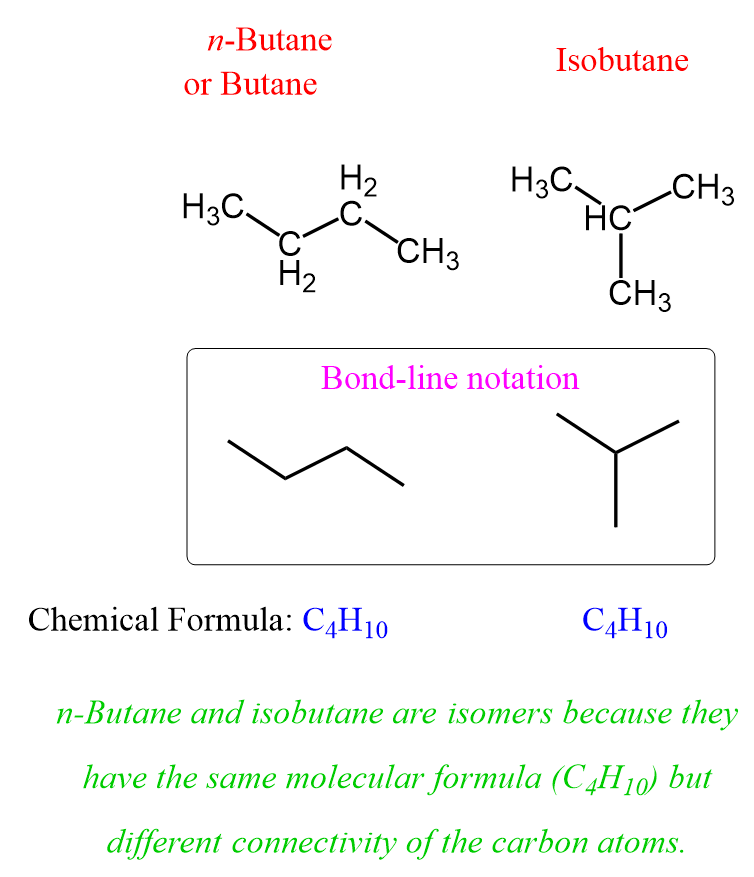
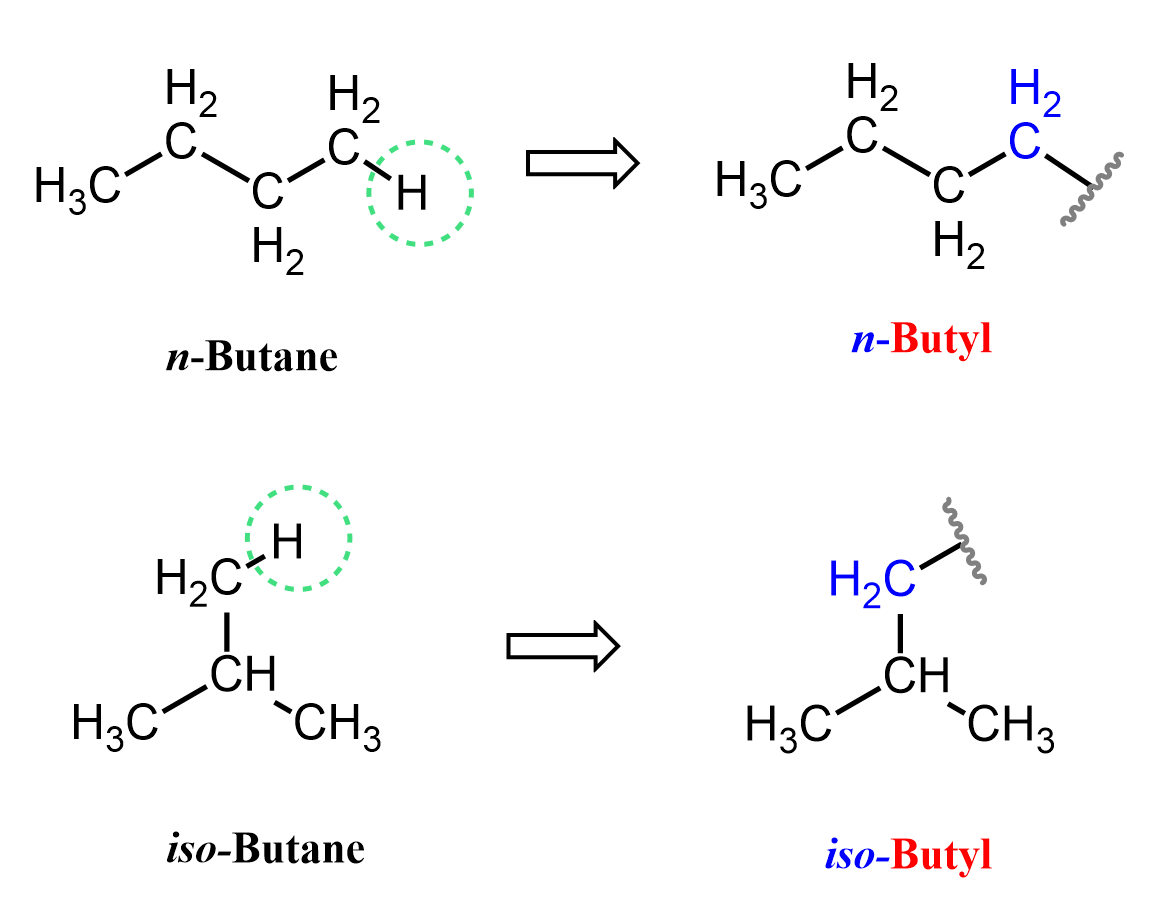
So, the alkyl group derived from butane is butyl (or n-butyl), and consequently, isobutyl is the alkyl group derived from isobutane:
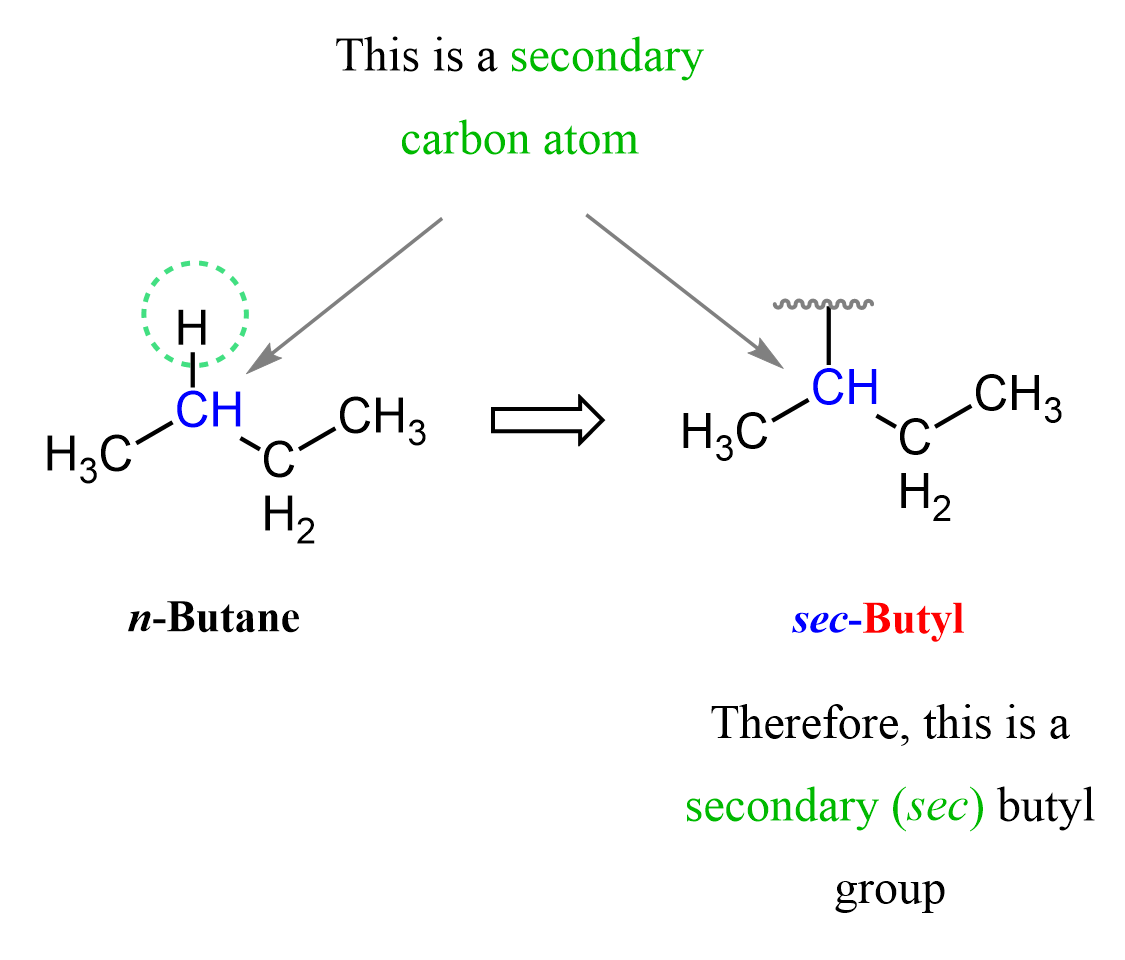
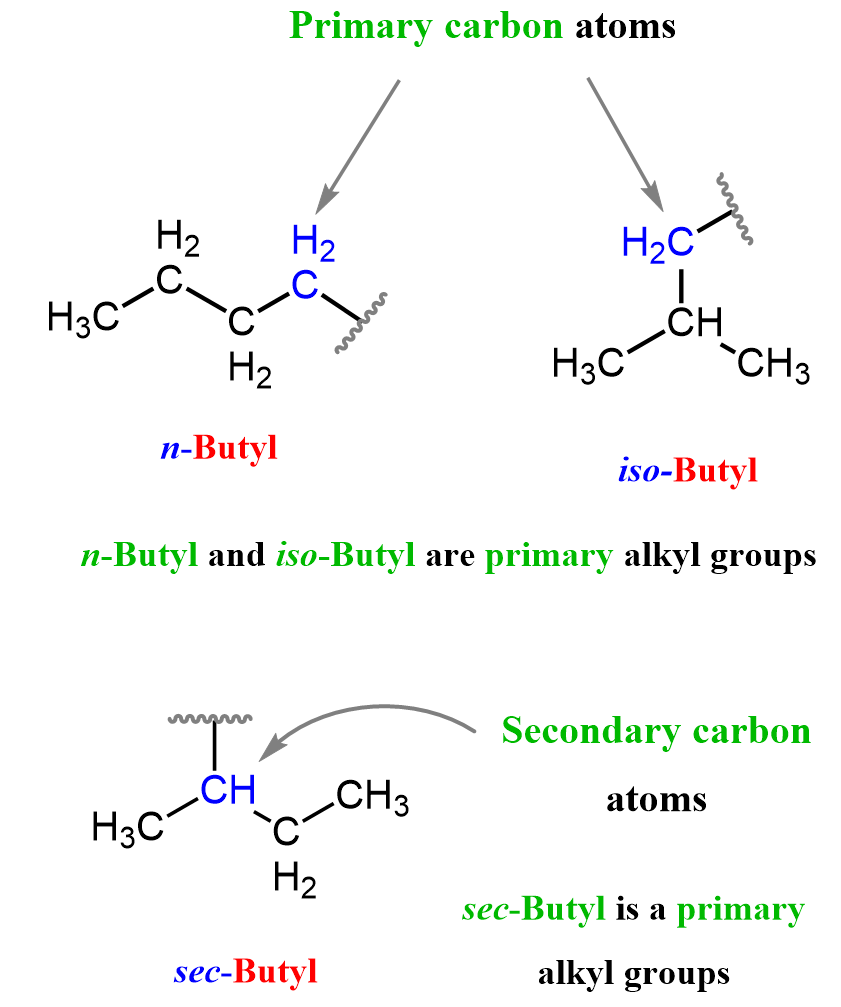
Now, speaking of butane, yes, it exists as only two constitutional isomers, but depending on which hydrogen is removed, we can also obtain the sec-butyl (secondary butyl) group. The reason we call it secondary is that the carbon from which the hydrogen was removed is connected to two other carbon atoms:
A reminder at this point about primary, secondary, and tertiary carbon atoms. A primary (1°) carbon is bonded to one other carbon atom, a secondary (2°) carbon is bonded to two carbon atoms, and a tertiary (3°) carbon is bonded to three carbon atoms:

Since the carbon that connects an alkyl group to the rest of the molecule determines its classification, n-butyl and isobutyl are primary alkyl groups, while sec-butyl is a secondary alkyl group:
The last butyl group is tert-butyl, which is formed by removing the hydrogen from the tertiary carbon of isobutane. So, even though butane has only two constitutional isomers, it provides more alkyl groups because the structure of the alkyl group depends on which hydrogen atom is removed. There are primary, secondary, and tertiary alkyl groups generated from the structures of the two isomers of butane:
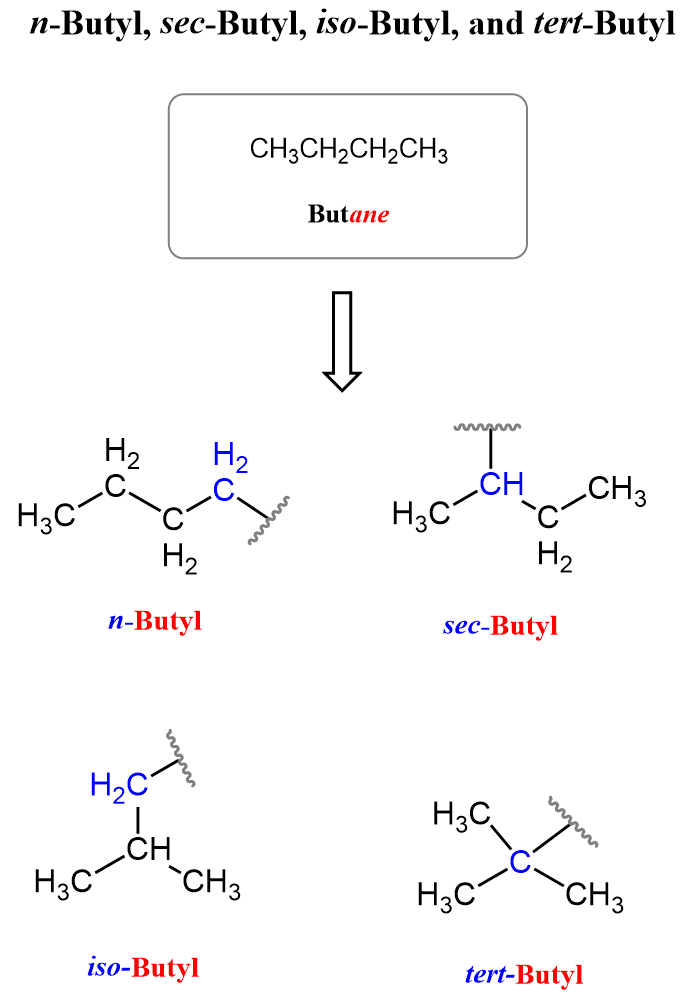
So, let’s imagine an infinitely long carbon chain and attach to it the alkyl groups of ethane, propane, and butane that we have discussed:

Alkyl Groups in Naming Organic Molecules
The names of the alkyl groups we have been discussing are used when naming organic compounds by their common names. Common names are traditional names that have been used for many years and are still widely encountered in organic chemistry, especially for simple molecules. They are simply more convenient because, unlike the systematic IUPAC nomenclature, common names do not always follow a consistent set of naming rules, so they are generally learned individually.
For example, although not the official IUPAC names, we have tert-butyl chloride, n-butyllithium, tert-butyllithium, etc:

The bottom row shows the official IUPAC names of the compounds. You can learn how these names are assigned in this article, and specifically in this post on the IUPAC nomenclature of alcohols.
Alkyl Groups in IUPAC Nomenclature
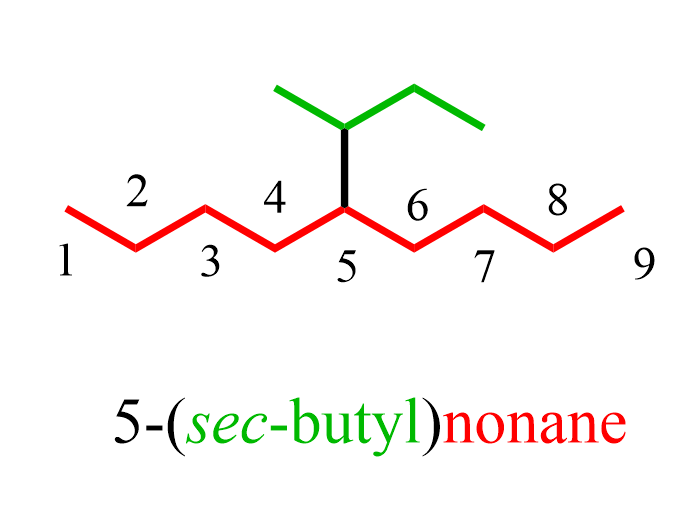
Let’s consider an example of how alkyl groups are used in IUPAC nomenclature. For example, in the following molecule, we have a sec-butyl group connected to a nine-atom carbon chain. The longest continuous chain is chosen as the parent chain, which is the “main” part of the molecule, and we then include the alkyl substituent by indicating its position on that chain. The final name is then determined by combining the position number and the substituent name, followed by the parent alkane name, which, in this case, is 5-(sec-butyl)nonane:
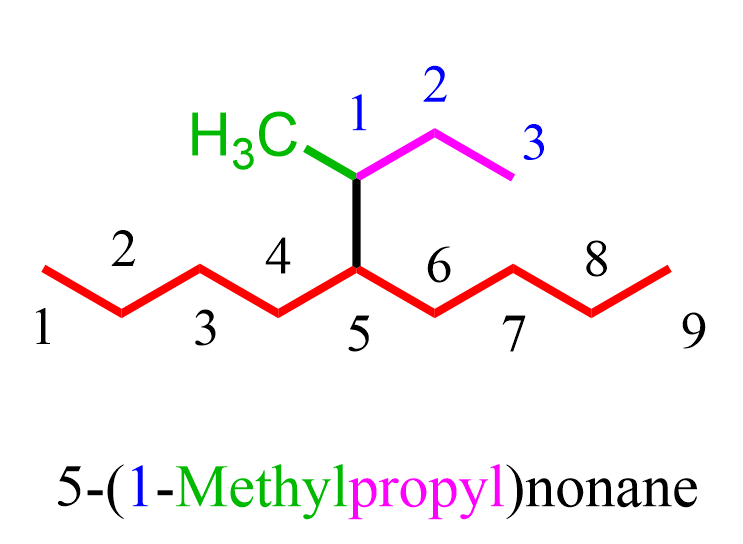
If we need to name this molecule according to the newest IUPAC rules, we need to treat the sec-butyl group as a complex substituent and assign its own numbering starting from the point of attachment. This means we no longer think of it as a simple “sec-butyl” group in the common naming sense, but instead recognize it as a four-carbon substituent where the attachment occurs at carbon 2, i.e., a butan-2-yl group. So, Putting everything together, the final IUPAC name of the molecule is 5-(1-Methylpropyl)nonane:
We have a separate post on naming complex substitutes, also known as complex alkyl groups, here, so feel free to check it out for more examples.
Summary of Alkyl Groups
To summarize what we learned about alkyl groups, remember that these are derivatives of the corresponding alkanes that originate by removing a hydrogen atom from the molecule. Make sure to memorize the names of the first ten alkanes because they form the foundation for naming most simple alkyl groups.
Also, review the principles of identifying primary, secondary, and tertiary carbon atoms in organic chemistry so you can correctly identify and name alkyl groups such as n-butyl, isopentyl, isobutyl, tert-butyl, neopentyl, and others.
Not all common names are accepted in official IUPAC nomenclature, so read questions carefully to determine how you are required to name the molecule. When in doubt, double-check whether the context expects common names or strict IUPAC naming conventions.
Check Also
- Naming Alkanes by IUPAC Nomenclature Rules Practice Problems
- Naming Bicyclic Compounds
- Naming Bicyclic Compounds-Practice Problems
- How to Name a Compound with Multiple Functional Groups
- Primary, Secondary, and Tertiary Carbon Atoms in Organic Chemistry
- Constitutional or Structural Isomers with Practice Problems
- Degrees of Unsaturation or Index of Hydrogen Deficiency
- The Wedge and Dash Representation
- Sawhorse Projections
- Newman Projections with Practice Problems
- Staggered and Eclipsed Conformations
- Conformational Isomers of Propane
- Newman Projection and Conformational Analysis of Butane
- Newman Projection of Chair Conformation
- Gauche Conformation
- Gauche Conformation, Steric, Torsional Strain Energy Practice Problems
- Ring Strain
- Steric vs Torsional Strain
- Conformational Analysis
- Drawing the Chair Conformation of Cyclohexane
- Ring Flip: Drawing Both Chair Conformations with Practice Problems
- 1,3-Diaxial Interactions and A value for Cyclohexanes
- Ring-Flip: Comparing the Stability of Chair Conformations with Practice Problems
- Cis and Trans Decalin
- IUPAC Nomenclature Summary Quiz
- Alkanes and Cycloalkanes Practice Quiz