
We have learned that to name a molecule, we need to find the parent chain and the smaller carbon fragments known as alkyl groups or substituents, in general. For example, removing one hydrogen from the corresponding hydrocarbon, we get the methyl, ethyl, and propyl substituents.

This looks easy, but as usual, there are situations where things get a little more complicated. In simple words, naming substituents gets more complex as their number of carbon atoms increases. For example, how do we name the larger substituent in this molecule?

Before getting to the exact rules, here is what you need to keep in mind when naming a molecule with complex substituents:
- Name the parent chain, name the complex substituent as if it is a parent chain, change the suffix from -ane to -yl (like in the case of simple alkyl groups), and add that “-yl” name to the name of the parent chain.

Essentially, you need to look at the complex substituent as a separate molecule and find its “parent chain” and the alkyl groups on it.
Ok, so the first thing you do is locate the substituent carbon that is connected to the parent chain – that is your carbon 1. Next, just number the longest carbon chain of the substituent, and add the alkyl or halide groups to make a full name:

Notice that the methyl group is the substituent on the “quasi parent chain,” so we add it with a locant to the “quasi parent name” butane.
At this point, all we need to do is change the suffix to butyl (2-methylbutyl) and compare its alphabetical priority to the other substituent (ethyl) on the actual parent chain. E goes before m, so we are going to name the molecule 3-ethyl-5-(2-methylbutyl)decane.

Notice that the name of the complex substituent is taken into parentheses.
Let’s work on another example. What is the IUPAC name of the following molecule containing a complex substituent?

Before getting to the substituent, we need to identify the parent chain, so take a moment to do that before reading further.
Alright, so hopefully you were able to identify the parent chain and the substituents, including the complex substituent we have on the bottom.

So, let’s leave the parent chain and the simple substituents for a moment and focus on naming the complex substituent as we learned:
- Locate the carbon connected to the parent chain
- Number the longest chain of the quasi-parent chain
- Add the substituents connected to the quasi-parent with their locants
- Change the suffix to -yl

The carbon directly attached to the parent chain is connected to three other carbon atoms, forming a branched group. The longest chain from that point contains three carbon atoms, so it’s a propyl group. Once again, we start numbering from the carbon connected to the actual parent chain.
There are also two methyl groups attached to the first carbon of this propyl chain, both on the same carbon, which gives us the name 1,1-dimethylpropyl. The common name of this complex substituent is tert-pentyl, similar to tert-butyl, where the tertiary carbon is connected to a parent chain.
The last step is to put all the substituents together based on their alphabetical order.
We have chloro at carbon 6, methyl at carbon 2, and the complex substituent 1,1-dimethylpropyl at carbon 5. Ignoring prefixes like “1,1-” or “di-”, chloro comes first, then dimethylpropyl, then methyl. Combining these gives 6-chloro-2-methyl-5-(1,1-dimethylpropyl)nonane.

Since we have mentioned tert-butyl, I am also going to list the common and IUPAC names of the complex butyl substituents: sec-butyl, tert-butyl, and iso-butyl.
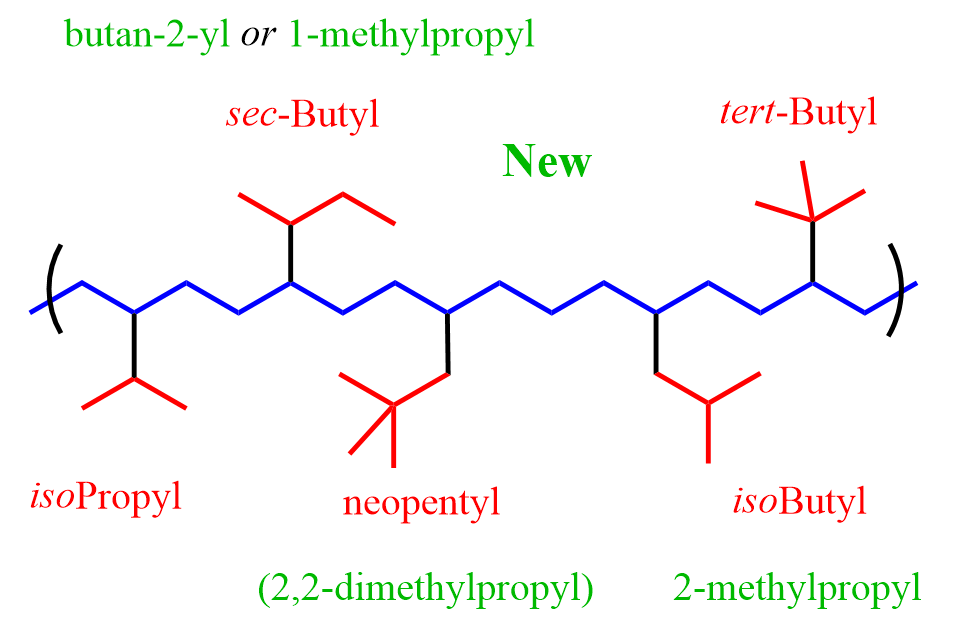
The preferred IUPAC names are shown in green, and according to the IUPAC blue book from 2013, this is how we should name the butyl substituents. I still accept the common names, but check with your instructor on what their policy is on this topic.
Let’s, however, see an example of naming a molecule that contains a sec-butyl using both approaches:

In the second option, sec-butyl is named as a complex substituent by identifying the parent chain and substituents on it:
-
The parent chain within the substituent is a three-carbon chain (propane),
-
There is a methyl group attached to carbon 1 of this chain,
-
And the point of attachment to the main molecule is also at carbon 1.
So, we are taking 1-methylpropane, dropping the -ane and replacing it with -yl, which gives the IUPAC name 1-methylpropyl.
This is the preferred IUPAC name for what is commonly referred to as sec-butyl.
Multiple Complex Substituents
When a molecule contains more than one complex substituent, we indicate their number using the special prefixes:
- bis – 2
- tris – 3
- tetrakis – 4
- pentakis – 5
- hexakis – 6
- heptakis – 7
- octakis – 8
- nonakis – 9
- decakis – 10
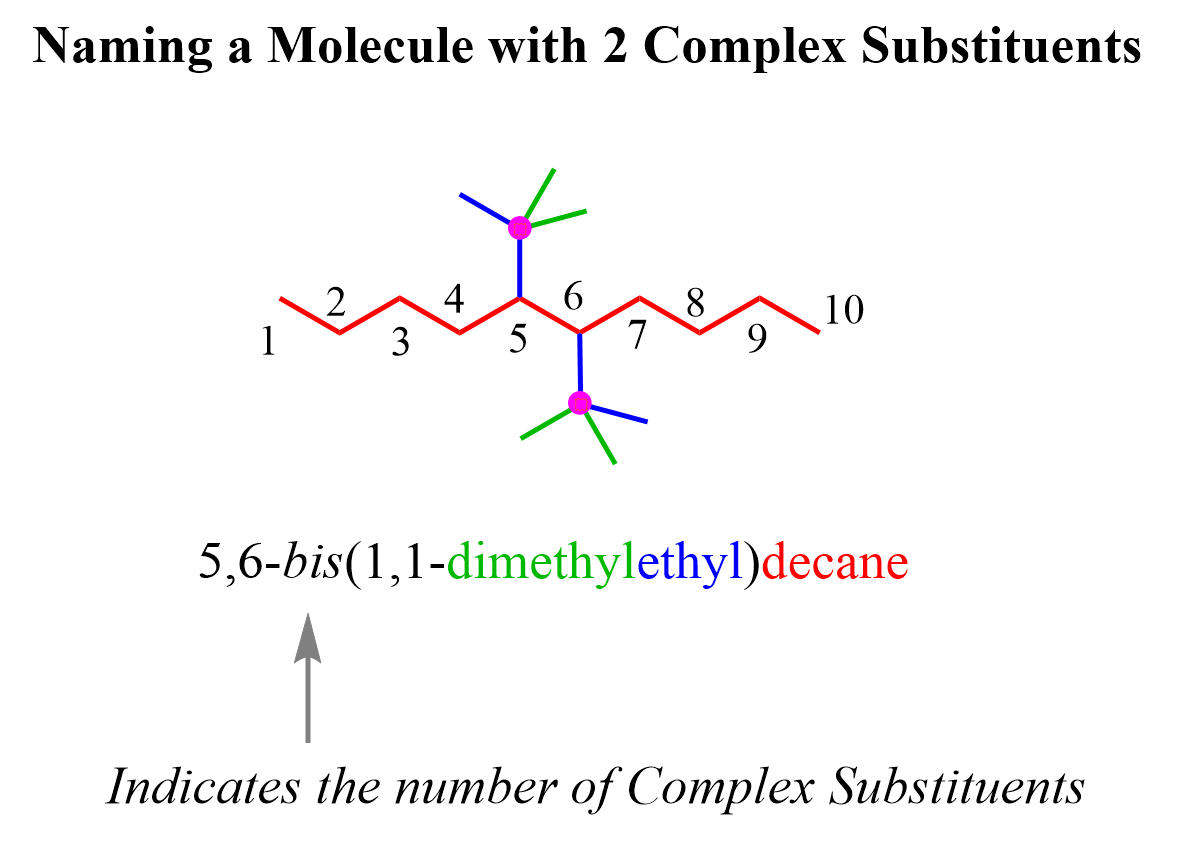
These are used only for complex substituents, not for simple ones. So, the familiar prefixes di-, tri-, tetra-, penta- etc. are replaced by bis-, tris-, tetrakis- when we are counting complex substituents. This avoids confusion.
For example, let’s say the molecule contains two tert-butyl groups. We first name the tert-butyl groups as complex substituents, and add them using the prefix “bis”:
Here is also a comprehensive article on naming alkanes based on the IUPAC rules for more examples and practice problems.
Related Articles
- Naming Alkanes by IUPAC Nomenclature Rules Practice Problems
- Naming Bicyclic Compounds
- Naming Bicyclic Compounds-Practice Problems
- How to Name a Compound with Multiple Functional Groups
- Primary, Secondary, and Tertiary Carbon Atoms in Organic Chemistry
- Constitutional or Structural Isomers with Practice Problems
- Degrees of Unsaturation or Index of Hydrogen Deficiency
- The Wedge and Dash Representation
- Sawhorse Projections
- Newman Projections with Practice Problems
- Staggered and Eclipsed Conformations
- Conformational Isomers of Propane
- Newman Projection and Conformational Analysis of Butane
- Newman Projection of Chair Conformation
- Gauche Conformation
- Gauche Conformation, Steric, Torsional Strain Energy Practice Problems
- Ring Strain
- Steric vs Torsional Strain
- Conformational Analysis
- Drawing the Chair Conformation of Cyclohexane
- Ring Flip: Drawing Both Chair Conformations with Practice Problems
- 1,3-Diaxial Interactions and A value for Cyclohexanes
- Ring-Flip: Comparing the Stability of Chair Conformations with Practice Problems
- Cis and Trans Decalin
- IUPAC Nomenclature Practice Problems
- IUPAC Nomenclature Summary Quiz
- Alkanes and Cycloalkanes Practice Quiz