
In this post, we will identify all the isomers with the molecular formula C₂H4O₂. One strategy to draw all the isomers with a given molecular formula is to calculate the degree of unsaturation so that we know whether the compounds contain any π bonds or ring structures.
Using the following formula, we determine that there is one degree of unsaturation, which means the isomers are all unsaturated compounds containing two oxygen atoms:

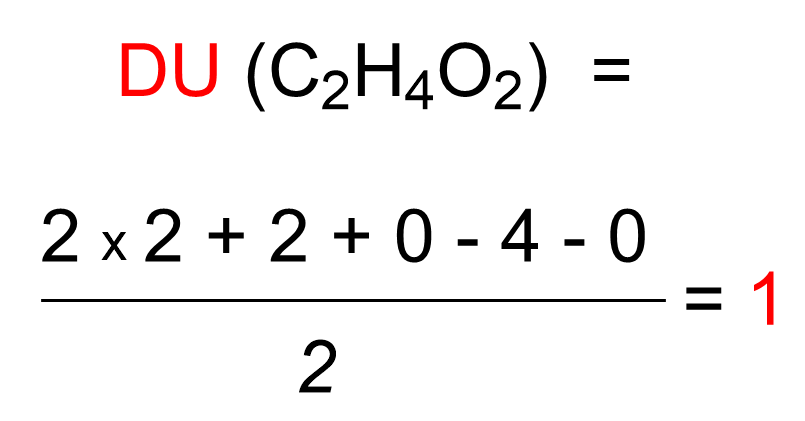
So, we know that the C2H4O2 isomers contain either/or a one pi bond and a ring. This also tells us the possible functional groups. What functional groups do you recall that contain oxygen atoms with a double bond?
One of the most common functional group units you are going to see in organic chemistry is the carbonyl bond (C=O). Now, considering that there are two oxygen atoms in C2H4O2, the candidates are carbocyclic acids and esters, so let’s list them first:
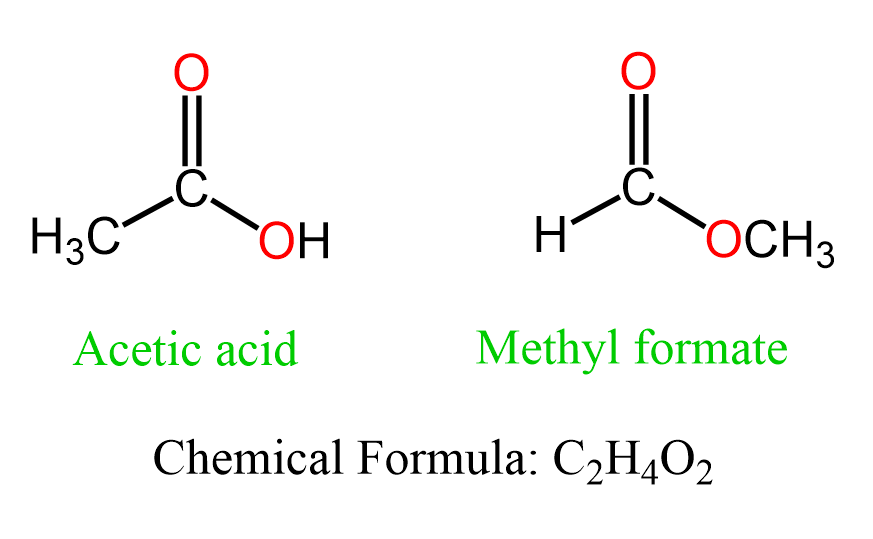
So, acetic acid and methyl formate are the two constitutional isomers with the molecular formula C2H4O2: one is a carboxylic acid, and the other is an ester.
Now, we all know it does not stop here – you are not going to get a question that is this easy in organic chemistry, are you?
So, what else can we think of? How can we have two oxygen atoms with one degree of unsaturation?
Unstable Molecule with the Molecular Formula of C2H4O2
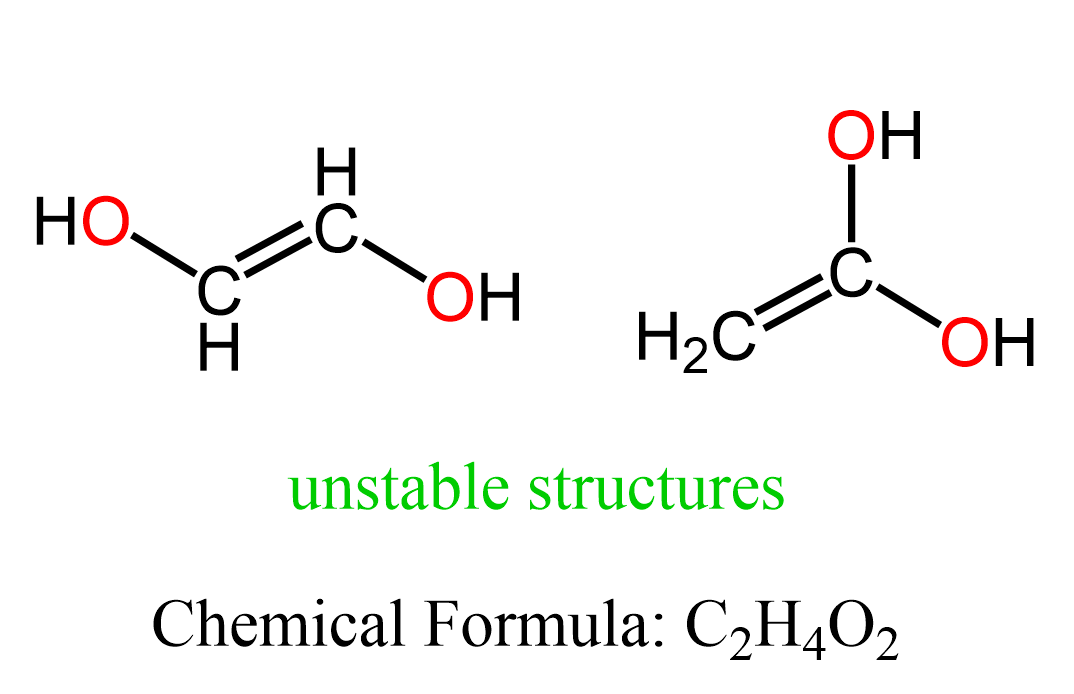
One of the principles you will learn in organic chemistry is the fact that connecting an OH group to a double-bonded carbon gives an unstable combination. This is because the resulting structure is an enol, which is generally unstable and rapidly rearranges to the corresponding carbonyl compound (aldehyde or ketone) through keto-enol tautomerization, as the carbonyl form is more stable:

Do not worry about the instability of the sp² C–OH bond and keto–enol tautomerization for now – it is a topic you will discuss later in the semester.
Let’s, for now, see what structures we can come up with that contain a double-bonded carbon with an oxygen connected to it. These will be cases where we connect one OH group to each CH group, or two of them to the same carbon atom:
Another possibility here is the keto form of the diol we have shown above. That is, we replace one of the OH groups attached to the C=C bond with an aldehyde group, resulting in the molecule glycolaldehyde:
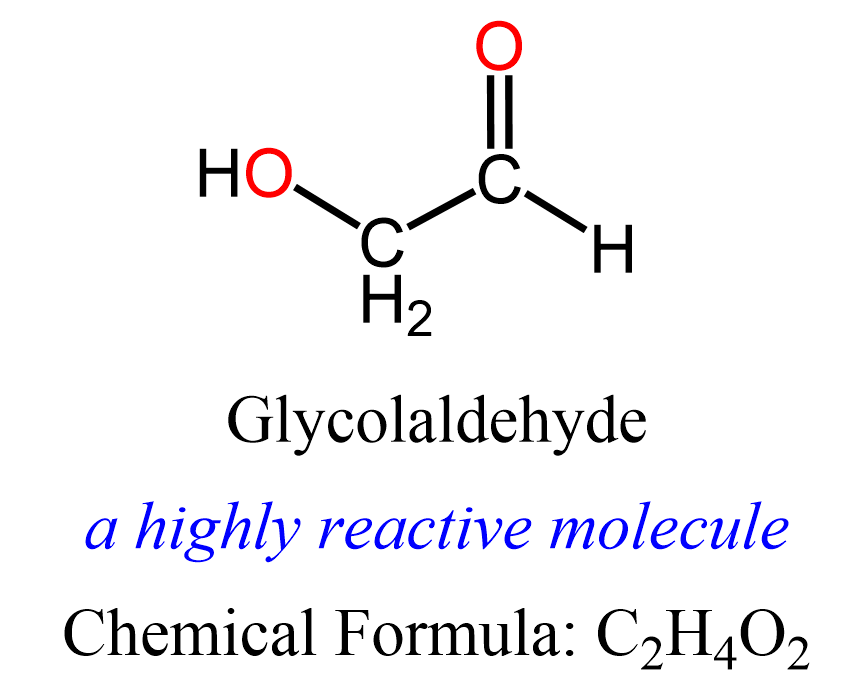
Glycolaldehyde is the simplest molecule that contains both an aldehyde group (–CHO) and a hydroxyl group (–OH). It is a highly reactive compound found in both biological systems and the interstellar medium.
Cyclic Structures with the Molecular Formula of C2H4O2
Remember, earlier we mentioned that one degree of unsaturation means either a π bond or a ring structure. Therefore, another possibility for the isomers is to have a ring with no double bonds in the molecule:
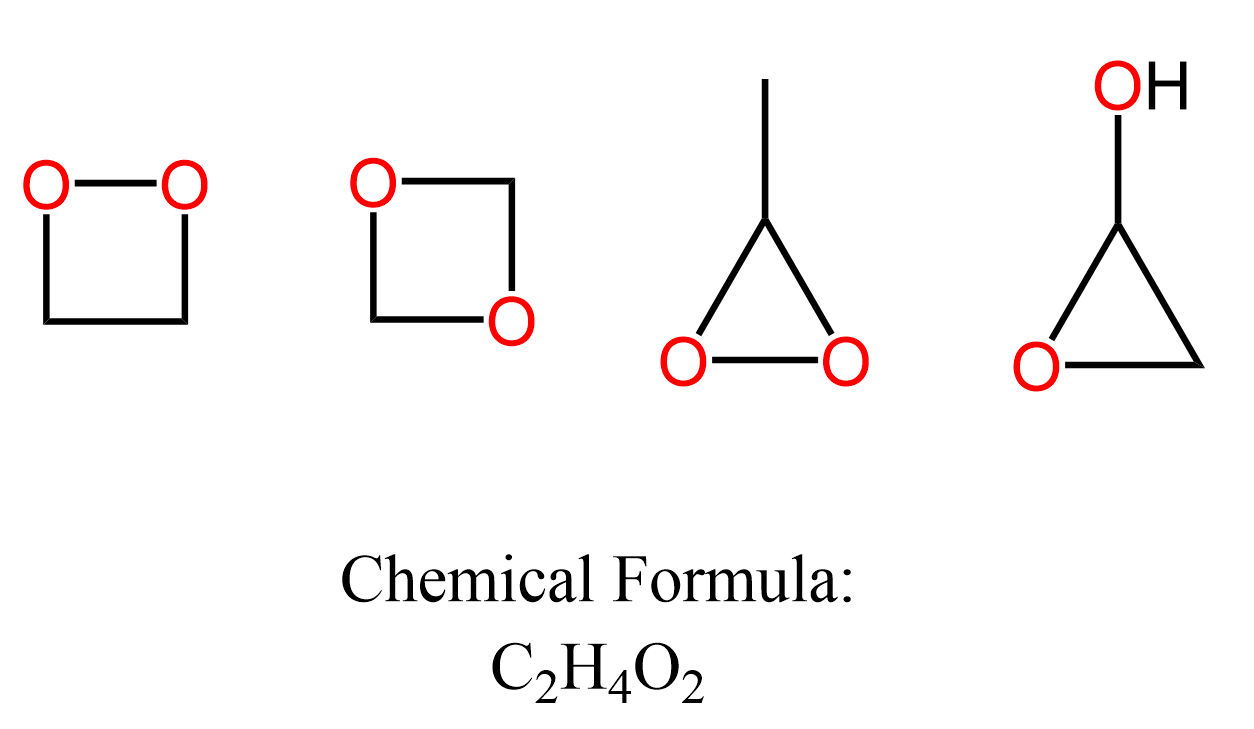
The first two molecules are 1,2-dioxetane and 1,3-dioxetane, which are highly strained four-membered cyclic systems. Because of this significant ring strain, and in the case of 1,2-dioxetane, also the presence of a weak O–O peroxide bond, both compounds are extremely unstable and tend to decompose readily under mild conditions, often breaking down into carbonyl compounds. One would imagine that the second pair of 3-membered rings is even more unstable because of the ring strain, so keep in mind that these are theoretical answers that fit the category of isomers with the molecular formula of C2H4O2.
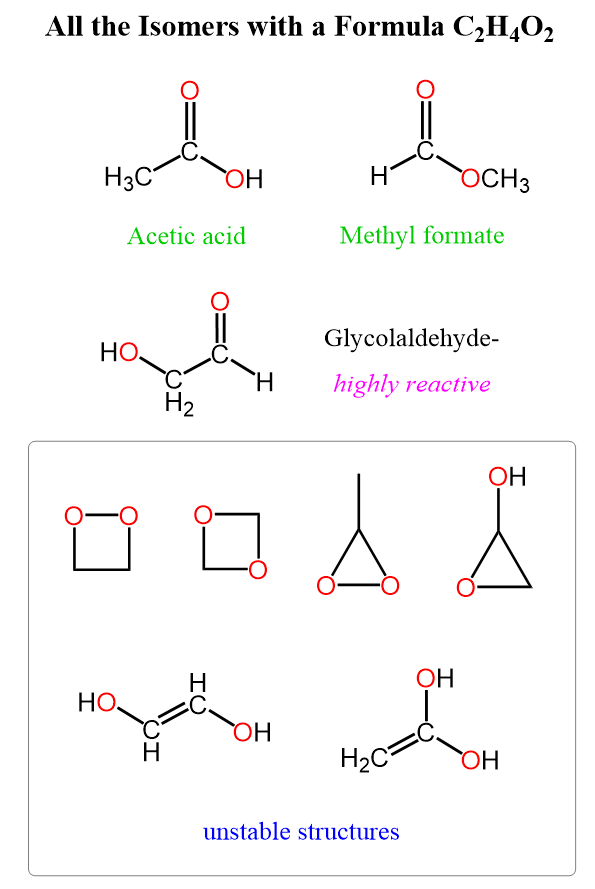
At the end, let’s put all the constitutional isomers with the Molecular Formula of C2H4O2:
Check Also
- Naming Alkanes by IUPAC Nomenclature Rules Practice Problems
- Naming Bicyclic Compounds
- Naming Bicyclic Compounds-Practice Problems
- How to Name a Compound with Multiple Functional Groups
- Primary, Secondary, and Tertiary Carbon Atoms in Organic Chemistry
- Constitutional or Structural Isomers with Practice Problems
- Degrees of Unsaturation or Index of Hydrogen Deficiency
- The Wedge and Dash Representation
- Sawhorse Projections
- Newman Projections with Practice Problems
- Staggered and Eclipsed Conformations
- Conformational Isomers of Propane
- Newman Projection and Conformational Analysis of Butane
- Newman Projection of Chair Conformation
- Gauche Conformation
- Gauche Conformation, Steric, Torsional Strain Energy Practice Problems
- Ring Strain
- Steric vs Torsional Strain
- Conformational Analysis
- Drawing the Chair Conformation of Cyclohexane
- Ring Flip: Drawing Both Chair Conformations with Practice Problems
- 1,3-Diaxial Interactions and A value for Cyclohexanes
- Ring-Flip: Comparing the Stability of Chair Conformations with Practice Problems
- Cis and Trans Decalin
- IUPAC Nomenclature Practice Problems
- IUPAC Nomenclature Summary Quiz
- Alkanes and Cycloalkanes Practice Quiz