Malonic Ester Synthesis
In the previous post, we talked about the acetoacetic ester synthesis, which is used for preparing ketones having one or two alkyl groups on the ɑ position: Another way to look at this reaction is to say that … Read more
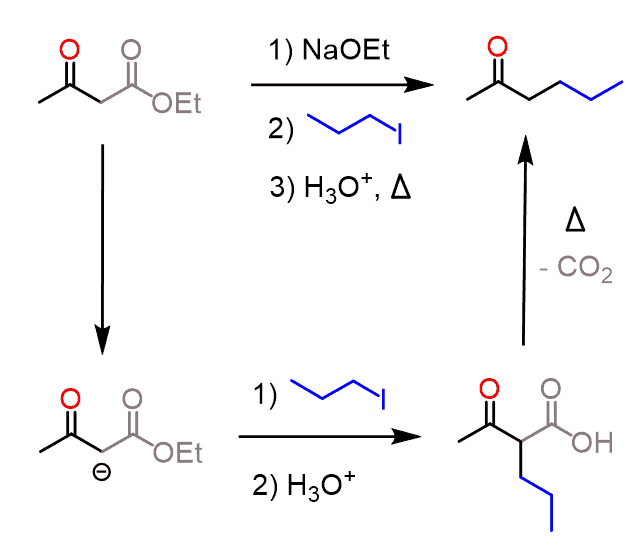
The acetoacetic ester synthesis is a useful synthetic tool for preparing ketones having one or two alkyl groups on the ɑ position: At first, this may look confusing since there is a whole ester group being lost in … Read more
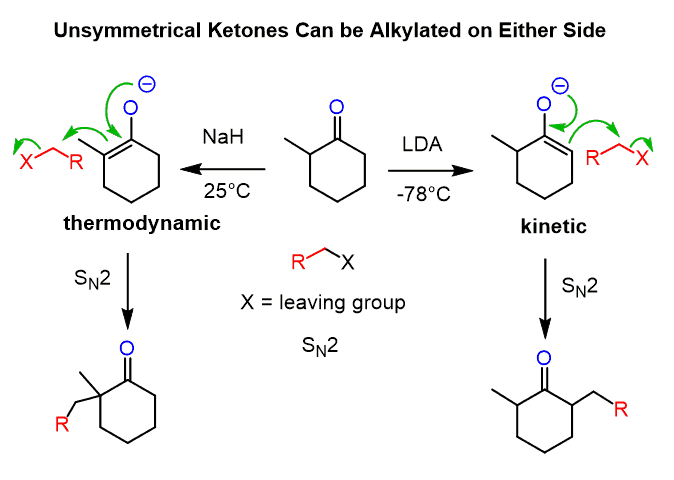
We have seen, in the alpha halogenation and aldol condensation reactions, that enolates are good nucleophiles capable of attacking halogens and carbonyl groups. In addition to these, enolates can also be alkylated when reacted with alkyl halides via the SN2 mechanism: … Read more
If a compound has two carbonyl groups (dicarbonyl compound), it undergoes an intramolecular aldol reaction if a five- or six-membered ring can be formed: What happens is one of the carbonyls is deprotonated at the ɑ position, thus … Read more
Carboxylic acids with α-hydrogen atoms can be brominated in the presence of catalytic amounts of phosphorus (or a phosphorus tribromide), forming α-bromo carboxylic acids. This is known as the Hell–Volhard–Zelinski (or HVZ) reaction: Now, let’s understand how this happens. First, … Read more
All the aldol reactions we discussed so far were between identical partners, meaning the same carbonyl compound served as an electrophile and a nucleophile in the form of an enolate: An aldol reaction between two different carbonyl compounds … Read more
We have seen that the product of the aldol reaction is a β-hydroxy carbonyl compound: One can look at it as an alcohol, and what is interesting about this alcohol is that it undergoes an elimination when heated … Read more
We have seen, in the halogenation of aldehydes and ketones, that enolates are quite good nucleophiles: This reaction shows that the ɑ position of a carbonyl compound is a potential nucleophilic site. So, keep this in mind and remember … Read more
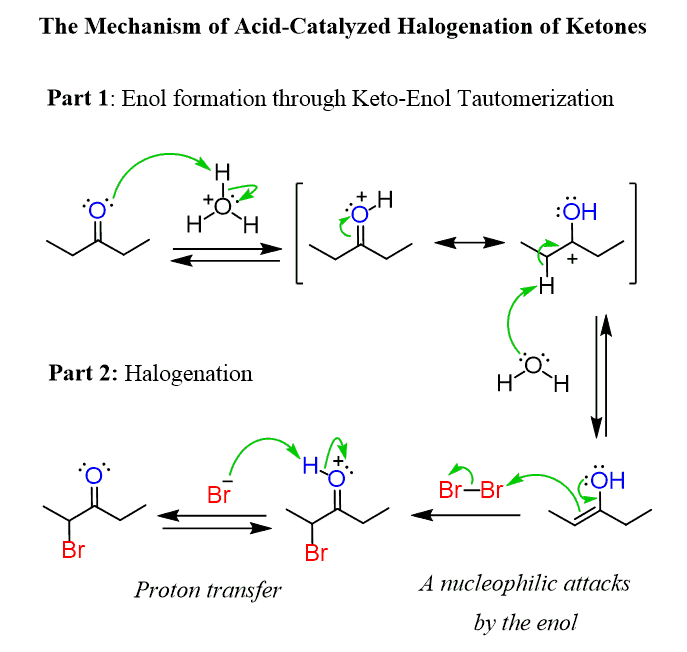
Ketones and aldehydes react with halogens at the alpha position when an acid or a base catalyst is used. The halogenation works with Cl2, Br2, and I2: Let’s start discussing the mechanism of the acid-catalyzed halogenation. The reaction … Read more
This is a comprehensive practice problem on the alpha carbon/enolate chemistry. The topics covered range from the simple halogenation reactions of enols to multistep synthetic transformations. To correctly answer these questions, you need to review the main principles of enolate … Read more