
In today’s post, we will discuss the physical properties of alkanes and cycloalkanes, such as their boiling points, melting points, and solubility in water and organic solvents. So, let’s start with the boiling point of alkanes.
Boiling Point and Melting Point
Both the melting point and the boiling point of a compound depend on the strength of the intermolecular forces between its molecules. The stronger these attractions are, the more energy is required to separate the molecules, resulting in higher melting and boiling points.
Alkanes are nonpolar molecules, so the only intermolecular forces they experience are the induced-dipole/induced-dipole van der Waals forces.

Although these are the weakest type of intermolecular attraction, they become stronger as the size of the molecule increases.
As the carbon chain gets longer, the molecular weight, surface area, and number of electrons all increase. This makes the electron cloud more polarizable, leading to stronger London dispersion forces between neighboring molecules. As a result, the boiling points of alkanes increase with increasing molecular size.
The first four members of the alkane series – methane, ethane, propane, and butane – are gases at room temperature. Alkanes from pentane (C₅H₁₂) through hexadecane (C₁₆H₃₄) are liquids, while heptadecane (C₁₇H₃₆) and higher alkanes are solids at room temperature.
 |
|||||
|
Name |
Formula |
Melting Point (°C) |
Boiling Point (°C) |
State (20 °C) |
Density |
|
Methane |
CH4 |
-182.5 |
-161.5 |
Gas |
0.000656 g/L |
|
Ethane |
C2H6 |
-183.3 |
-88.6 |
Gas |
1.26 g/L |
|
Propane |
C3H8 |
-187.7 |
-42.1 |
Gas |
1.83 g/L |
|
Butane |
C4H10 |
-138.3 |
-0.5 |
Gas |
2.48 g/L |
|
Pentane |
C5H12 |
-129.7 |
36.1 |
Liquid |
0.626 g/mL |
|
Hexane |
C6H14 |
-95.0 |
68.7 |
Liquid |
0.659 g/mL |
|
Heptane |
C7H16 |
-90.6 |
98.4 |
Liquid |
0.684 g/mL |
|
Octane |
C8H18 |
-56.8 |
125.6 |
Liquid |
0.703 g/mL |
|
Nonane |
C9H20 |
-53.6 |
150.8 |
Liquid |
0.718 g/mL |
|
Decane |
C10H22 |
-29.7 |
174.1 |
Liquid |
0.730 g/mL |
|
Heptadecane |
C17H36 |
22 |
302 |
Solid |
~0.777 g/mL |
|
Octadecane |
C18H38 |
28 |
316 |
Solid |
~0.777 g/mL |
Notice that the density of alkanes also increases with their molecular mass.
Alkanes in Crude Oil
Although methane is found mainly in natural gas, most of the alkanes come from crude oil. Crude oil is a complex mixture containing thousands of hydrocarbons with different chain lengths, which we separate in oil refineries based on their boiling points by a process called fractional distillation.
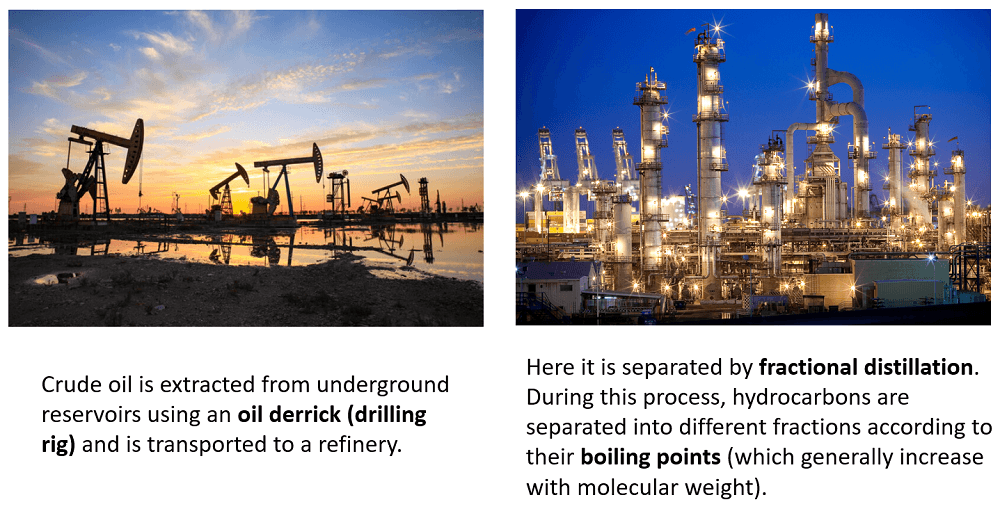
The shorter-chain alkanes, such as propane and butane, used as cooking and heating fuels (LPG), have the lowest boiling points, so they are collected at the top of the distillation column as gases.
The next fraction contains liquid alkanes that are used as gasoline (petrol) for cars. As the chain length increases, the boiling points become higher, giving heavier liquid fractions such as kerosene (jet fuel) and diesel fuel.
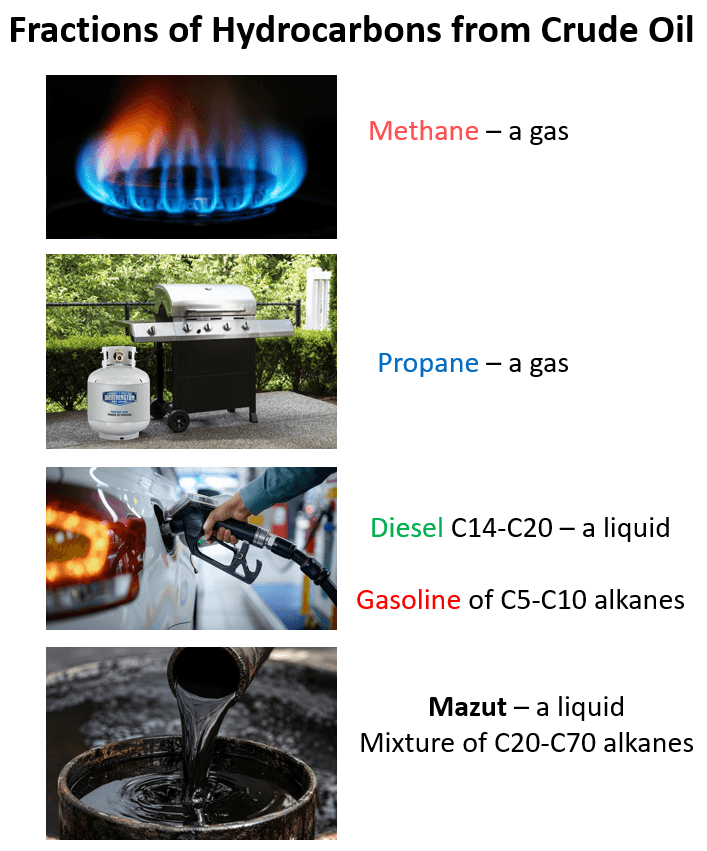
The heaviest fractions contain very large hydrocarbons that are thick, viscous liquids or solids at room temperature. These are used as fuel oil (mazut), lubricating oils, greases, paraffin wax, and even asphalt (bitumen) for paving roads.
The Effect of Branching on Melting Point
The next thing you should know about the patterns of boiling point is that molecular shape also affects the boiling point. Straight-chain alkanes generally have higher boiling points than their branched isomers because they have a larger surface area and can pack more closely together.
This can be seen by comparing the boiling points of n-pentane, isopentane, and neopentane, which are the three constitutional isomers with the molecular formula of C₅H₁₂.
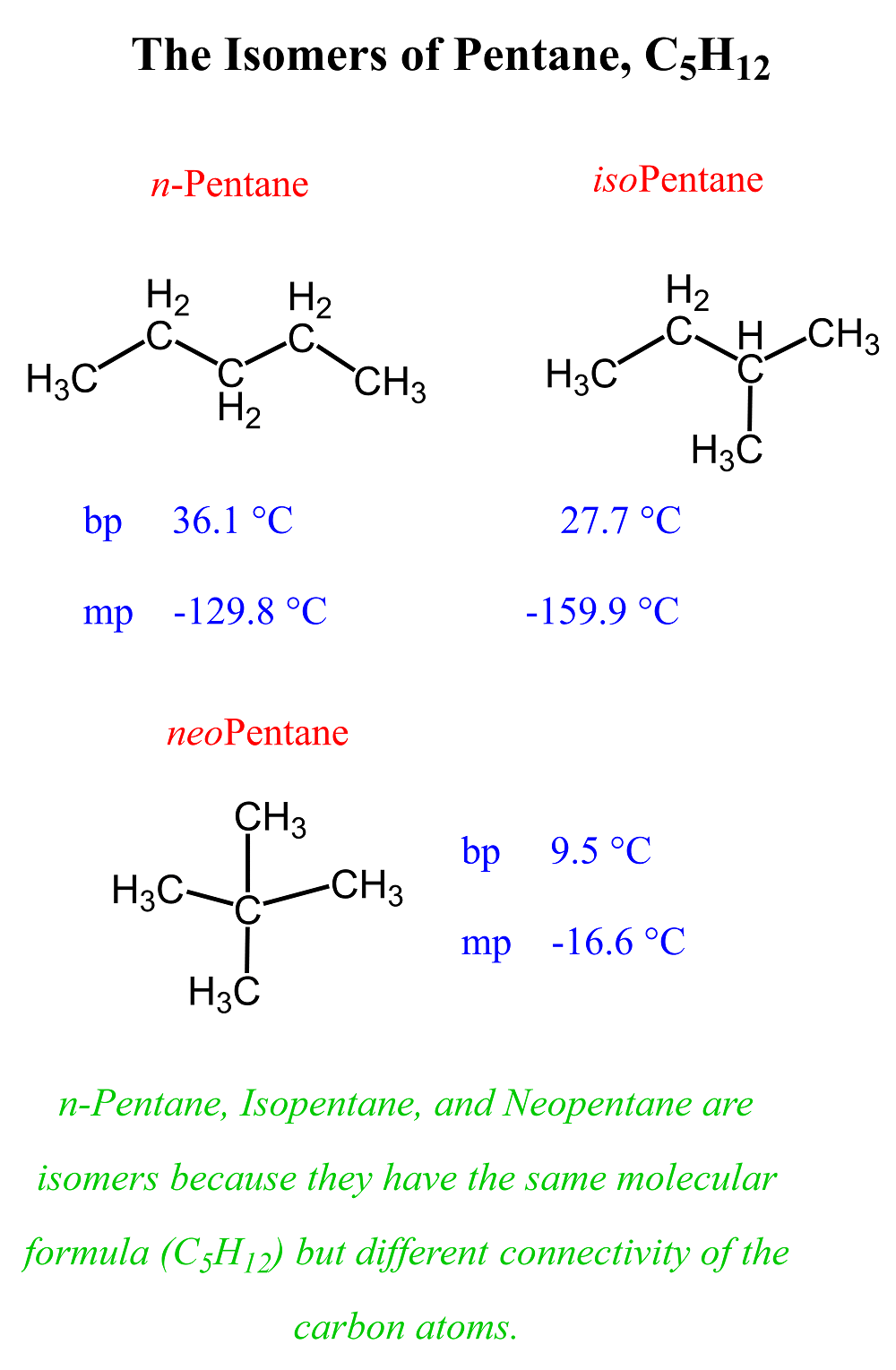
n-Pentane is unbranched and has the largest surface area, giving it the highest boiling point. Next is 2-methylbutane, while 2,2-dimethylpropane, the most highly branched isomer, has the lowest boiling point.

The analogy for this can be the stacking of regular vs crumpled paper sheets. Regular paper sheets stack nicely due to their larger surface area, allowing better contact between them. This is the opposite of crumpled paper sheets, which do not stack well because their contact area is much smaller. In the same way, the better the molecules stick to one another, the higher their boiling point.

So, remember that branching tends to decrease the boiling point of alkanes with the same molecular weight.
Melting Point
Aside from the intermolecular interactions, the melting point also depends on how the molecules are packed or arranged in the solid form. The more symmetrical they are, the better they pack and form a perfect crystal lattice, which results in a higher melting point. So, as the molecules fit tightly, more energy is required to break the lattice and melt them apart.
Let’s go back to the examples we discussed for the boiling point. Remember, the boiling point increases with less branching because of the increased surface area. So, pentane had a higher melting point than 2,2-dimethylpropane; 36.1 oC vs 9.5 oC.
Interestingly, the pattern is not observed for the melting points. 2,2-dimethylpropane has a higher melting point since it is more symmetrical than pentane, and when in the solid phase (before melting), its molecules are better packed.

Check out this article on the melting and boiling points of organic molecules, which is not restricted to alkanes only.
The Physical Properties of Cycloalkanes
Let’s also discuss how the melting and boiling points of alkanes and cycloalkanes compare. Both are nonpolar types of molecules, so their physical properties depend mainly on the strength of the London dispersion forces between their molecules.
Interestingly, cycloalkanes generally have higher boiling points than the corresponding open-chain alkanes with the same number of carbon atoms.
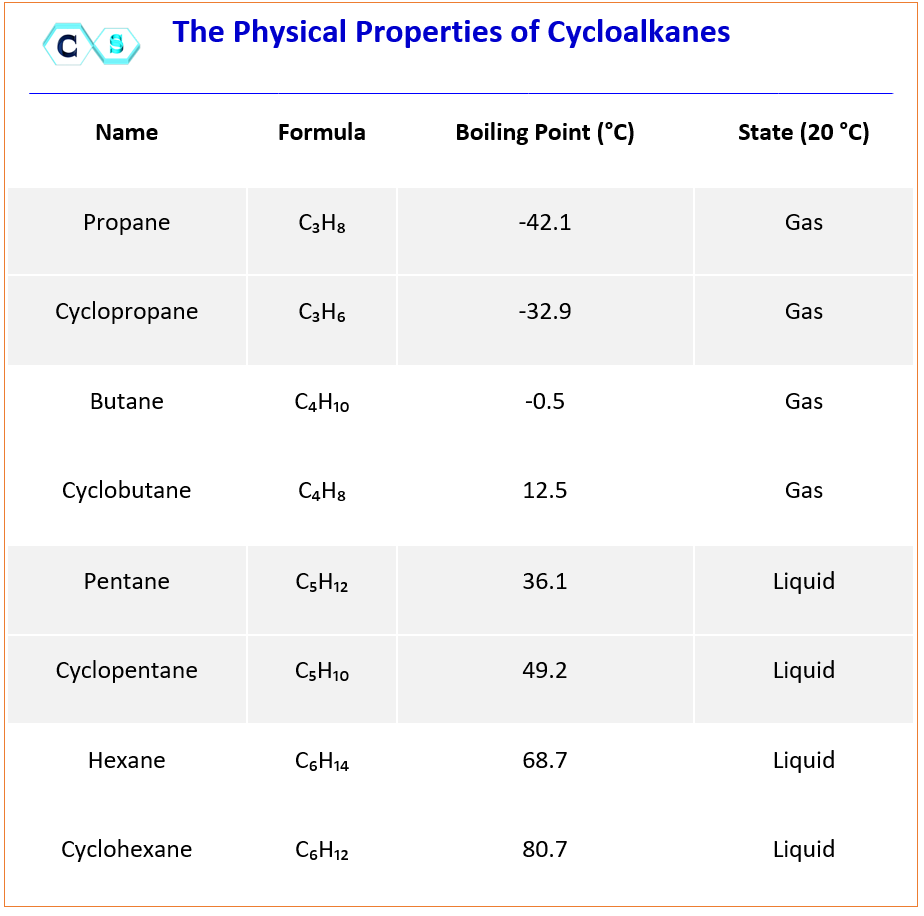
This is because their cyclic shape allows the molecules to pack more efficiently, resulting in stronger London dispersion forces. Open-chain alkanes, on the other hand, have the flexibility to sprawl out into different conformations, reducing the surface area available for intermolecular interactions.
Notice also that cycloalkanes have the general formula CₙH₂ₙ, compared with CₙH₂ₙ₊₂ for alkanes. So, despite having a smaller molecular weight per carbon atom, cycloalkanes still have higher boiling points.
The melting points of cycloalkanes follow the same general trend of increasing with molecular size. However, they are less predictable than boiling points because they are also influenced by how well the molecules pack in the crystal lattice. As a result, some cycloalkanes have unusually high melting points due to their greater molecular symmetry, which allows them to form more stable crystals.
Solubility of Alkanes
The golden rule of solubility is “like dissolves like”, and knowing that alkanes are nonpolar, it is not surprising that alkanes (both alkanes and cycloalkanes) are virtually insoluble in water.
The best example of demonstrating the insolubility of organic molecules in aqueous media is the use of a separatory funnel in the organic laboratory, which you may have already used in your class.
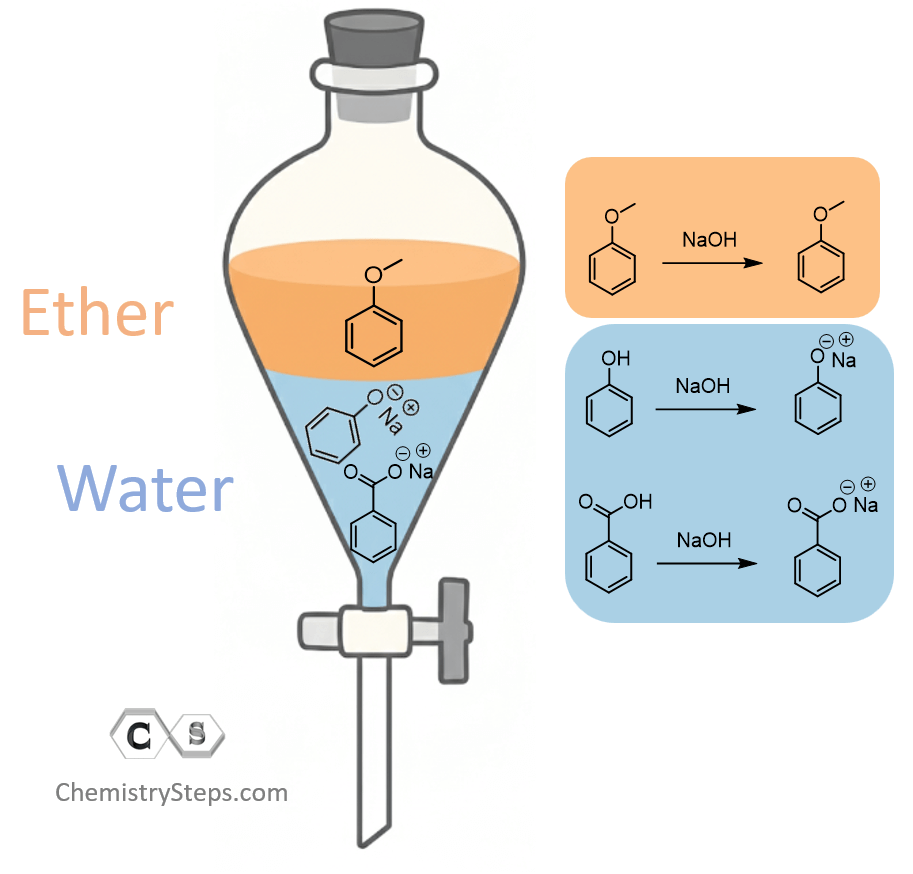
And here is an actual photo of oil mixed with water in a glass. Notice that the oil has a lower density, and it goes on the top layer:

On the contrary, they dissolve very well in the vast majority of nonpolar organic solvents. It is worth mentioning that some alkanes, such as hexane and cyclohexane, are commonly used as solvents for nonpolar organic molecules. If a little polarity is needed for dissolving compounds such as alcohols, aldehydes, etc., halogenated solvents such as dichloromethane and chloroform are often used.
Why Alkanes do Not Dissolve in Water
All of this should hopefully make sense to you; however, you may still be wondering why alkanes are not soluble/miscible in water. What is the reason behind the rule “like dissolves like”?
Well, in order to dissolve a compound, the solvent molecules must interact with the solute strongly enough to break the intermolecular interactions between the solute particles. To replace these interactions, the solvent molecules should “offer” a better alternative in terms of intermolecular forces. However, when one is polar and the other is nonpolar, they simply do not have equivalent types of intermolecular interactions.
Water “relies” on a strong network of hydrogen bonding, and alkanes have no possibility of forming hydrogen bonds. They can only participate in weak London dispersion forces, which are not strong enough to compensate for breaking the hydrogen-bonding network of water. As a result, the two systems remain separated, and alkanes are insoluble in water.
Other organic molecules containing polar heteroatoms and capable of hydrogen bonding, such as ketones, aldehydes, and esters, can interact with water. As a result, some of them with shorter hydrocarbon chains are water soluble.

Acetone, for example, which is often used as a nail polish remover, is miscible with water, meaning it can be mixed with water in any proportion.
We discuss the general trends in the solubility of organic compounds, covering a broader range of functional groups, in this post, so feel free to check it out as well.
Check Also
- Naming Alkanes by IUPAC Nomenclature Rules Practice Problems
- Naming Bicyclic Compounds
- Naming Bicyclic Compounds-Practice Problems
- How to Name a Compound with Multiple Functional Groups
- Primary, Secondary, and Tertiary Carbon Atoms in Organic Chemistry
- Constitutional or Structural Isomers with Practice Problems
- Degrees of Unsaturation or Index of Hydrogen Deficiency
- The Wedge and Dash Representation
- Sawhorse Projections
- Newman Projections with Practice Problems
- Staggered and Eclipsed Conformations
- Conformational Isomers of Propane
- Newman Projection and Conformational Analysis of Butane
- Newman Projection of Chair Conformation
- Gauche Conformation
- Gauche Conformation, Steric, Torsional Strain Energy Practice Problems
- Ring Strain
- Steric vs Torsional Strain
- Conformational Analysis
- Drawing the Chair Conformation of Cyclohexane
- Ring Flip: Drawing Both Chair Conformations with Practice Problems
- 1,3-Diaxial Interactions and A value for Cyclohexanes
- Ring-Flip: Comparing the Stability of Chair Conformations with Practice Problems
- Cis and Trans Decalin
- IUPAC Nomenclature Summary Quiz
- Alkanes and Cycloalkanes Practice Quiz