
We have seen that because of the rigid/locked nature of the double bond, alkenes are characterized by cis and trans isomerism. Cis and trans isomers are stereoisomers that are configurational isomers, meaning they cannot interconvert unless we break the bonds and connect the atoms differently.
This is unlike what we have with alkanes, where all the bonds are single, sigma bonds, which allow for free rotation about them. Thus, instead of configurations, we have different conformations of alkanes:

Now, things are a little different with cycloalkanes. Yes, they are composed of all sp³-hybridized carbon atoms, but because of the cyclic nature, there is no complete rotation about these bonds, and because of this, we have cis and trans isomerism in cycloalkanes as well.
For example, let’s consider the stereoisomerism of 1,2-dimethyl cyclohexane.
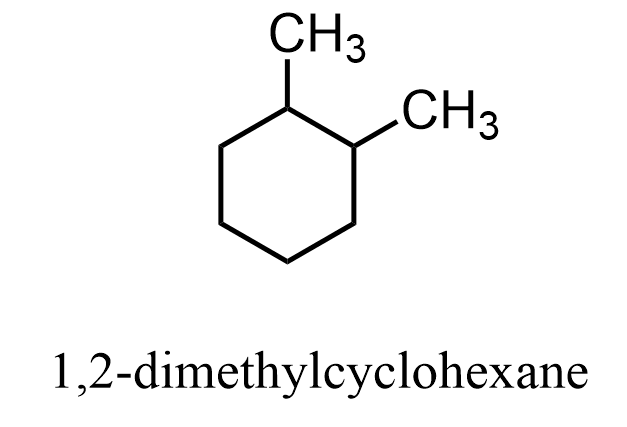
So, what is different about this molecule compared to a regular open-chain alkane? As mentioned earlier, although all the carbons are sp3-hybridized, their cyclic structure does not allow for 360o rotation about the bonds, thus the methyl groups can be either cis or trans toward each other.
When the two methyl groups are pointing in the same direction, we have the cis isomer, whereas when they are pointing in different directions, we have trans-1,2-dimethylcyclohexane. Importantly, there are two trans isomers of 1,2-dimethylcyclohexane, which are enantiomers.
Let’s list them all together:
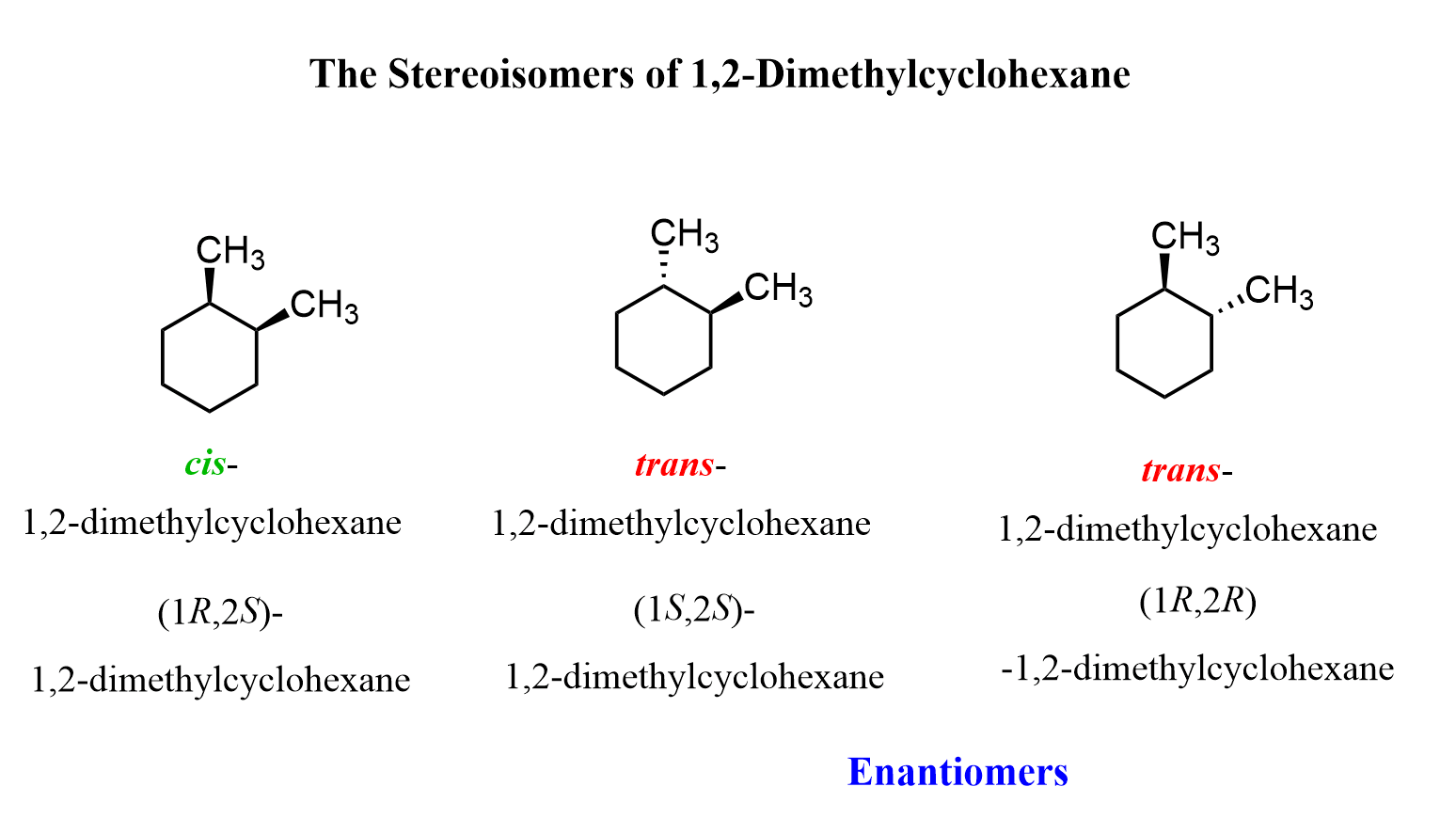
None of these can be interconverted without breaking covalent bonds, so they are different compounds. More specifically, they are stereoisomers.
Therefore, let’s first establish that 1,2-dimethylcyclohexane has three stereoisomers.
Now, another common question is about the number of chair conformations a substituted cyclohexane can have. Each substituted cyclohexane has two chair conformations, depending on whether the substituents occupy axial or equatorial positions. Therefore, 1,2-dimethylcyclohexane has a total of six chair conformations:
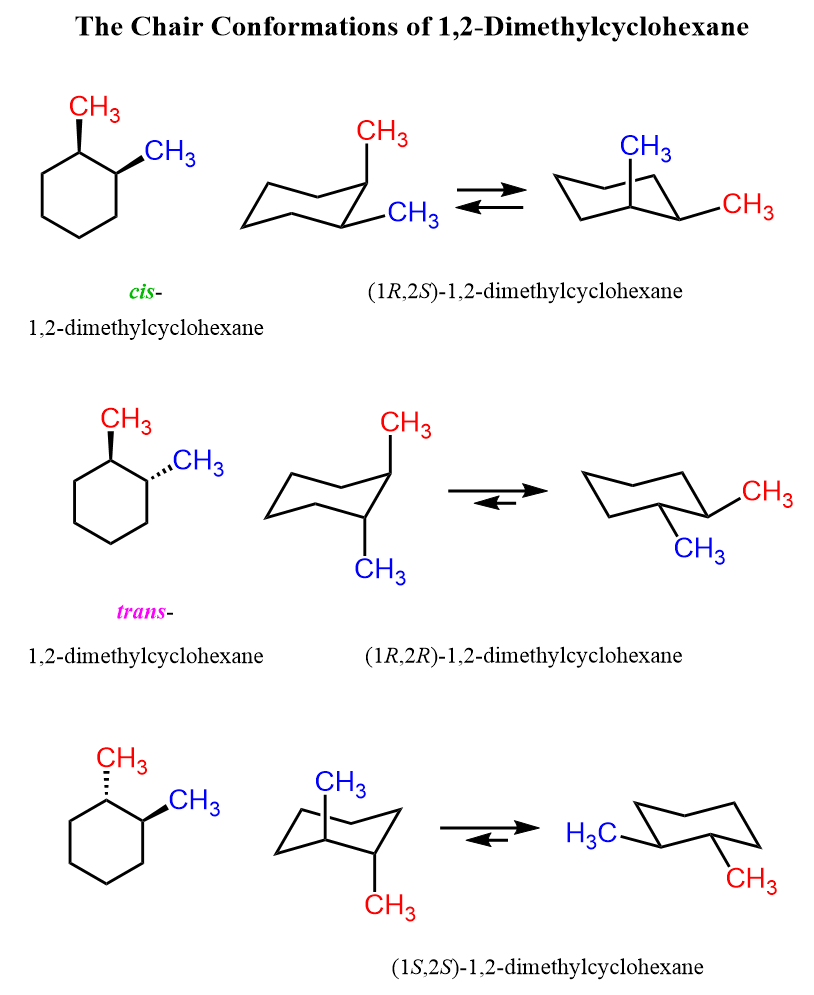
Notice that the equilibrium arrows are not always symmetrical, and the larger one points to the more stable chair conformation. This is due to the greater stability of groups being in the equatorial positions. You can review the principles of ring flipping and the stability of chair conformations, 1,3-diaxial interactions in the linked articles.
The Relationship of Stereoisomers of 1,2-Dimethylcyclohexane
The two trans stereoisomers of 1,2-dimethylcyclohexane are enantiomers because they are non-superimposable mirror images. The cis isomer, on the other hand, does not have an enantiomer because it is a meso compound. Remember, in simple terms, meso compounds are those that contain chiral centers but are achiral due to an internal plane of symmetry. Each of the two trans enantiomers is a diastereomer of the cis 1,2-dimethylcyclohexane.
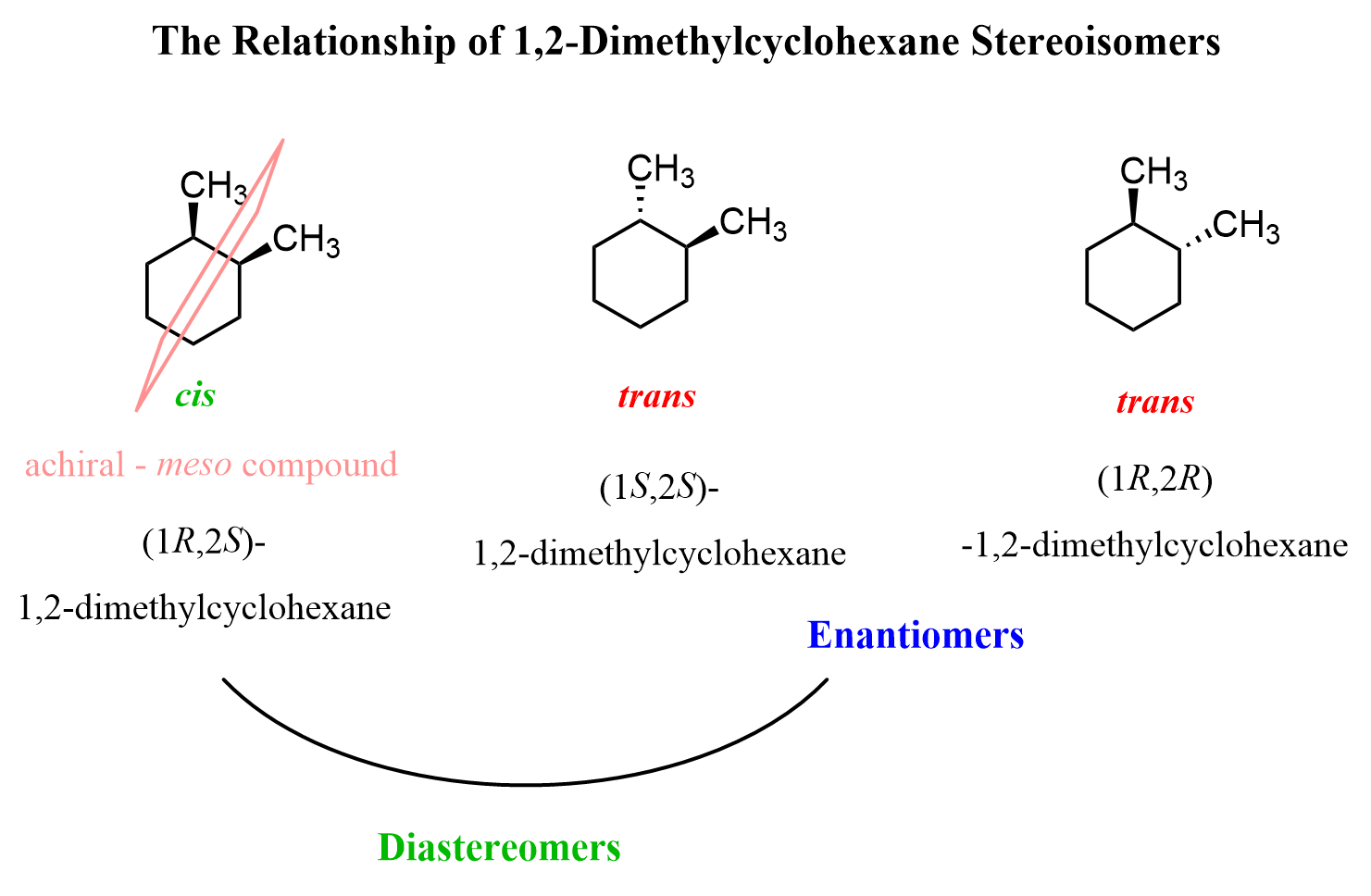
To summarize the stereoisomerism of 1,2-dimethylcyclohexane: 1,2-Dimethylcyclohexane exists as three stereoisomers: one cis isomer and a pair of trans enantiomers (1R,2R) and (1S,2S). The cis isomer is a meso compound due to an internal plane of symmetry, making it achiral, while the trans isomers are chiral enantiomers. Overall, there are 3 stereoisomers and 6 chair conformations in total.
Why is cis-1,2-Dimethylcyclohexane Achiral?
I also wanted to add a little more nm about the achiral nature of cis-1,2-dimethylcyclohexane. If we look at the chair conformations instead of the regular bond-line notation, we can see that there is actually no plane of symmetry:
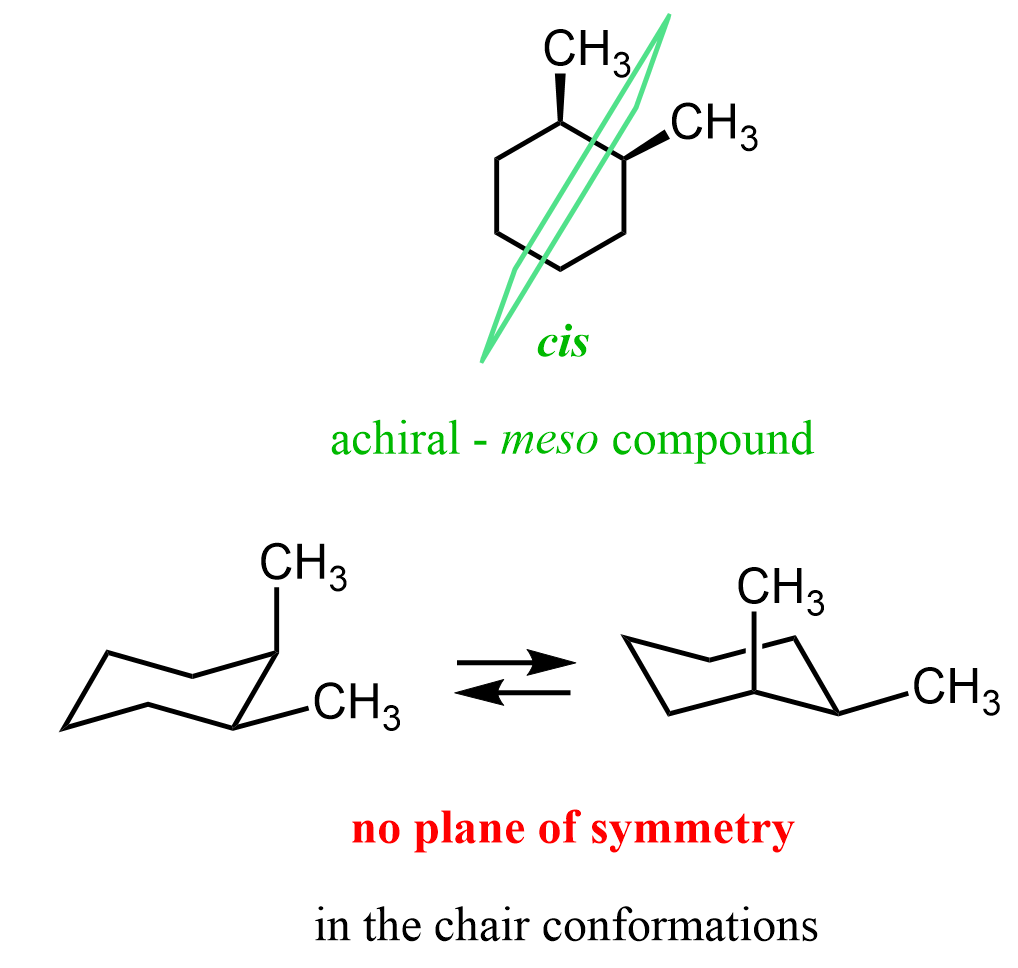
In fact, each chair conformation is a non-superimposable mirror image of the other one, which indicates that they are enantiomers. Yes, they are conformational enantiomers, and the reason the cis-1,2-dimethylcyclohexane is achiral is because of the rapid interconversion between these conformations.
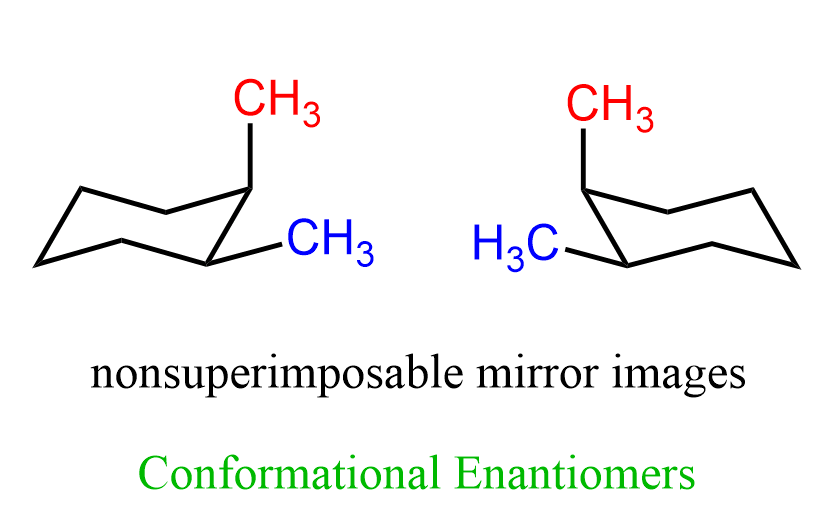
Although butane has no chirality centers, this can also be relevant if we can draw two non-superimposable mirror images of it.
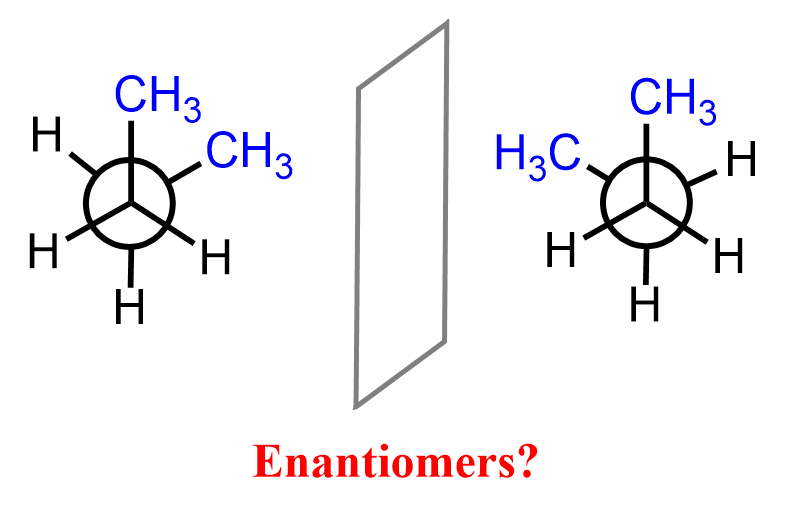
You can read this post on configurational and conformational isomers for a more detailed discussion. However, to keep it simple, remember that we do not bother about conformational isomers because they rapidly interconvert. As for meso compounds, the IUPAC definition is actually more complex than saying these are molecules that contain chiral centers but are overall achiral because of an internal plane of symmetry.
This is the IUPAC definition: “Meso compound – A term for the achiral member(s) of a set of diastereoisomers which also includes one or more chiral members.”
However, for the shortcut, which is what we all learn from textbooks and lectures, you can identify a plane of symmetry for any of the conformations of the molecule with chiral centers drawn in a simple bond-line or chair conformation – we claim that there is a plane of symmetry and therefore the molecule is a meso compound.
Once again, this is likely not needed for most of you, but it is a question that I have been asked on a few occasions, so I wanted to address it.
1,3-Dimethyl Cyclohexane
Let’s now discuss the stereochemistry of 1,3-disubstituted cyclohexane using the example of 1,3-dimethylcyclohexane. Conceptually, it is not different from the 1,2-dimethylcyclohexane: we have a meso cis isomer and two enantiomers of the trans isomer. This makes a total of three stereoisomers, and each comes with two chair conformations:
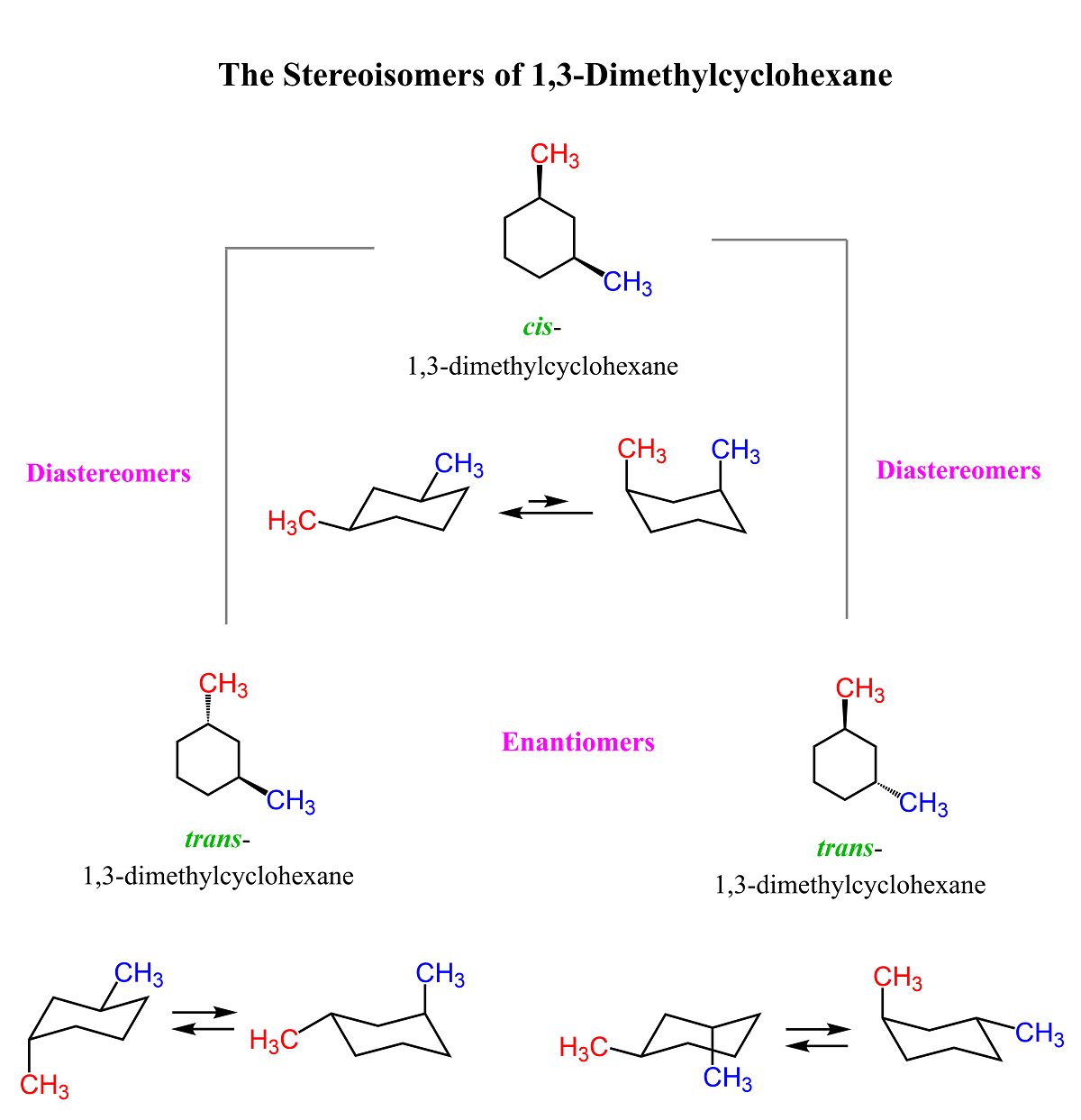
Notice that the chair conformations of the trans isomers are identical in energy because they each have one axial and one equatorial methyl group.
The cis isomer is different because its two chair conformations are diaxial and diequatorial, respectively, so they have different energies.
Cyclohexanes with Different Substituents
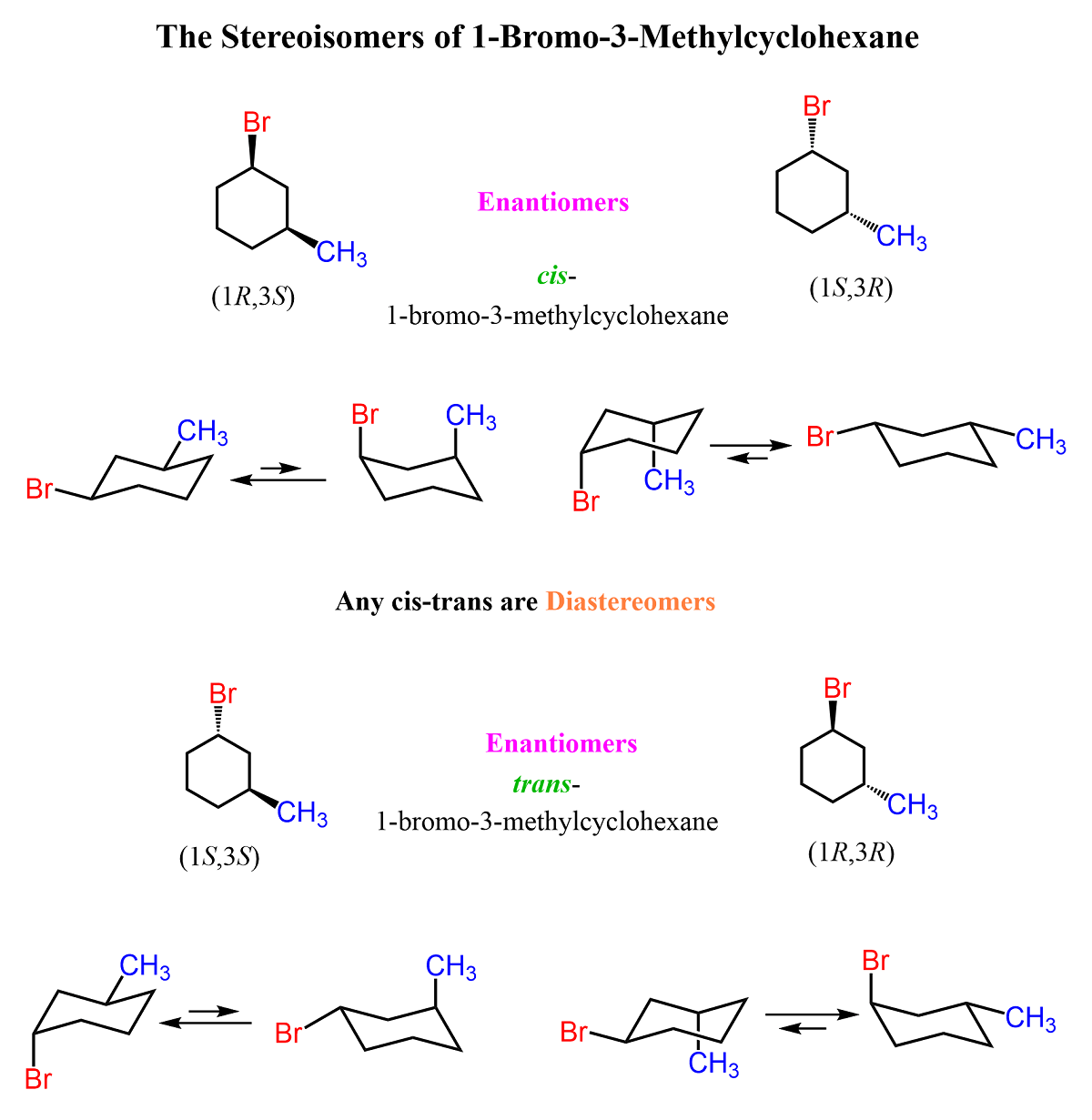
I want to mention at this point that having two methyl or any two identical groups on a cyclohexane ring gives it some symmetry, thus reducing the total number of stereoisomers. If instead of 1,2- or 1,3-dimethylcyclohexane, we have, for example, 1-bromo-2-methylcyclohexane or 1-bromo-3-methylcyclohexane, there would have been 4 stereoisomers, and each with its two chair conformations would give a total of 8 chair conformations.
1,4-Dimethylcyclohexane
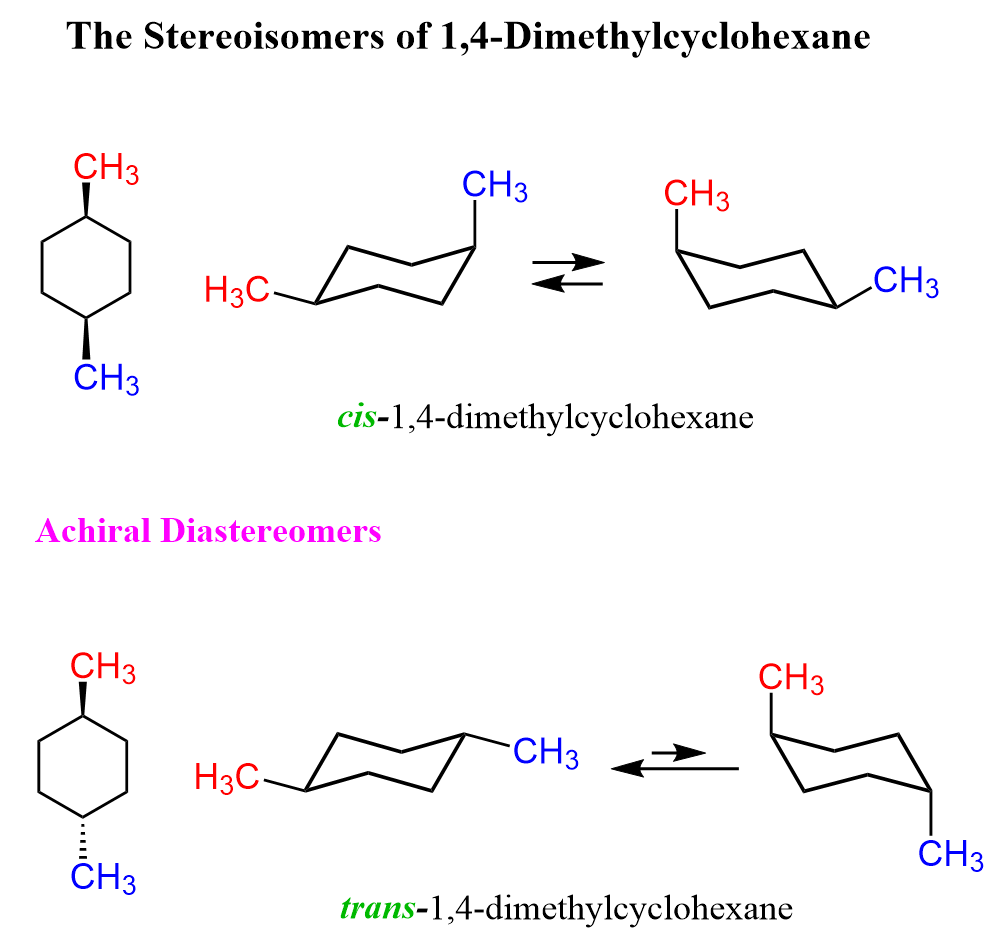
The situation with 1,4-disubstituted cyclohexanes is a little easier because they all have an internal plane of symmetry and are achiral. We have cis and trans isomers, and neither of them can have enantiomers – they are diastereomers. Each diastereomer has two chair conformations:
Polysubstituted Cyclohexanes
To determine the number of polysubstituted cyclohexanes, you can use the formula 2ⁿ and draw all the possible wedge and dash orientations of the groups.
For example, 1,2-dichloro-4-methylcyclohexane has 2³ = 8 stereoisomers, and each of these has two chair conformations with different stability.
Let’s draw the two chair conformations of (1R,2R,4S)-1,2-dichloro-4-methylcyclohexane and assess their relative stability:
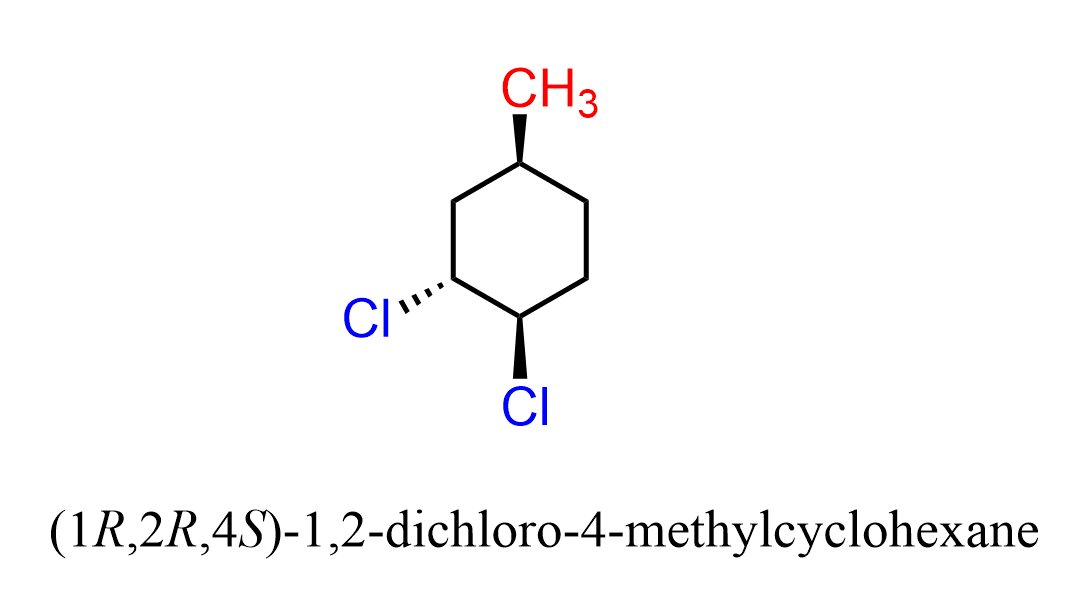
To do that, we need to draw the ring flip of the chair conformations. To answer this question, we need to draw the two chair conformations and compare the energies of all the axial groups on each conformer.
1. Number the ring and draw any chair conformation of the compound:

2. Draw the second chair conformation (ring-flip-check this post if not sure):

And now the stabilities: For each chair conformer, add the energy of all the groups on axial position.

In the first conformer, we have two chlorines in axial positions, so the total steric strain is:
2.2+2.2 = 4.4 kJ
For the second conformer, the chlorines are now equatorial, and we only have one methyl group in the axial position. Therefore, the energy is 7.3 kJ/mol.
Out of two conformations, the one with lower energy is more stable. So, despite having two axial groups, the first conformer is more stable as two chlorines do not bring as much steric interaction as the methyl group.
