
You are wondering about this question because you have started talking about naming organic compounds by using the IUPAC rules. Yes, that is the beginning of organic chemistry, so you don’t want to get behind in these topics.
Now, to understand what a substituent is, you need to realize that, like many everyday things, molecules also have a main part and additional parts.
For example, you have a new, nice, red, and expensive 😩 car. What is important here is the fact that it is a car – the rest are adjectives.
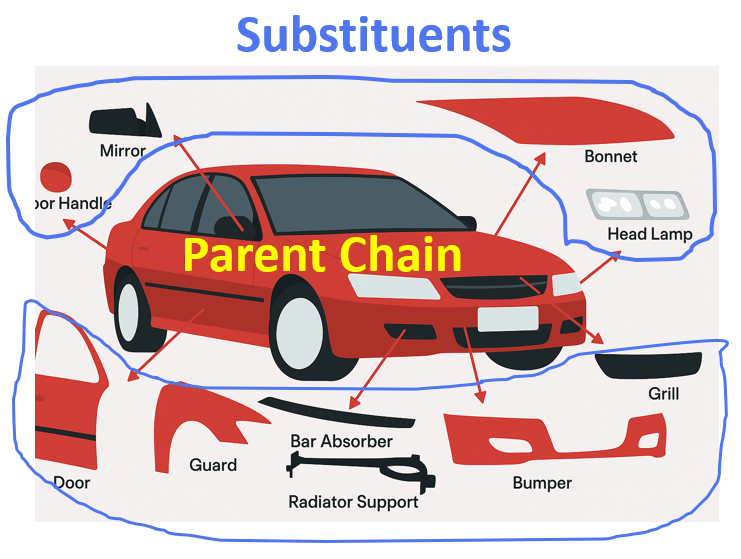
The same goes for organic molecules. To name them, you find the parent chain, let’s say pentane, and add the smaller fragments like methyl, ethyl, bromide, etc. These are the substituents. The parent chain is the longest continuous carbon chain in the molecule.
You are mostly going to see alkyl groups and halides (halogens) at the beginning of this topic:

An alkyl group is the small fragment we were talking about that is connected to the main part of the molecule. In the structure above, the parent chain is pentane (5 carbon atoms), and there is one substituent connected to it (CH₃). When the substituent is a carbon segment, we call it an alkyl group. An alkane becomes an alkyl when it is a substituent.
Alkyl groups are formed by removing one hydrogen from the corresponding alkane and are named based on this alkane by simply changing the ending from –ane to -yl.

It becomes a bit more difficult to identify the parent chain and alkyl substituents when they have about the same number of carbon atoms. For example, it is fairly easy to make a mistake in determining the parent chain and substituents in the following molecule:

The rule is that the parent chain must contain as many substituents as possible if there is a tie for the number of carbon atoms in the parent chain. It’s something you’ll need a bit of practice with, and we have a detailed post on the IUPAC nomenclature rules, so go ahead and check that out.
To keep it simple, for now, consider this structure where the parent chain has lots of substituents, and we name it accordingly by modifying the suffix:

So, that is how you identify substituents and start diving into the rules of IUPAC nomenclature. It can feel overwhelming at first, but don’t worry, you’re not alone! It’s completely normal to make mistakes as you start identifying parent chains, figuring out priority groups, or placing numbers in the correct positions. The key is to read the material and practice consistently. Although IUPAC rules come with their quirks, this is for Organic Chemistry in general: try to focus on understanding how and why each step happens and not just memorizing rules.
Along with anything else you are using, check out our full article on the IUPAC nomenclature of rules. It breaks everything down clearly, with plenty of examples and tips to guide you along the way!
Check Also
- Naming Alkanes by IUPAC nomenclature Rules Practice Problems
- Naming Bicyclic Compounds
- Naming Bicyclic Compounds-Practice Problems
- How to Name a Compound with Multiple Functional Groups
- Primary Secondary and Tertiary Carbon Atoms in Organic Chemistry
- Constitutional or Structural Isomers with Practice Problems
- Degrees of Unsaturation or Index of Hydrogen Deficiency
- The Wedge and Dash Representation
- Sawhorse Projections
- Newman Projections with Practice Problems
- Staggered and Eclipsed Conformations
- Conformational Isomers of Propane
- Newman Projection and Conformational Analysis of Butane
- Newman Projection of Chair Conformation
- Gauche Conformation
- Gauche Conformation, Steric, Torsional Strain Energy Practice Problems
- Ring Strain
- Steric vs Torsional Strain
- Conformational Analysis
- Drawing the Chair Conformation of Cyclohexane
- Ring Flip: Drawing Both Chair Conformations with Practice Problems
- 1,3-Diaxial Interactions and A value for Cyclohexanes
- Ring-Flip: Comparing the Stability of Chair Conformations with Practice Problems
- Cis and Trans Decalin
- IUPAC Nomenclature Practice Problems
- IUPAC Nomenclature Summary Quiz
- Alkanes and Cycloalkanes Practice Quiz